Key takeaways
- Promptwatch is a full-cycle GEO platform: it finds gaps, generates content to fill them, and tracks results. KIME is primarily a monitoring and reporting tool that surfaces insights but stops short of helping you act on them.
- Promptwatch tracks 10+ AI models including Grok, DeepSeek, Mistral, and Copilot. KIME covers the major four (ChatGPT, Perplexity, Gemini, Claude) with less breadth on emerging models.
- Promptwatch's AI Crawler Logs show exactly which AI bots visit your site and which pages get cited. KIME has no equivalent feature.
- KIME has a clean, marketer-friendly UI with an "AI Performance Score" and sentiment tracking that's easy to present in stakeholder reports. Promptwatch is more data-dense but also more powerful.
- Pricing: Promptwatch starts at $99/mo after a free trial. KIME has a free tier, making it accessible for smaller teams or those just getting started with AI visibility.
- For teams that want to actually improve their AI rankings, not just watch them, Promptwatch is the more complete tool. KIME works well as a lightweight monitoring layer or a starting point.
Overview
Promptwatch
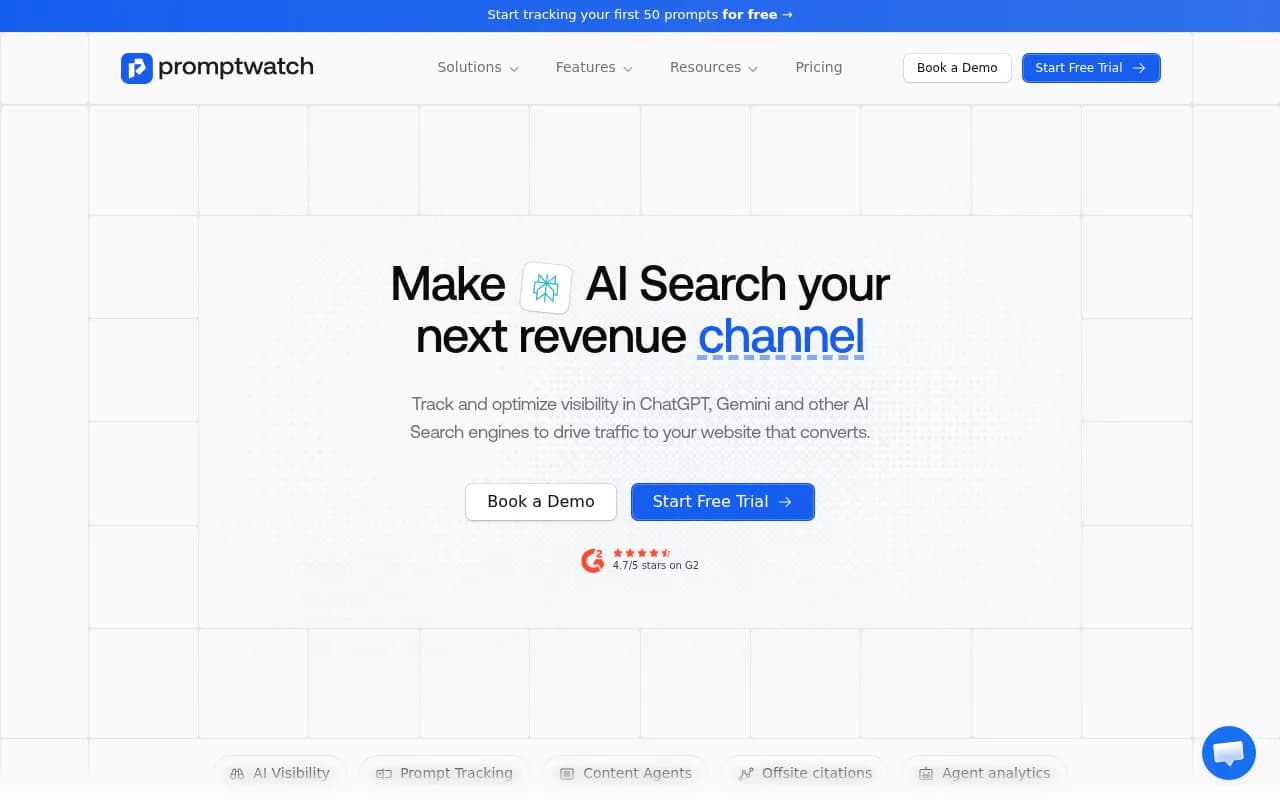
Promptwatch is an end-to-end AI search visibility and GEO platform used by 1,480+ brands and agencies. It tracks how brands appear across ChatGPT, Perplexity, Gemini, Claude, Grok, DeepSeek, Mistral, Copilot, Meta AI, and Google AI Overviews. What separates it from most competitors is the action loop: Promptwatch doesn't just show you where you're invisible, it helps you fix it. Answer Gap Analysis identifies which prompts competitors win that you don't. Content Agents generate articles and briefs grounded in real citation data. AI Crawler Logs show which bots are reading your pages and when those pages start getting cited. The platform has processed over 4.5 billion citations and prompts, and holds a 4.7/5 rating on G2.
KIME
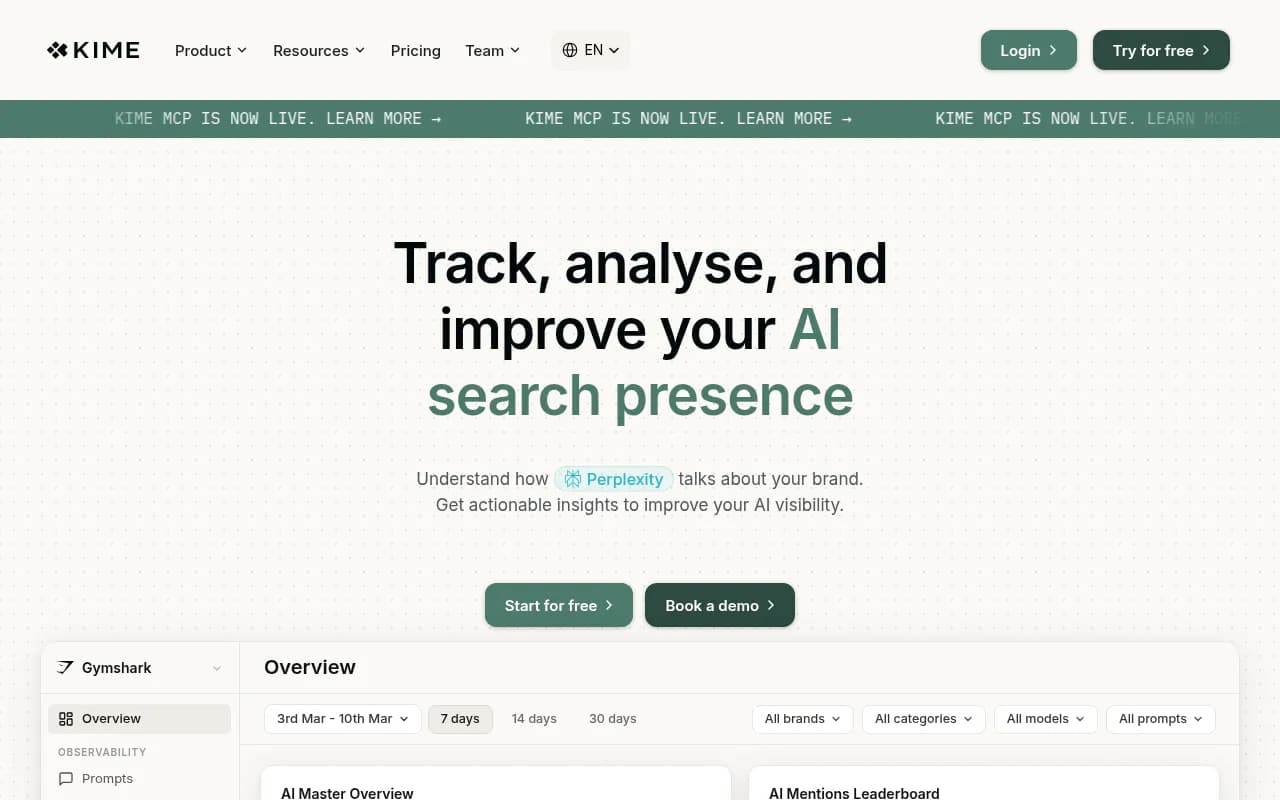
KIME is an AI search visibility platform aimed at marketing and SEO teams who want clean, digestible reporting on brand presence across AI models. Its dashboard centers on an "AI Performance Score" that rolls up visibility, placement, and sentiment into a single number, which makes it easy to track progress and report to stakeholders. KIME also includes competitor analysis, a Prompt Explorer for discovering relevant queries, and an "Actions" section that recommends steps to improve positioning. It recently launched an MCP (Model Context Protocol) integration. KIME's customer base includes brands like Gymshark, Chamberlain Coffee, and Saxo.
Side-by-side comparison
| Feature | Promptwatch | KIME |
|---|---|---|
| AI models tracked | 10+ (ChatGPT, Perplexity, Gemini, Claude, Grok, DeepSeek, Mistral, Copilot, Meta AI, Google AI Overviews) | Major 4 (ChatGPT, Perplexity, Gemini, Claude) + select others |
| Free tier | Free trial (50 prompts) | Free tier available |
| Paid plans start at | $99/mo | Not publicly listed |
| Content generation | Yes (AI Content Agents) | No |
| Content gap analysis | Yes (Answer Gap Analysis) | Partial (Actions section) |
| AI Crawler Logs | Yes (Pro and Business plans) | No |
| Prompt volume & difficulty | Yes | No |
| Sentiment tracking | No | Yes |
| Competitor heatmaps | Yes | Yes |
| Reddit & YouTube tracking | Yes | No |
| ChatGPT Shopping tracking | Yes | No |
| Offsite citation analysis | Yes | No |
| Multi-language / multi-region | Yes | Yes |
| MCP integration | No | Yes |
| API access | Yes | Limited |
| Looker Studio integration | Yes | No |
| G2 rating | 4.7/5 | Not listed |
| Target audience | Marketing, SEO, agencies, enterprise | Marketing, SEO teams |
Head-to-head feature deep-dive
Monitoring and model coverage
Promptwatch tracks 10+ AI models in real user-interface conditions, not just API outputs. That distinction matters because what ChatGPT shows a real user in its interface can differ from what the API returns. Promptwatch also covers newer and regional models like DeepSeek, Grok, and Mistral that most competitors haven't added yet.
KIME covers the four models most marketers care about day-to-day: ChatGPT, Perplexity, Gemini, and Claude. For many teams, that's enough. But if your audience is global or you're tracking emerging AI platforms, KIME's coverage leaves gaps.
Verdict: Promptwatch wins on breadth. KIME is fine if you only care about the mainstream four.
Reporting and dashboards
KIME's dashboard is genuinely well-designed for marketers. The AI Performance Score gives you a single number to track over time, and the breakdown into visibility, placement, and sentiment makes it easy to explain to a CMO or client. The industry ranking view (showing your brand vs competitors like Nike vs Adidas) is visually clean and presentation-ready.
Promptwatch's dashboards are more data-dense. You get prompt-level breakdowns, page-level citation tracking, competitor heatmaps by model, and visibility trend lines. It's more powerful but takes longer to get comfortable with. The trade-off is that Promptwatch gives you more to act on, while KIME gives you more to present.
Verdict: KIME for stakeholder reporting. Promptwatch for operational depth.
Content optimization and gap analysis
This is where the two tools diverge most sharply.
Promptwatch's Answer Gap Analysis shows you the exact prompts where competitors are getting cited but you're not. From there, Content Agents generate full articles, listicles, comparison pages, and content briefs grounded in real prompt data, citation patterns, prompt volumes, and competitor analysis. You're not getting generic SEO filler; you're getting content engineered around the specific gaps AI models are exposing.
KIME has an "Actions" section that recommends steps to improve positioning. Based on available information, this is more of a recommendations layer than a full content generation system. It tells you what to do; it doesn't do it for you.
Verdict: Promptwatch is the clear winner here. If content optimization is a priority, KIME can't match it.
AI crawler logs and technical insights
Promptwatch's Crawler Logs (available on Professional and Business plans) show real-time logs of AI crawlers hitting your website: which pages they read, errors they encounter, how often they return, and when a page moves from "crawled" to "cited." This is genuinely useful for diagnosing why certain pages aren't getting picked up by AI models.
KIME has no equivalent feature. If you're trying to debug why your content isn't being cited despite being published, KIME won't help you there.
Verdict: Promptwatch only. KIME doesn't offer this.
Prompt intelligence
Promptwatch assigns volume estimates and difficulty scores to each prompt, and shows query fan-outs: how one prompt branches into sub-queries. This helps you prioritize which prompts are worth targeting instead of spreading effort thin.
KIME has a Prompt Explorer for discovering relevant queries, but it doesn't appear to include volume or difficulty scoring. It's more of a discovery tool than a prioritization engine.
Verdict: Promptwatch for teams that want to prioritize strategically. KIME for basic prompt discovery.
Sentiment and brand perception
KIME tracks sentiment scores per brand and per prompt, which Promptwatch doesn't currently offer. If you're managing brand reputation or want to know whether AI models are describing your brand positively or negatively, KIME has a dedicated view for this.
Promptwatch focuses more on citation presence and visibility share than on the tone of those citations.
Verdict: KIME wins on sentiment tracking. It's one area where it has a clear edge.
Integrations and ecosystem
Promptwatch connects via Cloudflare, Fastly, Vercel, server logs, Google Search Console, or a tracking snippet. It also has a Looker Studio integration and an API for custom workflows.
KIME recently launched an MCP integration, which is interesting for teams building AI-native workflows. Its API access appears more limited than Promptwatch's.
Verdict: Promptwatch for enterprise integrations. KIME's MCP integration is a forward-looking differentiator worth watching.
Pricing comparison
Promptwatch publishes its pricing openly. KIME's paid plan pricing isn't listed publicly, which makes direct comparison harder.
| Plan | Promptwatch | KIME |
|---|---|---|
| Free | Free trial (50 prompts, 1 site, 5 articles) | Free tier available |
| Entry paid | Essential: $99/mo (1 site, 50 prompts, 5 articles) | Not publicly listed |
| Mid-tier | Professional: $249/mo (2 sites, 150 prompts, 15 articles, crawler logs) | Not publicly listed |
| Higher tier | Business: $579/mo (5 sites, 350 prompts, 30 articles) | Not publicly listed |
| Agency/Enterprise | Custom pricing | Not publicly listed |
| Annual discount | Yes | Likely yes |
Promptwatch's pricing is transparent, which makes budgeting easier. KIME's free tier is a genuine advantage for teams that want to test AI visibility tracking without a credit card. For teams that need content generation, crawler logs, and deeper analytics, Promptwatch's paid plans are where the real value sits.
Pros and cons
Promptwatch
Pros:
- Full action loop: monitoring, gap analysis, and content generation in one platform
- Tracks 10+ AI models including newer ones like Grok, DeepSeek, and Mistral
- AI Crawler Logs give technical teams real diagnostic data
- Prompt volume and difficulty scoring helps prioritize effort
- Reddit and YouTube tracking, ChatGPT Shopping monitoring, offsite citation analysis
- Transparent pricing; strong G2 rating (4.7/5)
- Looker Studio integration and API for custom reporting
Cons:
- No sentiment tracking
- More complex to learn than KIME; data-dense dashboards
- Paid plans required for crawler logs and full content generation
- No MCP integration currently
KIME
Pros:
- Clean, marketer-friendly dashboard with AI Performance Score
- Sentiment tracking is a genuine differentiator
- Free tier lowers the barrier to entry
- MCP integration for AI-native workflows
- Good for stakeholder reporting and executive summaries
- Prompt Explorer for query discovery
Cons:
- No AI content generation
- No crawler logs or technical site analysis
- No prompt volume or difficulty scoring
- No Reddit, YouTube, or offsite citation tracking
- No ChatGPT Shopping monitoring
- Paid pricing not publicly listed
- Narrower model coverage than Promptwatch
Who should pick which tool
Pick Promptwatch if:
- You want to actively improve your AI search rankings, not just monitor them
- Your team needs content gap analysis and AI-generated content briefs
- You're running an agency managing multiple clients across multiple sites
- Technical SEO matters to you and you want crawler log data
- You need coverage across 10+ AI models including newer ones
- You want transparent pricing and a clear upgrade path
Pick KIME if:
- You're just starting with AI visibility tracking and want a free entry point
- Your primary need is clean reporting for stakeholders or clients
- Sentiment analysis is important to your brand monitoring workflow
- You're building AI-native workflows and want MCP integration
- You need something lightweight that a non-technical marketer can use without a learning curve
Final verdict
These two tools are playing different games. KIME is a solid monitoring and reporting layer, well-suited to teams that need clean dashboards and sentiment data without a lot of setup complexity. It's a reasonable starting point for AI visibility tracking.
Promptwatch is built for teams that want to actually move the needle. The combination of Answer Gap Analysis, Content Agents, Crawler Logs, and 10+ model coverage means you're not just watching your visibility score, you're doing something about it. For marketing and SEO teams that treat AI search as a real acquisition channel, that's the more useful tool.
If budget is tight and you just want to dip a toe in, KIME's free tier is a fair place to start. But if you're serious about AI search visibility in 2026, Promptwatch is the more complete platform.