Key takeaways
- Promptwatch is a full optimization platform; LLMrefs is a solid monitoring tool. If you want to track your AI visibility, both work. If you want to improve it, only Promptwatch has the tools to do that.
- LLMrefs is $20/month cheaper at entry level ($79 vs $99), but Promptwatch's $99 plan includes AI content generation and content gap analysis -- features LLMrefs doesn't offer at any tier.
- Promptwatch tracks 10+ AI models including DeepSeek, Mistral, and Meta AI. LLMrefs covers the major engines (ChatGPT, Claude, Gemini, Perplexity, Grok, Copilot) but has a narrower stated model list.
- Crawler logs and Agent Analytics are Promptwatch-only. Knowing which pages AI bots are actually crawling -- and fixing errors before they hurt your citations -- is something LLMrefs can't help with.
- LLMrefs has a simpler, flatter pricing structure. One plan, one price. That simplicity is genuinely appealing for smaller teams or solo marketers who just want clean reporting.
- Promptwatch has 1,480+ verified brand and agency customers with a 4.7/5 G2 rating. LLMrefs shows a strong customer logo wall (eBay, HubSpot, IKEA, Shopify) but less public review data.
Overview
Promptwatch

Promptwatch is an end-to-end AI search visibility and GEO (Generative Engine Optimization) platform built around a specific idea: monitoring your AI visibility is only useful if you can act on it. The platform tracks how brands appear across ChatGPT, Perplexity, Claude, Gemini, Grok, DeepSeek, Mistral, Copilot, Meta AI, and Google AI Overviews -- then goes further with content gap analysis, AI-powered content generation, crawler log analysis, and traffic attribution. It's used by 1,480+ brands and agencies including Booking.com, Duolingo, Typeform, and Shutterstock, and has processed over 4.5 billion citations and prompts.
LLMrefs
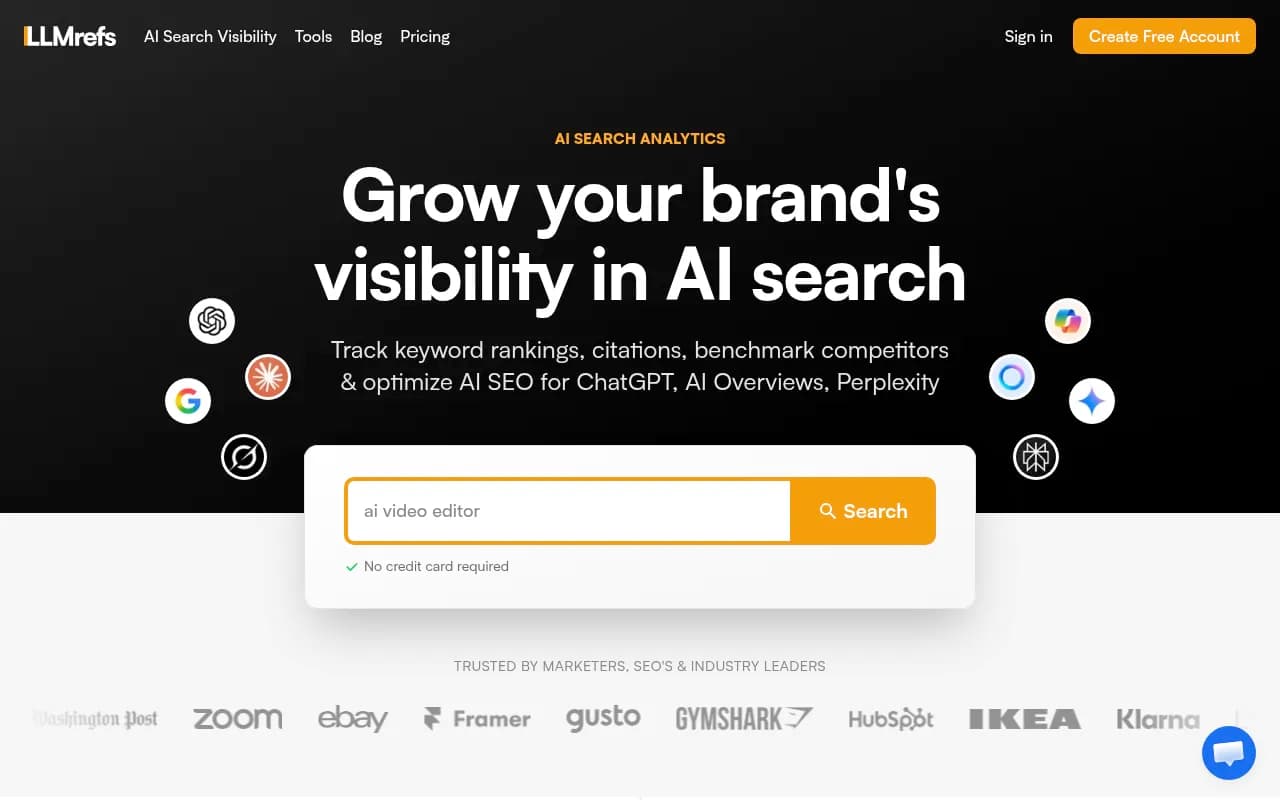
LLMrefs is an AI search analytics platform focused on keyword-level tracking and competitive benchmarking across generative AI engines. It lets you monitor brand visibility, citation rankings, and competitor performance across ChatGPT, Claude, Gemini, Perplexity, Grok, Copilot, Meta AI, and Google AI Mode. The pitch is clean: track your AI SEO like you'd track traditional keyword rankings. It's a single flat-rate product at $79/month with a 7-day free trial, and its customer list includes recognizable names like eBay, HubSpot, Gymshark, and Shopify.
Side-by-side comparison
| Feature | Promptwatch | LLMrefs |
|---|---|---|
| Starting price | $99/mo | $79/mo |
| Free tier | Free trial (50 prompts) | 7-day free trial |
| AI models tracked | 10+ (ChatGPT, Claude, Gemini, Perplexity, Grok, DeepSeek, Mistral, Copilot, Meta AI, Google AI Mode) | 8 (ChatGPT, Claude, Gemini, Perplexity, Grok, Copilot, Meta AI, Google AI Mode) |
| Prompt/keyword tracking | Yes -- up to 350 on Business plan | Yes |
| Competitor benchmarking | Yes | Yes |
| Content gap analysis | Yes | No |
| AI content generation | Yes (Content Agents) | No |
| Crawler log analysis | Yes (Agent Analytics) | No |
| Traffic attribution | Yes | No |
| Reddit & YouTube tracking | Yes | No |
| ChatGPT Shopping tracking | Yes | No |
| Offsite citation analysis | Yes | Limited |
| Multi-language/region | Yes | Yes |
| API access | Yes | Yes |
| G2 rating | 4.7/5 | Not publicly listed |
| Pricing model | Tiered (3 plans + agency) | Flat rate (1 plan) |
Head-to-head feature deep-dive
Prompt and keyword tracking
Both tools let you set up prompts or keywords and track how your brand appears in AI-generated responses over time. The mechanics are similar: you define what you want to monitor, the platform queries AI engines on a schedule, and you see your citation rate, ranking position, and share of voice.
LLMrefs frames this in familiar SEO language -- "keyword rankings" -- which makes it easy to onboard if you're coming from a traditional SEO background. The interface is clean and the reporting is straightforward.
Promptwatch adds a layer on top: Prompt Intelligence, which includes volume estimates and difficulty scores for each prompt, plus query fan-outs that show how a single prompt branches into related sub-queries. That means you're not just tracking prompts you already know about -- you're discovering which ones are worth prioritizing.
Verdict: Tie for basic tracking. Promptwatch wins on prompt discovery and prioritization.
Content gap analysis and optimization
This is where the two tools diverge most sharply.
LLMrefs doesn't have content gap analysis. It tells you where you're visible and where competitors are beating you, but it stops there. What you do with that information is up to you.
Promptwatch's Answer Gap Analysis shows you the specific prompts where competitors are getting cited but you're not -- and then maps those gaps to the content your site is missing. From there, Content Agents can generate articles, listicles, comparison pages, and briefs grounded in real prompt data, citation patterns, competitor analysis, and your own brand guidelines. The output isn't generic filler; it's built around the exact questions AI models are already answering from competitor content.
If you're a team that just wants visibility data to inform your own content strategy, LLMrefs is fine. If you want the platform to help you close the gaps, Promptwatch is the only option here.
Verdict: Promptwatch wins clearly. LLMrefs has no equivalent capability.
Crawler logs and agent analytics
Promptwatch's Agent Analytics is one of its most distinctive features and something no direct competitor in this space has matched well. It gives you real-time logs of AI crawlers (ChatGPT, Claude, Perplexity, etc.) hitting your website -- which pages they're reading, how often they return, any errors they're encountering, and the timeline from first crawl to first citation. You can connect via Cloudflare, Fastly, Vercel, server logs, Google Search Console, or a tracking snippet.
LLMrefs has nothing like this. It tracks what AI engines say about you in their responses, but it doesn't show you what's happening on your site from the AI crawler's perspective.
For teams who want to understand why certain pages aren't getting cited -- and fix the underlying crawl issues -- this gap matters a lot.
Verdict: Promptwatch wins. LLMrefs doesn't offer crawler log analysis.
Competitive intelligence
Both tools let you benchmark your AI visibility against competitors. You can see share of voice, which brands are appearing for which prompts, and how your citation rate compares.
Promptwatch adds Competitor Heatmaps that visualize your position vs competitors across different LLMs side by side. It also tracks offsite citations -- Reddit threads, YouTube videos, third-party listicles, and external domains that are driving AI visibility for your competitors. That's a genuinely useful signal: if a competitor is getting cited because of a specific Reddit thread or a "best of" listicle, you can see it and respond.
LLMrefs covers the core competitive benchmarking well. It's clean and readable. But it doesn't surface the offsite citation sources that explain why a competitor is winning.
Verdict: Promptwatch wins on depth. LLMrefs is solid for basic competitive tracking.
AI model coverage
| AI engine | Promptwatch | LLMrefs |
|---|---|---|
| ChatGPT / OpenAI | Yes | Yes |
| Claude (Anthropic) | Yes | Yes |
| Gemini | Yes | Yes |
| Perplexity | Yes | Yes |
| Grok (xAI) | Yes | Yes |
| Microsoft Copilot | Yes | Yes |
| Meta AI / Llama | Yes | Yes |
| Google AI Overviews | Yes | Yes |
| Google AI Mode | Yes | Yes |
| DeepSeek | Yes | Not listed |
| Mistral | Yes | Not listed |
Verdict: Promptwatch covers more models, particularly newer or less mainstream ones like DeepSeek and Mistral.
Ease of use and onboarding
LLMrefs has a simpler product surface. One plan, one price, a keyword-first interface that SEO practitioners will recognize immediately. The learning curve is low, and for teams that just want to get tracking set up quickly, that's a real advantage.
Promptwatch has more features, which means more to configure. The crawler log setup requires a technical integration step (Cloudflare worker, server log upload, or tracking snippet). Content Agents need brand guidelines and context to produce good output. That said, the core prompt tracking is straightforward to set up, and the free trial lets you start with 50 prompts without a credit card.
Verdict: LLMrefs is simpler to get started with. Promptwatch has a steeper ramp but more to offer once you're in.
Traffic attribution and ROI measurement
Promptwatch connects AI visibility to actual website traffic and revenue. Page-level tracking shows which pages are being cited, how often, and by which models. Traffic attribution links AI citations to site visits and conversions, so you can show the business impact of your GEO work.
LLMrefs focuses on visibility metrics -- citation rates, rankings, share of voice. It doesn't appear to offer traffic attribution or revenue connection.
For marketing teams who need to justify spend on AI visibility work, this difference matters. "We improved our citation rate by 15%" is a harder sell than "AI search drove 2,400 visits last month."
Verdict: Promptwatch wins. LLMrefs doesn't offer traffic attribution.
Pricing comparison
| Plan | Promptwatch | LLMrefs |
|---|---|---|
| Free trial | Yes (50 prompts, no credit card) | Yes (7-day trial) |
| Entry plan | $99/mo -- 1 site, 50 prompts, 5 articles | $79/mo -- flat rate |
| Mid plan | $249/mo -- 2 sites, 150 prompts, 15 articles, crawler logs | N/A |
| Business plan | $579/mo -- 5 sites, 350 prompts, 30 articles | N/A |
| Agency/Enterprise | Custom pricing | Not listed |
| Annual discount | Yes | Not listed |
LLMrefs' flat-rate model is genuinely appealing for smaller teams. You know exactly what you're paying, and there's no decision fatigue around tiers. The $79/month entry point is also lower than Promptwatch's $99.
That said, Promptwatch's $99 plan includes AI content generation (5 articles/month) and content gap analysis -- features that would otherwise require separate tools. If you're paying $79 for LLMrefs and then separately paying for an AI writing tool and a content brief tool, the total cost comparison shifts quickly.
Pros and cons
Promptwatch
Pros:
- Full optimization loop: track gaps, generate content, measure results
- Crawler logs show what AI bots are actually doing on your site
- 10+ AI models including DeepSeek, Mistral, and Meta AI
- Prompt volume and difficulty scoring helps prioritize effort
- Reddit and YouTube tracking surfaces offsite citation sources
- ChatGPT Shopping and entity tracking for e-commerce brands
- Traffic attribution connects visibility to revenue
- 4.7/5 on G2 with 1,480+ customers
Cons:
- More expensive at every tier ($99 vs $79 entry)
- More complex to fully configure, especially crawler integration
- Content Agents require setup (brand guidelines, context) to produce quality output
- Overkill for teams that genuinely only need monitoring
LLMrefs
Pros:
- Simple flat-rate pricing ($79/month, no tier confusion)
- Clean, SEO-familiar interface -- easy to onboard
- Covers all major AI engines
- Good competitive benchmarking out of the box
- 7-day free trial, no credit card required
- Recognizable customer logos (eBay, HubSpot, IKEA, Shopify)
Cons:
- Monitoring only -- no content gap analysis or generation
- No crawler log analysis
- No traffic attribution or revenue connection
- No Reddit or YouTube tracking
- No ChatGPT Shopping tracking
- Single plan means no room to grow without hitting a ceiling
Who should pick which tool
Pick Promptwatch if:
- You want to improve your AI visibility, not just measure it
- Your team produces content and wants data-driven briefs or AI-generated drafts
- You need to understand why certain pages aren't getting cited (crawler logs)
- You're running AI visibility for multiple sites or clients (agency plans)
- You need to show ROI from AI search to stakeholders (traffic attribution)
- You want the most complete picture of where AI citations come from, including Reddit and YouTube
Pick LLMrefs if:
- You're primarily a monitoring use case -- you want clean dashboards and competitive benchmarks
- You're a solo marketer or small team with a tight budget and no need for content generation
- You want a simple, flat-rate tool without tier decisions
- You're already using separate tools for content creation and just need the tracking layer
- You're new to AI visibility tracking and want something low-friction to start with
Final verdict
LLMrefs is a clean, affordable monitoring tool that does what it says. If you need keyword-level AI visibility tracking with competitive benchmarks and a simple pricing model, it's a reasonable choice.
Promptwatch is a different category of product. It monitors, yes -- but it also tells you what content to create, helps you create it, shows you what AI crawlers are doing on your site, and connects the whole thing to traffic and revenue. For any team that's serious about AI search as a growth channel rather than just a metric to watch, Promptwatch is the more complete platform.
The $20/month price difference at entry level is real but not the deciding factor. The deciding factor is whether you need a dashboard or a workflow.