Key takeaways
- Promptwatch and Moonlit Platform are not direct competitors -- they solve different problems. Promptwatch tracks and improves AI search visibility; Moonlit automates SEO content production.
- If your goal is to understand how your brand appears in ChatGPT, Perplexity, or Gemini, Promptwatch is the clear choice. Moonlit has zero AI visibility monitoring.
- If you need to produce large volumes of SEO content quickly with customizable AI workflows, Moonlit is purpose-built for that. Promptwatch's Content Agents are more focused and less flexible by comparison.
- Moonlit is dramatically cheaper: free tier available, paid plans from $20/mo vs Promptwatch's $99/mo entry point.
- Promptwatch's data depth (crawler logs, prompt volumes, competitor heatmaps, ChatGPT Shopping tracking) has no equivalent in Moonlit.
- The two tools can work well together: Promptwatch finds the gaps, Moonlit helps you fill them at scale.
Overview
Promptwatch
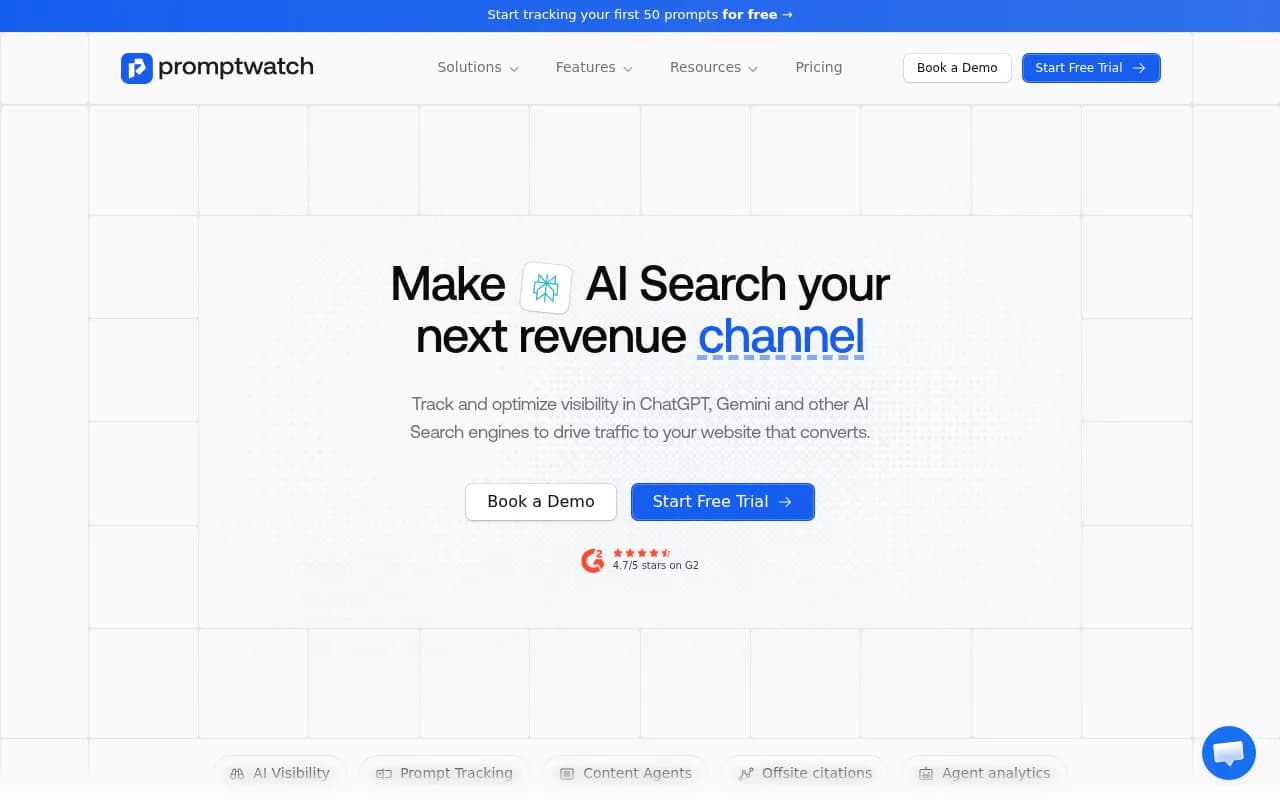
Promptwatch is an end-to-end AI search visibility platform built for brands and agencies that want to understand and improve how they appear in AI-generated answers. It monitors 10+ AI models -- ChatGPT, Perplexity, Claude, Gemini, Google AI Overviews, DeepSeek, Grok, Mistral, Meta AI, and Copilot -- and tracks brand citations, competitor visibility, and prompt-level performance. Beyond monitoring, it includes Content Agents that generate articles and briefs grounded in real prompt data, plus AI crawler logs that show exactly which pages AI bots are reading on your site. Used by 1,480+ brands including Booking.com, Duolingo, Typeform, and Yelp, it's rated 4.7/5 on G2.
The core value proposition: most AI visibility tools show you a dashboard and leave you stuck. Promptwatch shows you where you're invisible, tells you why, and gives you tools to fix it.
Moonlit Platform
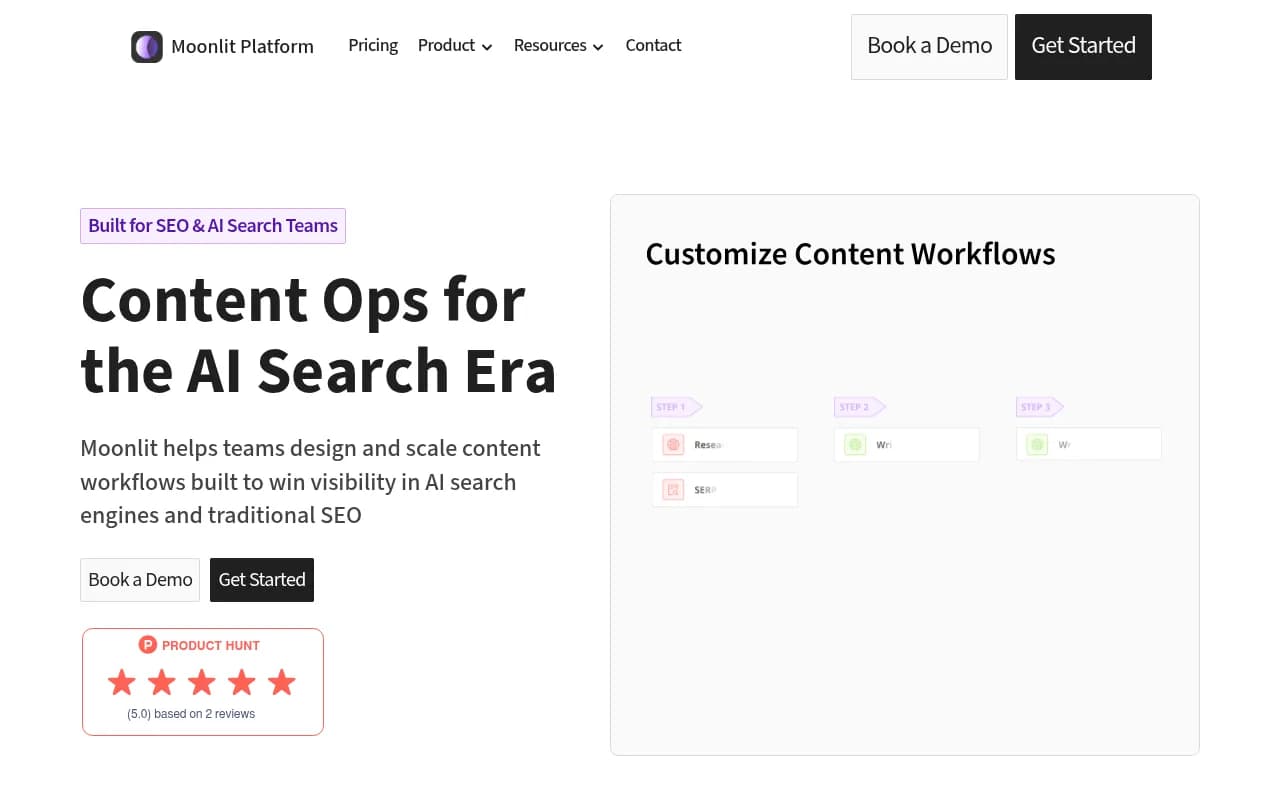
Moonlit Platform is a content automation tool aimed at SEO teams and agencies that need to produce optimized content at scale. It lets you build custom AI-powered content workflows -- combining SEO data sources, AI models, and your own knowledge base -- and run them in bulk across thousands of inputs. Pre-built templates cover things like blog writing, topical clustering, schema markup generation, internal linking, and keyword research. It's used by 5,000+ SEO and content teams, with a starting price of free and paid plans from $20/mo.
The core value proposition: stop doing repetitive SEO content tasks manually. Build a workflow once, run it at scale.
Side-by-side comparison
| Feature | Promptwatch | Moonlit Platform |
|---|---|---|
| Primary use case | AI search visibility & GEO | SEO content automation |
| AI model monitoring | 10+ models (ChatGPT, Perplexity, Claude, Gemini, etc.) | None |
| Content generation | Yes (Content Agents, briefs) | Yes (core feature, highly flexible) |
| Bulk content runs | Limited | Yes (thousands of inputs) |
| Custom workflow builder | No | Yes |
| Prompt/keyword tracking | Yes (prompt volumes, difficulty scores) | Keyword research only |
| Competitor analysis | Yes (heatmaps, citation comparison) | Limited (page-level competitor comparison) |
| AI crawler logs | Yes | No |
| Knowledge base / brand voice | No | Yes |
| Topical mapping | No | Yes |
| Internal linking automation | No | Yes |
| Schema markup generation | No | Yes |
| Reddit & YouTube tracking | Yes | No |
| ChatGPT Shopping tracking | Yes | No |
| Free tier | Free trial | Free plan (300 credits/mo) |
| Starting paid price | $99/mo | $20/mo |
| G2 rating | 4.7/5 | N/A |
| Target user | Marketing/SEO teams, agencies doing GEO | SEO teams, content agencies |
Head-to-head feature deep-dive
AI visibility monitoring
This is where the two tools diverge completely. Promptwatch is built from the ground up to track how AI search engines respond to prompts related to your brand and category. You can set up 50+ prompts, see which AI models mention your brand, how often, in what context, and how you compare to competitors. Crawler logs show which of your pages AI bots are actually reading. Prompt Intelligence gives you volume estimates and difficulty scores so you can prioritize.
Moonlit Platform has none of this. It doesn't monitor AI search engines, doesn't track brand citations, and doesn't tell you anything about how your content performs in AI-generated answers. That's simply not what it's built for.
Verdict: Promptwatch wins by default -- this isn't a close call.
Content generation
Both tools generate content, but the approach is very different.
Promptwatch's Content Agents generate articles, listicles, comparisons, and briefs grounded in real prompt data. The idea is that content is created to answer specific gaps AI models are exposing -- not generic SEO filler. You get brand guidance, competitor context, and citation data baked into the output. It's focused and purposeful, but not designed for high-volume production.
Moonlit's content generation is more flexible and scalable. You can build custom workflows that chain together SEO data sources, AI models, and your own knowledge base. The "Ultimate Blog Writer" template, for example, handles research, draft generation, internal linking, visuals, and schema in one run. You can train the system on your blog to match your tone. And you can run any workflow in bulk across thousands of inputs -- something Promptwatch doesn't offer.
| Capability | Promptwatch | Moonlit |
|---|---|---|
| Content briefs | Yes | Yes |
| Full article generation | Yes | Yes |
| Bulk generation | Limited | Yes (thousands of inputs) |
| Custom workflow builder | No | Yes |
| Knowledge base / brand voice | No | Yes |
| Grounded in AI prompt data | Yes | No |
| Internal linking | No | Yes |
| Schema markup | No | Yes |
| Topical clustering | No | Yes |
Verdict: Moonlit wins for volume and flexibility. Promptwatch wins for AI-search-optimized content with real data behind it.
Pricing
Moonlit is significantly cheaper at every tier. That said, the tools serve different purposes, so a direct price comparison is a bit like comparing a CRM to a spreadsheet -- technically both store data, but you're not really choosing between them on price alone.
| Plan | Promptwatch | Moonlit Platform |
|---|---|---|
| Free | Free trial | Free (300 credits/mo) |
| Entry paid | $99/mo (Essential: 1 site, 50 prompts, 5 articles) | $20/mo (Pro) |
| Mid tier | $249/mo (Professional: 2 sites, 150 prompts, 15 articles, crawler logs) | $75/mo (Team) |
| Upper tier | $579/mo (Business: 5 sites, 350 prompts, 30 articles) | $200/mo (Business) |
| Agency/Enterprise | Custom | Not listed |
Promptwatch's higher price reflects the infrastructure cost of actually querying AI search engines at scale, storing citation data, and running crawler log analysis. Moonlit's lower price makes sense for a workflow automation tool that runs on top of AI APIs you're already paying for.
Verdict: Moonlit wins on price. Promptwatch's cost is justified if AI visibility is a real business priority for you.
Competitor analysis
Promptwatch has a proper competitor analysis layer. You can track multiple competitors, see their visibility scores across AI models, compare citation rates prompt by prompt, and use Answer Gap Analysis to find prompts where competitors are visible but you're not. Competitor heatmaps give you a visual breakdown of who's winning for each topic.
Moonlit's competitor analysis is more limited -- the "SEO Page Perfector" template can analyze a competitor page and generate a more optimized version of it, but there's no ongoing competitor monitoring or systematic gap analysis.
Verdict: Promptwatch wins clearly.
Ease of use and workflow
Moonlit's workflow builder is its standout UX feature. You can visually chain together data sources and AI steps, save them as templates, and share them with your team. For teams that do repetitive SEO tasks, this is genuinely useful -- the learning curve is real, but once a workflow is built, it runs itself.
Promptwatch's interface is more structured and less customizable. You set up your brand, add prompts, and the platform does the monitoring. The Content Agents follow a guided flow rather than a freeform builder. One reviewer noted it's "less flashy" than some competitors but easy to use day-to-day. That tracks -- it's not trying to be a workflow tool.
Verdict: Depends on what you need. Moonlit's builder is more powerful for content teams. Promptwatch is simpler to get running for visibility tracking.
Integrations and data sources
Promptwatch connects to Cloudflare, Fastly, Vercel, Google Search Console, and server logs for crawler attribution. It has a Looker Studio integration and an API. It also pulls in Reddit and YouTube data to surface discussions influencing AI recommendations.
Moonlit integrates with various SEO data sources (keyword research APIs, etc.) and AI models, but the specific integrations aren't as clearly documented. The knowledge base feature lets you upload your own content to train the AI on your brand voice.
Verdict: Promptwatch has more documented, specific integrations relevant to its use case.
Pros and cons
Promptwatch
Pros:
- The only platform that combines AI visibility monitoring, content gap analysis, and content generation in one place
- Crawler logs show exactly which pages AI bots are reading -- most competitors don't have this
- Tracks 10+ AI models including ChatGPT Shopping and entity mentions
- Prompt Intelligence with volume and difficulty scores helps you prioritize
- Reddit and YouTube tracking surfaces off-site citation opportunities
- Strong customer base (Booking.com, Duolingo, Typeform) signals real enterprise trust
- 4.7/5 on G2
Cons:
- Expensive for smaller teams -- $99/mo is the floor, and meaningful features like crawler logs require $249/mo
- Prompt limits per plan can feel restrictive if you're tracking a broad topic area
- Content generation is focused on AI-optimized content, not high-volume SEO production
- No custom workflow builder -- you work within Promptwatch's structure
Moonlit Platform
Pros:
- Very affordable -- free tier available, paid plans start at $20/mo
- Custom workflow builder is genuinely flexible and powerful
- Bulk runs handle thousands of inputs, which is rare at this price point
- Knowledge base and persona training produce more on-brand output
- Pre-built templates cover a wide range of SEO tasks (schema, topical clustering, internal linking)
- Good fit for agencies doing high-volume content work
Cons:
- No AI visibility monitoring whatsoever -- you won't know how your content performs in AI search
- No competitor tracking or citation analysis
- Less established brand compared to Promptwatch (no major enterprise logos, no G2 presence noted)
- Workflow builder has a learning curve -- not plug-and-play
- Documentation and integrations are less clearly communicated
Who should pick which tool
Pick Promptwatch if:
- You want to know how your brand appears in ChatGPT, Perplexity, Gemini, or other AI search engines
- You're running a GEO or AI SEO strategy and need data to back it up
- You need to track competitors' AI visibility and find gaps in your own content
- You're a marketing or SEO team at a mid-size to enterprise brand that takes AI search seriously
- You want crawler logs to understand how AI bots interact with your site
- You're an agency reporting on AI visibility for clients
Pick Moonlit Platform if:
- Your main goal is producing large volumes of SEO content faster
- You want to build custom, reusable content workflows for your team
- You're an SEO agency or freelancer doing repetitive content tasks at scale
- Budget is a constraint and you need a capable tool under $100/mo
- You want to train an AI on your brand voice and knowledge base
- You're focused on traditional SEO (topical authority, internal linking, schema) rather than AI search visibility
Use both if:
- You're serious about AI search and need to both track visibility (Promptwatch) and produce content at scale to close gaps (Moonlit)
Final verdict
These tools don't really compete -- they occupy different parts of the SEO and content stack. Promptwatch is the right choice if AI search visibility is a strategic priority and you need real data on how your brand performs across ChatGPT, Perplexity, and the rest. Moonlit is the right choice if you need to produce and optimize SEO content faster without spending a lot.
If you're trying to decide between them, the real question is: are you trying to understand and improve your AI search presence, or are you trying to scale your content production? Answer that, and the choice makes itself.
For teams doing both, the combination actually makes sense: Promptwatch tells you what content to create, Moonlit helps you create it at scale.