Key Takeaways
- Promptwatch is an AI search visibility and GEO platform with public pricing from $95/mo. Omnibound is demo-led with no published price list.
- Promptwatch tracks more engines, including Copilot, Grok, DeepSeek and Mistral. Omnibound covers five: ChatGPT, Perplexity, Gemini, Claude and Google AI Mode.
- Omnibound's edge is buyer context. It builds prompts from CRM notes, sales calls and support tickets, then reads visibility against pipeline.
- Promptwatch's edge is depth on the technical and action side: IP-verified AI crawler logs, weekly site audits, visitor analytics, the Content Agent and the Action Board.
- Omnibound needs real setup work (CRM field mapping, analytics tagging). Promptwatch can be running in an afternoon.
- Pick Omnibound if your B2B team lives in a CRM and wants prompts from real buyer conversations. Pick Promptwatch for almost everyone else, especially SEO teams and agencies.
Overview
Promptwatch

Promptwatch is an end-to-end AI search visibility and generative engine optimization platform. It scrapes the real consumer interfaces of ChatGPT, Google AI Overviews, Google AI Mode, Gemini, Perplexity, Copilot and others, rather than relying only on APIs. That matters because user-facing answers and citations often differ from API outputs.
The part that separates it from most trackers is what happens after the data. Crawler logs show which AI bots hit your site and what errors they hit. Content gap analysis finds the prompts you lose. The Content Agent writes and publishes to Webflow, Framer or WordPress, and then the pages are tracked for crawls, citations and clicks. It reports 1,840+ brands and agencies and a 4.7/5 rating on G2.
Omnibound
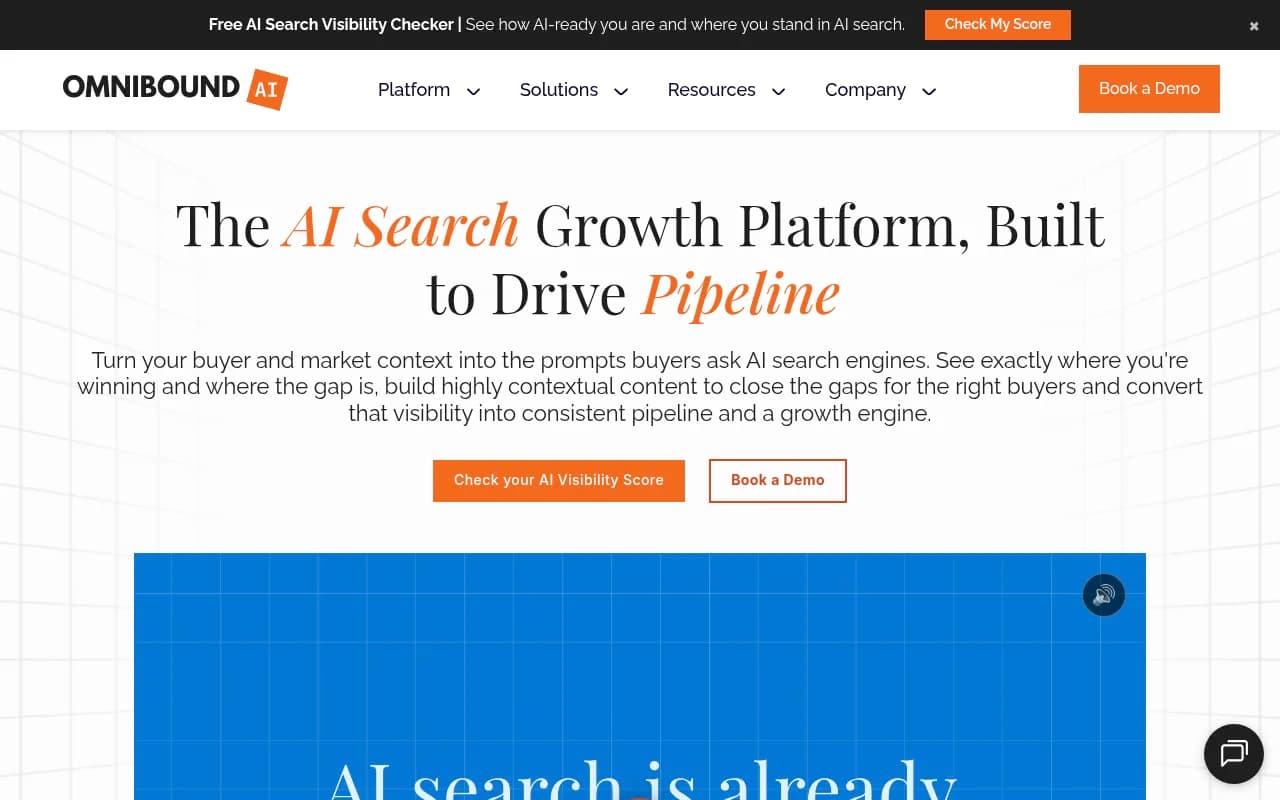
Omnibound positions itself as an AI search growth platform for B2B companies. Its central idea is a marketing context layer that pulls in sales calls, CRM notes, support tickets, reviews and competitor sites, then turns that into the prompts buyers actually ask. It tracks those prompts across five engines, surfaces scored content opportunities, and generates AEO and GEO content for different formats and buying stages.
The pitch is pipeline. Omnibound says it joins citations to Google Analytics and your CRM so you can see how AI visibility connects to deals. One reviewer, SaaSInsight, noted it did not validate the claim that each AI-referred session is tagged by engine and prompt, so treat that as something to test in a demo.
Side-by-side comparison
| Feature | Promptwatch | Omnibound |
|---|---|---|
| Starting price | $95/mo (Essential) | Custom, demo-led |
| Public pricing | Yes | No |
| Free option | Free Explore plan (10 prompts, ChatGPT only), 7-day trial on paid plans | Free AI Search Visibility Checker, free trial reported |
| Engines tracked | 10+ including Copilot, Grok, DeepSeek, Mistral, Alexa | 5 (ChatGPT, Perplexity, Gemini, Claude, AI Mode) |
| Prompt source | Volumes, difficulty, fan-outs, Search Console, PAA | CRM, calls, tickets, reviews |
| AI crawler logs | Yes, IP-verified | Not documented |
| Visitor analytics | Yes, AI traffic and conversions | GA and CRM attribution (vendor claim) |
| Content generation | Content Agent, Content Creation, Content Refresh | Scored opportunities, multi-format content |
| CMS publishing | WordPress, Webflow, Framer | Not documented |
| Reddit, YouTube, LinkedIn citations | Yes | Not documented |
| API and MCP | REST API v2, hosted MCP server | API claimed, no public docs |
| CRM and sales integrations | Slack, GSC, Bing, Looker Studio | Salesforce, HubSpot, Gong, Zendesk and more |
Head-to-head deep-dive
Prompt selection and buyer context
This is where Omnibound makes its best argument. Most trackers, Promptwatch included in part, start from keywords, search data and suggested prompts. Omnibound starts from what your buyers said on calls and in tickets. If your product is complex and your sales team hears the same ten questions every week, that is a smart seed list.
Promptwatch approaches it from the data side. Prompt Intelligence gives monthly volumes, difficulty scores and citation rates, and query fan-outs show the exact web searches AI runs for each response. You can also build personas and stack them. It is less tied to your internal conversations, but it tells you which prompts are worth winning.
| Aspect | Promptwatch | Omnibound |
|---|---|---|
| Prompt origin | Search and AI data, your pages, PAA | Sales calls, CRM, support tickets |
| Volume and difficulty scores | Yes | Not documented |
| Query fan-outs | Yes | Not documented |
| Personas | Yes, with persona stacking | Buyer context layer |
Verdict: Omnibound for B2B teams with rich call and CRM data. Promptwatch for prompt prioritization.
Engine coverage and data collection
Promptwatch tracks the real interfaces of ChatGPT, Google AI Overviews, Google AI Mode, Copilot, Gemini, Perplexity and Alexa, plus API models like Claude, DeepSeek, Mistral and Grok. It also watches coding agents such as Codex and Claude Code, which matters if you sell developer tools.
Omnibound covers five engines. That is arguably enough for B2B vendor research, and Omnibound's own comparison page concedes Promptwatch covers more. SaaSInsight called five engines mid-table. Omnibound also does not say how often prompts run or how answers are sampled, which makes it hard to judge data quality.
Verdict: Promptwatch, clearly.
Technical visibility and crawler data
If an AI bot cannot read your page, nothing else matters. Promptwatch shows IP-verified logs of GPTBot, OAI-SearchBot, ChatGPT-User, ClaudeBot, PerplexityBot and others, with the pages they read and the errors they hit. Spoofed bots are filtered. Weekly site audits run 21 checks. Promptwatch Data tracks this kind of traffic too, for example its AI crawler traffic report covering June to September 2026.
I found nothing comparable in Omnibound's public material. It focuses on what is cited, not why a page was or was not fetched.
Verdict: Promptwatch, by a wide margin.
Content creation and publishing
Both tools turn gaps into content. Omnibound scores opportunities by combining buyer context with prompt gaps, then drafts content for several formats and buying stages. Its claim of 7-format content creation comes from its own comparison page, so verify it in a demo.
Promptwatch's Content Agent plans, writes and publishes against visibility gaps, with a publishing calendar, monthly budget and a review inbox. It can push to WordPress, Webflow or Framer. Content Refresh gives git-diff-style updates for existing pages, and the Brand Book keeps tone consistent. Published pages are then tracked, and underperformers come back as actions on the Action Board.
Verdict: Promptwatch for closing the loop. Omnibound's content is likely more tailored if your buyer data is good.
Measuring business impact
Omnibound's pitch is that visibility should connect to pipeline. Joining citations to CRM data is useful if you already report pipeline there. The catch: setup effort is part of the cost, covering tagging, analytics configuration and CRM field mapping.
Promptwatch measures AI traffic directly with visitor analytics, then joins crawls, citations, clicks and Search Console or Bing data per page in 360 Insights. Crisp reported 2x higher conversion from AI traffic than traditional channels. It does not map to CRM deals the way Omnibound claims to, though the API and MCP can feed your own reporting.
Verdict: Tie, depending on whether you want CRM-level or page-level proof.
Integrations and API
| Area | Promptwatch | Omnibound |
|---|---|---|
| CRM | None native | Salesforce, HubSpot, Zoho, Dynamics 365 |
| Call tools | None | Gong, Zoom, Fireflies, Fathom and others |
| Support desks | None | Zendesk, Zoho Desk, Intercom |
| CMS | WordPress, Webflow, Framer | Not documented |
| Search data | Google Search Console, Bing | Google Analytics |
| CDN and logs | Cloudflare, CloudFront, Fastly, Vercel and more | Not documented |
| API | REST API v2, 110+ tool MCP server | Claimed, no public docs |
Verdict: Omnibound for sales stack integrations, Promptwatch for everything on the web and engineering side.
Support, security and reliability
Omnibound publishes a 99.5% monthly uptime target and caps maintenance at 8 hours per quarter, but names no support channel or response times. It also advertises encrypted data and role-based access. Promptwatch offers SSO, audit logs and a dedicated success manager on Enterprise.
Verdict: Roughly even, but Omnibound's lack of named support details is a gap.
Pricing comparison
Promptwatch pricing is public. Omnibound's is not. Always confirm at promptwatch.com/pricing.
| Plan | Promptwatch | Omnibound |
|---|---|---|
| Free | Explore: 1 project, 10 prompts, ChatGPT only | Free AI Search Visibility Checker |
| Trial | 7 days on monthly paid plans | Free trial reported, no card |
| Entry | Essential $95/mo (50 prompts, 6,000 responses) | Not published |
| Mid | Professional $245/mo (150 prompts, 18,000 responses) | Not published |
| Upper | Business $579/mo (350 prompts, 42,000 responses, Content Agent) | Not published |
| Agencies | Kick-off $199, Growth $399, Scale $799 | Not published |
| Enterprise | Custom, SSO, success manager | Custom |
Annual billing on Promptwatch gives 12 months for the price of 10. Note that the pricing page and the tool listing differ slightly ($95 versus $99), so check the live page.
The practical difference: with Promptwatch you can budget before talking to anyone. With Omnibound you cannot, and you should expect the cost of setup time on top of the subscription.
Pros and cons
Promptwatch
Pros:
- Public pricing from $95/mo with a free Explore plan
- 10+ engines tracked via real consumer interfaces
- IP-verified crawler logs and weekly site audits
- Content Agent with CMS publishing, plus the Action Board
- Reddit, YouTube and LinkedIn citation tracking
- MCP server and REST API
Cons:
- No native CRM or sales call integrations
- Breadth can feel like a lot on the cheaper plans
- Content and agent features scale with plan tier
Omnibound
Pros:
- Prompts built from real buyer conversations
- Strong CRM, call and support integrations
- Pipeline-oriented reporting
- Free AI Search Visibility Checker
Cons:
- No public pricing
- Only five engines tracked
- API has no public documentation
- Sampling frequency and methodology are not stated
- Setup effort for tagging and CRM mapping
- No named support channel or response times
Who should pick which tool
| If you are... | Pick |
|---|---|
| An SEO team or agency tracking many brands | Promptwatch |
| A developer-tool or API company | Promptwatch (coding agent tracking) |
| A B2B SaaS team with Salesforce or HubSpot and Gong | Omnibound |
| Shopping for price before a demo | Promptwatch |
| Needing crawler logs and technical diagnostics | Promptwatch |
| Wanting sales call transcripts to drive content | Omnibound |
If you want to compare more options before committing, the GEO software directory lists other platforms in this category. And if you would rather hand the SEO and GEO work to people, 1001 SEO Media runs this network and uses Promptwatch for its own AI visibility work.
Final verdict
Promptwatch is the better choice for most teams: more engines, public pricing, crawler logs, and agents that actually publish the fix. Omnibound is a credible niche pick if your whole workflow runs through a B2B CRM and sales call data, and you are fine with a demo-first buying process.