Key takeaways
- Promptwatch starts at $99/mo vs Radarkit's $29/mo -- a meaningful gap, but Promptwatch includes content generation and crawler logs that Radarkit simply doesn't have at any tier.
- Radarkit is a solid monitoring tool with a clean UI and competitive benchmarking. If all you need is "where does my brand rank across AI engines," it does that well for less money.
- Promptwatch tracks 10 AI models; Radarkit covers around 6. For brands that care about Grok, DeepSeek, Mistral, or Meta AI, Radarkit has a real gap.
- Promptwatch's Content Agents turn visibility gaps into publishable content. Radarkit has no equivalent -- you see the gap, then you're on your own.
- Promptwatch includes AI crawler logs (which pages ChatGPT, Claude, and Perplexity are actually crawling on your site). Radarkit doesn't offer this at all.
- For budget-conscious teams or solo marketers who just want to track and benchmark, Radarkit is a reasonable starting point. For teams that want to act on the data, Promptwatch is the more complete platform.
Overview
Promptwatch
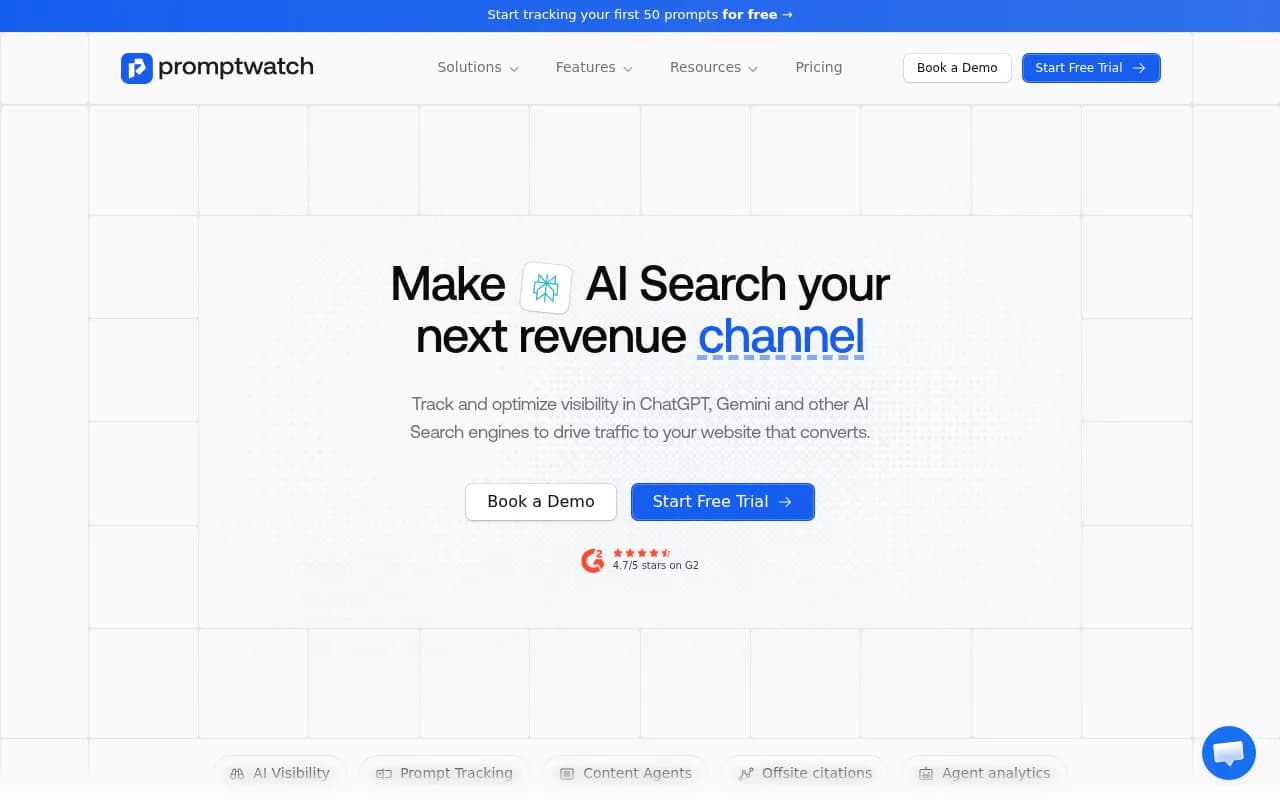
Promptwatch is an end-to-end AI search visibility platform used by 1,480+ brands and agencies. It tracks how brands appear in responses from ChatGPT, Claude, Gemini, Perplexity, Grok, DeepSeek, Mistral, Meta AI, Copilot, and Google AI Overviews -- then goes further with content gap analysis, AI-generated content, and real-time crawler logs. The core idea is a closed loop: find where you're invisible, create content to fix it, watch your visibility scores improve. It's rated 4.7/5 on G2 and has processed over 4.5 billion citations and prompts.
Radarkit
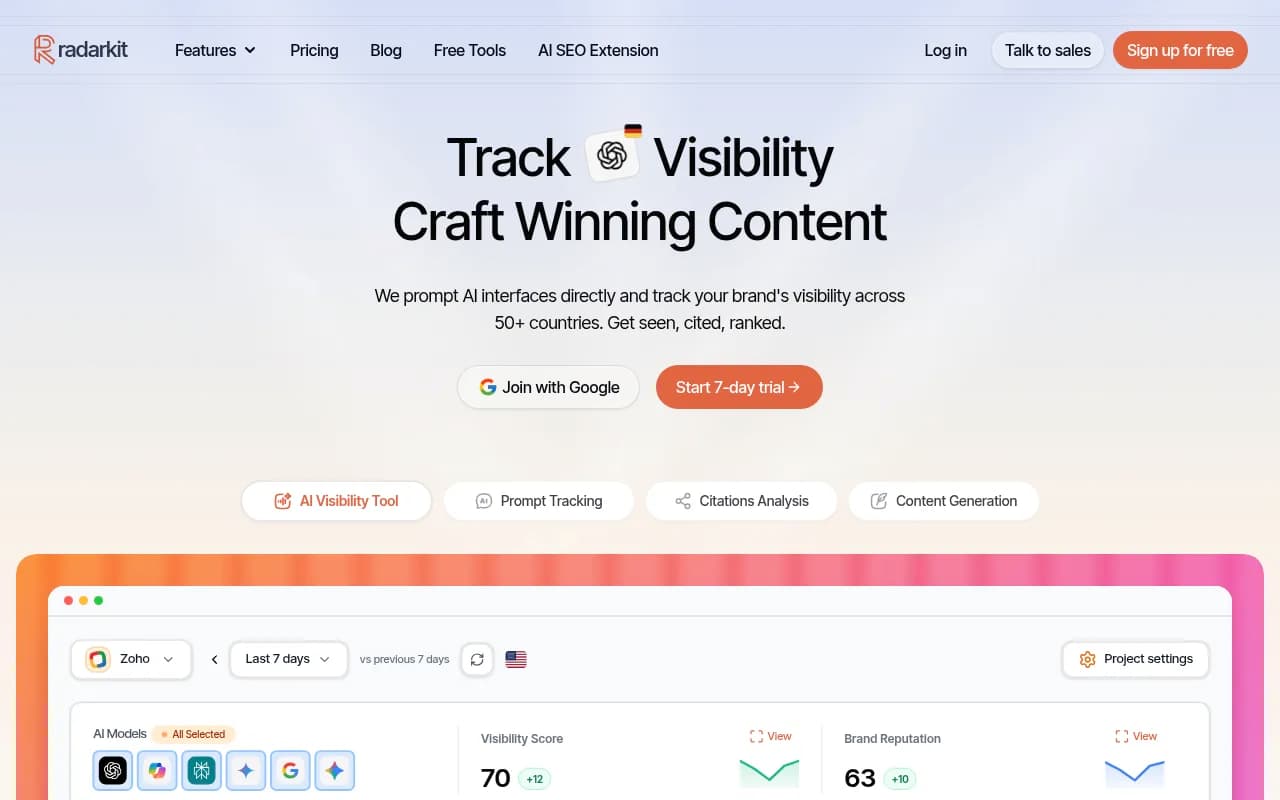
Radarkit is an AI search tracking and GEO visibility tool that monitors brand mentions and rankings across major AI engines. It covers ChatGPT, Copilot, Perplexity, Gemini, Google AI Mode, and Google AI Overviews. The platform includes competitive benchmarking, sentiment analysis, and average position tracking. It's priced accessibly starting at $29/mo with a 7-day trial, and the interface is clean and easy to navigate. Radarkit is positioned as a tracking and benchmarking tool -- it shows you where you stand, but doesn't help you change it.
Side-by-side comparison
| Feature | Promptwatch | Radarkit |
|---|---|---|
| Starting price | $99/mo | $29/mo |
| Free tier | Free trial (50 prompts) | 7-day trial |
| AI models tracked | 10 (ChatGPT, Claude, Gemini, Perplexity, Grok, DeepSeek, Mistral, Meta AI, Copilot, Google AI Overviews/Mode) | ~6 (ChatGPT, Copilot, Perplexity, Gemini, Google AI Mode, Google AI Overviews) |
| Prompt tracking | Yes | Yes |
| Citation analysis | Yes (page-level) | Yes |
| Competitive benchmarking | Yes (heatmaps) | Yes (avg position rankings) |
| Sentiment analysis | No | Yes |
| Content gap analysis | Yes | No |
| AI content generation | Yes (Content Agents) | No |
| AI crawler logs | Yes | No |
| Reddit & YouTube insights | Yes | No |
| ChatGPT Shopping tracking | Yes | No |
| Prompt volume & difficulty | Yes | No |
| Multi-language / multi-region | Yes (50+ countries) | Yes (50+ countries) |
| Offsite citation tracking | Yes | Limited |
| API access | Yes | Unknown |
| Looker Studio integration | Yes | No |
| G2 rating | 4.7/5 | Not listed |
| Target audience | Marketing teams, SEO teams, agencies | SMBs, solo marketers, growing teams |
Head-to-head feature deep-dive
Prompt tracking and AI model coverage
Both tools are built around prompt-based tracking -- you define the queries your target audience might ask AI engines, and the platform monitors where your brand appears in responses.
Promptwatch tracks 10 models. That includes the obvious ones (ChatGPT, Gemini, Perplexity) but also Grok, DeepSeek, Mistral, Meta AI, and Copilot. For brands operating in markets where these models have real user share, that coverage matters.
Radarkit covers ChatGPT, Copilot, Perplexity, Gemini, Google AI Mode, and Google AI Overviews -- the six most mainstream options. For most businesses, that's probably enough. But if you're tracking a brand in markets where DeepSeek or Grok are gaining traction, you'll hit a wall.
Both platforms prompt AI interfaces directly rather than relying purely on API outputs, which is the right approach. User-facing responses can differ from API responses, especially for shopping recommendations and citation formatting.
Verdict: Promptwatch wins on coverage. Radarkit covers the mainstream models well, but the gap matters for global brands.
Competitive benchmarking and visibility scoring
Radarkit's competitive benchmarking is genuinely good. The average position ranking table -- showing your domain vs competitors across AI responses -- is clean and immediately useful. The sentiment breakdown (positive/mixed/negative mentions) is a nice touch that Promptwatch doesn't replicate in the same way.
Promptwatch approaches competition differently with competitor heatmaps that show which brands are winning for each specific prompt and across which AI models. You can see not just that a competitor ranks higher, but exactly which prompts they're winning and why -- which feeds directly into the content gap analysis.
Verdict: Radarkit's sentiment analysis is a genuine differentiator. Promptwatch's heatmaps are more actionable for content strategy. It depends what you need the competitive data for.
Content gap analysis and content generation
This is where the two tools diverge most sharply.
Promptwatch's Answer Gap Analysis shows you the specific prompts where competitors are cited but you're not. You see the exact content your site is missing -- the topics, angles, and questions AI models want to answer but can't find on your pages. From there, Content Agents generate articles, listicles, comparisons, and briefs grounded in real prompt data, citation data, prompt volumes, persona targeting, and competitor analysis.
Radarkit has no equivalent. You can see your visibility scores and where competitors outrank you, but there's no mechanism to identify the specific content gaps or generate content to close them. You take the data and figure out the next step yourself.
For teams that have a content operation and just need the signal, that's fine. For teams that want the platform to accelerate the fix, Radarkit leaves a significant gap.
Verdict: Promptwatch wins clearly. Content generation is a core differentiator that Radarkit doesn't attempt to match.
AI crawler logs and technical insights
Promptwatch includes real-time logs of AI crawlers hitting your website -- which pages ChatGPT, Claude, Perplexity, and others are reading, how often they return, what errors they encounter, and when a page moves from "crawled" to "cited." This is genuinely useful for diagnosing why certain pages aren't being cited despite ranking well in traditional search.
Radarkit doesn't offer crawler logs. You can see citation data at the domain and page level, but there's no visibility into the crawl behavior that precedes citation.
Verdict: Promptwatch wins. Crawler logs are a technical capability that matters more as AI search matures and teams start debugging indexing issues.
Prompt intelligence and prioritization
Promptwatch includes volume estimates and difficulty scores for each prompt, plus query fan-outs that show how one prompt branches into sub-queries. This helps teams prioritize -- instead of tracking 50 prompts with equal weight, you can focus on high-volume, winnable ones.
Radarkit shows prompted time and which models a prompt was run on, but doesn't appear to include volume or difficulty scoring. Prioritization is left to the user.
Verdict: Promptwatch wins on prompt intelligence. For teams managing large prompt sets, the ability to prioritize by volume and difficulty is a real time-saver.
Reddit, YouTube, and offsite citations
Promptwatch surfaces Reddit discussions and YouTube videos that directly influence AI recommendations -- a channel most platforms ignore. It also tracks offsite citations: which external pages, listicles, and third-party sites are driving your AI visibility beyond your own domain.
Radarkit focuses primarily on your owned domain's performance. Offsite citation tracking appears limited compared to Promptwatch's approach.
Verdict: Promptwatch wins. Reddit and YouTube are increasingly influential in what AI models recommend, and ignoring them leaves a real blind spot.
Ease of use and onboarding
Radarkit's interface is clean and approachable. The dashboard is well-organized, and the competitive ranking tables are immediately readable. For a solo marketer or small team getting started with AI visibility tracking, it's a low-friction entry point.
Promptwatch has more features, which means more to learn. That said, the onboarding is structured and the platform has been reviewed positively for its guided setup. The tradeoff is real: more capability means more complexity, at least initially.
Verdict: Radarkit is easier to get started with. Promptwatch has a steeper learning curve but more to learn.
Pricing comparison
| Plan | Promptwatch | Radarkit |
|---|---|---|
| Entry / Starter | $99/mo (1 site, 50 prompts, 5 articles) | $29/mo |
| Mid-tier | $249/mo (2 sites, 150 prompts, 15 articles, crawler logs) | Pricing not fully public |
| Higher tier | $579/mo (5 sites, 350 prompts, 30 articles) | Pricing not fully public |
| Agency / Enterprise | Custom pricing | Not listed |
| Free access | Free trial (50 prompts) | 7-day trial |
| Annual discount | Yes | Unknown |
Radarkit's $29/mo entry point is genuinely accessible. For a small business or solo marketer who wants basic AI visibility tracking without committing to a larger budget, it's a reasonable option. The full pricing structure beyond the entry tier isn't prominently published, which makes it harder to evaluate at scale.
Promptwatch is more expensive at every tier, but the price includes capabilities that Radarkit doesn't offer at any price: content generation, crawler logs, prompt volume scoring, Reddit/YouTube tracking, and ChatGPT Shopping monitoring. Whether that premium is worth it depends entirely on whether your team will use those features.
Pros and cons
Promptwatch
Pros:
- Tracks 10 AI models, including Grok, DeepSeek, Mistral, and Meta AI
- Content Agents generate articles and briefs grounded in real prompt data
- AI crawler logs show exactly which pages AI engines are reading and when
- Prompt volume and difficulty scoring for prioritization
- Reddit and YouTube insights surface offsite influence on AI recommendations
- ChatGPT Shopping and entity tracking
- Strong customer base (1,480+ brands including Booking.com, Duolingo, Typeform)
- 4.7/5 on G2
Cons:
- More expensive -- $99/mo to start, $249/mo for crawler logs
- More features means more complexity; not the fastest tool to get started with
- No built-in sentiment analysis like Radarkit offers
Radarkit
Pros:
- Accessible pricing starting at $29/mo
- Clean, easy-to-navigate interface
- Sentiment analysis (positive/mixed/negative) is a useful differentiator
- Average position ranking across AI models is clear and actionable
- Covers 50+ countries
- 7-day trial to test before committing
Cons:
- No content gap analysis or content generation
- No AI crawler logs
- Covers ~6 AI models vs Promptwatch's 10 (no Grok, DeepSeek, Mistral, Meta AI)
- No prompt volume or difficulty scoring
- No Reddit or YouTube insights
- No ChatGPT Shopping tracking
- Full pricing structure isn't transparent beyond the entry tier
Who should pick which tool
Pick Promptwatch if:
- You want to do more than monitor -- you want to act on the data and create content that improves your AI visibility
- You need coverage of Grok, DeepSeek, Mistral, or Meta AI
- Your team wants to understand why certain pages aren't being cited (crawler logs)
- You're running an agency managing multiple clients and need depth and white-label reporting
- You want to track ChatGPT Shopping appearances or entity mentions
- Reddit and YouTube are part of your content or PR strategy
Pick Radarkit if:
- You're a solo marketer or small team with a tight budget and just need basic AI visibility tracking
- You want to get started quickly without a steep learning curve
- Sentiment analysis of brand mentions is important to your reporting
- You're primarily focused on the six mainstream AI models and don't need Grok or DeepSeek coverage
- You have your own content team and just need the signal -- not the content generation
Final verdict
Radarkit is a competent, affordable AI visibility tracker that does what it says. For teams with limited budgets or limited scope, it's a reasonable starting point. The sentiment analysis is a genuine plus, and the interface is clean.
But Promptwatch is a fundamentally different kind of tool. The monitoring is deeper (10 models, crawler logs, prompt intelligence), and more importantly, it doesn't stop at showing you the problem. The content gap analysis and Content Agents mean you can go from "we're invisible for this prompt" to "we published content to fix it" without leaving the platform. That closed loop is what separates a monitoring dashboard from an optimization platform.
If budget isn't the deciding factor, Promptwatch is the stronger choice for any team serious about AI search visibility in 2026.