Radarkit Review 2026
Tracks brand and content visibility across AI search engines, with prompt monitoring, citation analysis, and competitive benchmarking for GEO strategies.
Key takeaways
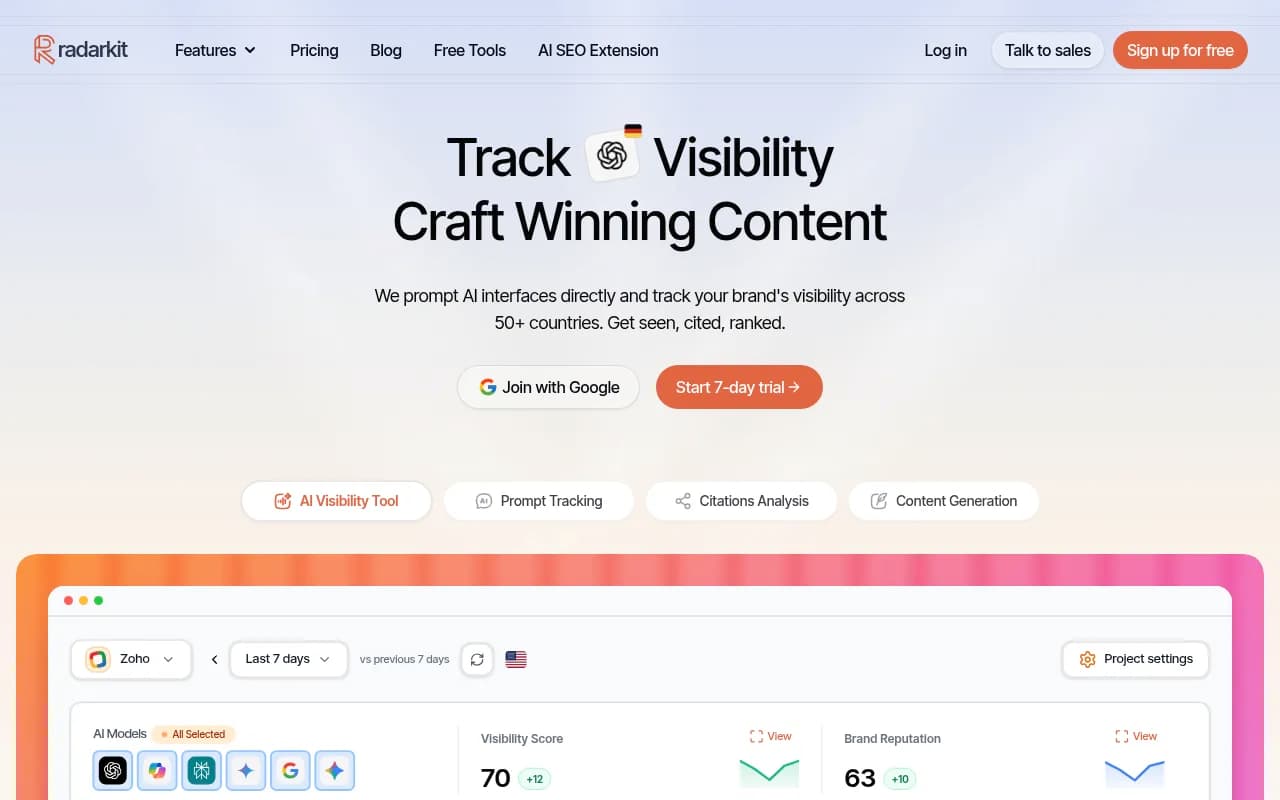
- Radarkit tracks brand visibility across six major AI platforms (ChatGPT, Copilot, Perplexity, Gemini, Google AI Mode, Google AI Overviews) by prompting the actual chat interfaces, not APIs
- The content writing tool combines Google SERP data with AI citation sources to generate optimized articles -- a meaningful differentiator from pure monitoring tools
- Pricing starts at $29/month, making it one of the more affordable options in the GEO tracking space
- Lacks several capabilities that Promptwatch offers: no AI crawler logs, no answer gap analysis, no prompt volume/difficulty scoring, no ChatGPT Shopping tracking, no Reddit/YouTube-specific insights, and no page-level citation attribution connecting AI visibility to actual revenue
- Best suited for small teams and individual marketers who want a low-cost entry point into AI search monitoring with basic content generation included
Radarkit is a relatively new entrant in the AI search visibility space, positioning itself as both a tracking tool and a content optimization platform. The core pitch is straightforward: as more people turn to ChatGPT, Perplexity, and Gemini instead of Google for product recommendations and research, brands need to know whether they're showing up in those answers. Radarkit monitors that presence and then helps you create content designed to improve it.
The tool covers six AI platforms -- ChatGPT, Microsoft Copilot, Perplexity, Google Gemini, Google AI Mode, and Google AI Overviews -- and claims to prompt those interfaces directly using real browsers rather than API calls. That distinction matters because AI chat interfaces can return different results than API endpoints, particularly for shopping recommendations and localized queries. Radarkit also supports 50+ countries with residential IP prompting, which means you can see how your brand appears to a user in Germany versus the United States for the same query.
The target audience is clearly small-to-mid-sized marketing teams, SEO professionals, and digital agencies that want to get ahead of the AI search shift without committing to enterprise-level pricing. The $29/month entry tier puts it within reach of individual consultants and freelancers, which is unusual in a category where most tools start at $99/month or higher.
Key features
Visibility score and brand reputation tracking
The dashboard centers on two headline metrics: a Visibility Score and a Brand Reputation score, both tracked over time with trend indicators. The Visibility Score reflects how often your brand appears in AI responses for your tracked prompts. Brand Reputation is derived from sentiment analysis of those mentions -- positive, mixed, or negative. In the demo data shown on the site, Zoho scores 70 on visibility and 63 on reputation, with the sentiment breakdown showing 92 positive mentions and zero negative ones. The scores are simple enough to share in a client report without explanation.
Average position tracking
Beyond raw mention counts, Radarkit tracks your average position in AI responses -- essentially, where in a ranked list your brand appears when AI assistants answer a query. This is more useful than a binary "mentioned/not mentioned" metric because position one and position five in an AI recommendation list are very different outcomes. The dashboard shows this as a time-series chart, so you can see whether your position is improving or degrading after content changes.
Prompt monitoring across multiple AI models
You set up prompts (keywords or questions) and Radarkit runs them across all six supported AI platforms on a scheduled basis. Each prompt shows which models mentioned your brand, what position you appeared in, and which competitors also appeared. The interface groups prompts into topics, so you can manage 10 or more related queries as a single cluster. Query fanout is supported -- Radarkit captures the sub-queries that AI platforms generate from a single prompt, which gives you a more complete picture of how AI models interpret your keywords.
Citation analysis
This is one of the more detailed features. For each tracked prompt, Radarkit shows every source that AI models cited, broken down by domain, content type (listicle, community/forum, guide, product page, review, etc.), citation count, citation share, and which specific AI models cited it. You can filter by your own site, competitors, links to competitors, or all sources. The "Links to Competitors" filter is particularly useful: it visits every AI-cited source and identifies where competitors are mentioned, giving you a map of third-party pages you might want to target for outreach or content placement.
Content type distribution
Radarkit categorizes citations by content format and shows you the breakdown for your domain versus the overall citation pool. In the Zoho example on the site, listicles account for 29.9% of citations, community/forum content (mostly Reddit) accounts for 25.8%, and social/platform content (LinkedIn) accounts for 20.1%. Knowing that Reddit threads and listicles dominate citations for your category tells you where to focus content creation and link-building efforts.
Content writing tool
This is where Radarkit tries to go beyond pure monitoring. The content tool analyzes the top 10 Google SERP results and the most-cited AI sources for a given keyword, extracts key terms and entities, identifies content gaps, and generates an article optimized for both Google rankings and AI citation. The output includes a content score (benchmarked against average and top performers), word count guidance, readability scoring, and a list of terms, topics, and entities to cover. You can auto-optimize existing content, insert internal links without needing Google Search Console, and delete or mark terms as done. The tool also adds fact-checked statistics and People Also Ask-style questions. Multi-language support is included -- the site shows examples in English and German.
LLM traffic monitoring
Radarkit includes a basic traffic attribution feature that shows sessions originating from AI platform referrals. You can see total LLM-referred sessions, the share of overall traffic those sessions represent, and a breakdown by platform (ChatGPT, Perplexity, etc.). This is a useful sanity check for connecting AI visibility to actual website traffic, though the feature appears relatively basic compared to full attribution platforms.
Competitive benchmarking
For each tracked prompt, you can see how competitors rank alongside you. The average rankings table shows domain-level positions across all tracked prompts, so you can quickly see whether Salesforce or HubSpot is consistently outranking you in AI responses for your keyword set. Competitor citation data is also available, showing which sources are citing your competitors and how frequently.
Brand reporting
Radarkit generates exportable brand reports formatted for client presentations. This is a practical feature for agencies that need to show AI visibility progress to clients without building custom dashboards.
Who is it for
Radarkit fits best for individual SEO consultants, small marketing teams at B2B SaaS companies, and boutique digital agencies that are starting to take AI search seriously but aren't ready to commit to higher-priced platforms. A solo consultant managing three or four client accounts could use the $29 or $79 tier to track AI visibility and generate content briefs without a significant budget commitment. The content writing feature means you're getting some production value, not just data.
Small-to-mid-sized B2B brands in competitive categories -- CRM, HR software, project management, e-commerce tools -- are a natural fit. These are categories where AI assistants are already fielding a high volume of "best X for Y" queries, and where appearing in position one versus position five in a ChatGPT response can meaningfully affect trial signups. The multi-country, multi-language support makes it relevant for European brands tracking visibility in DACH, UK, and US markets simultaneously.
Who should probably look elsewhere: enterprise marketing teams that need deep attribution, AI crawler log analysis, or content gap analysis at scale. Radarkit's feature set is solid for the price, but it doesn't yet offer the depth of prompt volume scoring, difficulty metrics, or page-level citation tracking that larger teams need to prioritize their GEO investments. Brands that rely heavily on Reddit or YouTube as citation channels will also find the coverage thinner than dedicated platforms.
Integrations and ecosystem
Radarkit's integration story is minimal based on available information. The platform supports Google sign-in for registration. The content tool claims to work without Google Search Console for internal link insertion, which lowers the setup barrier. There's no mention of Zapier, Slack, or API access on the public site.
Export functionality exists -- the citation data table shows an "Export 5266 URLs" option, and brand reports can be exported for client sharing. The content tool allows downloading generated content directly.
No browser extension, mobile app, or webhook support is mentioned. For teams that need to pipe data into a BI tool or custom dashboard, the lack of a documented API is a gap worth noting.
Pricing and value
Radarkit's pricing is among the lowest in the GEO tracking category:
- Individuals plan: $29/month -- aimed at solo users, entry-level prompt tracking
- Mid tier: $79/month -- built for small teams, expanded prompt and site coverage
- Pro plan: $139/month -- described as "best value" for small teams with more capacity
A 7-day free trial is available across plans. Annual billing presumably offers a discount, though specific annual pricing isn't published on the main page. The company notes that pricing can change with 30 days' notice and that fees are non-refundable.
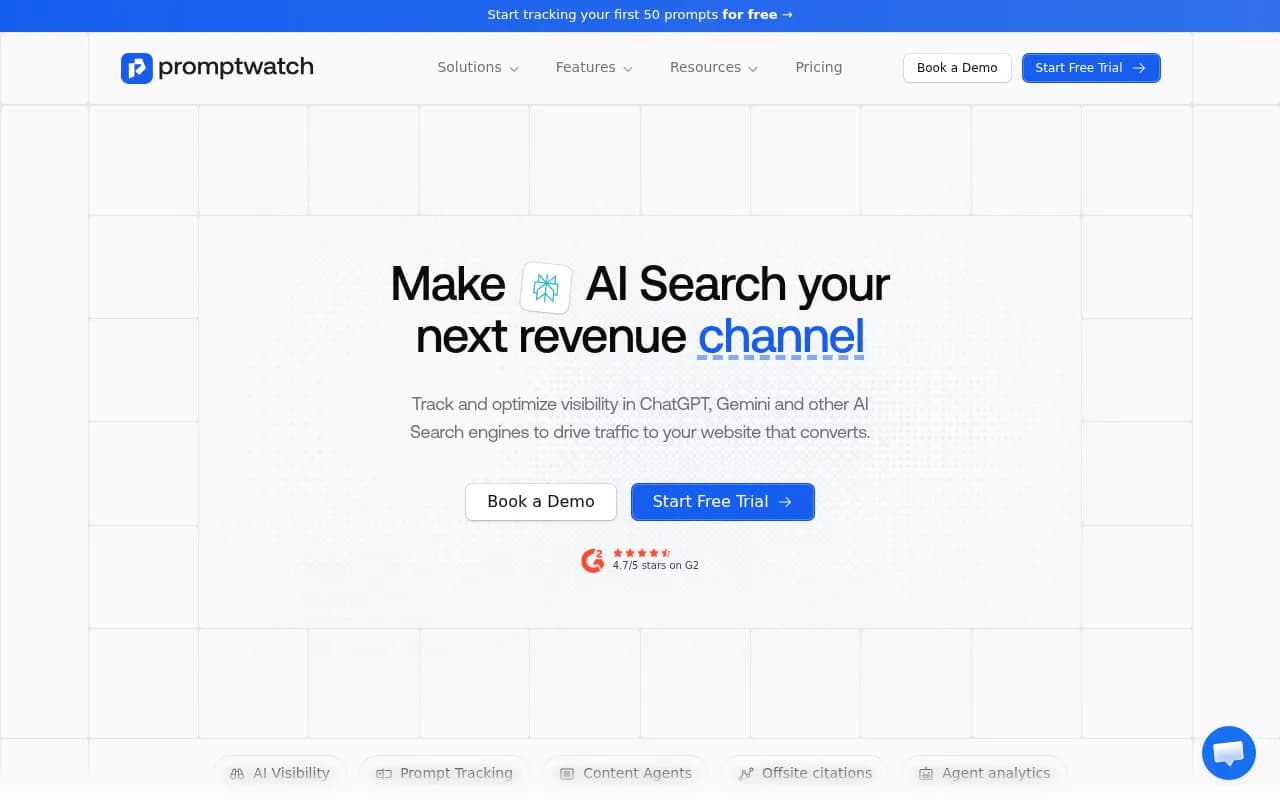
For comparison, most GEO platforms start at $99/month (Promptwatch's Essential tier) and go up from there. Radarkit's $29 entry point is genuinely accessible, though you're getting a correspondingly narrower feature set. The $139 Pro plan competes more directly with mid-tier offerings from other platforms, and at that price point the feature gap becomes more relevant.
For a freelancer or a startup just beginning to track AI visibility, the value is reasonable. For a team that needs crawler logs, answer gap analysis, or traffic attribution beyond basic referral counts, the price advantage starts to matter less than the capability gap.
Strengths and limitations
What Radarkit does well:
- Real browser prompting: Querying actual AI chat interfaces rather than APIs is the right approach, and Radarkit is explicit about this. It captures query fanout and localized results that API-based tools miss.
- Citation content type breakdown: Knowing that 25.8% of AI citations in your category come from Reddit threads is actionable. This breakdown by content format is more useful than raw citation counts.
- Accessible pricing: $29/month is a genuine entry point. Most competitors don't offer anything usable below $99/month.
- Content writing integration: Combining Google SERP analysis with AI citation data in a single content tool is a practical workflow that saves switching between tools.
- Multi-country, multi-language support: 50+ countries with residential IPs is solid coverage for international brands.
Honest limitations:
- No AI crawler logs: Radarkit doesn't show you when AI crawlers visit your site, which pages they read, or whether crawl errors are preventing citation. This is a significant gap for diagnosing why certain pages aren't getting cited. Platforms like Promptwatch offer real-time crawler log analysis that Radarkit doesn't have.
- No answer gap analysis or prompt intelligence: There's no feature that shows you which prompts competitors rank for that you don't, or that scores prompts by volume and difficulty. Without this, you're essentially guessing which keywords to prioritize. Promptwatch's Answer Gap Analysis and prompt volume/difficulty scoring solve this directly.
- Limited traffic attribution: The LLM traffic monitoring feature shows referral sessions by platform, but there's no page-level attribution, revenue connection, or conversion tracking. Understanding that ChatGPT sent 117 sessions is useful; knowing which of those sessions converted is what actually matters.
- No ChatGPT Shopping tracking: As ChatGPT's shopping recommendations become a meaningful traffic source for e-commerce and SaaS brands, the absence of shopping carousel monitoring is a gap.
- No Reddit or YouTube-specific insights: While Reddit appears in the citation data as a domain, there's no dedicated Reddit thread analysis or YouTube video tracking to surface which specific discussions are driving AI recommendations.
Bottom line
Radarkit is a capable, affordable entry point for brands and consultants who want to start tracking AI search visibility without a large budget. The combination of real-browser prompting, citation analysis, content type breakdowns, and a built-in content writing tool gives it more utility than pure monitoring dashboards at a similar price.
That said, teams that need to move beyond monitoring into systematic optimization -- identifying which content gaps to fill, understanding AI crawler behavior, attributing AI visibility to revenue, or scaling content production based on prompt volume data -- will find Radarkit's feature set limiting. For that level of depth, Promptwatch covers the full loop from gap identification to content generation to traffic attribution in a way Radarkit currently doesn't.
Best use case: A small marketing team or freelance SEO consultant tracking AI visibility for 1-3 brands across major AI platforms, using the citation data and content tool to inform their GEO content strategy without a large tool budget.
Frequently asked questions
What is Radarkit?
How much does Radarkit cost?
Does Radarkit have a content writing feature?
Which AI platforms does Radarkit monitor?
How does Radarkit compare to Promptwatch?
Can Radarkit track competitors?
Similar and alternative tools to Radarkit