Key takeaways
- Startup-friendly AI brand monitoring tools now start around $29-$95/month, but read the fine print: several vendors charge extra per engine or per prompt, so the advertised price is rarely the real price.
- ChatGPT surfaces only about 5 citations per response on average, versus roughly 10 for Perplexity and Google AI Overviews, according to Promptwatch's data on sources per response. That means startups are fighting over fewer slots on ChatGPT, so precision matters more than volume.
- Reddit's share of ChatGPT Search citations collapsed from around 3.8% in early August 2026 to just 0.5% by mid-August, per Promptwatch's Reddit citation data. A monitoring tool that only checks weekly will miss shifts like this entirely.
- Product pages became the most-cited content type on ChatGPT in July 2026, at 32.8% of citations, according to Promptwatch's citation type breakdown. If your product or pricing page is thin, that's the first thing to fix before you spend money on tracking.
- Most tools on this list only monitor. A smaller group, including Promptwatch, also finds the gap and helps close it with content generation and crawler-level diagnostics, which matters a lot when you don't have a team to interpret dashboards.
Why AI brand monitoring matters for a startup with no marketing headcount
Here's the uncomfortable part nobody at a five-person startup wants to hear: your prospects are already asking ChatGPT and Perplexity whether your product is any good, and you have no idea what those tools are saying back. Traditional analytics can't see it. Google Search Console can't see it. You're flying blind on a channel that's already sending real traffic.
The stakes are asymmetric for startups specifically. A well-funded competitor can throw a content team at the problem. You can't. But AI citation slots aren't winner-take-all the way Google's page one used to be. On ChatGPT Search in June 2026, no single domain held more than about 4% of citations, and Reddit's own lead over the runner-up shrank sharply month over month, per Promptwatch's ChatGPT citation share data. That's actually good news for a small brand: there's room to grab a slot if you show up with the right page at the right moment.
The bad part is that this space moves fast enough to break a manual process. ChatGPT changed its query fan-out behavior on August 8, 2026, rolling out the site: search operator at scale (jumping from roughly 0.4% to 17% of fan-out queries almost overnight, per Promptwatch's fan-out research), and Reddit's citation share on that same platform cratered within days. If you're checking ChatGPT manually once a month, you'd never catch a shift like that until it already cost you visibility.
What actually matters when picking a tool at this price point
Before the list, a few criteria that separate a useful startup tool from an expensive spreadsheet generator:
- Real engine coverage, not an asterisk. Several "budget" tools advertise a low base price, then charge separately for Claude, Gemini, or Google AI Mode. Read the add-on pricing before you commit.
- Prompt volume that matches your actual category, not a vanity number. Fifteen or twenty-five tracked prompts is fine for a niche B2B product; it's useless for anything with a broad audience.
- Whether it stops at the alert or helps you fix it. A dashboard that tells you "you're not mentioned" without telling you why or what to do about it just moves the problem, it doesn't solve it.
- Team seats. Some platforms cap seats even on paid tiers, which is a real constraint for a founder-led team that wants everyone looking at the same data.
Comparison table: startup-tier AI brand monitoring tools
| Platform | Entry price | Engines covered on entry tier | Notable catch | Best for | | --- | --- | --- | --- | | Promptwatch | Free tier, then $95/mo | All major LLMs, tracked from day one | Higher tiers needed for full crawler logs and automation | Startups that want monitoring plus content fixes, not just alerts | | Otterly.ai | $29/mo | 4 engines included, Claude/Gemini/AI Mode are paid add-ons | Add-ons push a fully loaded plan well past the advertised price | Teams that only need ChatGPT and Perplexity to start | | Peec AI | $95/mo | 3 of 7 engines, pick which | 4th engine costs $35-165/mo extra | Teams focused on 2-3 specific AI platforms | | Wellows | $29/mo | 5 engines, shared credit pool | Only 1,800 credits/mo across everything | Very small prompt sets, tight budgets | | Knowatoa | $59/mo | ChatGPT, AI Overviews, AI Mode | No Claude or Perplexity on entry tier | Startups mainly worried about Google's AI surfaces | | LLMRefs | $79/mo | 10 engines | Fewer granular features than pricier tools | Broadest coverage for the money | | Searchable | ~$50/mo | Up to 7 engines | Built-in content generation is basic | Founders who want tracking plus quick draft content | | Astiva AI | $29-$499/mo | Multi-platform with GA4 attribution | Positioned more for mid-market than seed-stage | Startups that already have GA4 revenue tracking set up | | Semrush AI Visibility Toolkit | $99/mo | ChatGPT, Perplexity, Gemini, Google | Add-ons (extra domain, extra user, extra prompts) stack fast | Teams already inside the Semrush ecosystem | | AthenaHQ | $295/mo ($245 annual) | 11 models | Priced for series A+ budgets, not pre-seed | Funded startups that outgrew entry tools |
The 10 platforms, one by one
1. Promptwatch
Promptwatch is the one platform on this list that doesn't stop at "here's whether you were mentioned." It shows why you are or aren't visible through AI crawler logs (which bots hit your site, what they read, where they error out), then closes the loop with Content Agents that plan, write, and publish GEO-optimized content straight to Webflow, Framer, or WordPress. That last part matters enormously for a startup: you probably don't have a content team to interpret a dashboard and turn it into action, so a tool that does the interpreting for you is worth more per dollar than a tool that just tracks.
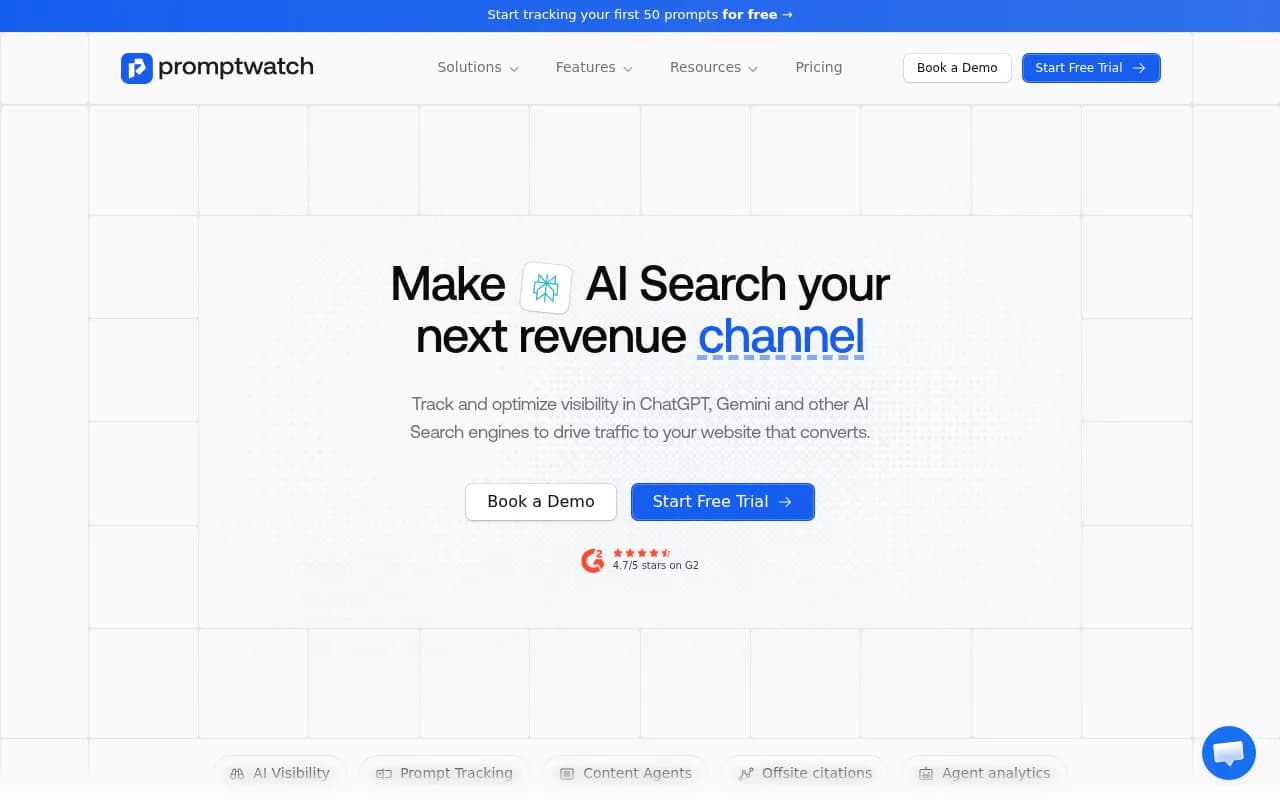
It tracks ChatGPT, Gemini, Claude, Perplexity, Grok, Meta Llama, DeepSeek, Mistral, Microsoft Copilot, Google AI Overviews, and Google AI Mode, plus Reddit and YouTube citations that most competitors skip entirely. The Essential tier is $95/month for one site, 50 prompts, and all LLM tracking with a 7-day free trial, and there's a genuinely usable free Explore tier (10 prompts, ChatGPT only) if you just want to see what's out there before paying anything. It's rated 4.7/5 on G2 with 1,840+ customers including Duolingo, Yelp, and Typeform, so it's not an unproven tool despite launching in April 2025.
2. Otterly.ai
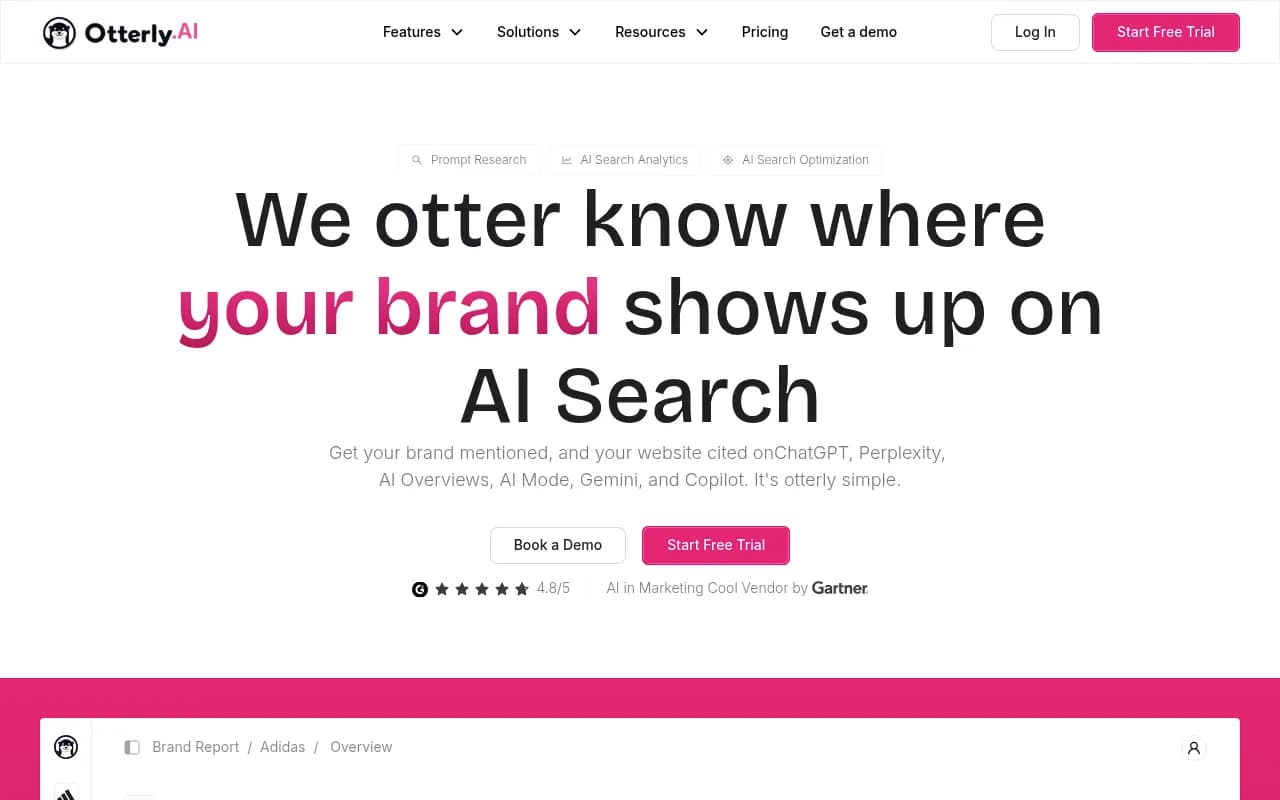
Otterly is the name that comes up in nearly every "best for startups" list, and the $29/month Lite tier is genuinely cheap on paper. The catch, and it's a real one, is that Claude, Gemini, and Google AI Mode are all paid add-ons on every tier. Add them to Lite and you're closer to $76/month, not $29. On the plus side, Otterly gives unlimited team seats on every plan including the cheapest one, which is unusual, and it covers six platforms once fully loaded: ChatGPT, Perplexity, Google AI Overviews, AI Mode, Gemini, and Microsoft Copilot.
3. Peec AI
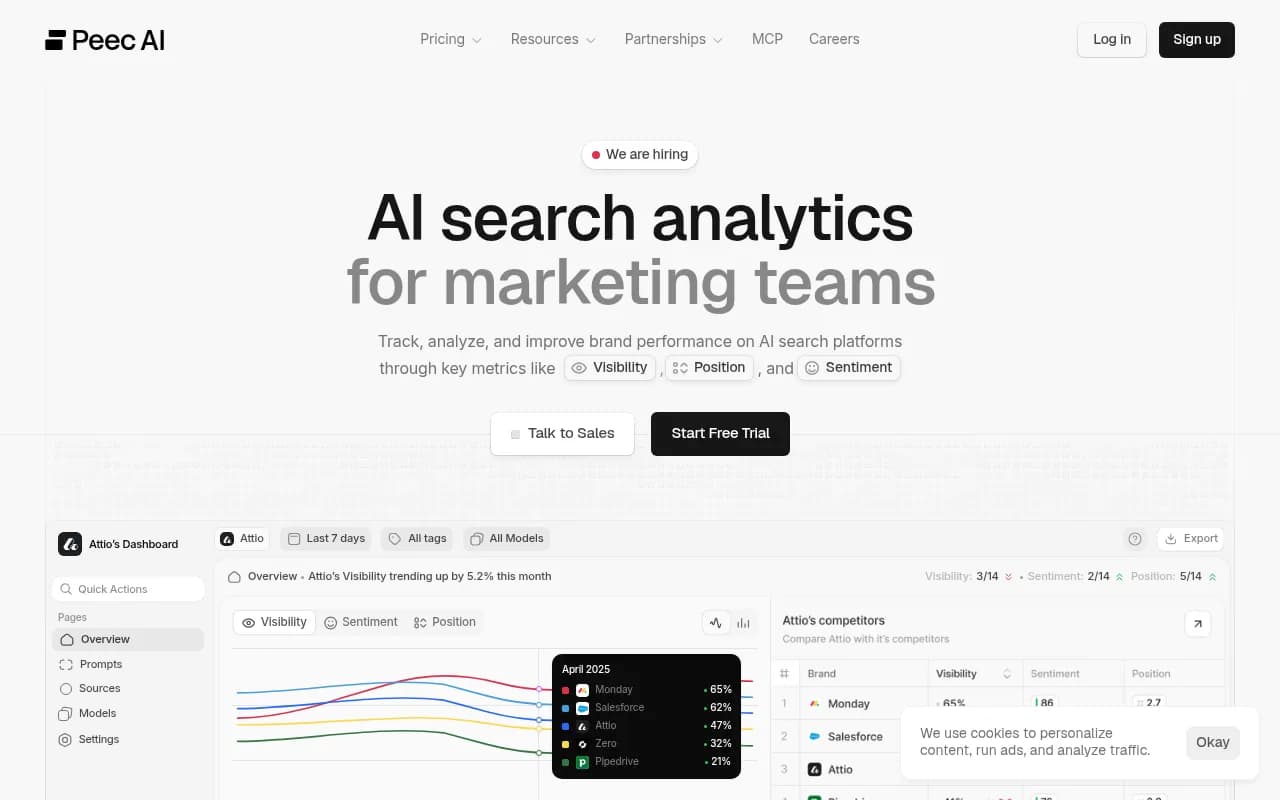
Peec's Starter tier is $95/month for 50 prompts and your pick of 3 of 7 available engines, with unlimited team seats, which is generous compared to most competitors at this price. The tradeoff is that engine cap: you choose 3, and adding a 4th costs $35-165/month depending on tier. If your prospects mostly live in ChatGPT and Google, this works fine. If you need broad coverage across every model from day one, the add-on costs erode the value quickly.
4. Wellows
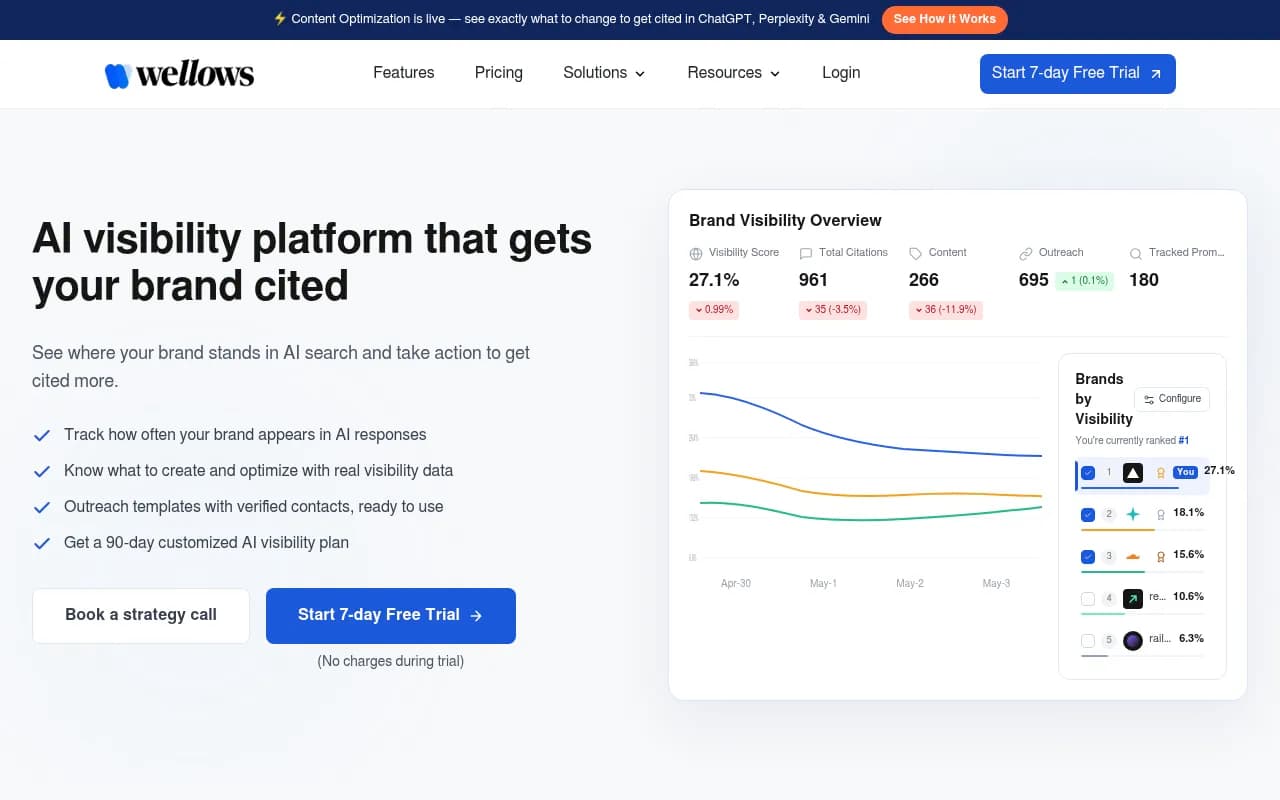
Wellows starts at $29/month and covers five answer engines (ChatGPT, Gemini, Perplexity, Google AI Overviews, Google AI Mode) with 1,800 credits shared across roughly 12 prompts a day. It's genuinely one of the cheapest ways to get multi-engine coverage, but that credit pool is tight, and you'll hit the ceiling fast if you're tracking more than a handful of core prompts.
5. Knowatoa
Knowatoa's Starter plan is $59/month and focuses on Google's AI surfaces (AI Overviews, AI Mode) plus ChatGPT, with sentiment alerts and competitor visibility-gap reporting baked in. It skips Claude and Perplexity on the entry tier, which is a real limitation if a meaningful chunk of your audience uses either. There's a free one-click audit if you want a taste before signing up.

6. LLMRefs
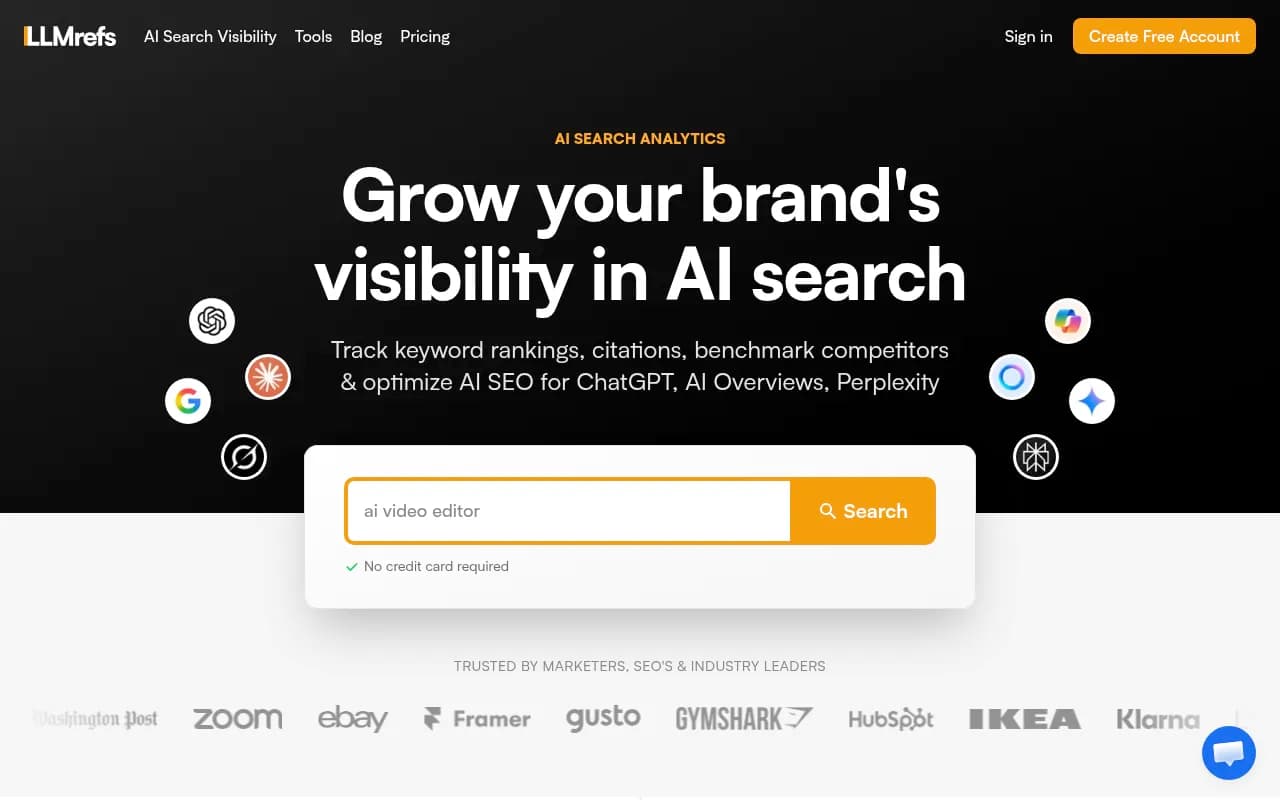
At $79/month, LLMRefs covers 10 engines on its "All in One" plan, which is the broadest coverage of any tool at this price point. The 7-day free trial doesn't require a credit card, which lowers the barrier to just trying it. It's lighter on the analysis and optimization side than pricier platforms, so treat it as a monitoring layer rather than a full GEO workflow.
7. Searchable
Searchable comes in around $50/month, tracks up to seven engines, and bundles in AI-optimized article generation, which is a nice touch for a startup that has zero content headcount. The generation side is basic compared to a dedicated content tool, so don't expect it to replace an actual writer, but as a starting point it's better than nothing.

8. Astiva AI
Astiva is positioned for teams that already have GA4 set up and want visibility data tied to actual attribution, not just mention counts. Pricing ranges from $29 to $499/month depending on tier. It leans mid-market B2B in its framing, but the entry tier is accessible enough for an early-stage team that's already disciplined about analytics.
9. Semrush AI Visibility Toolkit
If you're already paying for Semrush, the standalone AI Visibility Toolkit at $99/month bolts on tracking for ChatGPT, Perplexity, Gemini, and Google, covering 300-1,000 daily queries depending on the feature. The catch: additional domains, additional users, and extra prompt blocks are each their own $60-99/month add-on, and it adds up fast. One competitor review pointed out that a single extra teammate plus 50 extra prompts pushes the $99 plan to $258/month. If you're a solo founder on one domain, it's fine. If you're a small team, budget carefully.
10. AthenaHQ
Athena starts at $295/month ($245 billed annually), which puts it above what most pre-seed startups will want to spend, but it covers 11 models with unlimited team members included. One reviewer on Reddit flagged the pricing directly: "High pricing: AthenaHQ sits in the premium segment, which may not be suitable for smaller teams or early-stage startups." I'd put this on the list for a startup that's just raised a seed round and outgrown a $29-95/month tool, not for day-one tracking.

What the data says you should actually watch for
A few patterns worth building into your monitoring routine, regardless of which tool you pick:
Content type matters more than most startups assume. Product pages are now the single most-cited content type on ChatGPT Search, at 32.8% of citations in July 2026, up from about 18% in March, per Promptwatch's content type data. If your pricing page is vague or your product page buries the specs, that's a bigger lever than almost anything a monitoring tool alone can fix.
Social platforms aren't interchangeable. ChatGPT leans hard on Reddit for social citations (or did, before the August collapse), while Google AI Overviews and Grok favor YouTube, according to Promptwatch's social media citation breakdown. If your content strategy assumes "get on Reddit" is universal advice across every AI engine, it isn't.
Check more often than monthly. The Reddit collapse on ChatGPT happened over roughly a week in August 2026. A quarterly review cadence would have missed the whole thing, and by the time you noticed the drop in referral traffic, you'd have no idea why it happened.
A simple decision framework
If you have to pick one tool today and you're not sure where to start: take the free tier of a platform that tracks at least ChatGPT and one other engine, run it for two weeks against 10-15 prompts that match how real customers describe your problem (not your product name), and see what comes back. If your brand shows up rarely or gets described inaccurately, that's your answer on where to spend the next $50-100/month.
For startups that want the monitoring and the fix in one place rather than juggling a tracker and a separate content workflow, Promptwatch's Essential tier is the most complete package at this price band, mostly because it doesn't leave you staring at a dashboard wondering what to do next. For everyone else, Otterly, Peec, and Wellows are all legitimate entry points as long as you read the add-on pricing before you commit.
If you want to browse beyond this list, the GEO software directory at bestgeosoftware.com and the AI rank tracking directory at ai-rank-tools.com both cover a wider set of tools than fit here, including several newer entrants that haven't built a track record yet.