Key takeaways
- No one has published a measured timeline for how long a model takes to "forget" a crisis. Anyone quoting a precise number is guessing.
- Two layers are involved. Training data persists until a model is retrained. Live retrieval (the pages ChatGPT or AI Overviews fetch and cite) turns over in weeks to months.
- In Promptwatch Data, news pages cited by ChatGPT lost half their citations within 36 days, while landing pages and docs stayed cited for months. Crisis coverage fades fast; evergreen pages do not.
- You can influence the retrieval layer quickly with corrective pages, FAQs, reviews and high-authority coverage. The training layer is slower and mostly out of your hands.
- Monitor claims, sentiment and cited sources weekly after a crisis, not just whether your brand is mentioned.
The short answer
Models do not forget on a schedule. That is the honest answer, and it is less satisfying than a number of months.
What you can say is that an AI answer about your brand comes from two places. One is what the model absorbed during training. The other is what it pulls from the live web when it searches. They behave very differently after a crisis, and mixing them up is how teams end up either panicking too long or declaring victory too early.
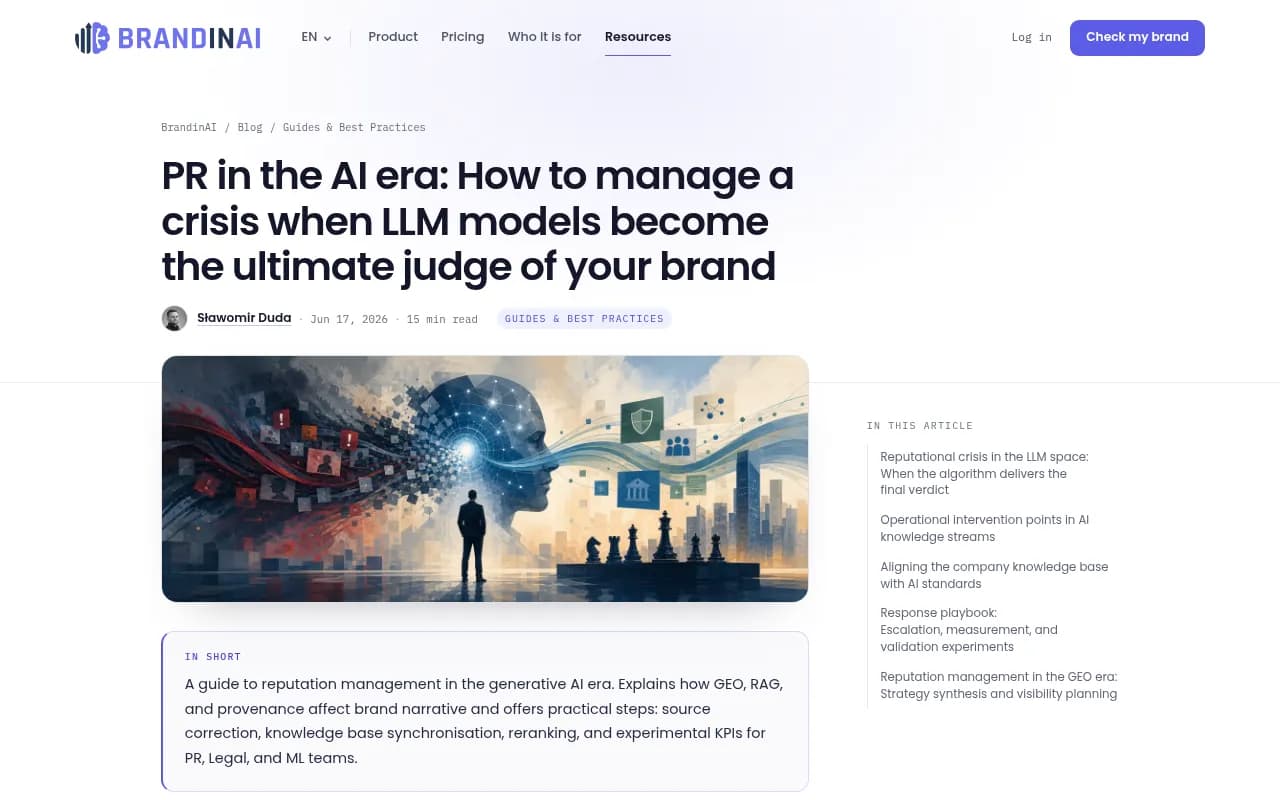
Mike Cook's piece for Mediaweek makes the blunt version of the argument: old PR crises are now training data, and models can repeat them with confidence. A guide from Brandinai describes the same scenario. A user asks an assistant about a company's credibility, and the model cites an incident from eighteen months ago that the company resolved, apologised for and updated its website about. For the company, it is closed. For the model, it is not.
Two memories: training data and live retrieval
The training layer
A base model learns from a large text corpus collected up to a cutoff date. Whatever was written about your crisis before that date, in news, forums, blog posts and reviews, is part of what the model "knows" about you. Status Labs makes the same point in its guide to how language models form brand perceptions: information embedded in training data persists until retraining, which is why reputation effects can last.
Two things make this layer hard to manage:
- You cannot edit it. There is no correction form for a trained model.
- The next training run does not wipe the slate. Newer models are trained on new data, but the old coverage is usually still in the corpus. What changes is the proportion. A crisis that was 80% of what was written about you in year one may be 20% of it by year three, if you have published and earned plenty since.
So "forgetting" at this layer is really dilution. It happens when later, better material outweighs the earlier material, and it only shows up when a new model ships.
The retrieval layer
Most AI products people actually use for brand questions, such as ChatGPT Search, Google AI Overviews, AI Mode and Perplexity, search the web and cite sources. For these, what matters is which pages are being fetched and cited today.
This layer turns over. Promptwatch Data tracked every classified page ChatGPT cited on July 6, 2026 for 90 days, and the decay differs a lot by content type. See the content half-life report for the full method.
| Content type | Cited again after day 0 | Still cited at day 30 | Still cited at day 60 | Half-life |
|---|---|---|---|---|
| News | 77% | not reported | 41% | 36 days |
| Docs | 93% | 76% | 67% | Likely 90+ days |
| Landing pages | not reported | 78% | 69% | Likely 90+ days |
| Comparisons | not reported | 72% | 63% | Likely 90+ days |
| Listicles | not reported | not reported | 60% | Likely 90+ days |
| Product pages, reviews, how-tos | not reported | not reported | 55% | 74 to 77 days |
The longer half-lives for landing pages, docs, comparisons and listicles are partly an artifact of the window ending at 90 days, so treat them as lower bounds.
For crisis work, the implications are fairly direct:
- Crisis news coverage fades from ChatGPT citations in about five weeks, at least in this sample. Almost a quarter of news pages were never cited again after day 0.
- Evergreen pages persist for months. That helps you if the evergreen page is your corrective FAQ or explainer. It hurts if the evergreen page is a hostile comparison, a review roundup or a forum thread about the incident.
That last point is the one people miss. The pages that keep a crisis alive in retrieval are rarely the original news stories. They are the durable explainers and retrospectives written afterwards.
Why branded questions are where crises show up
A crisis rarely damages how AI answers "best project management software." It damages the branded questions: "is X trustworthy," "X data breach," "X vs competitor," "should I buy from X."
Promptwatch's ChatGPT citation share by content type data (Sep 28 to Oct 4, 2026) shows what ChatGPT leans on for branded prompts:
- Product pages 23.3% and landing pages 22.8% of citations
- Reviews 5.6%, more than three times their share across all prompts
- Social posts 3.0%, almost four times their share overall
- FAQ pages 4.8%
- Press releases 2.1%
Two takeaways. First, your own pages are the biggest lever: nearly half of branded citations go to product and landing pages. Second, reviews and social posts are heavily over-represented on branded questions, which is exactly where angry customers write during a crisis. Press releases barely register at 2.1%, which is the data version of the "structural blindness to traditional press releases" that Brandinai describes. The classic statement-and-distribute playbook was built for newsrooms and search engines, not for models.
One caveat: ChatGPT cites social platforms rarely overall (0.46% of citations in the week of Sep 28 to Oct 4, 2026), while Google AI Overviews got 12.2% of its citations from social. See Promptwatch's social media citations data. Which engine your customers use changes where a crisis lingers.
A realistic timeline
Because no one has measured "forgetting" directly, here is a framework built from what is known. These are working estimates, not published benchmarks.
| Phase | What is happening | What to do |
|---|---|---|
| Days 0 to 2 | Coverage spreads. Research from Nadernejad Media cites figures that 96% of crises spread internationally within 24 hours and that responding within two hours improves sentiment recovery by 61%. Treat those as third-party statistics. | Detect fast, respond fast, publish your facts on your own domain. |
| Weeks 1 to 5 | News coverage is at peak citation. Live-search engines repeat it. | Publish corrective, factual pages. Do not expect answers to change yet. |
| Weeks 5 to 12 | News citations decay. Evergreen explainers and reviews remain. | Audit which durable pages AI is citing. Fix or outrank them. |
| Months 3 to 12 | Retrieval-based answers can change substantially if your corrective content is cited. | Keep earning coverage in authoritative outlets, track claims. |
| Next model releases | Training-based answers shift only with retraining, and mostly through dilution. | Keep the new, positive record growing. |
If someone asks "how long until models forget," the defensible answer is: weeks to months for live-search answers if you act, and one or more retraining cycles for what the model carries from training.
What to actually do
1. Find out what AI says right now
Before you fix anything, collect evidence. Run branded and category prompts across ChatGPT, Gemini, Perplexity, Claude and Google AI Overviews, in the countries and languages you operate in. Note three things for each answer: whether the crisis is mentioned, what specific claims are made, and which sources are cited.
The claims matter more than the mention. "The company was fined in 2025" and "the company is unsafe" are very different problems.
2. Separate the layers
For each bad answer, ask whether the model searched the web. If it cited sources, you have a retrieval problem and can act on the cited pages. If it answered with no sources, you are probably looking at training data, and your lever is long-term dilution.
3. Publish the corrective record on pages you control
Brandinai's advice on source correction and knowledge-base synchronisation points the same way as the citation data. Make the pages that AI actually cites about you say the current truth:
- A plain-language FAQ answering the questions people ask about the incident and what changed.
- Product, landing and docs pages that state facts directly (pricing, security practices, policies) rather than burying them.
- A dated explainer on what happened, what you fixed and what is independently verified. Landing pages and docs persist longest, so this is the right format.
Avoid pushing everything through a press release. At 2.1% of branded citations, it will not carry the weight.
4. Earn coverage in high-authority places
Muck Rack's guidance on measuring recovery recommends securing positive coverage in high-authority publications to influence how future AI answers represent you. That fits what the citation data shows: models cite third parties heavily on branded questions. Independent audits, credible customer stories, and reviews on the trusted sites in your category all feed the retrieval layer, and eventually the next training corpus.
5. Deal with the durable bad pages
List every evergreen page that keeps repeating the crisis: retrospectives, comparison posts, review roundups, forum threads. You cannot delete them. You can respond on the platform, ask for corrections where factually wrong, and publish better material that answers the same question.
6. Measure weekly for at least a quarter
Track these over time rather than checking once:
- Visibility and sentiment on branded prompts
- The specific claims AI makes, and how often
- Which pages and domains are cited
- Whether your corrective pages are being crawled and cited
A crisis can leave your mention rate unchanged while sentiment drops, so watching mentions alone will mislead you.
Tools for tracking the recovery
Generic social listening, of the kind Agility PR describes for spotting a crisis early, tells you what people are saying. It does not tell you what models are repeating. For that you need an AI visibility tool that collects real answers and citations.
Promptwatch fits this job because it covers the whole loop rather than only counting mentions. Its Brand Narrative pulls the individual claims AI makes about you out of every tracked response and scores themes like Reputation and Pricing against competitors. Fact Check, on Business and higher plans, lets you mark a claim inaccurate and finds the pages on your site that state it or its opposite. Citation tracking shows which pages AI relies on, and crawler logs show whether AI bots can read your corrective page at all. Pricing starts at $95/mo for Essential, but Fact Check needs Business at $579/mo, so confirm current plans at promptwatch.com/pricing.

Other tools in this space that are worth a look for sentiment and perception monitoring:
- Waikay, built around AI brand perception tracking

- LLM Pulse, which positions itself as a visibility and reputation platform

- Profound, an enterprise option for larger brands

- Peec AI and Otterly.AI, lighter-weight monitors if you only need to watch prompts over time


For a wider list, the directory at bestgeosoftware.com compares GEO software in more detail.
| Need | What to look for |
|---|---|
| Spot what AI claims about you | Claim-level or theme-level sentiment, not just a score |
| Find the pages feeding bad answers | Citation and source tracking per prompt |
| Check your fix is readable | AI crawler logs, site audits |
| Prove recovery | Trend lines by prompt and model over weeks |
| Act on gaps | Content planning and publishing tied to the data |
Common mistakes
- Waiting for the model to "forget." Retrieval-layer answers change when sources change, not when time passes.
- Treating a press release as the fix. Branded citations rarely go to them.
- Measuring once. Branded answers vary run to run, so one check proves little. Repeat prompts and compare trends.
- Ignoring review sites and forums. They are over-represented on branded questions.
- Promising a recovery date to leadership. Promise a monitoring plan and a set of milestones instead.
What we do not know yet
It is worth being plain about the gaps. There is no public study measuring the number of days or retraining cycles it takes for a given crisis to stop appearing in model answers. The Promptwatch half-life data measures how long pages stay cited, not how long a narrative lasts. The two are related but not the same, since a narrative can survive across many pages. Anyone selling a guaranteed erasure timeline is selling confidence the data does not support.
If you manage reputation for clients and need help building the content and PR side of a recovery, an agency such as 1001 SEO Media works on AI search visibility alongside the technical and digital PR pieces. Either way, the plan above holds: find the claims, fix the sources, keep earning better coverage, and measure every week.
If you want a quick baseline first, Promptwatch's free AI visibility report shows how ChatGPT, Gemini and Perplexity currently describe your brand, which is a reasonable place to start the evidence file.