Key takeaways
- Alhena AI, Ranketta and Yotpo Discover all track products, not just brand names. They differ in what they do after the tracking: Alhena attributes revenue, Ranketta rewrites and exports your feed, Yotpo Discover uses reviews and loyalty data.
- Ranketta covers the most engines of the three (six, including Copilot and AI Mode). Alhena covers four. Yotpo Discover shows four logos, including Claude.
- Only Alhena and Ranketta publish pricing. Alhena has a free tier with paid plans from $199/mo. Ranketta runs from EUR 29 to EUR 449/mo. Yotpo Discover is demo-only.
- Nearly every comparison of these tools is written by one of the vendors. Treat "the only tool that does everything" claims as marketing and test on your own catalog.
- If you also care about the wider AI search picture beyond products (crawler logs, Reddit and YouTube citations, content that gets cited), you will likely want a general GEO platform next to a product-level tool.
Why ecommerce needs different AI visibility tools
A SaaS marketer can learn a lot from "ChatGPT mentioned us in an answer about best CRM software." A store with 4,000 SKUs learns almost nothing from that. Which product was recommended? Was the price current? Did a product card render with an image? Did anyone buy?
That is the gap these three tools are built around. Each one answers it differently, and the differences matter more than the feature checklists suggest.
One caveat before we go further. The comparisons I found for this article were all vendor-authored. Alhena's roundup of twelve tools doesn't mention Ranketta or Yotpo Discover at all. Ranketta's roundup ranks itself first and says it is the only platform covering all four of its criteria. Treat both as positioning, not as neutral tests.
Shopping surfaces are also still a small slice of AI answers. Promptwatch's ChatGPT Shopping usage data shows ChatGPT attaches shopping features like product cards to only a low single-digit percentage of web-search responses. The rate moves in steps, roughly doubling overnight in late May and then falling back weeks later, which looks like OpenAI tuning when cards appear. Shopping features concentrate on commercial and transactional prompts, where trigger rates are far higher. So catalog readiness matters most where buyers are actually deciding.
The three tools at a glance
| Alhena AI Visibility | Ranketta | Yotpo Discover | |
|---|---|---|---|
| Core idea | Track SKUs and tie them to revenue | Track SKUs, then fix and export the feed | Visibility built on reviews, loyalty and UGC |
| Engines | ChatGPT, AI Overviews, Perplexity, Gemini | ChatGPT, AI Overviews, AI Mode, Gemini, Perplexity, Copilot | ChatGPT, Gemini, Perplexity, Claude |
| Product-level tracking | Yes, native | Yes, with a Best Sellers share-of-voice view | Yes, by product, category and region |
| Revenue attribution | Documented | Not documented | Not documented |
| Catalog connection | Live sync with storefront | Feed import (XML, CSV, JSON) | Built around Yotpo catalog and commerce data |
| Acts on findings | Citation strategy, product Q&A | AI feed enrichment agent, feed export | Onsite, Content and Activation agents |
| MCP support | Not documented | Yes, OAuth, works with Claude Desktop and Cursor | Yes, Discover MCP for Claude |
| Pricing | Free tier, paid from $199/mo | EUR 29 to EUR 449/mo, plus custom | Not published, demo only |
| Likely fit | Stores that want sales attribution | Catalog managers, European feed channels | US DTC brands already using Yotpo |
Alhena AI Visibility
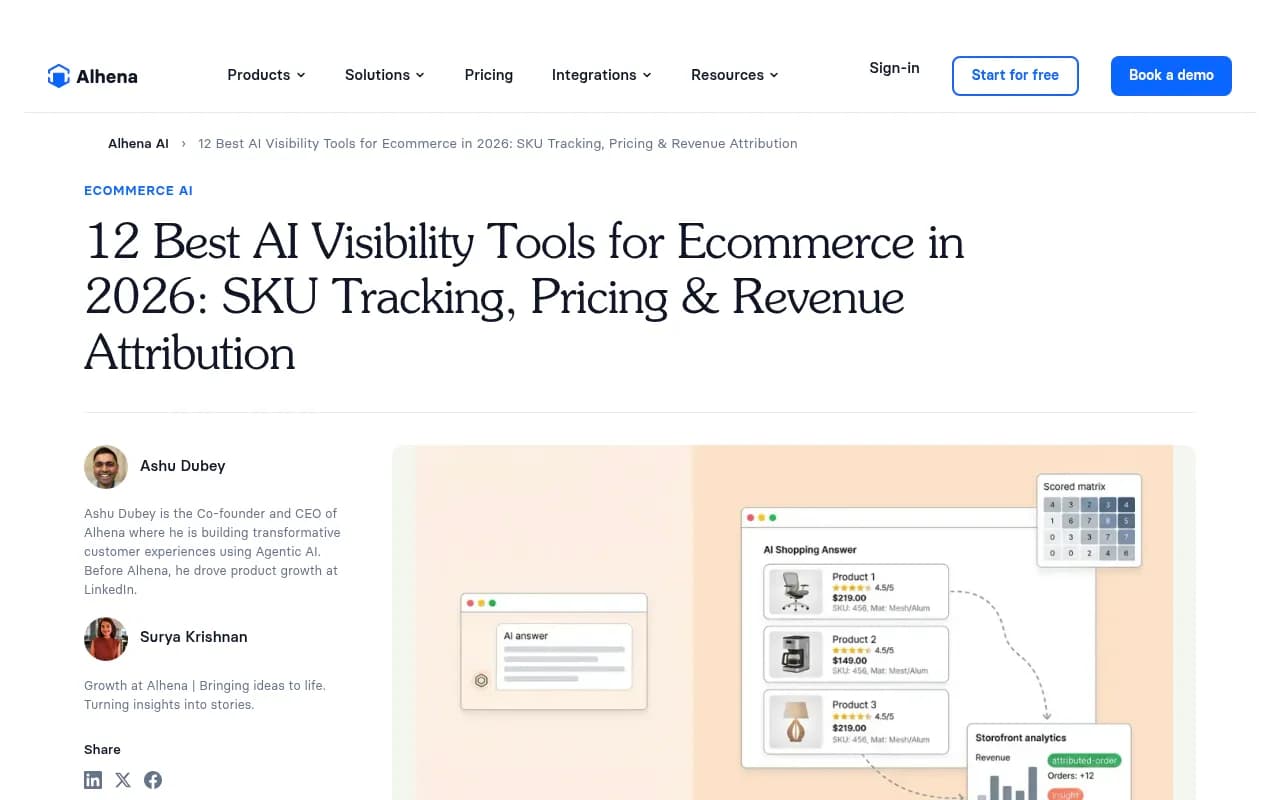
Alhena AI started as an AI shopping assistant for your own site, and its visibility product extends that into AI search. That origin shows. It connects to your storefront and shopping assistant, so it can trace a path from "this product appeared in a ChatGPT Shopping answer" to "this product generated this much revenue."
What stands out
Rendering analysis is the interesting part. Alhena checks whether a product showed up as a full card with price, ratings and images, or whether your brand was only named in passing. Those are very different outcomes and most brand-mention trackers lump them together.
It also lists SKU-level tracking, product-page Q&A generation and citation strategy among its published capabilities. According to Alhena, it is the only one of twelve tools it reviewed that documents a live catalogue connection and revenue attribution together. That is a claim from a vendor reviewing its own category, so verify it in a trial.
Limits
Four engines, not more. Alhena doesn't currently cover Grok, DeepSeek or Copilot, and its own comparison says so. The free plan is a snapshot (one engine, five questions), and recurring checks depend on the paid tier: monthly refreshes on Essentials, weekly on Growth and Scale. It also assumes you sell products. A B2B SaaS team would be paying for a catalog workflow it doesn't need.
Pricing
Free tier, with full features from $199/mo. A free trial is available and no demo is required, which makes Alhena the easiest of the three to test cheaply.
Ranketta
Ranketta is the most feed-centric of the three. Its pitch is that most tools tell you that you are invisible but not why, and that the cause often sits in the product feed itself.
What stands out
Tracking covers ChatGPT, Google AI Overviews, AI Mode, Gemini, Perplexity and Copilot, collected through the web interfaces rather than APIs. The Best Sellers view ranks the products AI recommends most often in your topics by share of voice, including competitors' SKUs.
The enrichment agent is the real differentiator. You connect a feed in XML, CSV or JSON, and the agent proposes rewrites to weak titles, generates descriptions where yours are thin, maps products to the Google product taxonomy, fills in missing GTINs where it can derive them confidently, and flags broken fields. Each proposal gets a confidence score from 0 to 100%. You can approve manually or set an auto-approval threshold so only borderline cases land in your queue.
Then it exports the cleaned catalogue to Google Merchant, Heureka, Zbozi, Shopify, or generic XML and JSON. The Heureka and Zbozi support suggests a European orientation, which fits the euro pricing.
The MCP server lets Claude Desktop, Cursor and other clients query your prompts, citations, fan-out queries and site audit results via OAuth. Handy if your analysts already live in an AI client.
Limits
No documented revenue attribution. Auto-approving AI-written titles and descriptions is also a trust decision: I would start with a high threshold and spot-check a sample of changes before letting anything ship unattended. And the pricing below comes from Ranketta's own blog, so confirm it on the pricing page.
Pricing (as stated by Ranketta)
| Plan | Price | Includes |
|---|---|---|
| Tracker | EUR 29/mo | 2 models, 25 prompts, 1 website, no feed enrichment |
| Starter | EUR 79/mo | 3 models, 25 prompts, 5,000 enrichment credits, 2 articles |
| Growth | EUR 199/mo | 4 models, 100 prompts, 15,000 credits, 6 articles, 3 countries |
| Scale | EUR 449/mo | 5 models, 300 prompts, 45,000 credits, 15 articles, 10 countries |
| Enterprise and Agency | Custom | 9+ models, 1,000+ prompts |
Note that enrichment only starts at Starter. If feed fixing is the reason you are looking at Ranketta, Tracker is not your plan.
Yotpo Discover
Yotpo Discover comes from a company best known for reviews, loyalty and UGC, and that is the angle. The product is built around your catalog and Yotpo's commerce data, and it targets DTC brands, omnichannel retailers and agencies.
Yotpo Discover
What stands out
Tracking works by product, category and region across ChatGPT, Gemini, Perplexity and Claude. It also surfaces what it calls real AEO competitors: brands that appear ahead of you in AI answers but may not be on your traditional competitor list. That is useful, because your AI competitors are often marketplaces and publishers, not the brands you benchmark against.
Three agents do the work:
- An Onsite Agent that identifies opportunities and acts on them
- A Content Agent that produces optimized content
- An Activation Agent that engages real reviewers and loyalty communities on Reddit, retail marketplaces and publisher sites
The Activation Agent is the most distinctive idea here. If your brand already has a base of verified reviewers, turning them into third-party mentions is an advantage a pure tracker can't copy. It also comes with a Discover MCP for Claude that pulls insights, creates content, checks citation performance and runs recurring workflows.
Limits
The page claims 35k+ commerce brands are powered by Yotpo, +16% #1 product placements in AI answers, and +20% awareness-stage shopper visibility. It doesn't say what baseline or period those numbers cover. The mention counts shown in the page's cards (for example ChatGPT 3,465) are UI illustrations, not benchmarks. There is no public pricing, just a demo request and a gated weekly AI Visibility Index.
Also, Yotpo's value is strongest if you are already in its ecosystem. If you run another reviews provider, the data advantage shrinks.
Which one fits which store
- You want to know which SKUs get recommended and what they earn: Alhena. Revenue attribution is the headline feature, and the free tier lets you test it.
- Your catalogue is messy and you sell through Google Merchant or European marketplaces: Ranketta. The feed agent and exports are aimed at exactly that problem.
- You already use Yotpo for reviews and loyalty, or you want to turn reviewers into AI-visible mentions: Yotpo Discover.
- You care about Copilot or AI Mode coverage: Ranketta has both. Alhena has neither. Yotpo's page shows neither.
- You care about Claude: Yotpo Discover shows it. The other two don't list it.
Questions to ask in every demo
- Does tracking use the real user interface or an API? Shopping cards and citations can differ between the two.
- How are product prompts chosen, and can I add my own commercial ones?
- Can I see which source pages AI cited when it recommended a competitor's product?
- What does revenue attribution rely on: your analytics, your storefront, or modeled estimates?
- If the tool changes my titles or descriptions, who approves it and can I roll back?
- How many prompts and refreshes are in the plan, and how often are they run?
Where a general GEO platform still helps
All three tools are product-centric. That is the right focus for a catalog, but AI visibility for a store is not only about products. It is also about the guides, comparisons and category pages that get cited, which AI crawlers actually visit your site, and what shows up on Reddit, YouTube and review sites. Promptwatch covers that wider layer with IP-verified crawler logs, citation analytics, and a Content Agent that writes and publishes to Webflow, Framer or WordPress. It also has a ChatGPT Shopping tracking page. Alhena's comparison lists Promptwatch's SKU tracking as "not documented," which may be stale, so check the current feature set.

It is also worth knowing how citations behave in general. In Promptwatch's data on ChatGPT citations by content type (Sep 28 to Oct 4, 2026), product pages were the most cited type at 22.4% of citations, followed by landing pages and listicles. That argues for treating product pages as content, not just feed rows. And Promptwatch Data on social media citations by AI model showed ChatGPT drawing just 0.46% of its citations from social platforms in the same week, while Google AI Overviews drew 12.2%. If Yotpo's Reddit-oriented activation is on your shortlist, that gap matters: it may pay off more for AI Overviews than for ChatGPT.
If you are still building a shortlist, the GEO software directory lists more options, including Peec AI and Profound, which both also come up in ecommerce comparisons.
A practical way to run the trial
Pick 20 to 30 commercial prompts your buyers really use, such as "best running shoes for flat feet under $150." Run them in each tool for two weeks. Record four things:
- Is your product named, or only your brand?
- Does a product card render, with price and image?
- Which competitors and marketplaces fill the shortlist?
- What does the tool tell you to change, and how specific is that advice?
Then ship one fix per tool-suggested action on a small set of SKUs and re-check. The tool that produces changes you can verify is the one worth paying for. Dashboards that only grow prettier are not.
Bottom line
Alhena is the cleanest pick if revenue is the question, Ranketta if the feed is the problem, and Yotpo Discover if reviews and loyalty are your moat. None of them has been independently reviewed that I could find, so lean on trials and your own prompts rather than anyone's ranking, including this one. Confirm all prices on the vendors' own pages before you commit.