Key takeaways
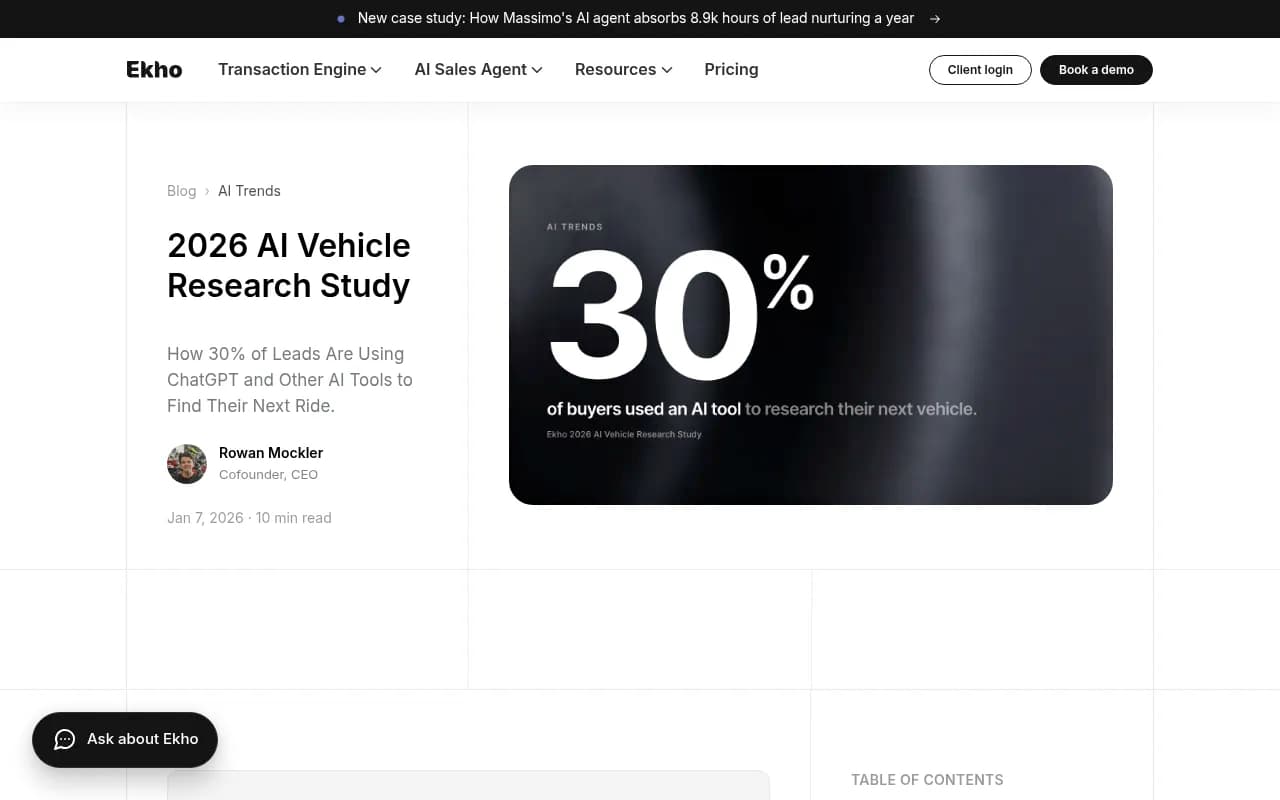
- Ekho's 2026 research found that roughly 30% of vehicle buyers now use generative AI tools, led overwhelmingly by ChatGPT, to research their next car, which means AI answers are becoming a real front door to the shopping journey, not a side channel.
- Dealership and OEM visibility inside ChatGPT, Gemini, Perplexity, and Google AI Overviews depends on different signals than classic SEO: review sentiment, structured inventory data, third-party comparison content, and how often AI crawlers can actually read your site.
- General-purpose AI visibility platforms like Promptwatch work well for automotive because they track prompts at the city and state level, which matters enormously for a business model built on local lots and regional dealer groups.
- Video matters more in automotive than in most verticals. Promptwatch's YouTube citation research found AI search engines pull review and walkthrough videos into answers at meaningful volume, so a tool that tracks YouTube citations gives dealers a real edge.
- No single tool fixes everything. The winning setup usually pairs a monitoring platform with a content or GEO execution layer that actually ships fixes to your inventory pages, FAQ content, and local landing pages.
Why automotive buyers moved into AI search first
Car shopping was already half-digital before ChatGPT existed. People spent weeks comparing trims, reading forum threads about reliability, and cross-checking dealer markups on Reddit. That research-heavy behavior is exactly the kind of task generative AI is good at collapsing into a single conversation.
Ekho's 2026 AI Vehicle Research Study put a number on it: about 30% of buyers are now using AI tools during vehicle research, and the intent those buyers show up with is higher than a typical cold search click. A buyer who asks ChatGPT "what's a reliable mid-size SUV under $35k with good resale value" and gets your model mentioned by name is arriving at your site already three steps into the funnel.
That shift creates a new problem for dealers and OEMs: you can't A/B test an AI answer, and you can't buy your way into a ChatGPT recommendation the way you'd buy a paid search ad. You can only earn it, by making sure your inventory, reviews, and comparison content are the kind of material large language models trust and cite. Measuring that is the whole point of AI visibility tooling.
What automotive brands should actually measure
Before picking a tool, it helps to know what "visibility" means for a car brand or dealership specifically, because it's different from, say, a SaaS company tracking feature mentions.
Model and trim-level mentions
Does ChatGPT recommend your specific model when someone asks about a category, like "best compact trucks for towing"? Generic brand awareness isn't enough, you need to know if the Tacoma beats the Ranger in that exact prompt.
Dealer-level local visibility
For dealer groups, this is the big one. A buyer in Tampa asking "best Honda dealer near me for a used CR-V" is a completely different query than a national brand prompt, and most generic AI visibility tools don't track at city or state granularity. Promptwatch is one of the few platforms built with state and city-level prompt tracking baked in, which matters a lot once you're running visibility for 40 rooftops instead of one brand.
Sentiment and review framing
AI models summarize review sentiment, and they don't always get it right. If Reddit threads or a few bad DealerRater reviews are shaping how an LLM describes your service department, you want to catch that before it shows up in a buyer's chat.
Video and third-party citations
Car buyers watch a lot of YouTube before they buy. Promptwatch's research on YouTube citations in AI search shows AI engines pulling video content into answers across ChatGPT, Perplexity, and AI Overviews, which means a well-produced walkthrough or comparison video can influence an AI recommendation the same way a review article does. Dealers rarely track this, and almost none of the general SEO tools do either.
Crawler access
If AI crawlers can't read your inventory pages, feature pages, or VDPs cleanly, none of the above matters. Most dealer websites run on DMS-provided templates with heavy JavaScript and inventory feeds that aren't crawler-friendly, so checking crawler logs is more useful here than in almost any other industry.
The best AI visibility tools for automotive in 2026
Here's how the leading platforms stack up specifically for dealership and OEM use cases.
| Tool | Local / city-level tracking | Video (YouTube) citation data | Content/GEO execution | Best for |
|---|---|---|---|---|
| Promptwatch | Yes, state and city | Yes, dedicated reports | Content Agents, CMS publishing | Dealer groups and OEMs wanting monitoring plus fixes |
| Scrunch AI | Limited | No | Monitoring only | Enterprise brand teams, no execution |
| Profound | Limited | No | Monitoring only | Large OEM brand marketing teams |
| Ahrefs Brand Radar | No | No | None | Teams already inside Ahrefs for SEO |
| Semrush AI Visibility Toolkit | No | No | Light content tools | Dealers already on Semrush |
| Otterly.AI | No | No | None | Small, budget-limited single dealerships |
| Knowatoa | No | No | None | Teams focused narrowly on AI Overviews |
Promptwatch
Promptwatch is built around a distinction that matters a lot for automotive: knowing you're invisible in a prompt is different from knowing why, and different again from actually fixing it. For a dealer group, that means you can see that "best Toyota dealer in Phoenix" prompts don't mention you, check the crawler logs to see if your location pages are even being read by ChatGPTBot or PerplexityBot, and then let the Content Agent draft and publish a fix to your CMS, whether that's Webflow, Framer, or WordPress.

The city and state-level prompt tracking is the feature dealer groups ask about most, since national brand visibility and local-lot visibility are genuinely different problems. The platform also tracks Reddit and YouTube citations specifically, which matters for automotive given how much shopping research happens in forum threads and video reviews. Pricing starts at $95/month for a single site on the Essential plan, scaling to $579/month on Business for multi-rooftop groups tracking several sites and hundreds of prompts.
Scrunch AI and Profound
Both are capable enterprise-grade monitoring platforms that larger OEM marketing teams use to track brand sentiment and share of voice across models. Neither includes the execution layer, Reddit and YouTube citation detail, or crawler log access that dealer-level teams tend to need, and both sit at higher price points without that functionality.


Ahrefs Brand Radar and Semrush AI Visibility Toolkit
If your dealership marketing team is already paying for Ahrefs or Semrush for traditional SEO, their AI visibility add-ons are a reasonable way to get a first read on brand mentions without a new subscription. The tracking is shallower than dedicated GEO platforms, with fixed prompt sets and no local-level granularity, and neither tool gives you crawler logs or content generation tied to the data.

Otterly.AI and Knowatoa
For a single independent dealership without the budget for an enterprise platform, these are reasonable entry points to see whether your brand even shows up in AI answers at all. They're monitoring-only tools with no content execution, so treat them as a diagnostic step before investing further.


A practical rollout plan for a dealership or OEM team
The tool matters less than how you use it. Here's a sequence that works whether you're running one rooftop or forty.
- Start with a baseline audit. Run your brand, your top three models, and your city plus "dealer" against ChatGPT, Gemini, Perplexity, and Google AI Overviews. Note whether you're mentioned, how you're described, and who beats you.
- Check crawler access before you touch content. If AI crawlers are hitting 404s or getting blocked by robots.txt on your inventory pages, no amount of content will fix visibility. This is where crawler log access, which most AI visibility tools skip entirely, earns its keep.
- Fix the highest-intent local prompts first. "Best [brand] dealer near [city]" prompts convert at a completely different rate than generic brand-awareness prompts. Prioritize those location pages.
- Feed AI models the comparison content they actually cite. Promptwatch's research on ChatGPT citation share by domain rank shows citations aren't only going to massive domains, mid-authority sites get cited regularly if the content directly answers the query. A clean, specific comparison page beats a thin one on a bigger domain.
- Don't ignore Reddit, but don't overinvest either. Promptwatch's data on Reddit citations dropping in ChatGPT shows reddit.com's share of ChatGPT citations fell from roughly 4% to 0.5% in a single day in August 2026. Forum sentiment still shapes buyer perception, but it's a shrinking direct citation channel, so weight your effort toward your own site and dealer review platforms instead.
- Recheck monthly, not quarterly. Model updates and AI search behavior shift fast enough that a quarterly cadence will miss real changes in how your brand gets described.
Where to go from here
If you're still deciding between platforms, the GEO software directory at bestgeosoftware.com is a reasonable place to compare more options side by side, and ai-rank-tools.com focuses specifically on prompt-tracking tools if that's the narrower problem you're solving for right now.
For most dealer groups and OEM marketing teams, the real decision isn't which tool tells you the most about your current visibility, it's which one actually helps you move it. A dashboard full of red flags with no path to fixing them doesn't sell a single car. Pick a platform that closes the loop between seeing the problem and shipping the fix, whether that's Promptwatch's content agents or a manual process built around whatever monitoring tool you choose, and treat AI visibility the same way you already treat your Google Business Profile: something that gets checked weekly, not something you set up once and forget.