Key takeaways
- Insurance is a contested category in AI search: brokers and comparison sites (Insureon, The Zebra, Insurify, Policygenius) win most citations, while household carrier names (Progressive, GEICO, State Farm) win brand mentions without always being cited as sources, per Conductor's 2026 Insurance AI Search Benchmarks.
- Google AI Mode drives 43.9% of insurance AI citations and Perplexity 33.6%, meaning most teams optimizing only for ChatGPT are missing where the bulk of insurance queries actually get answered.
- ChatGPT cites roughly 5 sources per response versus about 10 for AI Overviews and Perplexity, per Promptwatch's data on average sources per response, so every insurance citation is more contested in ChatGPT than on Google's AI surfaces.
- How-to and comparison content is growing fast in ChatGPT's citation mix while generic landing pages are losing ground, according to Promptwatch's ChatGPT citation types data for August 2026.
- Tools in this space range from $29/mo lite trackers to $500+/mo enterprise platforms. Pick based on whether you need simple monitoring or an engine that also helps you close the gap with content and crawler-level diagnostics.
Why insurance brands can't ignore AI search anymore
I'll be blunt: if you run marketing for a carrier, MGA, or independent agency and you're not checking what ChatGPT or Google's AI Overviews say about your brand, you're already behind. Not in a vague, hand-wavy sense, in a measurable one.
Conductor's 2026 Insurance AI Search Benchmarks, based on 445 insurance domains, found that Google AI Mode now drives 43.9% of insurance-related AI citations, with Perplexity close behind at 33.6%. ChatGPT trails both. That's a genuinely uncomfortable fact for a lot of insurance marketing teams, because most of the AI-visibility conversation over the past two years has been ChatGPT-centric. If your team built a GEO strategy around ChatGPT alone, you optimized for the wrong engine first.
There's also a split worth understanding before you buy any tool: citations and mentions are not the same thing. Progressive gets mentioned in 6% of AI brand-mention responses, GEICO and State Farm around 4% each, but the pages actually cited as sources skew toward brokers and comparison sites like Insureon (2.9% overall citation share, and 13.2% within the broker/aggregator subindustry), The Zebra, Insurify, and Policygenius. In other words, people ask AI about Progressive, but AI often cites a comparison site to answer the question. That's the "Mention-Source Divide" Semrush flagged in its AI Visibility Index: fewer than 20% of brands are both frequently mentioned and cited as sources.
For a carrier, that means brand awareness in AI answers doesn't automatically translate into being the source AI trusts. For an agency or broker, it means there's real opportunity if your content is structured the right way, because you don't need to be Progressive-sized to win a citation.
What actually gets cited in insurance AI answers
A few patterns from the data are worth building a content calendar around before you even look at a tool.
First, domain authority matters less than people assume. Promptwatch's August 2026 citation share by domain rank data shows mid-authority sites (DR 46-75) capturing almost half of ChatGPT's citations, while the biggest domains (DR 91-100) actually lost share across the month, dropping from roughly 7% to 3%. A regional agency with a well-built claims FAQ has a real shot. You don't need to out-publish a national carrier, you need to out-answer it on a specific question.
Second, content type matters a lot. Promptwatch's breakdown of ChatGPT citation types in August 2026 shows how-to content more than doubling its citation share within a single month, from about 4.3% to 9.1%, while generic landing pages fell from 20% to under 12%. If your site is mostly coverage landing pages with no how-to or comparison depth, that's the gap to close. "How to file a claim after a storm," "does my policy cover X," "term vs whole life insurance, which is cheaper" -- these formats are winning citations right now, not product pages alone.
Third, don't bet your whole strategy on Reddit. Reddit's share of ChatGPT Search citations collapsed from around 3.8% to under 1% almost overnight on August 14, 2026, an 86% relative drop, according to Promptwatch's report on Reddit citations dropping in ChatGPT. Google AI Overviews and AI Mode show only a gradual decline in Reddit citations by comparison. If you've been leaning on insurance subreddit threads to influence ChatGPT, that channel just got a lot less reliable; it's holding up better on Google's AI surfaces.
Fourth, pricing-intent queries are the single biggest driver of insurance citations, at 17.6% of all citations tracked by Conductor. "What does it cost," "how do I get a quote" -- these are the questions AI answers most often, and they're exactly the pages insurance marketers tend to under-invest in because they feel too simple to write well.
Fifth, be careful with ads. ChatGPT now shows ads in an average of 20.1% of search responses with web search over the past 90 days, and that rate has climbed as high as 43.9% on individual days, per Promptwatch's ChatGPT ads data. Here's the part that matters for insurance specifically: 73.3% of ad-bearing responses happen on generic, informational prompts, not branded or competitor-comparison searches. If you're budgeting paid AI-search spend, generic coverage questions are where the ad inventory actually is, not brand-defense terms.
Comparing AI visibility tools for insurance
Most general AI-visibility tools will track brand mentions fine. What separates them for an insurance use case is whether they track the right engines (AI Mode and Perplexity matter as much as ChatGPT here), whether they help with compliance-sensitive content, and whether they stop at monitoring or actually help you fix citation gaps.
| Tool | Starting price | Engines tracked | Content/action features | Best for |
|---|---|---|---|---|
| Promptwatch | $95/mo (Essential) | ChatGPT, Gemini, Claude, Perplexity, Grok, AI Overviews, AI Mode, and more | Content Agents, CMS publishing, crawler logs, Unified Actions | Carriers and agencies that want monitoring and fixes in one platform |
| Profound | $99/mo (Starter) | ChatGPT only at entry tier, more at Growth | Content gen at Growth tier ($399/mo) | Enterprise teams needing deep ChatGPT data |
| Peec AI | ~EUR 70-85/mo (annual) | 3 engines of choice | Data export, recommendations included | Teams wanting flexible engine selection |
| Semrush AI Visibility Toolkit | $99/mo per domain | ChatGPT, Google AI, Gemini, Perplexity | AI-readiness audit, competitor analysis | Existing Semrush users |
| Otterly.ai | $29/mo (Lite) | ChatGPT; other engines as paid add-ons | GEO URL audits | Smaller agencies on a tight budget |
| ZipTie | $69/mo (Basic) | Credit-based checks across engines | Content generation add-on | Teams wanting usage-based pricing |
Promptwatch
Promptwatch is built to answer a different question than most trackers. A basic prompt tracker tells you whether your agency got mentioned in a ChatGPT answer about auto insurance. Promptwatch tries to tell you why you weren't cited, where AI actually found the competitor it did cite, and what to publish to close that gap, then helps you publish it.

For insurance specifically, a few features line up well with the data above. Its crawler logs (Agent Analytics) show exactly when ChatGPTBot, PerplexityBot, GoogleOther, and Google-Agent hit your site, which pages they read, and where they hit errors, which matters a lot for insurance sites with gated content behind compliance disclaimers or state-specific licensing pages that bots might be failing to crawl correctly. Its citation trends classify every citation into content types, so you can see directly whether your how-to and comparison pages are gaining or losing share, rather than guessing from aggregate industry data. The content gap analysis and Content Agents can draft and publish coverage-question pages (the "does my policy cover X" format that BrightEdge research flags as the one gap only the brand itself can fill) directly to your CMS.
Promptwatch also tracks Reddit and YouTube citations separately, which matters given how unevenly Reddit's influence is shifting across engines right now. At 1,840+ customers and a 4.7/5 rating on G2, it's used by brands in regulated, trust-heavy categories including financial services firms like Rabobank, ABN AMRO, and Achmea, companies that face similar compliance and credibility pressure as insurance carriers. Pricing starts at $95/mo for the Essential tier (50 prompts, 6,000 responses, 5 AEO articles monthly), scaling to $245/mo Professional and $579/mo Business for larger teams tracking more sites and regions.
Profound
Profound's Starter tier is $99/mo but only tracks ChatGPT, with 50 prompts and one region. That's a real limitation given that AI Mode and Perplexity drive more insurance citations than ChatGPT does. You'd need the $399/mo Growth tier to get content-generation features, and Enterprise pricing is quote-only.

Peec AI
Peec AI repriced in August 2026 to euro-denominated, annual-billing tiers, starting around EUR 70-85/mo for three engines of your choosing, with data export and recommendations included even at the entry tier. That flexibility to pick engines is useful for insurance, since you can prioritize AI Mode and Perplexity over ChatGPT if your benchmark data (like Conductor's) says that's where your category gets answered.

Semrush AI Visibility Toolkit
If your team already lives in Semrush for traditional SEO, the AI Visibility Toolkit at $99/mo per domain adds AI tracking without a new login. The catch: add-ons stack quickly, with extra domains, users, and prompt blocks each adding $60-99/mo, which can get expensive fast for an agency managing several carrier or MGA clients.
Otterly.ai
Otterly's $29/mo Lite tier is genuinely cheap for 15 tracked prompts, but it's ChatGPT-only at that price; Gemini, Claude, and other engines are paid add-ons that can push a "$189/mo" Standard plan closer to $357/mo once you add the engines insurance brands actually need to watch.

ZipTie
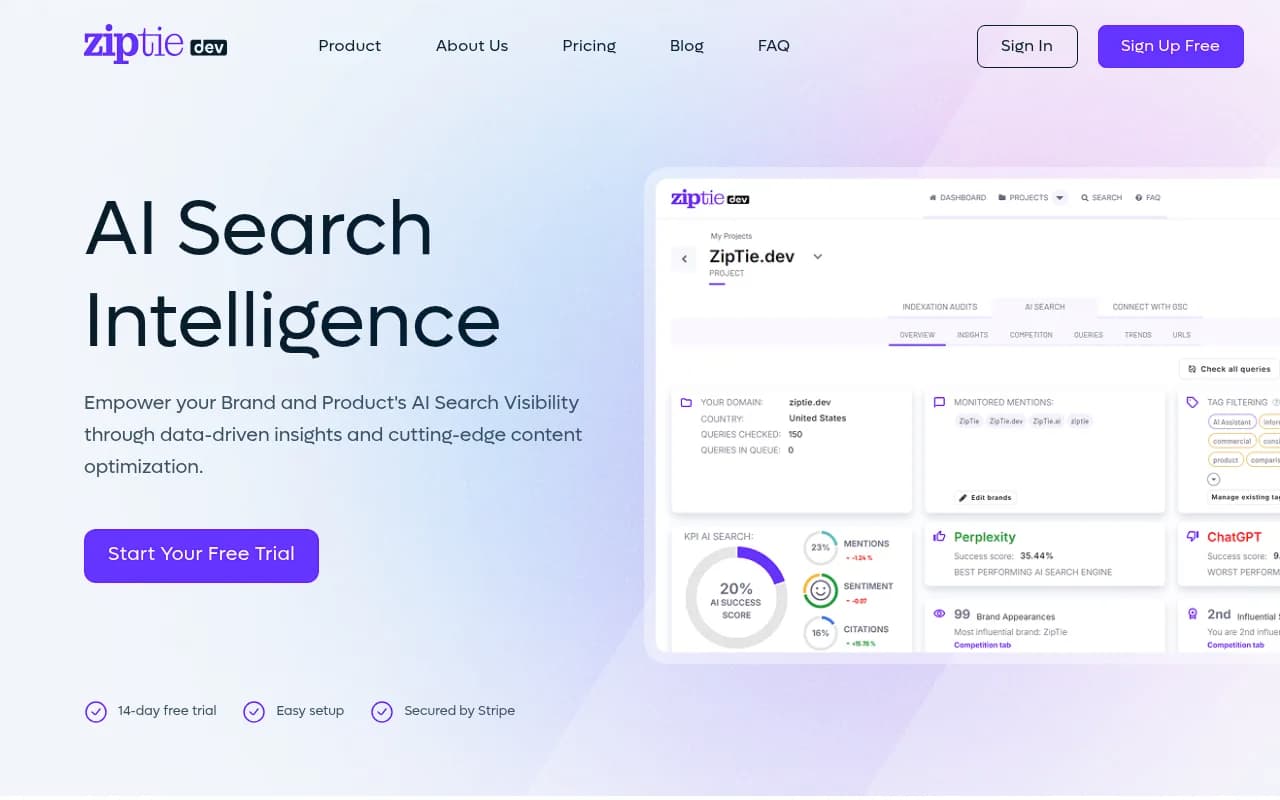
ZipTie uses a credit-based model (checks, not flat prompt counts) starting at $69/mo for 500 checks. It's a reasonable fit if your query volume is unpredictable month to month, which can happen in insurance when seasonal events (hurricane season, open enrollment) spike certain coverage questions.
A practical starting checklist
Before picking a tool, map out what you actually need to track. For most insurance marketing teams, that's:
- Coverage-specific questions by line of business (auto, home, life, commercial, cyber) rather than generic "best insurance company" prompts
- Pricing and quote-intent queries, since these drove 17.6% of insurance citations per Conductor's data
- Branded coverage questions ("does [carrier] cover flood damage") separately from generic category questions, since BrightEdge's research found ChatGPT cites insurers mainly on branded questions, while generic coverage questions get answered by regulatory and health domains instead
- AI Mode and Perplexity performance, not just ChatGPT, given the 43.9% and 33.6% citation share those engines hold in insurance specifically
- Crawler activity on compliance pages, licensing disclosures, and AM Best rating mentions, since these build the trust signals LLMs weigh for a YMYL category like insurance
Once you know what you're tracking, match that to budget. The general market guidance holds for insurance too: $69-100/mo gets you entry-level tracking, $150-300/mo covers a mid-market setup with multiple engines, and enterprise platforms with compliance-grade features run $400-600/mo and up. Given the compliance stakes in insurance, including the real risk of LLMs hallucinating policy details, it's worth paying for a platform that gives you crawler-level visibility rather than just a monthly mention count.
If you want to browse beyond the tools covered here, the GEO software directory at bestgeosoftware.com lists more platforms by category, and agenticseotools.com is worth a look if you want tools that go further into automated content execution.
Getting the content right, not just the tracking
A tool only tells you where you stand. Someone still has to write the how-to pages, the coverage FAQs, the claims guides that AI actually wants to cite. If your in-house team doesn't have the bandwidth to produce that volume of compliant, well-structured content consistently, that's a different problem than picking a tracker.
This is the kind of work 1001 SEO Media does for brands across regulated industries: technical SEO, content production, and AI search optimization built to get cited inside AI answers, not just ranked on a results page. For insurance specifically, that means structuring coverage pages, claims guides, and quote-intent content so they read the way AI engines now expect, short, direct headings, clear answers up front, and the compliance details visible rather than buried in a footer.
Whatever tool you land on, the real work starts after the first report. Insurance AI visibility isn't something you check once a quarter; the citation mix is shifting monthly, as the Reddit collapse in ChatGPT and the rise of how-to content both show. Build the habit of checking, and build the content pipeline to act on what you find.