Key takeaways
- Search poisoning covers fake paid ads (malvertising) and manipulated organic results that send people to look-alike sites. No single tool catches both.
- Paid search monitors such as BrandVerity and The Search Monitor watch who is bidding on your brand terms. Takedown platforms such as Netcraft, Fortra and BrandShield remove the fake sites behind them.
- Counterfeit and marketplace threats are a different problem. Red Points and OpSec Online are built for that.
- Most vendors in this category are quote-only. Expect demos and sales calls, and validate coverage and takedown service levels before you sign.
- Classic SERP defense now has an AI-search twin: wrong or poisoned answers in ChatGPT and AI Overviews. Add AI visibility monitoring to the stack.
What search poisoning actually is
Search poisoning is an umbrella for attacks that put a malicious result in front of someone who is searching for something legitimate. It comes in two flavors. SEO poisoning manipulates organic rankings so a bad page shows up for terms your customers use. Malvertising buys or hijacks paid placements, so the bad result sits above the real one.
SentinelOne describes SEO poisoning as a type of malvertising where attackers automate both the poisoning and the creation of malicious domains. Their worked example is a search for "Blender 3D": on January 18, three malicious ads appeared above the legitimate blender.org result. The ads rotated quickly, and the attacker's infrastructure sat behind Cloudflare. That rotation is the part that hurts defenders. By the time you find one ad, it has been swapped for another.
SentinelOne also notes that attackers do best against organizations without extensive internal brand protection resources. That is the honest reason to buy tooling here. Manual spot checks of Google do not scale, and the ads you see from your own office, in your own location, are not the ads your customers see.
It helps to separate this from neighboring threats. Vectra's comparison distinguishes SEO poisoning from phishing, malvertising and typosquatting by the lure mechanism and by where the victim meets the attack. In practice the attacks chain together. A fake ad leads to a cloned login page on a typosquatted domain, and credentials get harvested. Memcyco covers this pattern specifically: fake search ads that hijack customer journeys and enable credential theft and account takeover.
One caveat on evidence. I could not find reliable public statistics on how prevalent search poisoning is or how fast takedowns typically happen, so I am not going to quote any. Be skeptical of vendors who do without a source.
The three jobs your tooling has to do
Before comparing products, split the problem into jobs. Most buying mistakes come from expecting one tool to do all of them.
- Detect. Find the fake ads, spoofed domains and poisoned results. This needs distributed crawling from many locations and devices, at a frequency high enough to catch rotating ads.
- Remove. Get the content or domain taken down. This depends on relationships with registrars, hosts, ad platforms and marketplaces, plus evidence gathering.
- Prove and prevent. Report on what happened, feed it into incident response, and identify repeat offenders such as affiliates breaking program rules.
Paid search monitors are strong on detection and compliance evidence. Takedown platforms are strong on removal. Threat intelligence suites are strong on investigating who is behind it.
Comparison at a glance
| Tool | Primary strength | Best for | Pricing visibility |
|---|---|---|---|
| BrandVerity | Paid search and SERP monitoring | Trademark bidders, affiliate compliance | Tiers published, no dollar prices |
| The Search Monitor | Unauthorized ads, affiliate hijacking, typosquatting | Paid search enforcement | Custom |
| AdPolice | Paid search and affiliate fraud | PPC-focused teams | Custom |
| Adthena | Paid search competitive intelligence | Teams wanting market context | Custom, described as high cost |
| Netcraft | Phishing takedowns, domain intelligence | Phishing and impersonation at volume | Quote-only |
| Fortra (PhishLabs) | Lookalike domains, phishing monitoring | Fully managed service | Quote-only |
| BrandShield | Trademark, impersonation, ecommerce | Broad brand and IP protection | Quote-only |
| Red Points | Marketplace monitoring, counterfeits | Counterfeit enforcement | Quote-only |
| OpSec Online | Anti-counterfeiting, product authentication | Physical product brands | Quote-only |
| ZeroFox | Deep and dark web investigations | Threat intel teams | Quote-only |
| Corsearch / Incopro | IP and brand protection services | Larger legal-led programs | Custom per brand |
A note on sources: Netcraft's 6-platform comparison, which is where several of these descriptions come from, is vendor content and ranks Netcraft first. I have treated its category labels as a starting point, not a verdict. Netcraft itself advises buyers to validate coverage, integrations and service levels with each vendor directly, which is good advice.
Paid search and SERP monitoring tools
If your exposure is fake or unauthorized ads on branded queries, start here.
BrandVerity
BrandVerity is the name most often mentioned for paid search monitoring. It identifies unauthorized ads bidding on protected brand terms and supports affiliate program enforcement. It positions the product around trademark infringers, affiliate compliance and SERP control, and argues that infringers raise your CPCs and drag down your CTRs.
The pricing page does not show dollar figures, but the tiers show how monitoring depth scales:
| Plan | Keywords | Monitoring frequency | Extras |
|---|---|---|---|
| Professional | 100 | 6x daily | Unlimited users, dedicated customer success manager, free setup and training |
| Premium | 200 | 12x daily | API access |
| Enterprise | Thousands | Up to 288x daily | API access |
That 288x figure is the interesting one. Given how quickly the ads in SentinelOne's example rotated, check frequency matters more than keyword count for hijack-style attacks. If you only have a few brand terms but face aggressive attackers, a higher frequency tier is the better spend.
The Search Monitor, AdPolice and Adthena
The Search Monitor uses a crawler called SmartCrawler to detect unauthorized paid ads, affiliate hijacking, typosquatting and cloaked links. A 2025 comparison article describes it as potentially expensive. AdPolice focuses on paid search and affiliate fraud and has limited scope beyond PPC. Adthena leans toward competitive intelligence and paid search monitoring with AI-driven insights, and the same article calls it high cost.
Those descriptions come from a 2025 article, so treat the pricing remarks as possibly stale and ask for current quotes. My view: if you want pure enforcement, The Search Monitor and BrandVerity are the closest comparison. Adthena makes more sense if you also want competitor ad intelligence and will use it.
Takedown and impersonation platforms
Paid search monitors tell you the ad exists. They do not shut down the credential-harvesting site behind it. For that you need a takedown-oriented platform.
Netcraft
Netcraft is positioned around phishing and online brand impersonation, with rapid takedowns, domain intelligence and broad threat coverage. If the end of your search poisoning chain is a fake login page, this is the category to prioritize. The Bolster comparison similarly points to Netcraft for phishing and domain takedown at volume.
Fortra and PhishLabs
Fortra covers lookalike domains and phishing monitoring and is the pick in several comparisons for a fully managed service. If your security team is small and you want someone else to run the queue, managed service matters more than the feature list.
BrandShield
BrandShield covers impersonation, trademarks and ecommerce. One honest limitation from the Bolster review: its center of gravity is counterfeit and trademark work rather than credential-harvesting phishing. Brands whose main threat is fraudulent login pages should confirm how far its phishing and domain coverage extends before buying.
ZeroFox
ZeroFox gives visibility into criminal forums, marketplaces and encrypted channels. That is useful when you want to know who is organizing the campaign, not only remove individual pages. It is overkill if you only need ad monitoring.
Counterfeit and marketplace protection
Some poisoning campaigns lead to fake storefronts selling knockoffs rather than stealing credentials. Red Points is built for marketplace monitoring and counterfeit enforcement, and OpSec Online for anti-counterfeiting and product authentication with IP enforcement. Podqi, a newer entrant, also pitches enforcement automation, and it has launched a free public scanner, Brandsweep.ai. I have not verified its claims independently, and the review I read was published by Podqi itself.
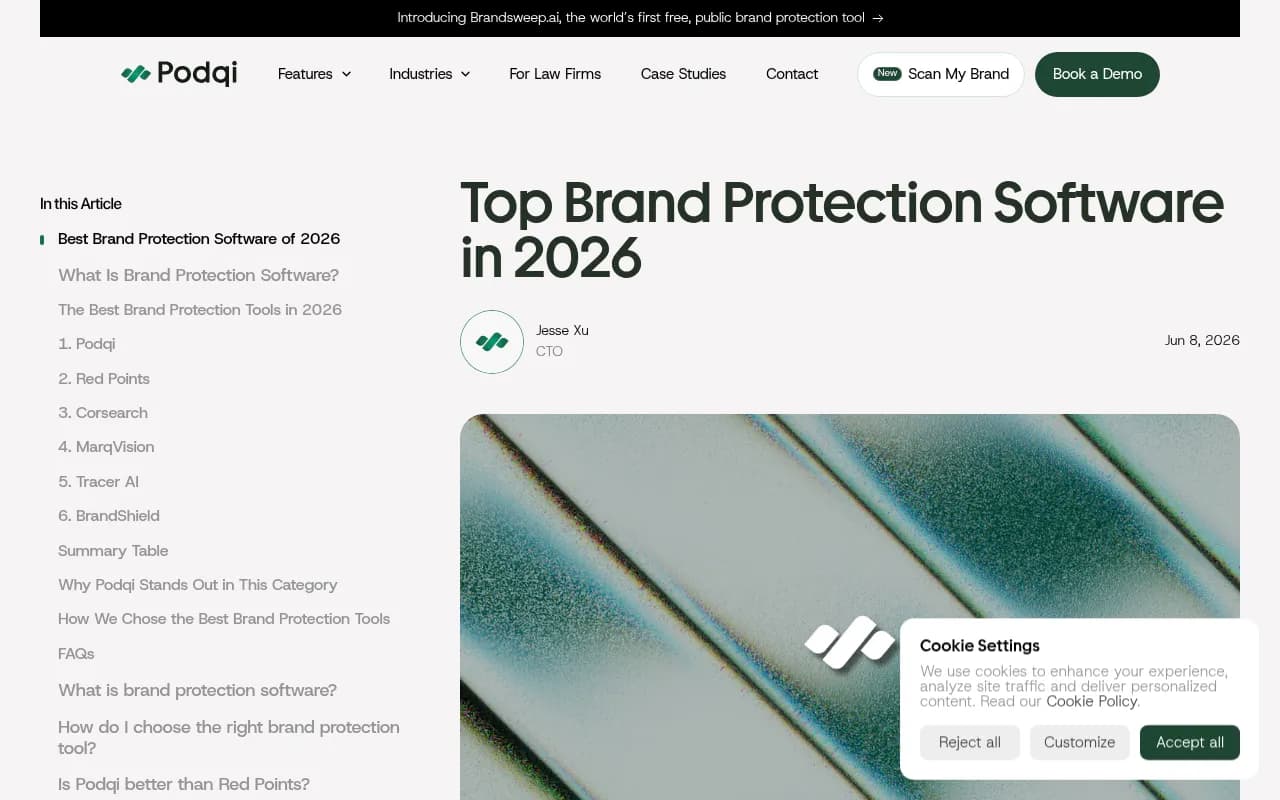
That article makes a point worth repeating from its own framing: AI tools and website builders now let attackers spin up convincing fake storefronts, clone domains and launch ad campaigns in hours instead of days. It also cites OECD and EUIPO estimates that counterfeit and pirated goods trade exceeds $467 billion globally. Whether or not you buy Podqi, the threat-speed argument is the real reason manual review stopped working.
For peer-review signals, Gartner Peer Insights lists a Brand Protection Software category, with RiskProfiler, Allure Security, Darkivore, Cyble Vision and Red Points among the products shown. Gartner's definition is broad: fake domains, phishing sites, rogue apps, social impersonation, counterfeit sales and logo misuse. Use it to find reviewer comments, not as a ranking.
Matching the tool to your threat
| If your main problem is... | Start with | Then add |
|---|---|---|
| Competitors or affiliates bidding on your brand terms | BrandVerity or The Search Monitor | Affiliate policy and enforcement process |
| Fake ads leading to cloned login pages | Netcraft or Fortra | Paid search monitor for early detection |
| Counterfeit goods on marketplaces and fake shops | Red Points or OpSec Online | BrandShield for broader trademark coverage |
| Organized campaigns you need to investigate | ZeroFox | A takedown provider |
| Small team, no security staff | A managed service (Fortra) | Quarterly manual SERP audits |
Questions to ask vendors
Most of these tools are sold through demos, and I found no public pricing for Netcraft, BrandShield, Red Points, Fortra or ZeroFox. Netcraft's own page routes you to a pricing form. Go into those calls with specific questions.
- From how many countries, devices and times of day do you check search results? Ads are geo-targeted and dayparted, so a single vantage point misses things.
- How often is each keyword checked, and can I raise frequency for attack periods?
- Who submits takedowns, and what happens when a registrar or ad platform pushes back?
- Do you capture automated evidence (screenshots, redirect chains, headers) that I can reuse for legal or incident response?
- Does it integrate with my SIEM, ticketing or incident-response workflow?
- Can I get takedown time data for customers like me, in writing?
That last one matters because public takedown-time statistics are scarce. Ask for your own numbers in a pilot.
Do not forget AI search
Search poisoning is moving into AI answers as well. If ChatGPT, Gemini or Google AI Overviews cite a fake support page or a scammer's lookalike site when someone asks about your brand, that is the same harm through a new channel. Traditional SERP monitors do not look there.
Tools like Promptwatch can track what AI engines say about your brand and which sources they cite, so you can spot a bad page showing up in answers. Its IP-verified crawler logs also show which AI bots are reading your real pages, which helps explain why a spoofed page might be winning the citation instead.

For context on how AI engines choose sources, Promptwatch Data publishes regularly updated research on citation behavior. For instance, in the week of Sep 28 to Oct 4, 2026, ChatGPT got only 0.46% of its citations from social platforms while Google AI Overviews got 12.2%, so where a poisoned or impersonating page can appear differs a lot by engine.
Other options in this space include [tool:profound], [tool:otterly-ai] and [tool:peec-ai] for brand mention monitoring, and a wider list lives in the GEO software directory at bestgeosoftware.com. Be clear about the split, though. These track AI answers. They are not takedown services.



If you want to build your own lightweight checks, such as scraping branded search results from several regions on a schedule, web data tools like [tool:bright-data] and [tool:apify] can supply the collection layer. It is a real engineering project and not a replacement for a vendor with takedown relationships, but it fills gaps cheaply.

A practical defense stack
Here is a setup that works for a mid-sized brand without a huge security team.
- Own your brand SERP. Claim every brand-term ad slot you can afford, and keep your official pages strong. Verified, well-maintained pages leave less room for impostors.
- Run a paid search monitor. Pick BrandVerity or The Search Monitor and set alerts on brand, product and login-related terms, including common misspellings.
- Contract a takedown provider. Netcraft or Fortra for phishing chains, with a clear service-level agreement for response time.
- Add marketplace protection only if you sell physical goods. Red Points or OpSec Online.
- Monitor AI answers. Check how engines describe you and which sources they cite.
- Document an escalation path. Who calls legal, who warns customers, who pauses ads when a campaign is active.
- Re-audit quarterly. Rotating ads mean last quarter's findings are stale.
If you would rather hand parts of this to specialists, an SEO agency with technical and digital PR experience can help with the organic side: hardening your brand SERP and pushing impostor pages down. 1001 SEO Media does this kind of work, though takedown enforcement itself still belongs with the platforms above.
Final take
No vendor in this list solves search poisoning alone. Paid search monitors find the ads. Takedown platforms remove the infrastructure. Threat intel suites explain the campaign. Marketplace tools handle the fake shops. The best programs are two or three of these joined by a clear process, plus a fresh look at AI answers.
If I had to pick a starting pair for a typical brand facing fake ads and cloned login pages, it would be BrandVerity for detection and Netcraft for removal, then a quote from Fortra to compare against the managed-service route. Confirm every price and service level directly, because almost none of it is public.