Key takeaways
- ChatGPT has no fixed ranking. A good tracker reports mentions, citations, and share of voice per prompt, not one position number.
- Content teams need more than a dashboard. The useful question is which page to write or refresh next, and whether it worked.
- Promptwatch's data shows citation share depends on prompt intent, so plan content per intent: product pages and listicles for commercial prompts, guides and docs for informational ones.
- Budget trackers like Otterly.AI, Peec AI, ZipTie, and Nightwatch are fine for monitoring. Few of them help you produce the article.
- Most "best of" lists on this topic are written by vendors who rank themselves first. Treat them as feature checklists and verify pricing yourself.
Why a ChatGPT rank tracker is different from a Google rank tracker
Google gives you ten blue links and a number. ChatGPT gives you one synthesized answer that names a handful of brands and cites a handful of sources. There is no position 4 to climb from.
So "rank tracking" here is a loose label. What these tools actually do is run a set of prompts through ChatGPT on a schedule and log whether your brand was named, whether your pages were cited, who else showed up, and how you were described. The Leapd guide makes the same point: the unit is citation presence, not list position.
The number you should care about also moves around. Promptwatch Data's research on ChatGPT query fanouts shows that one prompt can trigger several background searches, and the average has drifted over time, with query length shrinking too. That means the thing you are "ranking" for is partly a set of short searches ChatGPT invents on your behalf. A tracker that only shows the headline prompt hides half the picture.
What content teams actually need from a tracker
A monitoring tool tells you that you are missing. A content team needs to know what to write on Monday. When I compare tools for a content workflow, I look at five things:
- Prompt-level data: which prompts mention you, which cite you, which competitors win.
- Citation sources: the pages ChatGPT actually pulls from, including third-party ones.
- Real ChatGPT output, not only API calls, since the user-facing answer can differ.
- A path from gap to draft: briefs, a content agent, or at least an exportable list of gaps.
- A way to check the result: did the new page get crawled, cited, and did it send visits.
That last one is where most tools stop. They are dashboards. You get a score, then you open a different tool to write.
The content intent angle: what ChatGPT cites by prompt type
Before picking a tool, it helps to know what you are trying to produce. Promptwatch Data's report on ChatGPT citation share by content type (Sep 28 to Oct 4, 2026) breaks down what ChatGPT cites:
| Content type | Share of ChatGPT citations |
|---|---|
| Product pages | 22.4% |
| Landing pages | 16.8% |
| Listicles | 13.6% |
| How-to guides | 8.7% |
| Documentation | 7.5% |
| General articles | 6.1% |
| Comparisons | 5.9% |
| News | 5.7% |
| FAQ pages | 3.3% |
| Reviews | 1.7% |
The split by intent is more useful than the total. For commercial prompts like "best CRM for small businesses," product pages (26.0%), landing pages (20.6%), listicles (15.0%), and comparisons (7.9%) make up almost 70% of citations. For informational prompts, how-tos and docs climb. For branded prompts, your own site, FAQ pages, and reviews matter more, with reviews at 5.6%, more than triple their overall share.
I find this uncomfortable for content teams who default to blog posts. A lot of the citation share sits on pages that describe what a company sells. If your tracker shows a commercial gap, the fix may be a better comparison page or product page, not another thought-leadership article.
Plan a refresh cadence from half-life data
Content does not stay cited forever. Promptwatch Data's content half-life report tracked pages ChatGPT cited on July 6, 2026 for 90 days. Landing pages and docs held up best: 78% and 76% were still cited after 30 days. Product pages, reviews, and how-tos reached their half-life at roughly 74 to 77 days. News was the weak spot, with half its pages gone after 36 days.
Practical read: refresh product pages and how-tos on a schedule, roughly every two to three months, and treat news as a short burst format. Your tracker should flag pages that lose citations so the refresh queue builds itself.
The best ChatGPT rank trackers for content teams in 2026
Pricing below comes from the vendors' own roundups and may be out of date. Check each pricing page before you buy.
Promptwatch
Promptwatch is the one I would put first for a content team, mainly because it covers the whole loop and not just the monitoring step. It tracks ChatGPT through the real interface, in the countries and languages you pick, alongside Gemini, Perplexity, Claude, Google AI Overviews, and others. Prompts come with volumes, difficulty, and query fan-outs, so you see the background searches ChatGPT runs.
What matters for writers is what happens after you find a gap. The content gap analysis maps your pages against prompts AI answers, and the Content Agent plans, writes, and publishes articles to WordPress, Webflow, or Framer, with a review inbox if you want to approve everything. Content Refresh gives diff-style updates for existing pages. Then IP-verified AI crawler logs, Page Tracker, and visitor analytics show whether the page was read, cited, and clicked. The Action Board turns all this into a prioritized to-do list.

Pricing starts at $95/mo (Essential) and $245/mo (Professional). The Content Agent and the automated workflow start on Business at $579/mo. Essential has no crawler logs or AEO articles, so content teams realistically want Professional or Business. Confirm at promptwatch.com/pricing. There is a 7-day free trial and a free AI visibility report if you want a quick look first. For direct comparisons, see Promptwatch vs Profound and Promptwatch vs Peec.
Profound
Profound is an enterprise-grade monitoring platform, popular with large brands that care about narrative control and detailed analytics. It is strong at showing what AI says about you. For content teams, the gap is execution: you get insight, then do the writing elsewhere. Pricing is higher than the budget tools, and in the vendor roundups the entry price quoted is far below what enterprise buyers typically end up paying, so get a real quote.

Otterly.AI
Otterly.AI is an affordable cross-engine monitor, quoted at around $29/mo in the roundups. It suits agencies watching several small brands and teams who want a simple brand-mention log. Do not expect crawler logs, traffic attribution, or content generation.

Peec AI
Peec AI is a clean, simple tracker with smart prompt suggestions. A good first tool if you only need visibility, sentiment, and competitor share of voice in a tidy interface. Like Otterly, it leaves the content work to you.

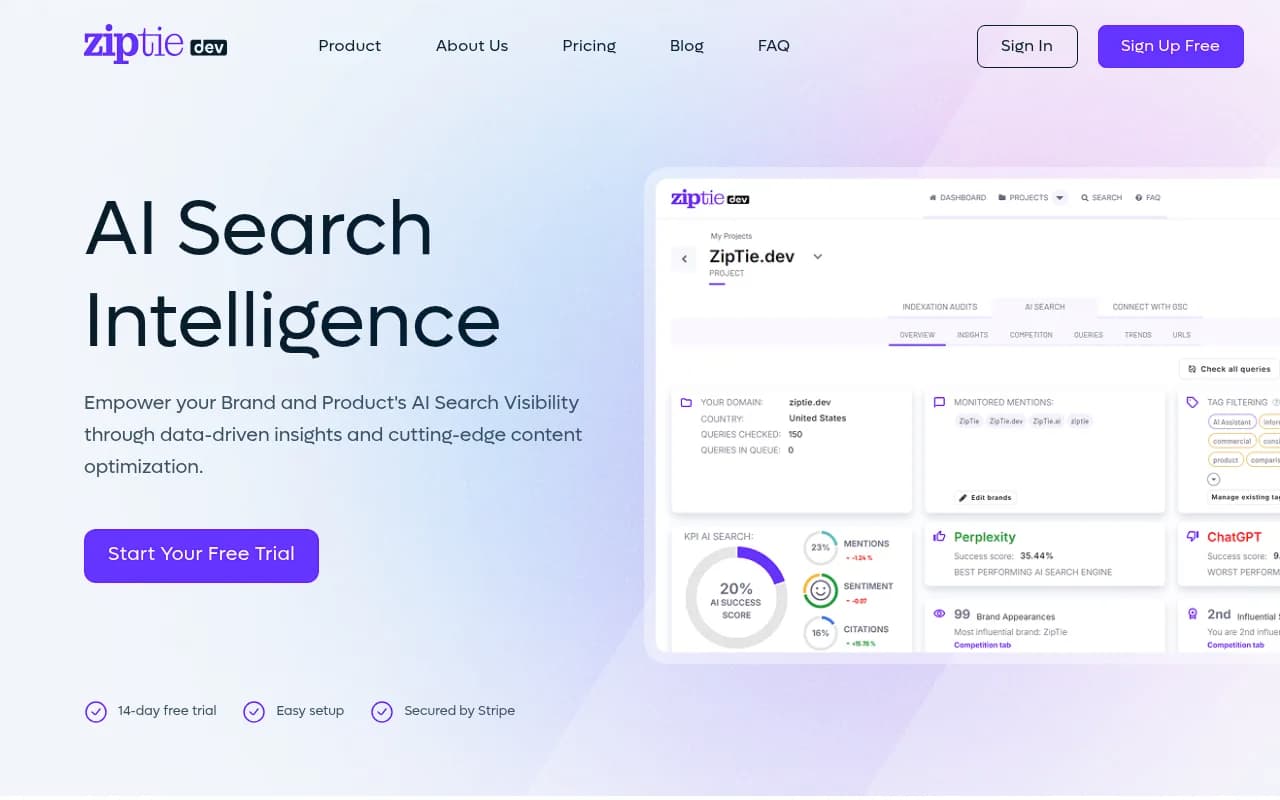
ZipTie
ZipTie is a focused AI search tracker that leans toward actionable recommendations. Roundups list it around $69/mo. It sits between a pure monitor and a full optimizer, and works if your team wants clear "do this next" notes without a large platform.
Nightwatch
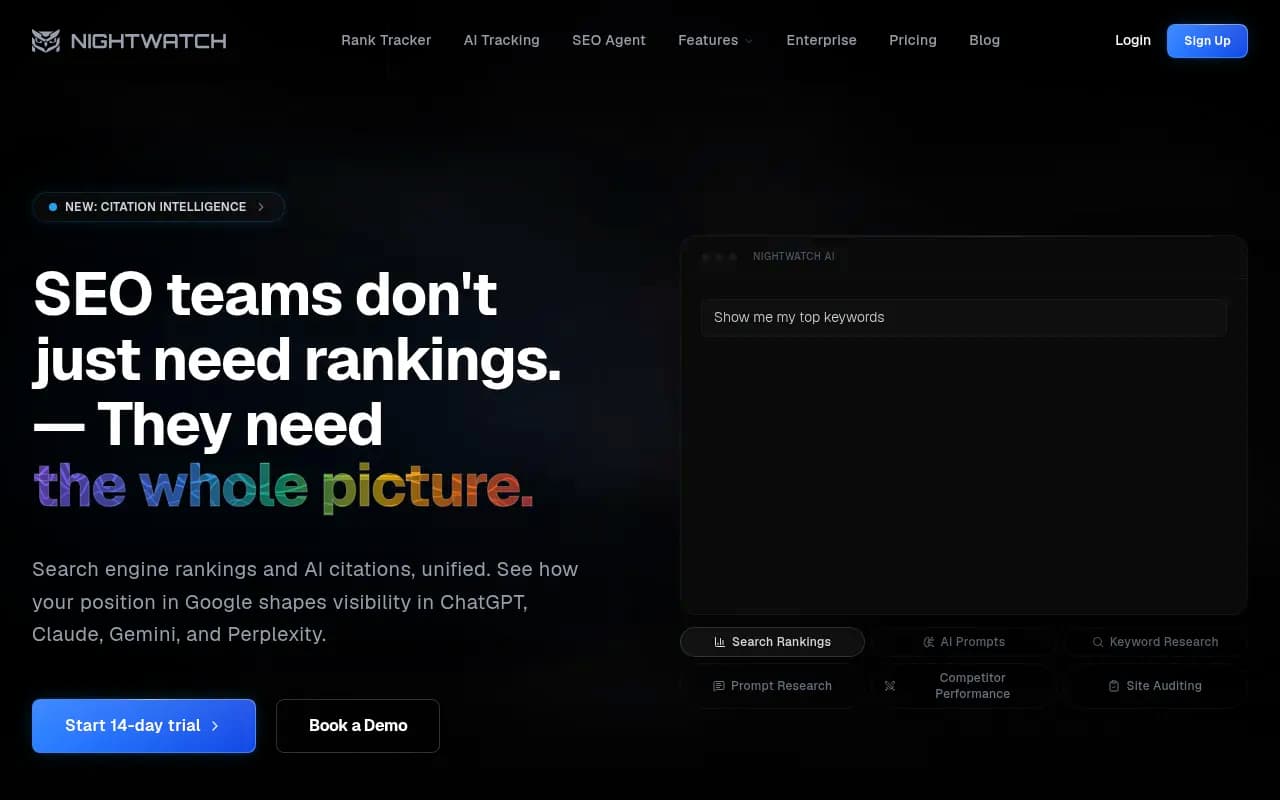
Nightwatch started as a Google rank tracker and has extended into AI search. The pitch is hybrid reporting: traditional rankings and ChatGPT visibility in one place, with unlimited seats. That is handy for agencies reporting both, though the AI side is an add-on to the base price.
KIME
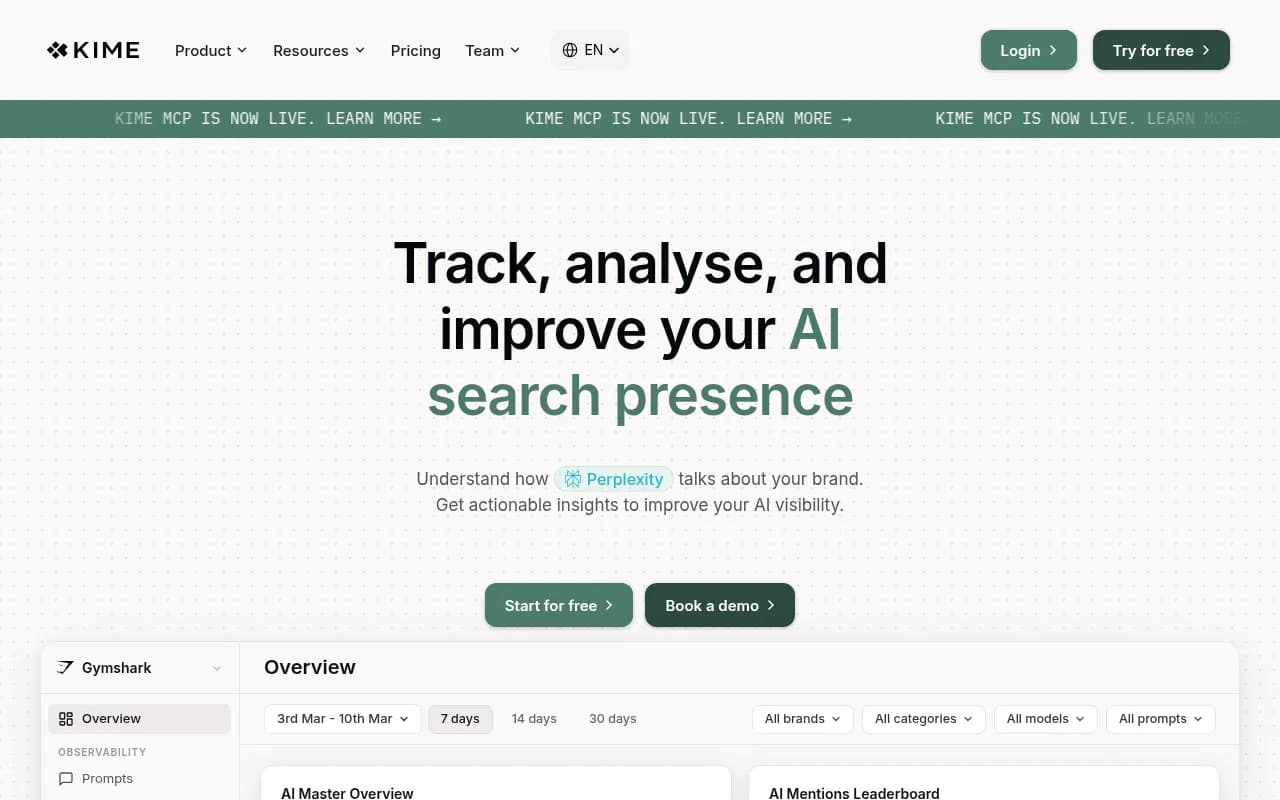
KIME tracks ChatGPT and eight other AI engines and includes an Action Centre for optimization. It also publishes the "best ChatGPT rank trackers" article that ranks itself first and claims roughly 60% of organic traffic now comes from AI responses. I would not repeat that figure; it is unsourced. As a tool, it is worth a look for multi-seat marketing teams.
Morningscore
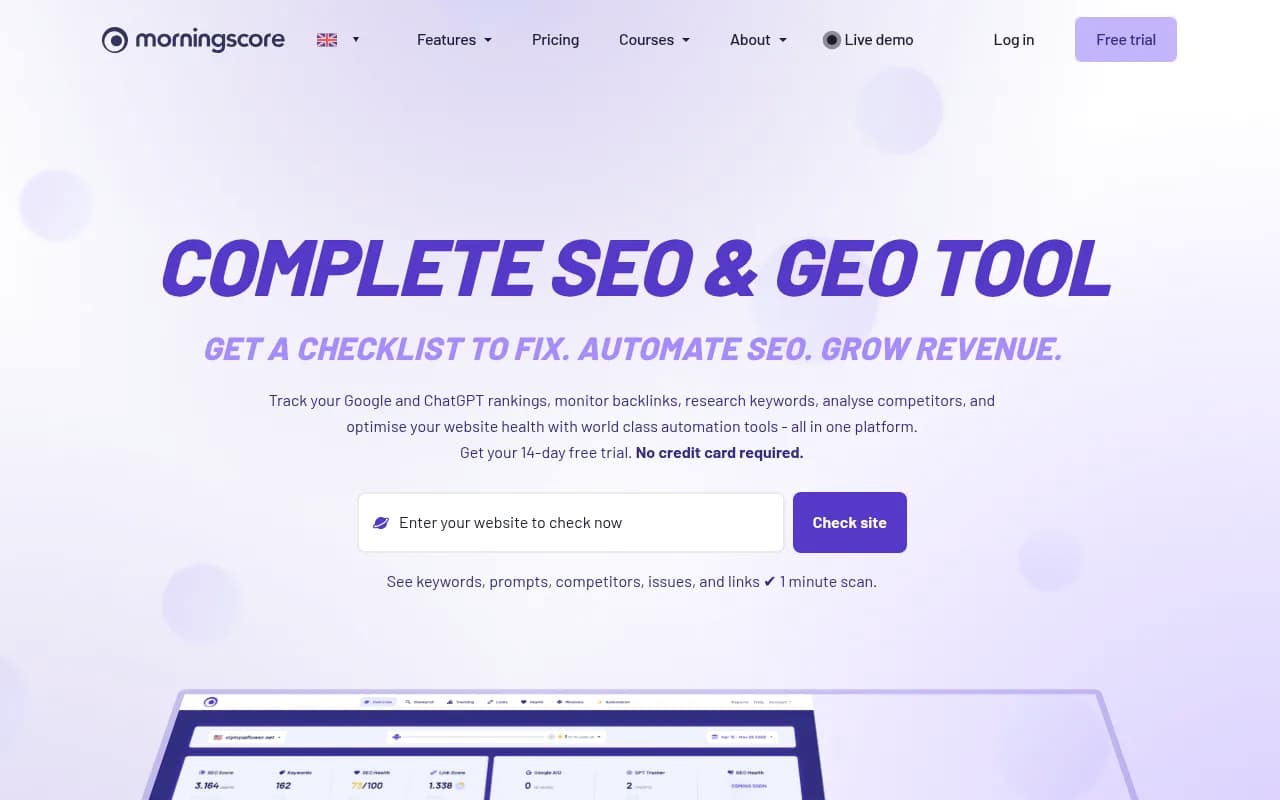
Morningscore is a gamified SEO tool with beginner-friendly AI tracking. Reasonable for startups with a non-technical content person who wants a gentle on-ramp.
Semrush and Ahrefs Brand Radar
If you already live in an SEO suite, Semrush and Ahrefs Brand Radar add AI visibility to what you use. Convenient, but the prompt sets are typically fixed and the AI-specific depth is shallower than purpose-built platforms.

Geoptie and Searchable
Geoptie positions itself for content teams that want to find and fix ChatGPT gaps with no limit on content generated. Searchable turns AI responses into measurable scores. Both publish their own roundups, so read their rankings with the usual salt.

Comparison table
| Tool | Tracks real ChatGPT UI | Helps write the fix | Crawler logs | Best for |
|---|---|---|---|---|
| Promptwatch | Yes | Yes, Content Agent and refresh | Yes | Content teams that want gap-to-article in one product |
| Profound | Yes | Limited | No | Enterprise narrative monitoring |
| Otterly.AI | Yes | No | No | Low-cost multi-brand monitoring |
| Peec AI | Yes | No | No | Simple visibility tracking |
| ZipTie | Yes | Recommendations | No | Small teams wanting clear next steps |
| Nightwatch | Yes | No | No | Agencies mixing Google and AI reports |
| KIME | Yes | Action Centre | Not stated | Multi-seat marketing teams |
| Geoptie | Yes | Yes | Not stated | Teams wanting unlimited content generation |
Treat the cells as starting points. Features change quickly, and several of these come from vendor-written comparisons.
Turning tracker data into articles
A tracker is only worth its fee if it changes your editorial calendar. Here is the workflow I would run.
1. Group prompts by intent
Split your tracked prompts into commercial, informational, and branded. Each maps to a different content type, per the citation data above. A single flat prompt list is how teams end up writing the wrong format.
2. Find where competitors are named and you are not
Sort by prompts where competitors appear and you do not. These are your real gaps. Check which pages ChatGPT cites for those prompts. If it cites comparison pages and listicles, you need one of those. If it cites docs, you need clearer documentation.
3. Write to the fan-outs, not just the prompt
Promptwatch's fanout data suggests writing headings that read like short search queries and front-loading the entity and category in titles and H2s, for example "Best CRM for small agencies 2026". Build focused pages for sub-questions like "X vs Y," pricing, and alternatives. The free ChatGPT query fan-out generator is a quick way to see likely sub-queries.
4. Check that AI can read the page
A brilliant article does nothing if the crawler is blocked. Check robots.txt and CDN rules. The AI crawler URL inspector is free, and crawler logs in a platform like Promptwatch show whether the bots actually visited. Promptwatch Data's AI crawler traffic report shows how much verified crawler traffic from OpenAI, Anthropic, Google, and others is out there.
5. Mind where citations come from
Do not assume Reddit threads will carry you. Promptwatch Data found reddit.com's share of ChatGPT citations fell from about 4% to 0.5% on August 14, 2026, and ChatGPT drew only 0.46% of citations from social platforms against 12.2% for AI Overviews in a late September to early October 2026 sample. For ChatGPT, owned pages and well-structured editorial content matter more than social seeding.
6. Measure, then refresh
After publishing, watch three things: crawl, citation, and traffic. If a page is crawled but not cited, it is a content problem. If it is not crawled, it is an access problem. Refresh on the half-life schedule above.
How to choose
- Just need to know whether ChatGPT mentions you: Otterly.AI, Peec AI, or ZipTie will do.
- Reporting both Google and AI rankings for clients: Nightwatch or an SEO suite add-on.
- Enterprise brand monitoring with heavy analytics: Profound.
- A content team that needs to close gaps and prove results: Promptwatch, since it writes, publishes, and measures in the same place.
A few warnings. Do not choose on price per prompt alone; check how many responses you get and whether data comes from the real ChatGPT interface. Do not trust a single rank number. And do not judge tools by their own blog posts, since almost every "top 8" list online is vendor-authored and puts the publisher near the top.
If you want to browse more options, the directories at bestgeosoftware.com and ai-rank-tools.com list dozens of trackers by category.
Common mistakes
- Tracking 20 vanity prompts and no buyer prompts.
- Measuring one run instead of trends. ChatGPT answers vary run to run.
- Writing blog posts when the cited format is a comparison or product page.
- Ignoring citation drops. Promptwatch Data saw average citations per response fall around the GPT-5.3 rollout on March 4, 2026, so a sudden dip may be a platform change and not your content.
- Never refreshing. Half your cited pages will fade within a quarter or two.
Bottom line
Pick the tracker that matches how your team works. If your bottleneck is knowing where you stand, a cheap monitor is enough. If your bottleneck is turning that knowledge into published articles and proving they got cited, you want a platform that goes from gap to draft to measurement. Start with a trial, track your 30 most important buyer prompts for two weeks, and see which tool tells you what to write next.