Key takeaways
- Healthcare and pharma buyers should treat security review and claim accuracy as gating criteria, not nice-to-haves. Check each vendor's trust page directly for SOC 2, ISO 27001, SSO, audit logs and data residency before you sign.
- Promptwatch is ISO/IEC 27001 certified and GDPR compliant, with an EU-based data handler, SSO on Enterprise, an organization audit log, and Fact Check for flagging inaccurate AI claims about your brand.
- In ChatGPT healthcare answers, government and public health sites and medical research databases dominate citations, so your GEO plan needs peer-reviewed evidence and guideline alignment, not just more blog posts.
- Dashboards that only report a score are not enough in a regulated setting. You need an approval workflow, source-level transparency and a way to confirm that a fix worked.
- Pharma teams must route any AI-optimized content through medical, legal and regulatory review. No GEO tool replaces MLR.
Why healthcare and pharma need a different GEO shortlist
Most GEO buying guides are written for SaaS and e-commerce teams. Healthcare is a different animal. The content is YMYL, the claims are regulated, the legal exposure is real, and the procurement team will ask for a security questionnaire before anyone sees a demo.
There is also a demand reason to care. SearchEye cites an Ipsos survey in which 31% of consumers used generative AI for healthcare information between doctor appointments, but only 38% somewhat or generally trusted it. High usage plus shaky trust means the answers about your drug, clinic or device carry real weight, and wrong answers do real damage. A separate review published in the Journal of Medical Internet Research reported that 39% of LLM users sought physical or mental health information.
So the job is bigger than "show up more." It is: show up, be described accurately, be cited from sources your compliance team can defend, and do it on a platform your security team will approve.
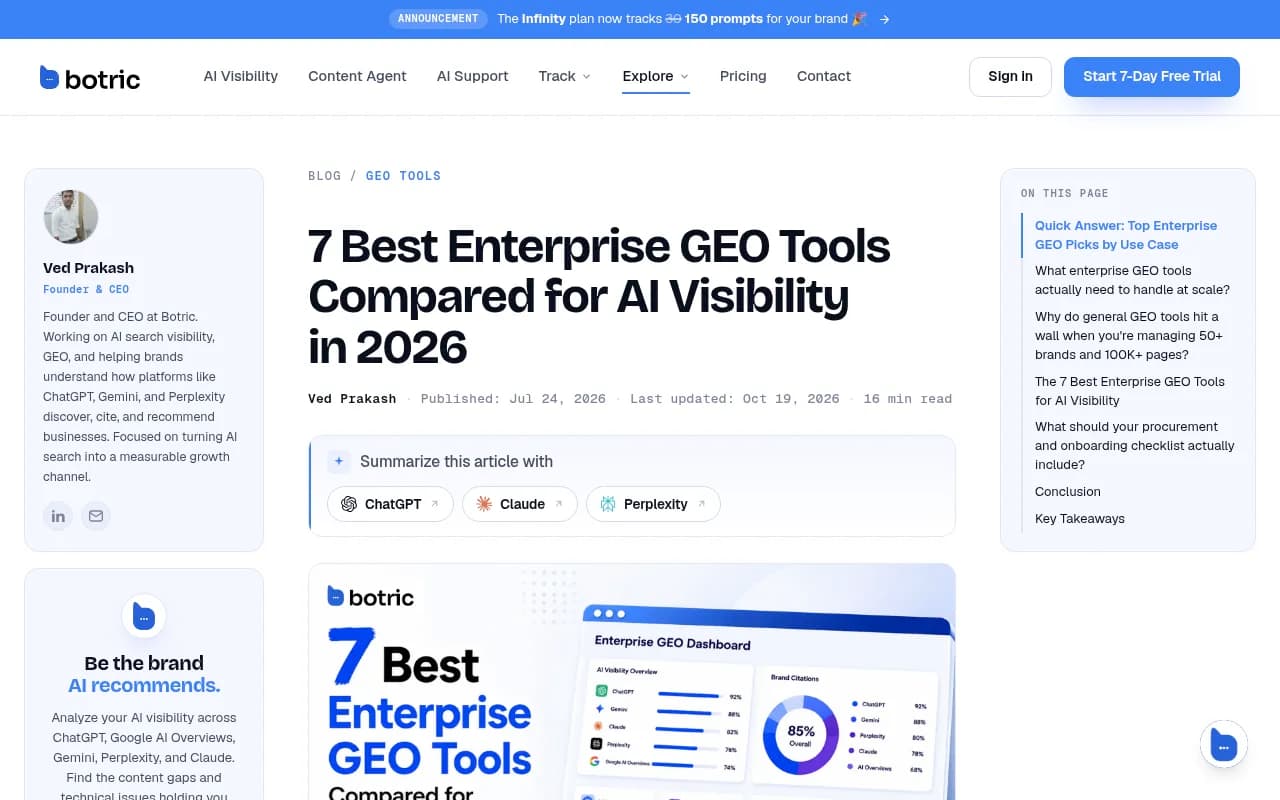
A caveat on the sources I used. Several of the comparison articles ranking these tools are published by vendors who put themselves first (SearchEye and Botric both do). I use them for criteria, not for rankings. I also did not verify every vendor's security claims. Treat the table below as a starting point and confirm each credential on the vendor's own trust page.
What AI actually cites for healthcare prompts
Before picking a tool, understand the terrain. Promptwatch Data's October 2026 report on healthcare citations in ChatGPT covers organic healthcare prompts from Sep 9 to Oct 8, 2026. A few findings that should shape your plan:
- NIH is the top source at 5.46% of all healthcare citations, spread across six nih.gov subdomains. PubMed Central (2.38%) and PubMed (2.33%) follow. NIH alone earns more than the FDA, NHS, CMS and SAMHSA combined.
- The FDA is second at 1.76% and the NHS third at 1.1%.
- Government and public health sites hold 7.06% of citations, medical associations 1.39%, hospitals and clinics 0.89%, and reviews and directories 0.46%.
- Medical societies punch above their weight. The American Society of Plastic Surgeons (0.64%) and the American Academy of Dermatology (0.54%) together earn more than Mayo Clinic and Cleveland Clinic combined.
- Doctify and WebMD are the only review and directory sites in the top 20, at 0.23% each.
The practical read: if your own domain is not in that mix, the path to citations often runs through the sources AI already trusts. Back claims with peer-reviewed studies linked on PubMed or PubMed Central, keep pages consistent with FDA, CDC, NHS and NICE guidance, work with the medical associations in your specialty, and keep physician profiles on Doctify and WebMD complete. That is Promptwatch Data's own advice from the same report, and it matches what you would expect for YMYL content.
There is also a competition angle. Promptwatch's average sources per response data (published Sep 2025, so treat the numbers as dated) found ChatGPT cites about 5 sources per web-search answer, while Google AI Overviews and Perplexity cite about 10. Fewer slots means a tougher fight in ChatGPT.
The security and governance checklist
Before you compare features, send every vendor the same questions. This is the list I would give a healthcare procurement team.
- Certifications: SOC 2 Type II or ISO/IEC 27001, with a current report you can request under NDA.
- Data handling: where data is stored, who processes it, and whether the vendor ingests any patient or customer data at all. A good GEO platform should not need PHI. If a vendor asks for it, ask why.
- Access control: SSO (SAML/OIDC), role-based access, project-level permissions and scoped API keys.
- Auditability: an audit log showing who changed what, and whether the change came from the UI, the API or an AI agent.
- Privacy law: GDPR posture and a data processing agreement. If you plan to sign a BAA, ask for one explicitly. Most GEO tools do not need to touch PHI, but your legal team will want that in writing.
- Human approval: can AI-written content sit in a review queue before publishing, or does it go live automatically?
- Claim accuracy: can you mark an AI statement about your brand as wrong, and find the page that taught the model the wrong thing?
- Source transparency: can you see the exact citations behind each answer, not only a score?
That last pair is where healthcare differs most from other verticals. A mention is not a win if the model says your drug has an indication it does not have.
Comparison table: enterprise GEO tools for regulated industries
This table summarizes what each vendor publicly emphasizes. Security columns marked "verify" mean I did not independently confirm the credential, so check the vendor's trust center.
| Tool | Positioning | Security and governance signals | Best for |
|---|---|---|---|
| Promptwatch | End-to-end GEO: monitor, trace, act, measure | ISO/IEC 27001 certified, GDPR compliant, SSO and white-label portal on Enterprise, audit log on Business and up | Healthcare and pharma teams that want fixes, not just dashboards |
| Profound | Enterprise AI visibility analytics | Frequently cited for governance depth; verify SOC 2 and SSO | Large regulated brands with a monitoring-first mandate |
| BrightEdge | Enterprise SEO plus AI search intelligence | Established enterprise vendor; verify certifications | Teams already standardized on BrightEdge |
| Conductor | Organic marketing platform with AI search insights | Enterprise workflows; verify certifications | Content-heavy marketing orgs |
| seoClarity | Enterprise SEO with Clarity ArcAI | Enterprise suite; verify certifications | Large SEO teams that want one suite |
| Adobe LLM Optimizer | GEO inside Adobe Experience Cloud | Inherits Adobe enterprise procurement; verify scope | Adobe-centric enterprises |
| Yext Scout | AI search competitive intelligence | Strong in structured location data; verify certifications | Multi-location providers and health systems |
| Peec AI | Analytics across models and countries | Lighter governance; verify | Analytics-heavy teams without heavy compliance demands |
| Evertune | Analyzes AI responses at scale | Verify | Brand research at volume |
| AthenaHQ | AI visibility monitoring | Verify | Mid-market monitoring |
The shortlist
Promptwatch
Promptwatch is the one I would put first for most healthcare and pharma teams, mainly because it combines the security paperwork procurement wants with the workflow marketers actually need. It is ISO/IEC 27001 certified and GDPR compliant, and data is handled by an EU-based company, which tends to shorten security reviews. Enterprise adds SSO and a white-label dashboard and client portal. Business and above include an organization audit log that records every change and whether it came from the dashboard, the API, an MCP client or Agent Chat, which is a useful detail when an AI agent can edit things.

For healthcare specifically, two features stand out. Brand Narrative pulls the individual claims AI makes about you and competitors out of every tracked response, grouped into themes like Pricing, Features, Support and Reputation. Fact Check (Business, Agency Scale and Enterprise) lets you mark a claim Accurate or Inaccurate, then reads the pages crawled from your site to find the ones that state it or its opposite, with quotes and a recommended next step. If a model keeps saying your device is not suitable for a patient group, you can find the page it learned that from.
On the compliance side of content, the Content Agent writes and publishes to WordPress, Webflow or Framer with a review inbox where you approve, edit or decline each piece, so nothing has to go live hands-off. A Brand Book and Knowledge Base keep facts and tone consistent. That review inbox is where your medical and legal reviewers plug in. Promptwatch is not a substitute for MLR, and I would not run pharma content through any tool without it.
Other things that matter for this audience: IP-verified AI crawler logs to confirm bots can actually read your clinical pages, Citation Trends that classify sources (including government and directory types), personas so you can prompt like a patient versus a physician, and local GEO targeting at exact coordinates for multi-site health systems. Tracking covers ChatGPT, Gemini, Claude, Perplexity, Google AI Overviews, AI Mode, Copilot and more, using the real interfaces rather than only APIs.
Pricing: Business is $579/mo (5 projects, 350 prompts, Content Agent, Fact Check, audit log); Enterprise is custom. Confirm at promptwatch.com/pricing. You can start with the 7-day free trial or the free AI visibility report, and the Promptwatch vs Profound page covers the closest enterprise comparison.
Profound
Profound is the name that comes up most often when regulated enterprises ask about governance. Third-party roundups describe it as the strongest fit for organizations that need extensive security controls and monitoring depth. The tradeoff, from what is publicly known, is a higher price point, no Reddit tracking, no ChatGPT Shopping coverage and no agentic execution. If your mandate is strictly measurement and reporting, it is a serious option. If you also need the content work done, you will be adding other tools.

BrightEdge, Conductor and seoClarity
These are the incumbents. If your SEO team already runs on one of them, adding the AI search module avoids a new vendor review, which in healthcare is a real advantage. The catch is depth. Suites that bolt AI tracking onto an SEO platform tend to rely on fixed prompt sets and offer less AI-specific data, such as crawler logs and traffic attribution. Ask each to demonstrate citation-level transparency, not just a visibility score.
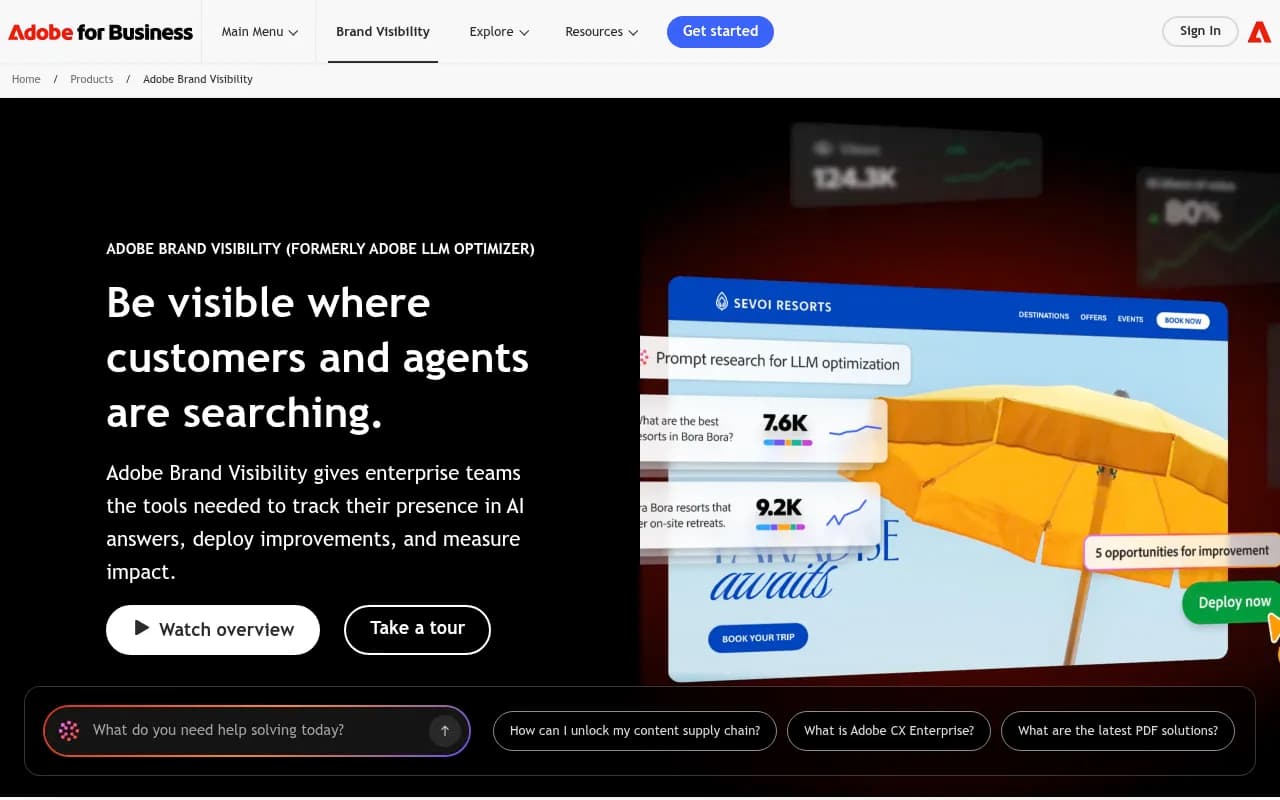
Adobe LLM Optimizer
Worth a look if your pharma marketing stack already lives in Adobe Experience Cloud, since procurement and security review may already be done. Verify how much of the tracking and fix workflow is native versus dependent on other Adobe products.
Yext Scout
Health systems with many locations and providers have a structured data problem as much as a content problem. Yext's strength is verified listings data, and Scout adds AI search competitive intelligence on top. It is a good complement to a GEO platform for provider directories, though it is not the full optimization loop on its own.
Yext Scout
Peec AI, Evertune and AthenaHQ
All three are credible for monitoring. Peec AI is often praised for analytics across models and countries; Evertune analyzes AI responses at scale. For a pharma enterprise, I would hesitate on any of them until I had seen their security documentation and confirmed SSO and audit capabilities, since the public material emphasizes analytics over governance.



For a wider view of the category, the GEO software directory at bestgeosoftware.com lists more options than I can cover here.
What pharma teams should do differently
Pharma adds a layer that provider organizations do not face. Promotional rules around prescription products mean that content optimized for AI answers still counts as communication about your product. I did not research FDA promotional rules in depth for this guide, so treat this as a framing point and take it to your regulatory team: anything you publish to influence AI answers should go through your normal medical, legal and regulatory review.
Where GEO tools help is on the monitoring side, which is lower risk than publishing:
- Track what models say about your brand, indications, side effects and competitors across ChatGPT, Gemini, Claude and Perplexity.
- Flag inaccurate statements and trace them to source pages, including third-party ones.
- Check whether your approved prescribing information and patient pages are crawlable. Blocked or erroring pages are a common cause of models relying on outdated third-party summaries.
- Watch which government, society and database pages AI cites, since those are the sources you cannot control but can align with.
For teams new to the workflow, the Promptwatch 90-day GEO program is a reasonable template for phasing monitor, trace, act and measure.
How to run the evaluation
A process that works for most regulated buyers:
- Send the security questionnaire first. Drop any vendor that cannot produce a current certification report or confirm SSO and audit logging.
- Build a test monitor of 30 to 50 real prompts. Mix patient-style questions, physician-style questions and brand-versus-competitor comparisons. Use personas if the tool supports them.
- Run two vendors in parallel for two to four weeks. Compare whether you can see the underlying citations, not only the score.
- Test the correction loop. Pick one inaccurate claim and see how fast you can find the source page and what the tool recommends.
- Test the approval flow. If content generation is in scope, confirm that nothing publishes without a named reviewer.
- Check reporting. Exports, scheduled PDFs and API access matter when compliance wants evidence trails.
Quick recommendations
| If you are... | Start with |
|---|---|
| A hospital system or pharma brand that needs monitoring plus action, with strict security review | Promptwatch Enterprise |
| A large regulated brand with a monitoring-only mandate | Profound or Promptwatch |
| Already standardized on an SEO suite | BrightEdge, Conductor or seoClarity AI modules |
| In the Adobe ecosystem | Adobe LLM Optimizer |
| Running many locations and provider listings | Yext Scout alongside a GEO platform |
| Looking for analytics-only reporting with fewer compliance demands | Peec AI |
If you would rather hire help than run this in-house, an agency that understands both SEO and generative engine optimization can shorten the learning curve. 1001 SEO Media is the agency behind this directory and works with Promptwatch as its AI visibility platform.
Bottom line
The best enterprise GEO tool for healthcare is the one your security team will approve and your content team will use. Ask for certifications first, insist on citation-level transparency, and keep medical and regulatory review in the loop for anything that gets published. For most teams, Promptwatch covers that combination: ISO 27001, SSO, audit logs, Fact Check and a review inbox for content. Pair it with a hard look at which government, society and database sources AI already trusts in your category, because that is where your citations will come from.