Key takeaways
- Enterprise GEO buying is decided by security and operations (SSO, SCIM, audit logs, data residency, MSAs), not by who shows the prettiest visibility score.
- Most published rankings of this category are written by competing vendors. Treat every security claim as a lead to verify on the vendor's trust page, not as a fact.
- The twelve platforms here split into monitoring-led, workflow-led and suite-led products. Pick based on the work your team cannot already do.
- Crawler logs, per-engine reporting and a path from insight to published fix separate platforms that scale from dashboards that report.
- Run a paid pilot with the same 100 to 200 prompts on your shortlist before signing anything.
What makes a GEO tool "enterprise"
Generative engine optimization (GEO) is the work of measuring and improving how a brand shows up in answers from ChatGPT, Gemini, Perplexity, Claude, Copilot and Google AI Overviews. An enterprise GEO platform does that across many brands, markets, languages and models, with the controls a large company's IT and legal teams insist on.
Plenty of tools do the first part. Far fewer do the second. A mid-market monitor can be great at showing you a mention rate and still fail a security review in week one.
One caveat before the list. I could not independently verify SOC 2 reports, SSO implementations or support SLAs for these vendors. The security details below come from vendor pages and vendor-adjacent comparison articles (Presenc AI, xSeek, Meikai and MaxAEO all sell competing products and have an incentive to flatter themselves). Use this guide to build a shortlist, then request the actual trust documentation.
The enterprise buyer's checklist
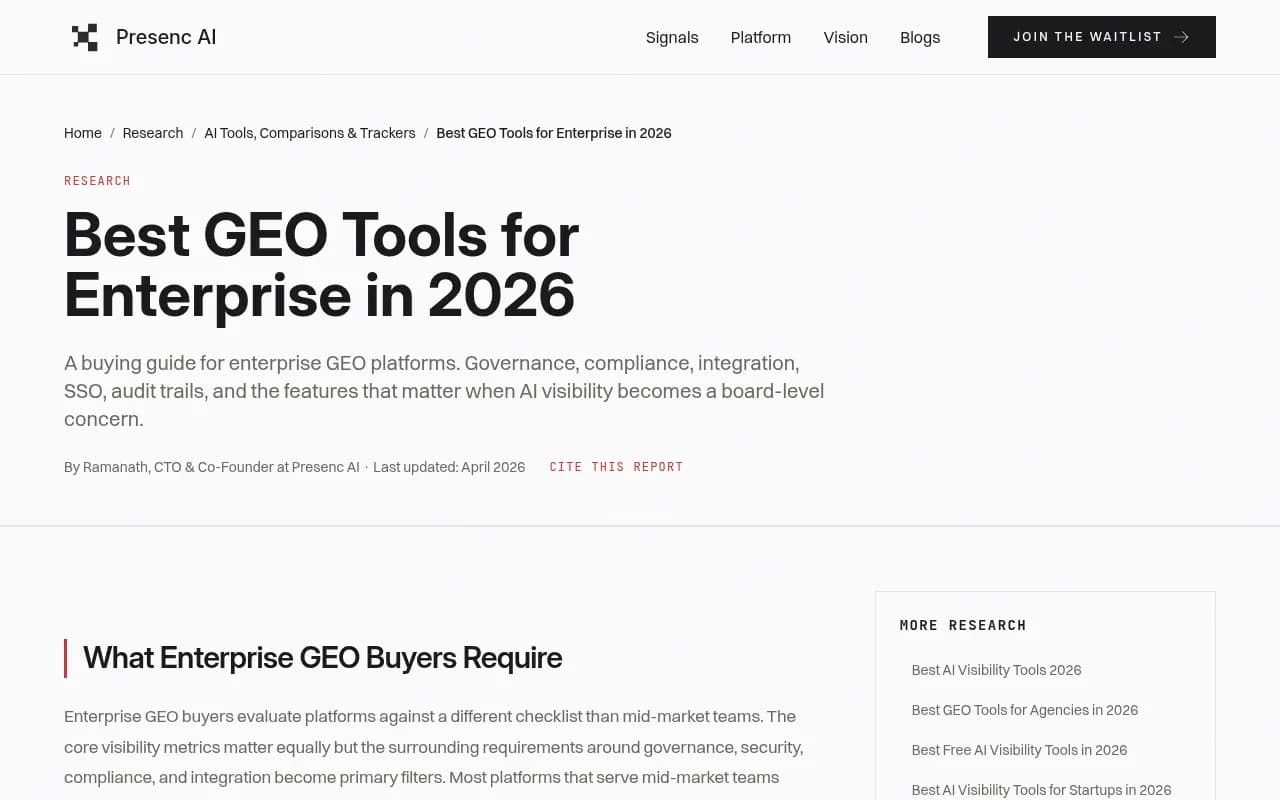
The most useful framing I found comes from Presenc AI's enterprise buying guide. Even though Presenc sells its own product, the checklist itself is sound. Here it is, trimmed to what actually blocks deals.
Security and access
- SAML SSO (Okta, Azure AD, Ping) and ideally SCIM provisioning. Without these, a tool does not get adopted at scale.
- Role-based access control across brands, agencies and regions.
- Audit logs that show who changed monitoring configuration and when.
- A current SOC 2 Type II report, or ISO/IEC 27001 certification, plus a GDPR data processing agreement.
- Data residency options if you operate under GDPR, CPRA or sector rules.
Scale
- Multi-brand and multi-market architecture that does not become operational chaos at 30 brands.
- Prompt and response volumes that fit your tracking plan, with faster-than-daily refresh when you are running a launch.
- API, MCP and BI connectors (Looker Studio, Snowflake, Databricks) so GEO data lives in your data stack.
- Per-engine reporting. According to Promptwatch Data on average sources per response (published September 2025), ChatGPT cites about 5 sources per web-search answer, Google AI Overviews about 10, and Perplexity almost exactly 10 every day. Copilot swung from under 2 to nearly 17 within weeks. A blended score hides all of that.
Support
- A named customer success contact and priority escalation path.
- Quarterly business reviews, not just a ticket queue.
- Willingness to negotiate an MSA, liability terms and security questionnaires.
Governance
- Hallucination and inaccurate-claim detection, so legal and comms hear about wrong AI statements within hours.
- Brand-safety alerting for negative associations.
- Compliance-aware prompt sets for regulated industries.
The 12 platforms at a glance
| Platform | Type | Security signals (verify on trust page) | Strongest at | Watch out for |
|---|---|---|---|---|
| Promptwatch | End-to-end GEO platform | ISO/IEC 27001, GDPR, SSO and white-label on Enterprise, audit log | Monitoring plus fixing: crawler logs, Content Agent, CMS publishing | Content Agent starts on Business plan |
| Profound | Enterprise analytics and agents | SAML and OIDC SSO, RBAC, SOC 2 Type II, HIPAA (per vendor) | Prompt volume data, crawler analytics | Custom pricing, involved buying process |
| AthenaHQ | Monitoring and workflow | Enterprise controls claimed | Cross-LLM monitoring, content agents | Pricing not public |
| Scrunch | Monitoring plus delivery | Enterprise tier | Agent Experience Platform for AI-ready pages | Technical implementation effort |
| Bluefish | Enterprise suite | Enterprise program support | AI commerce, custom measurement | Weighted toward large brands |
| Conductor | SEO platform with AI insights | Established enterprise vendor | Ties GEO to existing SEO workflows | Less GEO-native |
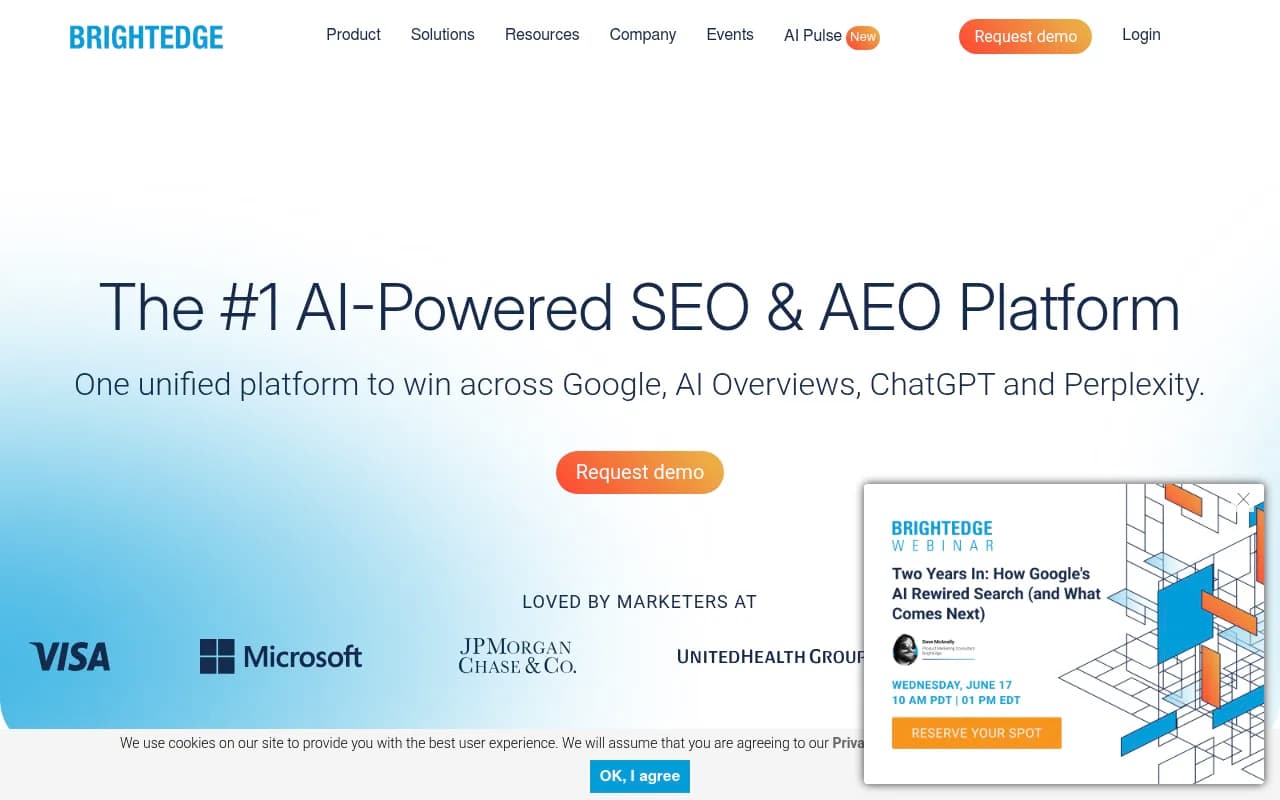
| BrightEdge | SEO platform with AI intelligence | Established enterprise vendor | Teams already on BrightEdge | Same as above |
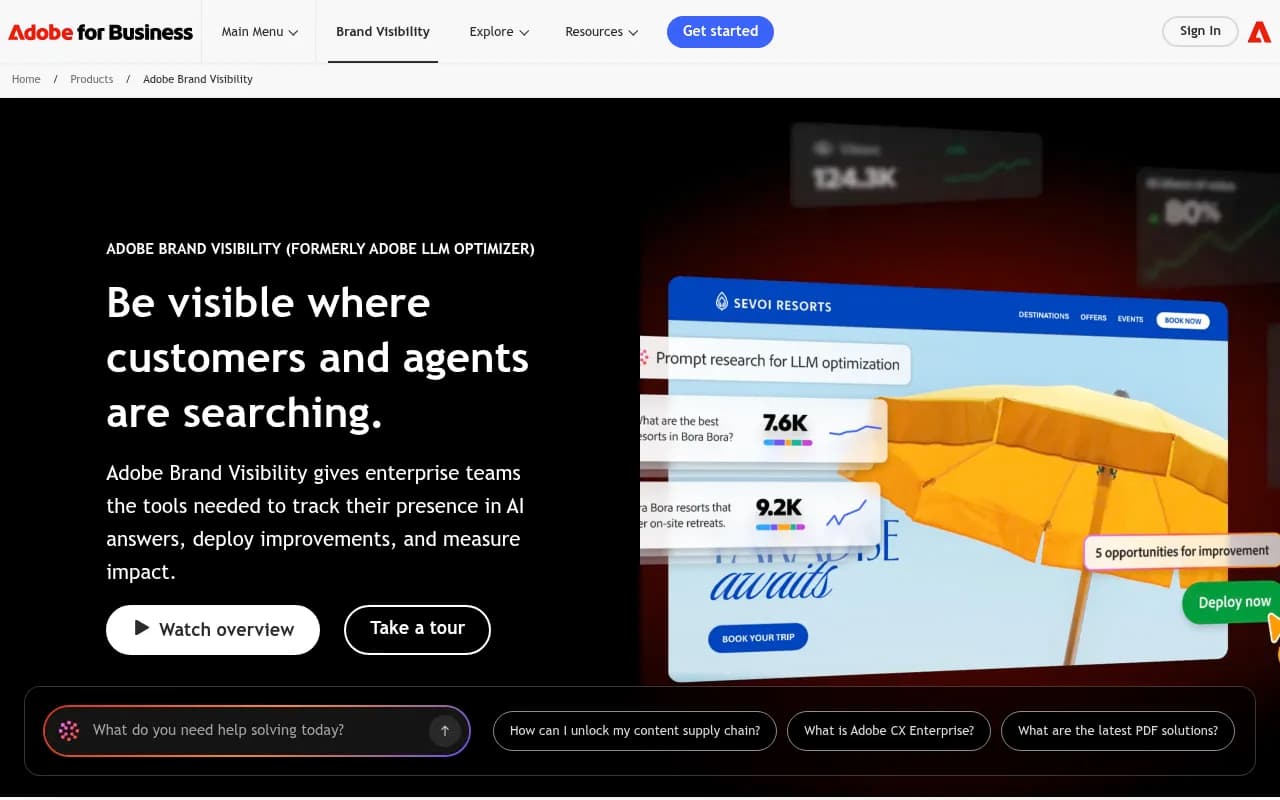
| Adobe LLM Optimizer | Suite component | Adobe enterprise stack | Teams in Experience Cloud | Makes most sense inside Adobe |
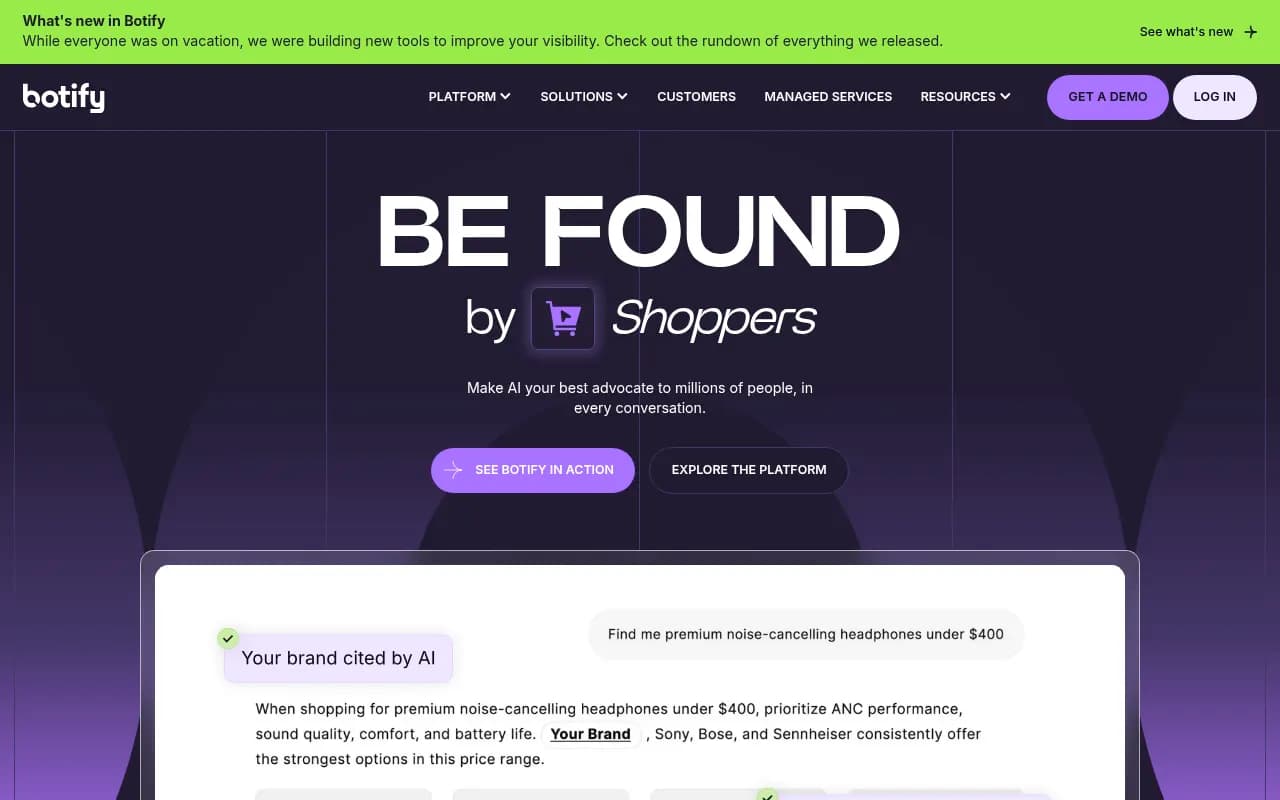
| Botify | Technical SEO plus AI search | Enterprise tier | Crawlability and technical readiness | Technical focus |
| Peec AI | Focused analytics | Confirm enterprise details | Clean analytics, exports, API and MCP | Monitoring-led |
| Otterly.AI | Accessible monitor | Confirm enterprise details | Multi-country monitoring, audits | Better for small teams than complex procurement |
| Evertune | Large-scale response analysis | Confirm with vendor | Analyzes AI responses at scale across 11 models | Narrower workflow |
1. Promptwatch: best for teams that want to fix visibility, not just track it
Promptwatch is the platform 1001 SEO Media uses for its own GEO work, so weigh that as a disclosure. It covers the full loop: tracking from real AI interfaces (ChatGPT, Google AI Overviews, AI Mode, Gemini, Perplexity, Copilot, Meta AI, Alexa) in each country and language, then tracing where answers come from, then acting on the gaps, then measuring the result.

For enterprise buyers the pieces that matter are:
- ISO/IEC 27001 certification and GDPR compliance, with data handled by an EU-based company. That shortens procurement reviews.
- Roles (owner, editor, viewer) with project-level access, scoped API keys, SSO on Enterprise, and an organization audit log on Business, Agency Scale and Enterprise that records whether a change came from the dashboard, API, MCP client or Agent Chat.
- IP-verified AI crawler logs so you can tell an access problem from a content problem. Promptwatch's AI crawler traffic data (June 8 to September 6, 2026) shows OpenAI at 79.8% of verified AI crawler requests in the week of August 31, down from 94.8% in mid-June. If a provider is big in that mix but near zero in your logs, you are probably blocking it.
- Brand Narrative and Fact Check to flag inaccurate claims AI makes about you, and the pages teaching it wrong.
- A Content Agent that writes and publishes to WordPress, Webflow or Framer, then tracks whether the page gets crawled, cited and clicked.
Pricing is published: Essential $95/mo, Professional $245/mo, Business $579/mo, with agency plans from $199/mo and tailored Enterprise. Confirm at promptwatch.com/pricing. Honest limitation: the Content Agent, faster-than-daily tracking and Fact Check start at Business, and agency plans exclude content generation.
Next step: run the free AI visibility report or book a demo with your security questionnaire in hand.
2. Profound: best for demand data and a citation system of record
Profound is the name that comes up first in most enterprise shortlists. Its pitch is real prompt-volume data, answer analysis, crawler analytics and agents that research, draft and publish content. According to xSeek's comparison, its enterprise product supports SAML and OIDC single sign-on, role-based access control, SOC 2 Type II and automated backups. Another roundup attributes SOC 2 Type II and HIPAA to the vendor and notes up to nine answer engines on Enterprise.

The tradeoff is the buying process. Pricing is custom (the pricing page lists a 7-day trial and Enterprise), and SSO and SOC 2 documentation sit at the Enterprise tier. See Promptwatch vs Profound for a head-to-head from a competitor, with that bias in mind.
3. AthenaHQ: best for measurement plus workflow
AthenaHQ combines cross-LLM monitoring, prompt-volume data, content agents, citation analysis and enterprise controls. MaxAEO describes it as a serious mid-market and enterprise option for teams that want more than a free grader without a fully custom content-delivery platform on day one. Pricing was not listed publicly in the sources I reviewed.
4. Scrunch: best for technical readiness and AI-ready page delivery
Scrunch pairs prompt and citation monitoring with source intelligence and its Agent Experience Platform, which serves AI-oriented versions of your pages. That is a genuinely different approach: instead of only recommending fixes, it changes what bots see. Your engineering and security teams will want to review how that delivery layer works before you commit.

5. Bluefish: best for large-brand programs and AI commerce
Bluefish emphasizes enterprise AI monitoring, custom measurement frameworks, automated optimization workflows and AI commerce. One comparison says it is likely strongest in programs where vendor support and workflow design matter, which is another way of saying you buy it for the relationship as much as the software.

6. Conductor: best if your SEO program already lives there
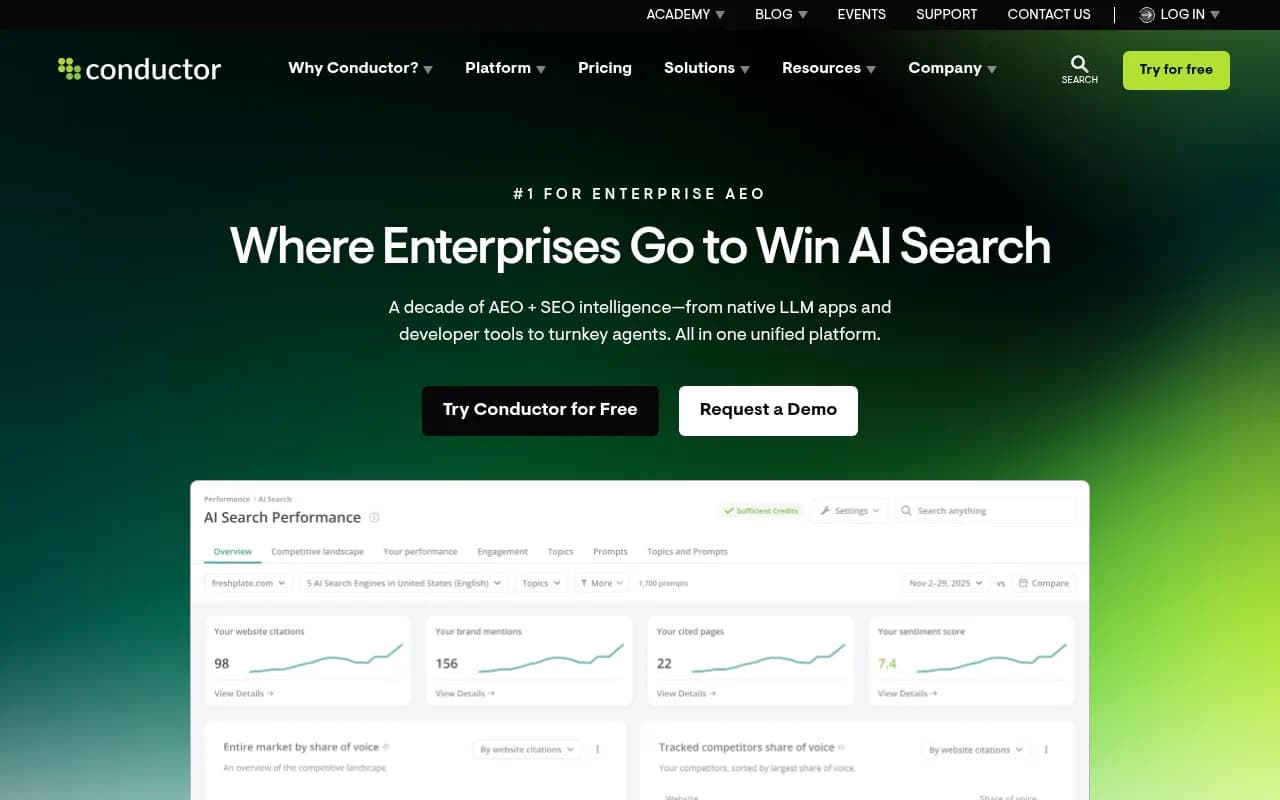
Conductor ties GEO to established SEO workflows. If your organization already has Conductor contracts, security approval and trained users, the procurement path is the shortest on this list. The cost is that it is an SEO platform extending into AI, not a GEO-native product.
7. BrightEdge: best for existing BrightEdge shops
Same logic as Conductor. BrightEdge brings enterprise SEO and AI search intelligence into a platform your team may already use. Ask specifically how many AI engines it tracks and whether prompts are fixed or customizable.
8. Adobe LLM Optimizer: best inside Adobe Experience Cloud
Adobe's offering is an enterprise GEO suite that lives in its own stack. If your content, analytics and governance already run through Adobe, integration and procurement are simpler. Outside that stack, it is harder to justify.
9. Botify: best for technical SEO teams
Botify extends a crawl-heavy technical SEO product into AI search optimization. It suits teams whose main blocker is crawlability and site architecture at very large scale.
10. Peec AI: best for focused measurement
Peec offers prompt, brand, competitor and source analytics with recommendations, exports, Looker Studio, API and MCP access. It is monitoring-led. MaxAEO notes it suits many teams but public enterprise details should be confirmed.

11. Otterly.AI: best for accessible multi-country monitoring
Otterly offers multi-country monitoring, prompt research, content and crawlability audits, plus API and MCP access. It is more at home with small teams and agencies than with complex enterprise procurement. That is not a criticism, just a fit question.

12. Evertune: best for response analysis at scale
Evertune analyzes AI responses at scale and reportedly covers 11 models, including ChatGPT, AI Overviews, AI Mode, Gemini, Claude, Perplexity, Meta AI, DeepSeek and Copilot. Worth a look if statistical rigor in how responses are sampled is your main concern.

How to compare them without trusting anyone's marketing
Ask for proof on security
Request the SOC 2 Type II report or ISO certificate, the DPA, the subprocessor list and the penetration test summary. Ask whether SSO is included in the quote or a separate line item. Several vendors reserve SSO and SOC 2 documentation for the top tier.
Test data quality yourself
Public capability pages cannot tell you whether the data is any good. Give every vendor the same 100 to 200 prompts, covering branded, competitor and category queries in your real markets, and compare:
- Do results differ materially from what you see when you ask the engine by hand?
- Are responses collected from real interfaces or only APIs? Answers and citations can differ between the two.
- Can you see individual responses, not just a score?
Look past the visibility score
Every platform here can produce a headline number. It is the least useful thing any of them makes. What you want is a diagnosis: coverage problem, prominence problem, crawlability problem or reputation problem. Then you want a path to fixing it.
Check the loop from insight to published fix
Monitoring-only tools leave the work to your team. Ask each vendor to show a page going from gap identified, to content produced, to published, to crawled, to cited. Where that chain breaks is where your headcount goes.
Which platform for which situation
| If you need | Start with |
|---|---|
| One platform to monitor, fix and measure, with published pricing | Promptwatch |
| Demand data and a mature enterprise sales motion | Profound |
| Measurement with content agents | AthenaHQ |
| AI-ready page delivery | Scrunch |
| AI commerce at a large brand | Bluefish |
| GEO inside an existing SEO suite | Conductor or BrightEdge |
| GEO inside Adobe | Adobe LLM Optimizer |
| Crawl and architecture fixes | Botify |
| Lightweight measurement and exports | Peec AI or Otterly.AI |
If your shortlist is still too broad, the GEO software directory at bestgeosoftware.com lists many more platforms by category.
A sane buying process
- Write down the three jobs you cannot do today (measurement, content production, technical fixes, reporting).
- Send the security questionnaire to your top four vendors in week one. Slow answers are an answer.
- Run a 30-day pilot with identical prompts.
- Score data accuracy, time to first fix, and how many seats your team needs.
- Negotiate the MSA, SSO inclusion, support tier and data residency in writing.
If you would rather hand the program to specialists, an agency like 1001 SEO Media can run the pilot and the ongoing GEO work, though you should still insist on seeing the vendor's security documentation yourself.
Bottom line
There is no universal winner. The platform that fits is the one that covers the work your team cannot already do and survives your security review. Shortlist three, test them on identical prompts, and make the vendors prove their claims.