Key takeaways
- Donors now ask ChatGPT, Gemini, and Perplexity questions like "which charities help refugees?" GEO tools show whether your organization is named, cited, or missing from those answers.
- Start free: Google Search Console and a manual check of 10 to 20 donor questions tell you a lot before you pay for anything.
- Small teams do well with a low-cost monitor (Otterly.AI, Peec AI, Airefs). Teams that want fixes and not just reports should look at a platform with content and crawler features, such as Promptwatch.
- Much of a charity's visibility lives on third-party pages: fundraising platforms, rating sites, directories. Your tool and your plan should cover those too.
- I could not verify current nonprofit discounts for most vendors. Ask for one before you buy. Several vendors will give it if asked, but I won't claim any do.
Why nonprofits need to care about GEO
Generative engine optimization (GEO) is the work of getting your organization mentioned and cited inside AI-written answers. Some vendors call it AEO. The terms overlap enough that you can treat them as the same thing.
For a charity, this matters in an unusually direct way. People ask AI "where should I donate for clean water?" or "how do I find a food bank near me?" The answer is a short list of names. If you are not on it, you never get the click, the donation, or the volunteer sign-up. And there may be no link to measure the loss, because AI answers can name you without sending traffic.
Nonprofit Tech for Good puts the fundraiser's version simply: GEO means structuring and writing content on your fundraising platform's campaign page so AI can synthesize it and recommend it. That framing is useful because it points at something nonprofits often forget. Your visibility is not only your own website.
What the data says AI cites
Before picking a tool, it helps to know what you are trying to move. Here is what Promptwatch Data shows.
Pages that describe what you do get cited most
In Promptwatch's report on content types ChatGPT cites (Sep 28 to Oct 4, 2026), product pages made up 22.4% of classified citations and landing pages 16.8%. Listicles were 13.6%, documentation 7.5%, how-to guides 8.7%, and FAQ pages 3.3%.
A charity does not sell products, but the equivalent is clear: program pages, donate pages, and campaign pages. Those are your citation surface. For branded prompts (ones that name a specific organization), reviews were 5.6% of citations, more than three times their overall share. My inference, not the report's: charity-rating and review pages probably play that role for nonprofits.
Health charities face heavy competition
If you work in health, look at Promptwatch's healthcare citation report (Sep 9 to Oct 8, 2026). NIH leads at 5.46%, then PubMed Central at 2.38%, PubMed at 2.33%, the FDA at 1.76%, and the NHS at 1.1%. Government and public health sites together earn 7.06%. Reviews and directories earn only 0.46%.
You will not outrank the NIH. The realistic play is to cite and link to those authorities in your own pages, keep medical claims backed by peer-reviewed sources, and get recognized by medical associations in your field.
Social is a Google story, not a ChatGPT one
Per Promptwatch's social media citation data for Sep 28 to Oct 4, 2026, social platforms make up just 0.46% of ChatGPT citations, but 12.2% of Google AI Overviews citations. In AI Overviews, YouTube earns 4.28%, Facebook 2.38%, Reddit 2.15%, Instagram 1.61%, and LinkedIn 1.55%. On Perplexity, social is 2.7%, with LinkedIn and Reddit at 0.86% each.
Nonprofits are usually active on Facebook and YouTube already, so that is good news for AI Overviews. For ChatGPT, put your effort into your own site. Reddit's share of ChatGPT citations also collapsed in mid-August 2026, as this report documents, so don't build a ChatGPT strategy around Reddit threads.
What to look for in a GEO tool as a nonprofit
Most GEO tools do the same four jobs: mention tracking, citation tracking, sentiment, and share of voice. A vendor-neutral buyer's guide from Olostep makes the point that the tool should cover the engines your audience actually uses. Beyond that, nonprofits have their own filters.
- Price. Many nonprofits have a few hundred dollars a month at most, often less.
- Seats. Communications, fundraising, and program staff all want to look. Per-seat pricing hurts.
- Geography. Local charities need location-aware tracking. "Food bank near me" answers change by city.
- Third-party coverage. You need to see which outside pages AI cites about you, not just your domain.
- Action, not just a score. A two-person team does not have time to turn a dashboard into a to-do list. Tools that tell you what to fix are worth more.
- Data handling. Don't paste donor data into any of these tools. They only need public prompts about your cause and brand.
Comparison: GEO tools worth a look
Pricing changes often and I did not verify vendor pricing pages for this guide, so treat the right-hand column as a fit guide, not a quote. Check each vendor's pricing page, and ask about a nonprofit rate.
| Tool | Type | Good fit for |
|---|---|---|
| Google Search Console | Free search data | Every nonprofit, as a baseline |
| Otterly.AI | Monitoring | Small teams that want affordable tracking |
| Peec AI | Monitoring with suggestions | Mid-size teams comparing against peer charities |
| Airefs | Monitoring | Tight budgets |
| Promptwatch | Monitoring plus content and crawler tools | Teams that want fixes, not only reports |
| Profound | Enterprise analytics | Large international NGOs |
| Semrush AI Visibility Toolkit | SEO suite with AI tracking | Teams already using Semrush |
| Ahrefs Brand Radar | SEO suite with AI tracking | Teams already using Ahrefs |
| BrightLocal | Local SEO with AI visibility | Local charities and chapters |
| WordLift | Schema and content tagging | Teams with a lot of editorial content |
The tools, by nonprofit situation
If you have no budget
Start with what costs nothing. Open Google Search Console and look at which queries already bring people to your program and donate pages. Then write 15 questions a donor, volunteer, or beneficiary might ask an AI. Run them in ChatGPT, Gemini, and Perplexity, and write down who gets named. It takes an afternoon, and it will tell you whether you have a problem.
Promptwatch also offers a free AI visibility report that scans how ChatGPT, Gemini, and Perplexity talk about your brand, with a crawler access check. It needs no login.
If you need a low-cost monitor
These tools tell you where you stand and track it over time.

Otterly.AI is positioned as affordable AI brand visibility monitoring. It suits a small team that just wants to know whether the organization shows up.

Peec AI adds smart suggestions on top of tracking, which helps if nobody on staff is an SEO.
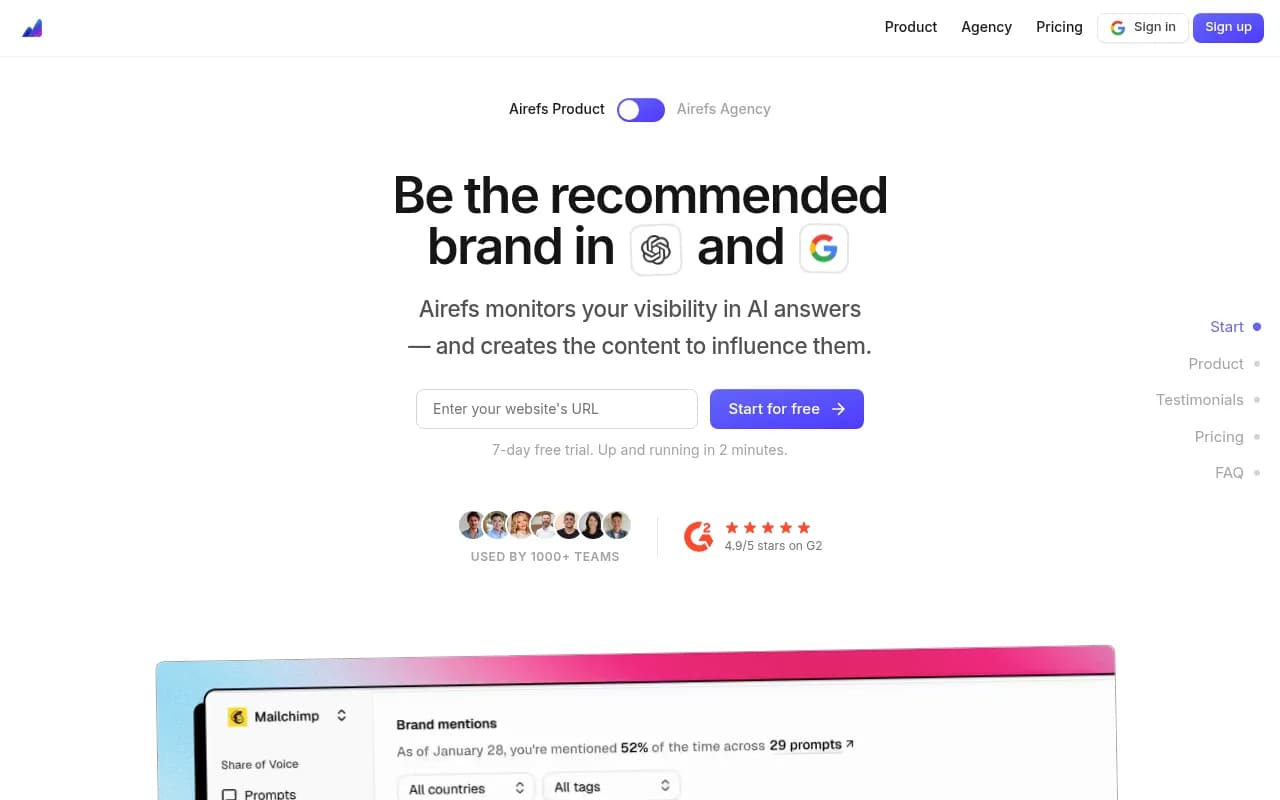
Airefs is another budget option for AI search visibility tracking.
The limit of this category is that it tells you the problem and stops. If your team has the time to act on the reports, that is fine. If you don't, you will have a dashboard nobody opens by February.
If you want the tool to help fix things
Promptwatch is the one I would put here, and I should be plain that this site's publisher, 1001 SEO Media, uses it for its own GEO work. It tracks ChatGPT, Gemini, Claude, Perplexity, Google AI Overviews, and Google AI Mode from the real interfaces, then goes further: a content gap analysis shows which donor questions AI answers without you, and the Action Board turns that into a prioritized to-do list.

Two features matter specifically for charities. First, AI crawler logs show whether AI bots can actually read your site. Plenty of nonprofit sites run on old builds or heavy donation widgets that block or confuse crawlers, and this is an access problem, not a content one. Second, on the Business plan, local GEO targeting pins monitoring to exact coordinates, which suits chapters, food banks, and shelters whose answers are all about "near me."
Pricing as listed at promptwatch.com/pricing: Essential is $95 per month (50 prompts, 1 project), Professional is $245 (150 prompts, crawler logs, 5 AEO articles), and Business is $579 (350 prompts, the automated Content Agent, state and city tracking, local targeting). All plans have unlimited team seats, which fits the multi-department reality of nonprofit teams. There is a 7-day free trial on monthly billing. I have no confirmed nonprofit discount to report, so ask. If you run a consultancy serving several charities, the agency plans start at $199 per month.
If you already pay for an SEO suite
Before buying anything new, check what you have. A research roundup from US Tech Automations lists Semrush, Ahrefs, Google Search Console, and Screaming Frog as the consensus core of nonprofit SEO tools. Both of the first two now have AI tracking add-ons.

The caveat: suites tend to track a fixed prompt set and go shallow on AI-specific data. They are fine as a first look, less good as a long-term GEO program.
If you are a large international NGO
Enterprise platforms make sense when you run campaigns in several countries and languages, and have a team to use the output.

Expect sales calls and annual contracts. Compare against Promptwatch using the head-to-head with Profound before you commit.
If you run local chapters or service sites
For a food bank, a shelter, or a clinic network, the questions are local. BrightLocal combines local SEO rankings, listings, and reviews with AI visibility.
Pair it with clean, consistent listings. Wrong opening hours on a directory is exactly the kind of fact AI repeats.
If you publish a lot of stories and reports
Schema and entity tagging help AI understand who you are and what you do.

This is secondary. Do it after the basics below.
The nonprofit-specific playbook
A tool only measures. What you do next decides whether anything changes. This is the order I would work in.
- Fix crawler access. Make sure robots.txt does not block AI bots you want. Promptwatch's free AI crawler URL inspector and robots.txt generator for AI help here.
- Rewrite program and donate pages. State who you serve, where, what a gift does, and the numbers behind it. Plain facts beat slogans, because AI summarizes what it can extract.
- Add FAQ pages. Answer the real questions: Is my donation tax deductible? Where does the money go? Who is eligible for help?
- Keep your about and impact pages factual and current. Out-of-date figures get repeated.
- Work your third-party presence. Fundraising platform campaign pages, charity-rating profiles, and directories. I could not find citation data for specific rating sites, so check which of these show up when you run your own prompts. Then update the ones that appear.
- Use Facebook and YouTube for AI Overviews. Public pages, captions, and video descriptions matter there more than for ChatGPT.
- Re-run your prompt list monthly. Content has a shelf life. In Promptwatch's content half-life study, landing pages and docs stayed cited longest, while news lost half its pages within 36 days. So evergreen program pages are a better bet than news posts.
A practical note on AI tools in general: only feed public information into any assistant or tracker. StratusLIVE's nonprofit AI guide cites an NTEN and Bridgespan survey in which just 39% of nonprofit executives had written guidance on safe AI use. Write the policy before the pilot.
How to run a 30-day pilot
Pick one tool and one goal. Something like: appear in at least 5 of 15 donor-question prompts in ChatGPT by day 30.
- Week 1: build the prompt list, record the baseline, check crawler access.
- Week 2: rewrite the two or three pages AI should be citing.
- Week 3: add FAQ content and fix third-party profiles.
- Week 4: re-run the prompts, compare, decide whether to keep paying.
If you can't point to a change by then, the issue is probably content or access, not the tool.
Where to look for more options
The catalog is large and changing quickly. For broader comparisons, the GEO software directory at bestgeosoftware.com lists many more tools than fit here.
Bottom line
Start with Search Console and a manual prompt check. If the results show gaps, a low-cost monitor like Otterly.AI or Peec AI covers a small team. If nobody has time to translate reports into action, a platform that also helps write and publish content, such as Promptwatch, earns its higher price. Whatever you pick, ask for a nonprofit rate, keep donor data out, and judge it after 30 days by whether your name shows up more often when someone asks where to give.