Key takeaways
- AI Mode has no ranked list of ten links, so "rank" means whether a brand appears in the answer, how prominently, and which sources get cited. A tracker built on classic SERP positions will miss it.
- For pitching, you need three things: fast setup for a prospect you have never tracked, per-engine reporting, and output a CMO can read without a walkthrough.
- Google's own properties dominate AI Mode citations. Promptwatch Data shows google.com at 7.31% of citations in June 2026, so a tracker should report Google-owned surfaces separately from the client's domain.
- Pricing and AI Mode coverage vary a lot by plan. Some tools gate AI Mode behind higher tiers, so confirm on each vendor's pricing page before you commit.
- Promptwatch is the pick if you want to go past the pitch deck: it finds the gaps, writes the content, and checks whether it worked.
Why AI Mode needs its own tracking approach
Google AI Mode does not return a fixed list of ten blue links. It writes an answer, pulls from several sources, and attaches citations. The same query can return different sources depending on location, device, and time. That makes a single "position 3" number close to meaningless.
What you can measure instead:
- Whether the brand is mentioned in the answer at all
- How prominently, and in what order relative to competitors
- Which domains and URLs get cited
- Share of the answer space against named competitors
- Sentiment, and what claims the model makes about the brand
AI Overviews are a different animal. They sit above a classic results page, and the rest of the SERP still behaves normally. AI Mode drops the list entirely. Some vendors lump the two together, so ask any tool directly whether it captures AI Mode responses or only Overviews.
What the data says about AI Mode citations
This matters for how you frame a pitch. In Promptwatch's Google AI Mode citation share data for June 2026 (May 31 to June 26), google.com took 7.31% of all AI Mode citations, more than YouTube (2.88%) and Reddit (2.52%) combined. Google's own share rose from 4.24% in May, a 72% jump. No independent site in the top 17 cleared 1%.
Two takeaways for agencies. First, the open-web opportunity is in the long tail, so a prospect with strong niche pages can realistically win citations. Second, Google Business Profile, Maps, Merchant Center, and YouTube now work as direct GEO channels. A tracker that only reports on the client's own domain will hide the story.
Engines also differ sharply from each other. In Promptwatch's social media citation data for Sep 28 to Oct 4, 2026, social platforms made up 12.2% of Google AI Overviews citations but only 0.46% of ChatGPT's. A tool that blends every engine into one score can send you into a pitch with a misleading number. Per-engine reporting is not optional.
What agencies should look for when pitching
Tracking for an existing client and tracking for a prospect are different jobs. When you pitch, you have days, not months, and you need a result that makes a skeptical marketing director lean forward.
- Pitch or prospect workspaces. You should be able to spin up a project for a brand you do not yet work with, without paying for a full client seat.
- Fast first data. Some tools take a day or more before the first results show up. Ask how long.
- Real AI Mode capture. Responses collected from the actual interface, not inferred from an API or a generic SERP scrape.
- Competitor view. A prospect cares about the competitor that keeps showing up. Auto-discovered competitors save time.
- Citation detail. Which domains and URLs get cited. Citation slots are scarce: Google AI Overviews cite roughly 10 sources per answer, ChatGPT about 5 (average sources per response, an older report from September 2025).
- Readable reporting. Shareable dashboards or PDFs, ideally white-label.
- A next step. A gap report is nice. A tool that tells you what to publish is better.
- Pricing that scales with clients, not one that punishes you for tracking ten prospects.
Comparison table
Pricing and AI Mode details below mix our own plan data with figures from a vendor comparison blog (Omnia). Treat third-party numbers as starting points and verify on each vendor's pricing page.
| Tool | Best for | Agency / pitch workflow | AI Mode note | Action layer |
|---|---|---|---|---|
| Promptwatch | Agencies that want to find gaps and fix them | Agency plans from $199/mo, unlimited projects and pitch projects | Tracks real Google AI Mode interface, plus AI Overviews and other engines | Content Agent, Action Board, Agent Chat |
| Profound | Enterprise agency rosters | Agency Mode with client workspaces and pitch environments | Reportedly not in the Starter plan; Omnia cites $399/mo minimum | Content creation, crawler attribution |
| Scrunch AI | Agencies that want referral economics | Referral commission, prospecting licenses | Broad model coverage | Agent-ready pages, no content generation |
| Peec AI | Pure multi-client monitoring | Agency plans, pitch projects, unlimited users | Confirm per plan | Light |
| Rankability | Agencies bundling SEO and AI visibility | Shareable dashboards, SPI score | Included, weekly refresh (per Omnia) | Yes, content tools |
| SE Ranking Visible | Agencies managing many small brands | Multi-brand management | Included, daily (per Omnia, $99-$355) | Limited |
| Rankshift | Citation gap analysis | Citation gap focus | Daily to weekly (per Omnia, $92-$473) | Yes |
| Otterly.AI | Solo marketers, small agencies | Low-cost setup | Confirm per plan | Briefs, no content generation |
The best Google AI Mode rank trackers for agencies
Promptwatch
Promptwatch is the one on this list that is built as a full optimization loop, not a dashboard. It monitors the real interfaces of Google AI Mode, AI Overviews, ChatGPT, Gemini, Perplexity, Copilot and more, in the country and language you choose. That matters for AI Mode specifically, because user-facing answers and citations can differ from API outputs.

For a pitch, the useful parts are:
- Agency plans with unlimited projects, pitch projects, prompts and team seats: Kick-off at $199/mo, Growth at $399/mo, Scale at $799/mo. Pitch projects can also be created through the API and MCP.
- Visibility Score, Share of Voice, Position and Sentiment per engine, so you can show a prospect where they are weak in AI Mode specifically, not a blended number.
- Heatmaps and persona views that show how visibility changes by buyer type.
- Brand Narrative, which pulls out the individual claims AI makes about a brand and its competitors. This tends to land well in a pitch because it is concrete. "Gemini says your product lacks X" gets attention.
- Citation tracking including Reddit, YouTube, LinkedIn and Instagram, plus Offsite Mentions for third-party pages naming the brand without linking.
- IP-verified AI crawler logs, which tell you whether the problem is access or content. Most competitors lack this.
The difference after you win the client is that the Content Agent and Action Board turn the gaps into published pages, and Page Tracker and visitor analytics show whether those pages got crawled, cited and clicked. Note the agency plans do not include the Content Agent, AEO articles or the white-label client portal. Agencies that need those go to Enterprise. Business ($579/mo) is the first brand plan with the Content Agent.
How it stacks up against the others: Promptwatch vs Profound, vs Peec, vs Scrunch, vs Otterly. It is also rated 4.7/5 on G2 and ISO/IEC 27001 certified, which helps when a client's procurement team asks. Start with the 7-day free trial, or run the free AI visibility report on a prospect's domain the night before a meeting. See the agency solution page and confirm pricing at promptwatch.com/pricing.
Profound
Profound is the one most agencies name first, and its own agency article calls it the best for the job (it is a vendor blog, so weigh that). Agency Mode gives each client an isolated workspace and a pitch environment, and it tracks multiple answer engines daily. It is strong, and priced like it. Per the Omnia comparison, Google AI Mode is not in the Starter plan, so you would be looking at roughly $399/mo before you can track it. Verify that number.

Good fit if you run AEO as a scaled service with a large roster. Overkill if you want a quick visibility score for a pitch.
Scrunch AI
Scrunch is aimed at enterprise teams and agencies willing to pay for wide model coverage, and it has an infrastructure layer for fixing technical crawling problems. Its partner program is the attraction for agencies: reported referral commission up to 20% and a free prospecting license for pitches. The gap is content generation, which it does not do yet.

Peec AI
Peec AI is the cleaner multi-client monitoring option, with credit-based agency plans, pitch projects, and unlimited users on brand plans. It is a tracker, so pair it with your own content process. Check AI Mode coverage by plan.

Rankability
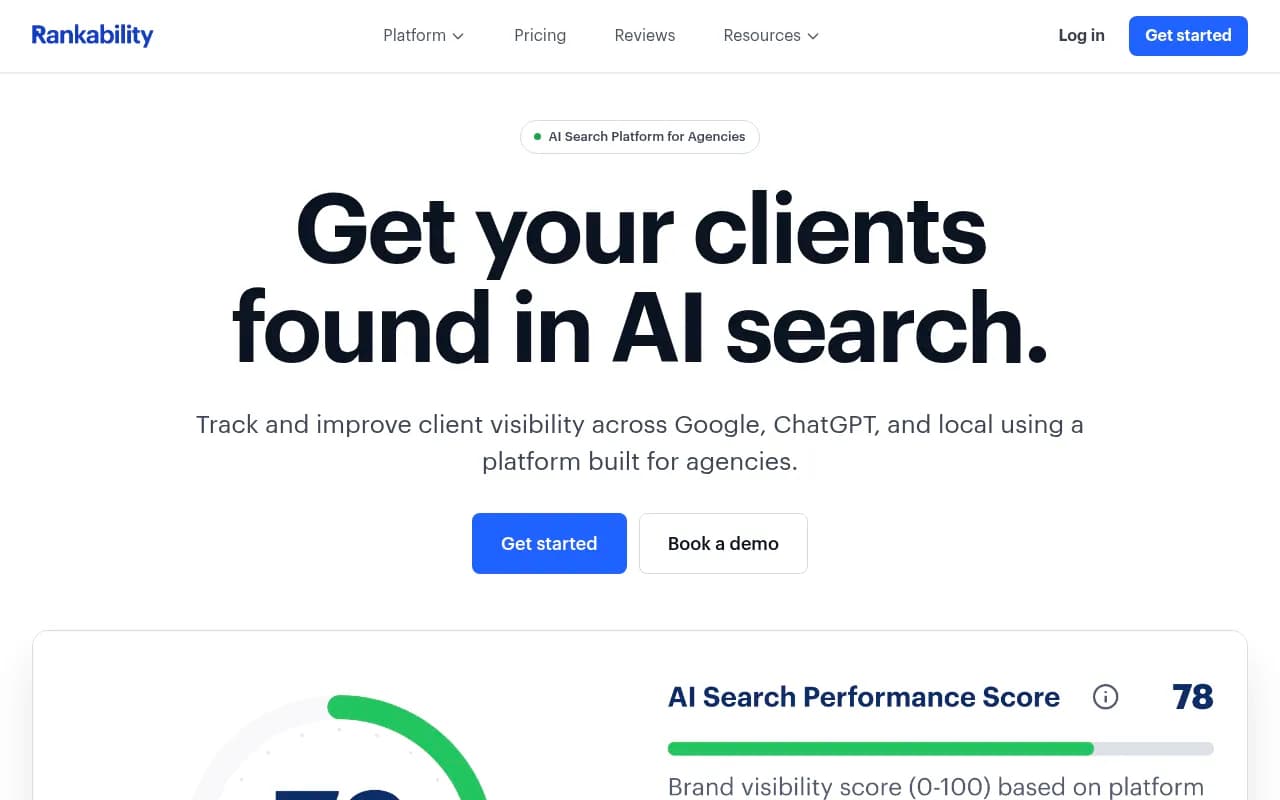
Rankability is built for SEO agencies and combines classic rank tracking with AI mentions and citations in a unified SPI score, in dashboards you can share with clients. Per Omnia it includes AI Mode and refreshes weekly. Weekly is the thing to note: for a pitch it is fine, for monitoring a launch it is slow.
SE Ranking Visible
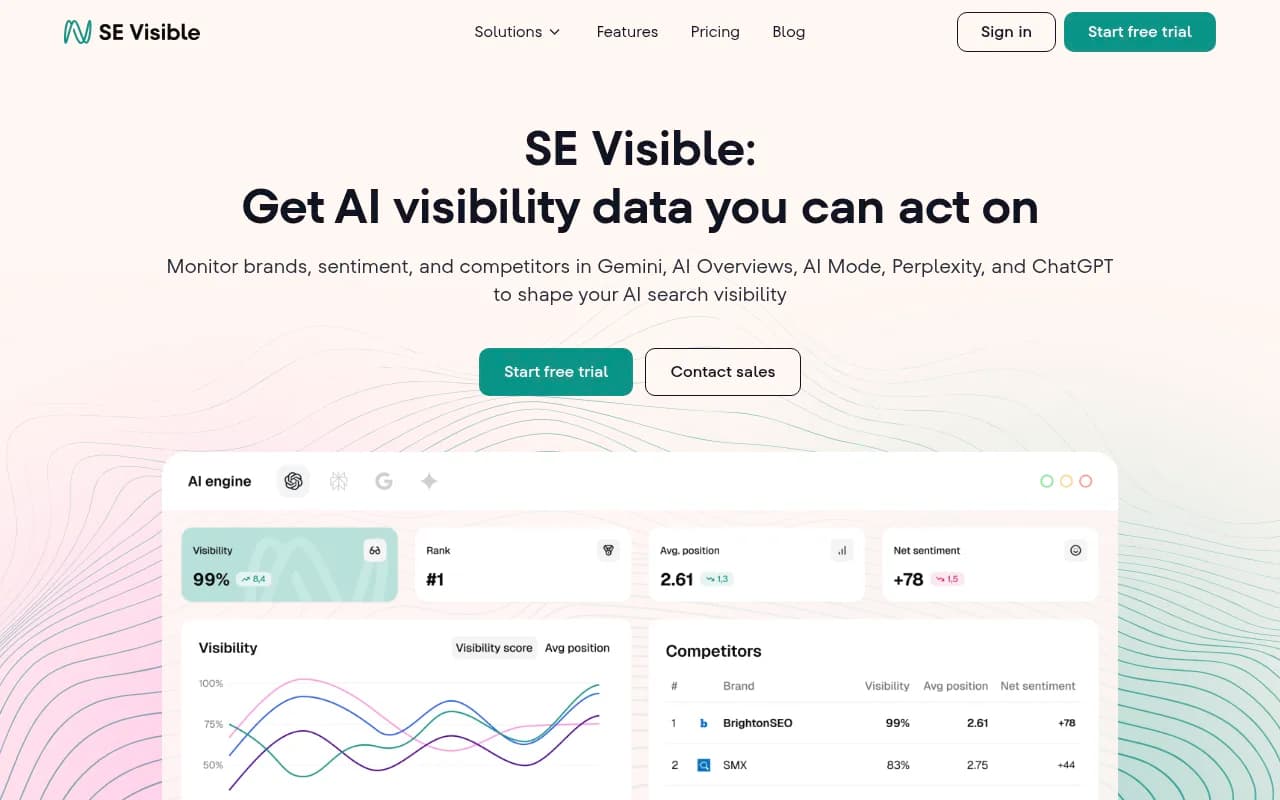
SE Ranking's Visible product is a practical choice for agencies managing lots of small client brands at a low price point, with daily refresh. It lacks an action layer, so it reports and stops.
Rankshift
Rankshift is useful when your pitch hinges on a citation gap: here are the sources AI cites for your competitor and not for you. Refresh runs daily to weekly depending on plan.
Otterly.AI
Otterly is the low-cost entry point for solo marketers and small agencies. Setup is quick and recommendations are clear. It has no real prompt-volume data and no in-platform content generation.

Semrush and Ahrefs Brand Radar
If your agency already lives in Semrush or Ahrefs, the AI add-ons are convenient and clients recognize the brand. The trade-off is fixed prompt sets and shallower AI-specific data, and neither gives you crawler logs.

Others worth a look
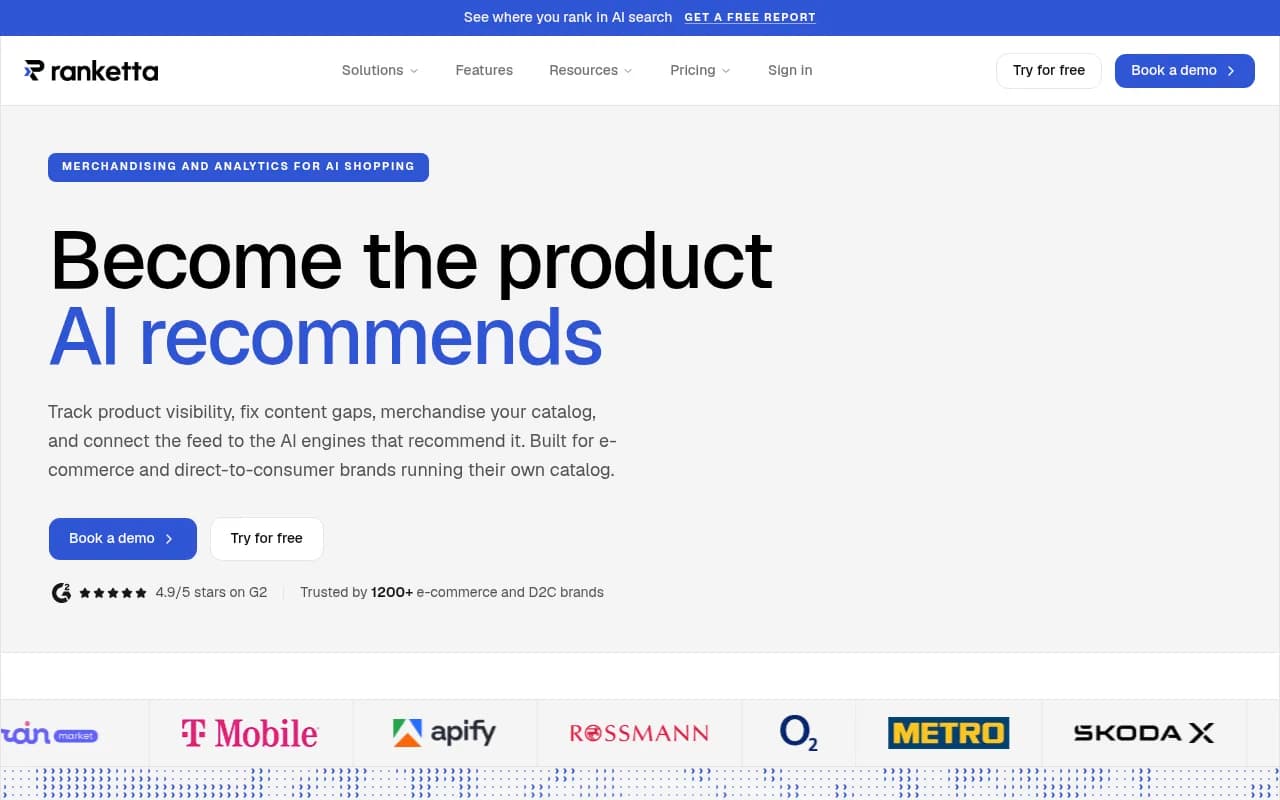
Search Party is an agency-focused AI visibility platform, and Ranketta suits rosters heavy on e-commerce and D2C brands with product-level tracking. For a broader scan, the GEO software directory at bestgeosoftware.com and the AI rank tracker directory list many more.
How to validate a tracker before you pitch with it
Vendor blogs, including a few cited here, tend to rank themselves first. Run your own test.
- Pick one prospect and five prompts you can check by hand in Google AI Mode.
- Run the same prompts in two or three trackers.
- Compare mention, order of brands and cited URLs against what you see manually.
- Run them again next day. Some variation is normal in AI answers, but wild swings mean the tool is capturing noise.
- Check that the tool is capturing AI Mode and not only AI Overviews.
- Time how long it takes from signup to usable data.
If a tool cannot reproduce what you see in the browser, do not put its numbers in front of a client.
Building the pitch itself
A tracker is only half of it. The pitches that work tend to follow a simple shape.
Show the gap, then the cause
Open with a visibility screenshot per engine: here is where you appear, here is the competitor who appears instead. Then show why. Maybe the competitor is cited from a listicle you are not in. Maybe the prospect's key pages are blocked from AI crawlers. Crawler logs and citation data answer that, and it is far more persuasive than a score.
Use the Google-owned angle
Given that google.com is the single biggest cited domain in AI Mode, point out whether the prospect's Business Profile, Maps listing, Merchant Center feed and YouTube channel are in shape. These are quick wins a prospect's own team may have ignored.
Keep the first deliverable small
Propose a 90-day plan with a handful of target prompts, not a 200-prompt monster. The 90-day GEO program in the Promptwatch Academy is a decent skeleton, and GEO for agencies covers reporting cadence.
Be honest about volatility
AI answers move. Tell prospects you will report trends over weeks, not single snapshots. It saves an awkward conversation later.
Which one should you pick?
- You want to pitch and then deliver: Promptwatch. Gap analysis, content, publishing and measurement in one place.
- You run a large enterprise roster and have budget: Profound.
- You want partner-program economics: Scrunch AI.
- You only need monitoring across many clients: Peec AI or SE Ranking Visible.
- You sell SEO and AI visibility as one bundle: Rankability.
- You are testing the water on a tiny budget: Otterly.AI.
If you would rather hand the work to specialists than build the practice yourself, agencies like 1001 SEO Media run GEO and AI search work for brands, and use Promptwatch for the tracking.
Final checks before you buy
Pricing and plan limits change often, and several figures here come from vendor-published comparisons. Confirm AI Mode coverage, refresh cadence, number of prompts per client and white-label options on each pricing page. Then run the five-prompt test above on a real prospect. The tool that matches what you see in your browser, and gives you something to do on Monday morning, is the one to keep.