Key takeaways
- Local GEO (generative engine optimization) is a different problem than brand-level GEO. Agencies need per-location tracking across AI Overviews, AI Mode, ChatGPT, Gemini and Perplexity, not just one visibility score for the whole brand.
- Local Falcon, BrightLocal, GMBapi, and Semrush Local lead the pure local-GEO category in 2026, each with a different pricing model (credit-based, location-banded, flat per-location, or add-on to a bigger suite).
- Pricing models matter as much as features. A $30/location/month tool across 40 clients with an average of 5 locations each runs roughly $14,400/year, so per-location cost needs to be part of the pitch, not an afterthought.
- Gemini and several AI engines pull business details straight from Google Business Profile, so GBP hygiene (hours, categories, descriptions) is now an AI-citability lever, not just a local-pack ranking factor.
- Most agencies end up running a two-layer stack: a local-GEO tool for per-location geo-grid and AI visibility tracking, plus a brand-level platform like Promptwatch for crawler logs, content gap analysis, and automated content production across the whole client portfolio.
Why local GEO is a different animal
Regular GEO asks one question: does ChatGPT mention my brand? Local GEO asks that same question 50, 200, or 2,000 times, once per location, often with different answers in each city. A franchise with 300 locations doesn't have one AI visibility problem. It has 300 of them, layered on top of each other, with some locations citable in Gemini and invisible in ChatGPT, and vice versa.
That's the core reason generic AI-visibility trackers struggle with multi-location clients. They're built to answer "is this brand showing up," not "is location #214 on Main Street showing up when someone asks ChatGPT for the best dentist nearby." Agencies managing franchise, healthcare, home services, or retail chains need geo-grid style tracking married to AI-engine monitoring, and that combination is still a fairly small category.
It's also a crowded fight for citation slots. Promptwatch's data on average sources per response shows ChatGPT typically cites around 5 sources per web-search answer, roughly half what a Google results page offers, while AI Overviews cites about 10 and Perplexity cites almost exactly 10 every day with barely any variance. Fewer slots per answer means a local listing or location page has less room to compete, which is exactly why agencies need visibility into which locations are winning citations and which ones have gone dark.
What to look for in a local GEO platform
Before comparing specific tools, it helps to know what separates a genuinely useful local GEO platform from a rebranded rank tracker:
- Geo-grid tracking (3x3 up to 21x21 grids) combined with AI-engine visibility, not one or the other
- Bulk/campaign-level scanning so an agency can run dozens of locations in one pass instead of location by location
- GBP hygiene monitoring, since Gemini and other engines pull hours, categories, and descriptions directly from Google Business Profile
- A pricing model that scales predictably as the client roster grows, rather than jumping in awkward tiers every time you cross a location-count boundary
- White-label reporting and multi-client workspaces, since agencies are reporting to 10, 30, or 100 separate clients
- Some way to plug into an AI workflow (MCP server, API, or AI agent) for agencies building their own reporting pipelines
The main local GEO platforms compared
| Platform | Pricing model | AI engines tracked | Best for |
|---|---|---|---|
| Local Falcon | Credit-based, $24.99-$199.99/mo retail tiers, enterprise to $4,999/mo | ChatGPT, Gemini, Perplexity, Grok, AI Mode, Apple Intelligence/Maps, AI Overviews | Agencies wanting geo-grid plus broad AI coverage in one scan |
| BrightLocal | Location-count bands, Track/Manage/Grow, ~$41-$65/mo at 1 location | MCP server connects Claude, ChatGPT, Mistral to client data | Agencies already using BrightLocal for citations and reviews |
| GMBapi | Flat per-location, $16 down to $4.50/location at 201-500 locations | ChatGPT, Gemini, Perplexity included at no extra credit cost | High-volume franchise and multi-location rosters |
| Semrush Local | ~$30-$60/location/month | AI Agent, MCP server, AI Visibility Toolkit | Agencies that want local GEO bundled with full-spectrum SEO |
| Localo | $39/mo (1 GBP) to $69/mo (10 GBPs) | AI Agent plus MCP server on every plan | Smaller agencies focused on GBP management |
| GBPPromote | Flat $5.33/location/month | Geo-grid rank tracking, reviews, citations | Budget-conscious agencies needing the cheapest true all-in-one |
Local Falcon
Local Falcon calls itself the original local-focused GEO platform, and the feature list backs that up: geo-grid rank tracking from 3x3 up to 21x21 grids, plus AI Search Visibility tracking across eight platforms including ChatGPT, Gemini, Perplexity, Grok, AI Mode, Apple Intelligence/Maps, and Google AI Overviews. Its proprietary SAIV (Share of AI Voice) metric gives agencies a baseline per location/query pair, which is genuinely useful when a client asks "are we getting better at this."
The catch is the credit system. Pricing starts at $24.99/month for 7,500 credits and climbs to $199.99/month for 63,000 credits, with enterprise tiers running up to $4,999/month. Falcon Agent, an autonomous copilot that can run scans, audit GBPs, and chain workflows, comes free with any paid plan, which softens the credit-pricing sting a bit. One G2 reviewer, an automotive digital director, reported scanning 2,239 locations in a single campaign, so the platform clearly holds up at real enterprise scale.
BrightLocal
BrightLocal's three tiers, Track, Manage, and Grow, price by location-count band rather than a flat per-location rate. At 50 locations, Grow runs about $494/month billed monthly or roughly $370/month annually. At 100 locations, that's $989/month or about $742/month annually. List prices are set to rise 5-10% starting July 2026, so agencies locking in annual contracts now get a better deal than they will later this year.
BrightLocal launched an MCP server in January 2026 that connects Claude, ChatGPT, and Mistral directly to client data, available on the Grow plan. It's also an official Apple Maps and Yelp listing-management partner, which matters for clients outside the Google-only bubble. The tiered pricing is fine for agencies with a stable client base, but it gets awkward the moment a client's location count crosses into the next band.
GMBapi
GMBapi is built specifically for agencies running bulk GBP fulfillment across multi-location and multi-client portfolios, and its pricing reflects that focus: $16/location/month for a single location, scaling down to $4.50/location at 201-500 locations, with no setup fees and a published price-match policy. Local rank tracking and AI visibility tracking across ChatGPT, Gemini, and Perplexity are included on every plan with no credit system, which is a real differentiator against Local Falcon's credit model.
It doesn't have an MCP server yet, which puts it a step behind BrightLocal and Semrush Local for agencies building AI-native workflows. But for agencies whose entire business is high-volume franchise or multi-location management, the flat per-location pricing and included AI tracking make the math easy.
Semrush Local and the full-suite option
Semrush Local costs more per location than the dedicated tools, roughly $30/location/month on the Base tier and $60/location on Pro, but it comes bundled with Semrush's broader SEO toolkit, an AI Agent, an MCP server, and an AI Visibility Toolkit. For agencies already paying for Semrush for organic SEO work, adding local on top can be cheaper than running two separate subscriptions.
Yext and the enterprise listings layer
Yext sits a level above the tools above in both price and ambition. Current enterprise pricing isn't published, it's a custom quote based on location count and product mix, but the self-serve legacy tiers ran $199-$999/year per location as a reference point. The headline feature in 2026 is Scout, Yext's AI agent that delivers a visibility score, AI rankings, brand sentiment, listings accuracy, and prioritized recommendations benchmarked against competitors.
Yext Scout
Yext's Knowledge Graph acts as a single source of truth, address, hours, phone, SKUs, amenities, FAQs, reviews, propagating that data to listings, local pages, locators, and review responses. That structured-data approach is built specifically to be AI-readable, which matters more every month as engines lean on structured business data instead of crawling a page and guessing. Head-to-head against SOCi, Yext wins on data depth and competitive intelligence at enterprise scale; SOCi is the easier pick for franchisees who mostly care about social posting and basic listings updates.
Birdeye Search AI
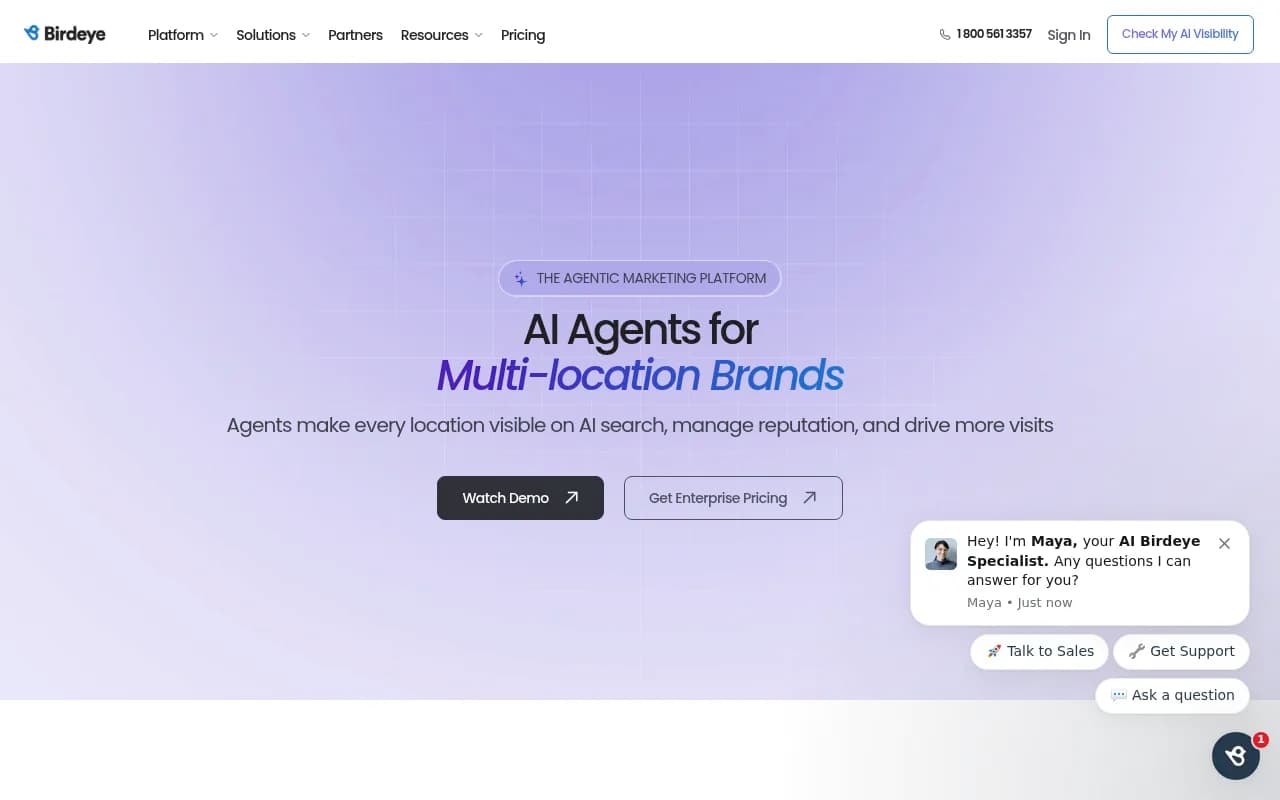
Birdeye's Search AI module tracks "LLM Citation Frequency" and "Query Match Coverage" across ChatGPT, Perplexity, and Gemini for multi-location enterprises, syncing structured business attributes across every branch and review profile. It's worth a look for agencies whose clients already run reputation management through Birdeye and want the AI visibility layer added without introducing another vendor.
The budget end: GBPPromote, Moz Local, Synup
Not every client needs enterprise tooling. GBPPromote prices at a flat $5.33/location/month, which is close to the cheapest true all-in-one on the market, covering bulk updates, geo-grid tracking, reviews, and citations. Moz Local starts around $14-$16/month with custom pricing past 50 locations. Synup splits pricing by module, roughly $35/location for Listings Pro, $20 for Reviews Pro, and $5 for SEO Pro, which lets agencies mix and match per client instead of paying for features nobody uses.
A useful rule of thumb from the pricing research: roughly $5-$30/location/month covers the pure per-location pricing market. A $30/location tool across 40 clients averaging a handful of locations each adds up to around $14,400 a year, so that per-location number needs to show up in the client proposal, not just the internal budget spreadsheet.
Where to put GBP hygiene in the workflow
One detail that's easy to skip over: Gemini pulls local business info directly from Google Business Profile. That means outdated hours, a missing service category, or a sparse business description doesn't just hurt local pack ranking, it directly reduces how often that location gets cited in AI answers. Agencies running audits across client portfolios should treat GBP completeness as an AI-visibility task, not just a local SEO checklist item, and run baseline AI visibility scans across every location and priority query (AI Overviews, AI Mode, Gemini, ChatGPT at minimum) before claiming any improvement.
Citation consistency across directories, the old NAP (name, address, phone) discipline, still matters here too. Inconsistent business data across listings undermines AI trust signals the same way it's always undermined local pack ranking, it's just a bigger deal now because AI engines have fewer citation slots to work with and less patience for conflicting information.
Where a brand-level GEO platform fits
Local GEO tools answer "is this specific location showing up." They don't typically tell you why a location's content isn't getting crawled, what AI traffic a location page actually converts, or how to get a weak location page fixed without manually rewriting 200 pages. That's the gap a platform like Promptwatch fills on top of a local-GEO stack.

Promptwatch tracks AI crawler logs (which bots hit which client pages and whether they error out), citation analytics down to the page level, visitor analytics showing real traffic and conversions from AI platforms, and Content Agents that can draft and publish GEO-optimized updates to a client's CMS. For agencies managing many brands or franchise systems at once, that combination answers the "now what do we fix" question that pure monitoring tools leave open. Promptwatch's content-type research is directly relevant to multi-location work too: product and landing pages make up roughly 39% of all ChatGPT citations, and that share jumps to 22.8% for landing pages specifically on branded prompts, which is a strong argument for building real, distinct location pages instead of one templated page swapped by city name. See the full breakdown in Promptwatch's citation share by content type data.
It's also worth knowing that mid-authority domains (DR 46-75) earned almost half of all ChatGPT citations in August 2026, according to Promptwatch's citation share by domain rank data. Most multi-location client sites will never hit DR 90+, and that's fine. A focused, well-built location page on a mid-authority domain still has a real shot at getting cited.
Recommended stack by agency size
| Agency profile | Suggested stack |
|---|---|
| Small agency, 5-15 location-heavy clients | GBPPromote or Moz Local for per-location tracking, BrightLocal Manage for citations and reviews |
| Mid-size agency, franchise and multi-location clients | GMBapi or Local Falcon for bulk geo-grid and AI visibility, Promptwatch layered on top for brand-level content and crawler insight |
| Enterprise/agency with Fortune 1000 clients | Yext for listings and structured data at scale, Promptwatch or Birdeye Search AI for AI citation tracking and content execution |
Agencies that want to browse more options beyond this shortlist, especially for the broader GEO and AI-visibility category outside pure local use cases, can check the directory at bestgeosoftware.com. For agencies that specifically need to compare AI rank tracking tools against each other, ai-rank-tools.com is a narrower starting point.
A note on the pricing model trap
One pattern worth flagging before signing a contract: tiered, location-band pricing (the BrightLocal model) works fine early in a client relationship, but it gets awkward every time a client crosses a boundary, suddenly jumping from a $65/month tier to a $200/month tier because they opened their 11th location. Flat per-location pricing (GMBapi, GBPPromote) scales more predictably and is easier to explain in a client proposal, since the agency can show exactly how cost grows with the account instead of hitting invisible cliffs. That's a small detail that makes budgeting conversations with clients much less painful six months into a contract.
Multi-location GEO isn't a solved problem yet. The tools above cover the per-location mechanics well, geo-grid, GBP sync, bulk scanning, but the "now fix it" layer is still thin outside of a handful of platforms. Agencies that pair a dedicated local-GEO tool with a broader AI-visibility and content platform are, for now, the ones actually closing the loop from tracking to measurable AI traffic.