Key takeaways
- Bluefish AI still has no public pricing page as of late 2026; bluefishai.com/pricing returns a 404, and every call to action routes to a demo request.
- Independent 2026 reviews estimate annual contracts somewhere between $150,000 and $500,000+, plus $15,000 to $100,000 in implementation, though other sources cite lower monthly tiers ($299 to $799) that likely apply to smaller pilots.
- The company raised a $43 million Series B in April 2026 (co-led by Threshold Ventures and NEA), bringing total funding to $68 million, and added a fifth product pillar, AI Accuracy, in May 2026.
- Bluefish is built for Fortune 500 brands with dedicated PR, brand, and commerce teams. If you don't have that org structure or budget, cheaper self-serve tools cover most of the same ground.
- For teams that need to track AI visibility without a six-figure commitment, platforms like Promptwatch publish pricing upfront and include crawler logs, content generation, and CMS publishing that Bluefish doesn't offer at any tier.
What Bluefish AI actually is
Bluefish calls itself an "Agentic Marketing Platform" for enterprise brands trying to control how they show up in ChatGPT, Google AI Overviews, Perplexity, Claude, and retail AI assistants like Amazon Rufus. It's organized around five pillars: AI Monitoring, GEO Optimization, GEO Measurement, Agentic Commerce, and, since May 2026, AI Accuracy.
Founded in 2024 by Alex Sherman (ex-PromoteIQ, acquired by Microsoft), Jing Feng, and Andrei Dunca (ex-LiveRail, acquired by Facebook), the company has moved fast. It closed a $20 million Series A led by NEA and Salesforce Ventures, then a $43 million Series B in April 2026 co-led by Threshold Ventures and NEA, with Amex Ventures, TIAA Ventures, and Bloomberg Beta also participating. That's $68 million total. Customers named across Bluefish's own announcements and independent reviews include Adidas, American Express, Hearst, LVMH, Ulta Beauty, and Tishman Speyer. The company claims roughly 10% of the Fortune 500 as engaged customers.
None of that tells you what it costs. That's the actual subject of this guide.
The pricing situation in 2026: still closed, still confusing
Here's the blunt version: Bluefish has never published pricing, and that hasn't changed. As of this research, bluefishai.com/pricing returns a 404. There's no free tier, no trial, no self-serve signup. Every button on the site pushes you toward a demo request.
That forces buyers to rely on secondhand numbers, and those numbers don't agree with each other, which is its own signal about how opaque this vendor is.
| Source | Reported figures | Notes |
|---|---|---|
| Nick Lafferty's Profound vs. Bluefish comparison | Growth ~$299/mo, Business ~$799/mo, extra seats $50/mo, crisis response add-on $300/mo | Most granular breakdown found, but unverified against an official Bluefish source |
| QuickSEO comparison | "Five- to six-figure annual" contracts, no self-serve, no free tier | Describes enterprise-only sales motion |
| Meev / OpenLens estimates (mid-2026) | $150,000 to $500,000+/year, plus $15,000 to $100,000 implementation | Closed pilot program, 4 to 6 week onboarding reported |
| Dageno AI review (updated Sept 2026) | No dollar figures given; explicitly warns third-party numbers are unverified | Recommends requesting a full written cost proposal before signing anything |
The most useful thing you can take from this table isn't a single number, it's the range. Monthly tiers in the $299 to $799 bracket almost certainly describe a lighter self-serve-adjacent package that doesn't reflect what a true Fortune 500 deployment costs. The six-figure annual estimates are probably closer to what "the real Bluefish" looks like once you add Collections, Custom AI Audiences, AI Accuracy, and white-glove onboarding.
If you're budgeting for Bluefish, treat this like a procurement project, not a subscription purchase. Ask for a written quote that covers:
- The annual platform fee and minimum contract term
- Included brands, markets, languages, users, prompts, and AI engines
- Implementation, onboarding, custom research, and consulting fees
- API, data warehouse, CRM, and analytics integration costs
- Overage charges, additional seats, and premium support tiers
- Data retention, export rights, and renewal price increases
Most vendors in this category will hand you a slide deck before a number. Bluefish is no different, and that's worth knowing going in.
What changed in 2026: AI Accuracy and the Series B
Two things moved the needle on Bluefish this year. The funding round, obviously, but also a genuinely new product feature that's worth understanding before you evaluate the price tag.
On May 5, 2026, Bluefish launched AI Accuracy, its fifth pillar, alongside a new capability called Brand Vault. The pitch: ingest a brand's first-party content to build a continuously updated, verified source of truth that can be shared with LLMs to reduce hallucinations about that brand. Bluefish cites industry estimates that 5 to 20% of AI responses contain a factual error, and references a March 2026 Rithum survey where 58% of shoppers said their trust in a brand drops when AI gets product information wrong, with 16% abandoning the purchase entirely.
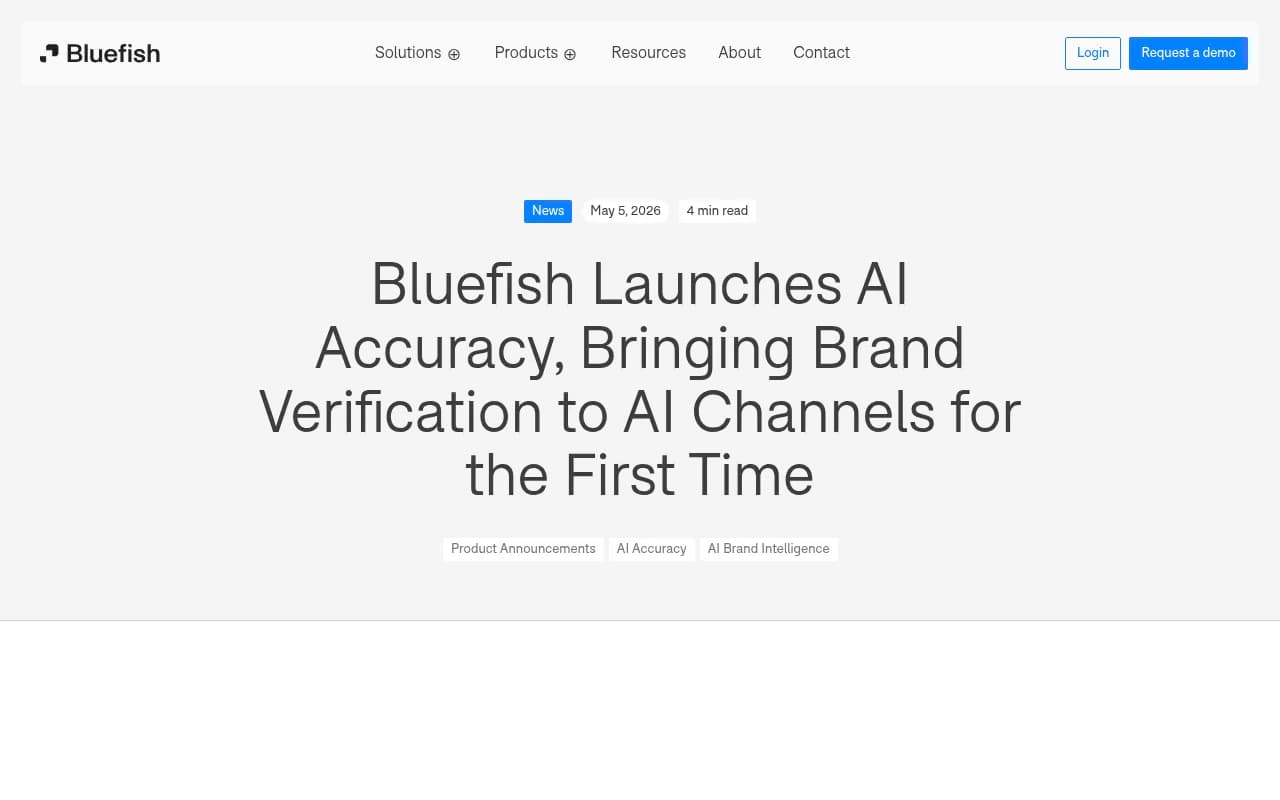
COO Jing Feng put it plainly in the announcement: "AI is only as accurate as its sources, and when AI gets facts about a brand wrong, consumers don't blame AI, they blame the brand." That's a fair point, and it's the kind of thing that actually matters for regulated industries like pharma and financial services, where a wrong AI answer isn't just embarrassing, it's a compliance problem.
Whether AI Accuracy is included in base pricing or sold as an add-on isn't publicly disclosed. Given the pattern with Collections and Custom AI Audiences (both launched as headline features tied to funding announcements), I'd assume it's bundled into higher-tier or enterprise contracts rather than something you get on a $299/month plan, if that plan even still exists in its current form.
Is it still worth it in 2026?
Depends entirely on who's asking.
If you're a Fortune 500 brand with 50+ person marketing headcount, a dedicated PR function, and a six-figure line item already earmarked for "AI search risk," the math can work. Bluefish's coverage of Agentic Commerce (tracking Amazon Rufus and retail AI assistants) is a genuine differentiator most visibility-only competitors don't touch. And in categories with hundreds of SKUs, pricing that changes weekly, and real hallucination exposure, a tool built specifically to catch and fix factual errors in AI answers earns its keep.
If you're not that buyer, the closed pricing model becomes a real obstacle rather than a minor annoyance. By the time you've sat through two demos and a security review, the market has moved. And several reviewers note real functional gaps even at the top end: no GA4 or conversion attribution, no Google Search Console integration, no MCP server for querying data from inside ChatGPT or Claude. Custom AI Audiences are simulated prompt sets, not a direct feed of real user queries, which is worth probing in any demo.
How Bluefish compares to other platforms on price
The table below lines up Bluefish against competitors with published pricing, so you can see roughly where it sits.
| Tool | Entry price | Public pricing? | Notable strength |
|---|---|---|---|
| Bluefish AI | Reportedly $299 to $799/mo, six-figure annual for enterprise | No | Agentic Commerce (Rufus, retail AI), AI Accuracy fact-checking |
| Profound | $99/mo (Growth) | Yes | Lower entry point, similar enterprise focus |
| Scrunch AI | ~$250/mo | Yes | Persona-based tracking |
| AthenaHQ | ~$295/mo | Yes | YC-backed, straightforward visibility monitoring |
| Promptwatch | $95/mo (Essential) | Yes | Crawler logs, content generation, CMS publishing, Reddit/YouTube citation tracking |

A few of these are worth a closer look depending on what you actually need. If Agentic Commerce and enterprise brand-safety features are the draw, Bluefish and Profound occupy similar territory, just at very different price transparency levels.



The case for looking beyond monitoring
Here's the thing that gets lost in most Bluefish comparisons: tracking whether AI engines mention you correctly is only half the job. The other half is doing something about it, fast, when they don't.
Most platforms in this space, Bluefish included, stop at monitoring and briefing. You get a dashboard showing visibility scores, sentiment, and maybe a content brief. Someone on your team still has to write the fix, get it approved, publish it, and wait weeks to see if it moved the needle.
Promptwatch takes a different approach. It's built around the idea that answering "how do I grow AI-driven revenue" matters more than answering "was my brand mentioned." Beyond tracking visibility across ChatGPT, Gemini, Claude, Perplexity, Grok, Google AI Overviews, and AI Mode, it shows you AI crawler logs (which bots hit which pages, and whether they errored out), citation trends broken down by content type, and actual visitor and conversion data from AI platforms to your site. Then its Content Agents write and publish GEO-optimized pages directly to Webflow, Framer, or WordPress on a schedule, closing the loop from insight to action rather than leaving you with a to-do list.

It's used by more than 1,840 brands and agencies, including Duolingo, Yelp, Fireflies, and agency networks like Monks and WPP, and it's rated 4.7/5 on G2. Crisp, one of its customers, reported 2x higher conversion rates from AI traffic compared to traditional channels after adopting it. Pricing starts at $95/month for the Essential plan and scales to $579/month for Business, with agency plans starting at $199/month, all published openly, no sales call required to see the numbers.
That's the contrast that matters here. Bluefish's Agentic Commerce and AI Accuracy features are genuinely useful for the narrow slice of Fortune 500 brands with the budget and org structure to use them well. But for most marketing teams that need to know why they're invisible in AI answers and fix it without a six-month procurement cycle, a platform with transparent pricing and built-in execution is the more practical starting point. If you want to see how Promptwatch stacks up against 20 other GEO platforms including Bluefish, the full comparison is at promptwatch.com/best-geo-and-ai-visibility-platforms-compared-2026.
A quick gut check before you request a Bluefish demo
A few questions worth asking in the first call, based on gaps flagged repeatedly across independent reviews:
- Ask to see the exact prompt and full AI response behind a specific citation, including the cited URL, not just the root domain.
- Ask how Custom AI Audiences are generated. They're simulated prompt sets, not a live feed of real user queries, since AI platforms don't disclose actual user prompts.
- Ask whether content briefs come with any writing, publishing, or localization support, or if that work still lands entirely on your team.
- Ask for sample data in your specific market before treating any coverage or accuracy claim as proven. Vendor claims about "millions of prompts processed daily" aren't independently audited.
If Bluefish can answer those clearly and the number that comes back fits your budget, it's a legitimate option for a large brand with complex, multi-market AI exposure. If the sales process feels slower than your content team can afford to wait, that's worth weighing against tools that let you start seeing data this week instead of next quarter. For a broader look at what else is out there, the GEO software directory at bestgeosoftware.com is a reasonable place to keep comparing options once you've got a sense of your budget.