Key takeaways
- Bluefish, AthenaHQ, and Scrunch AI all target large teams, but they solve different problems: Bluefish is a brand governance and measurement suite for Fortune 500 buyers, AthenaHQ is an automation-first platform that publishes optimized content for you, and Scrunch (acquired by Sitecore in June 2026) is built around serving AI-optimized page experiences directly to bots.
- Pricing diverges sharply. Scrunch publishes a $250/month Core plan, AthenaHQ starts at $295/month self-serve, and Bluefish is sales-led only, with no public pricing at all.
- The real differentiator in 2026 is the action layer. Monitoring where you appear is table stakes; the contested ground is whether the platform helps you win citations, not just count them.
- That contest is getting sharper because ChatGPT's citation inventory is limited and increasingly commercial. Product pages became the most-cited content type on ChatGPT Search in July 2026 at roughly a third of all citations, which favors platforms that can optimize and serve commercial pages.
- If none of these three fit your budget or procurement timeline, there are credible alternatives, including Profound at the high end and end-to-end platforms like Promptwatch that combine monitoring with automated content execution at a lower price point.
The enterprise AI visibility market in 2026
A lot changed in this category over the past year, and honestly, if you evaluated these platforms in 2025 your notes are probably stale.
Scrunch got acquired. Sitecore announced the deal on June 3, 2026, which means Scrunch's Agent Experience Platform now sits alongside a full digital experience platform with content publishing muscle. Bluefish closed a $43M Series B in April 2026, bringing total funding to $68M, and claims roughly 10% of the Fortune 500 as customers. AthenaHQ, the smallest of the three at a $2.2M Y Combinator seed, quietly crossed 100+ paying customers and launched a citation prediction engine that genuinely has no direct equivalent among competitors.
So this is no longer a market of lookalike prompt trackers. The three platforms have diverged into distinct bets on what enterprise AI visibility actually requires.
One more piece of context that shapes everything: the citation economy is tightening. ChatGPT typically cites around 5 sources per web-search answer, while Google AI Overviews and Perplexity cite closer to 10, according to Promptwatch's data on average sources per response. And no single domain holds more than about 4% of ChatGPT Search citations, per Promptwatch's June 2026 citation share analysis. There is no equivalent of "ranking #1 in Google" here. Visibility is won across a long tail of pages, prompts, and engines, which is exactly why enterprises are paying premium prices for platforms that diagnose and fix, not just report.

Bluefish AI: the Fortune 500 brand governance play

Bluefish calls itself an Agentic Marketing Platform, and the positioning is deliberate. It is not trying to be a prompt tracker with enterprise pricing bolted on. It is trying to be the system of record for how Fortune 500 brands appear, and are interpreted, across AI channels.
The platform spans five modules: AI Monitoring, GEO Optimization, GEO Measurement, AI Commerce, and AI Accuracy. The last one is where Bluefish is most differentiated. The AI Brand Vault ingests your first-party content and maintains a continuously updated "source of truth" that can be shared with LLM providers as grounding material. The pitch is about hallucination control: if a model is going to say something about your brand, you want it reading your facts, not a stale forum thread.
The metrics go deeper than most competitors too. Beyond visibility and share of voice, Bluefish tracks favorability, sentiment, safety, and accuracy, with model-aware diagnostics that try to explain which sources and semantic drivers shaped a given answer. For a regulated enterprise, a pharma company, or a luxury brand worried about misrepresentation, that diagnostic depth matters more than raw prompt counts.
The customer list backs the positioning: Adidas, American Express, Hearst, LVMH, Ulta Beauty, Tishman Speyer. Around 80% of customers are reportedly Fortune 500, and the company processes millions of prompts and responses per day.
Where Bluefish falls short
Bluefish is a measurement and governance platform, not an executor. Third-party feature comparisons flag what it lacks: no AI-crawler technical audits, no structured data generation, no automated content publishing, no ChatGPT Shopping carousel tracking. If your team wants a platform that writes and ships content, Bluefish is not that.
Engine coverage is also worth verifying before you sign. As of late 2025, third-party reviews noted Bluefish did not yet support Claude, Copilot, AI Mode, or DeepSeek. Its own April 2026 materials list ChatGPT, Google AI, Claude, Perplexity, and Amazon Rufus, which suggests coverage expanded, but the current engine list should be confirmed on a demo call.
And then there is the buying experience. No public pricing, sales-led only, and third-party estimates put contracts in the five-to-six-figure annual range with multi-week sales cycles. That is normal for enterprise software, but it means Bluefish is effectively inaccessible below a certain budget threshold, which the company seems fine with.
AthenaHQ: automation-first, with an unusual pedigree
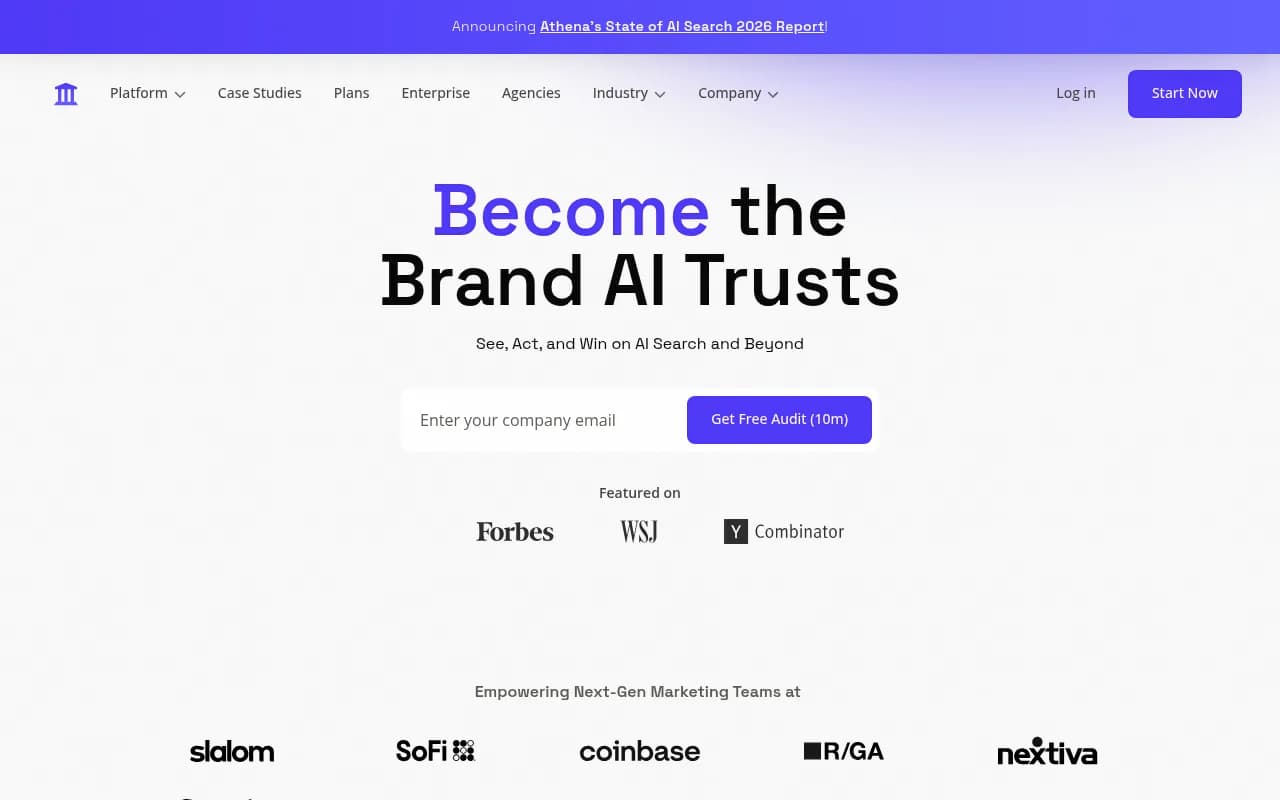
AthenaHQ is the interesting outsider in this comparison. It has a fraction of the funding, but its founder, Andrew Yan, was a Google Search product manager who worked on Google's next-gen AI search alongside DeepMind. That origin shows up in how the product thinks about answer engines.
The core differentiator is the Action Center. It automatically generates and publishes AI-optimized content, enforces brand voice guidelines, and handles on-page and off-page GEO actions, including dynamic robots.txt and llms.txt management for AI crawler access. A base content optimization agent is included even on the entry plan. In a market where most tools stop at dashboards, AthenaHQ actually ships content.
The Enterprise tier adds the Athena Citation Engine (ACE), which reads a piece of content and predicts its likelihood of being cited. I have not seen a direct equivalent in any competitor, and for content teams prioritizing what to publish next, a citation-likelihood score is a genuinely useful primitive. Enterprise also adds SSO, audit logs, multi-region and multi-language tracking, executive dashboards with Tableau, Power BI, and Looker support, and persona targeting.
Named customers include SoFi, Wix, and ZoomInfo. Native integrations with Shopify, Webflow, GA4, and Google Search Console let you tie AI visibility to actual site traffic and revenue, which neither Bluefish nor Scrunch does as cleanly.
Where AthenaHQ falls short
The pricing model is credit-based: $295/month buys 3,600 credits, where one credit equals one AI response. That is transparent at entry but scales unpredictably as you add prompts, engines, and frequency. Self-serve plans are also limited to single-country coverage, so multi-region monitoring requires the Enterprise tier. There is no free trial (some third-party reviews claim otherwise, but AthenaHQ's own pricing page says no), and API access is a paid add-on.
The bigger question for large teams is durability. A $2.2M seed-stage company serving enterprise accounts carries vendor risk that Bluefish, with $68M and Fortune 500 traction, or Scrunch, now backed by Sitecore, simply does not. Some procurement teams will not care. Others will.
Scrunch AI: the agent experience bet, now with Sitecore behind it
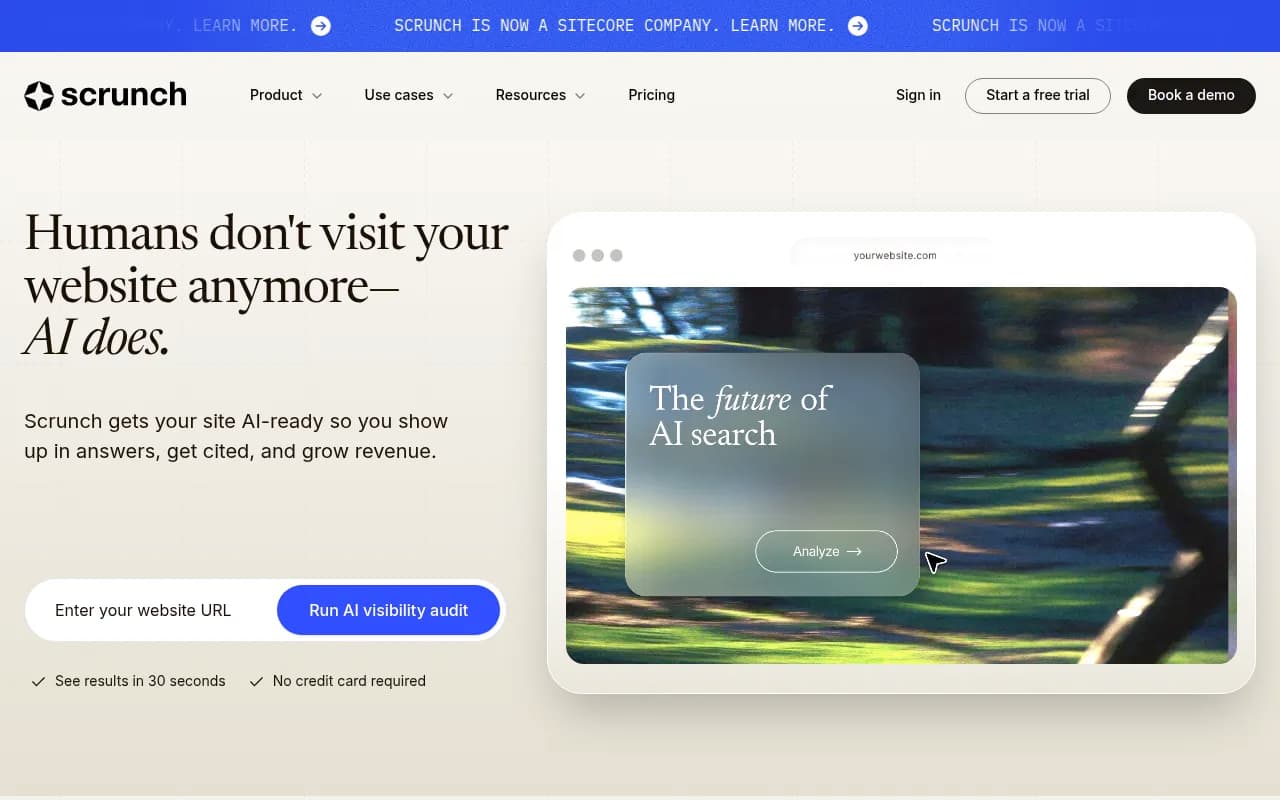
Scrunch's differentiator is the Agent Experience Platform (AXP), a content delivery layer that serves AI-optimized versions of your pages directly to bots. Instead of only changing what you publish, you change what AI agents see when they arrive. Adobe's LLM Optimizer is the only other platform with a comparable feature, per multiple independent comparisons.
The reported results are striking. In Sitecore's own analysis of Akamai, AXP-enabled pages saw a 364% increase in brand presence for non-branded prompts and a 218% increase in citations versus comparable non-AXP pages. Treat those as vendor-supplied numbers, but the mechanism is sound: if AI agents are fetching your pages, controlling the agent-facing version of those pages is a real lever.
The Sitecore acquisition changes the calculus. Scrunch was already serving 500+ brands, including Lenovo, SKIMS, Penn State, and Crunchbase. Now AXP sits next to Sitecore's content publishing and DXP infrastructure, which addresses the execution gap that pure monitoring platforms have.
Where Scrunch falls short
Scrunch is the only one of the three with published pricing, which I appreciate. Core is $250/month (billed annually), and it is more limited than the number suggests: 125 prompts, 4 engines (ChatGPT, Perplexity, Google AI Overviews, Copilot), one country, 5 user licenses, and basic content generation. The full package, meaning AXP, 9 engines, API access, SAML SSO, unlimited countries, and SOC 2 Type II, is Enterprise-only at custom pricing.
One caveat worth flagging: an independent mid-2026 review described AXP as still in limited pilot, "a future promise rather than a current, accessible feature," even though the pricing page lists it as an Enterprise line item. If AXP is the reason you are buying Scrunch, get written confirmation of general availability and deployment timelines before contracting.
AXP also assumes engineering capacity. A content delivery layer is infrastructure, not a dashboard toggle. Mid-to-large enterprises with complex catalogs and dev resources can deploy it; smaller teams will struggle.
Head-to-head comparison
| Bluefish AI | AthenaHQ | Scrunch AI (Sitecore) | |
|---|---|---|---|
| Funding / backing | $68M raised | $2.2M seed (Y Combinator) | $26M raised, acquired by Sitecore (June 2026) |
| Entry pricing | Custom, sales-led only | $295/mo Starter, 3,600 credits | $250/mo Core (annual billing) |
| Engines at entry tier | Not published | 8+ (ChatGPT, Perplexity, AI Overviews, AI Mode, Gemini, Claude, Copilot, Grok) | 4 (ChatGPT, Perplexity, AI Overviews, Copilot) |
| Action layer | Partial (Brand Vault, GEO Optimization module) | Yes (Action Center, auto-publishing; ACE at Enterprise) | Yes (AXP, Enterprise-only; verify GA status) |
| Content publishing | No | Yes, automated | Via AXP and Sitecore DXP |
| Enterprise security | SOC 2, SSO, RBAC | SSO, audit logs at Enterprise | SAML SSO, SOC 2 Type II at Enterprise |
| Standout feature | AI Brand Vault, model-aware diagnostics | Athena Citation Engine | Agent Experience Platform |
| Named customers | Adidas, Amex, LVMH, Hearst | SoFi, Wix, ZoomInfo | Lenovo, SKIMS, Crunchbase, Akamai |
| Best for | Fortune 500 brand governance and accuracy | Automation-first teams tying visibility to revenue | Enterprises with engineering capacity and complex catalogs |
Why the "action layer" is the real battleground
Here is the thing that separates serious platforms from prompt trackers in 2026: what happens after the dashboard tells you something is wrong.
The citation data makes this concrete. Product pages became the single most-cited content type on ChatGPT Search in July 2026, at 32.8% of all citations, nearly double their share from March 2026, according to Promptwatch's citation types analysis. Listicles were the fastest-growing format that month. What that means practically is that AI search is getting more commercial, and the pages that win citations are product and commercial pages that need active optimization, governance, and sometimes entirely agent-facing versions.
A monitoring-only tool can tell you your product pages are invisible. An action-layer platform can rewrite them, publish them, or serve a different version to the bot. That is the whole reason Scrunch built AXP, AthenaHQ built the Action Center, and Bluefish built the Brand Vault. They are three different answers to the same question.
Which platform should your team choose
Choose Bluefish if you are a Fortune 500 brand with governance requirements
If you are a large, regulated, or reputation-sensitive organization, and your primary anxiety is what AI models say about you rather than how many citations you get, Bluefish is the strongest fit. The Brand Vault, the accuracy and safety metrics, and the security posture (SOC 2, SSO, RBAC) are built to pass infosec review at companies where that review is the hard part. Just budget for a sales cycle and an enterprise contract, and do not expect the platform to write your content.
Choose AthenaHQ if you want execution without a sales cycle
AthenaHQ is the pick for teams that want to move fast, publish optimized content automatically, and connect AI visibility to revenue through GA4 and Shopify. The credit model and single-country self-serve limits are the tradeoffs. For a mid-market or upper-mid-market team that would otherwise need an agency to execute on AI visibility insights, the Action Center does real work. Verify the Enterprise tier's pricing directly; third-party estimates of "$2,000+/month" circulate but the company quotes custom.
Choose Scrunch if agent experience is your strategic bet
If your team believes the next phase of search is agentic, meaning AI agents browsing, comparing, and transacting rather than just answering, Scrunch's AXP is the most developed position in this comparison, and Sitecore's backing makes it more deployable than it was a year ago. The Akamai numbers, if they hold for your site, justify the Enterprise contract on their own. But confirm AXP availability in writing, and make sure you have the engineering resources to deploy a content delivery layer.
Alternatives worth a look
These three are not the only credible options for large teams, and depending on your situation, a different lane might serve you better.
Profound remains the category's most-funded player at $155M raised, with a $99 self-serve entry point and deep answer-engine research. If your evaluation list is strictly enterprise, it belongs on it alongside Bluefish.
If your concern is that all of these platforms are monitoring-heavy and execution-light at prices that climb fast, Promptwatch is worth a serious look. It takes the end-to-end approach furthest at a lower price point: crawler logs showing exactly which pages AI bots read and where they hit errors, citation and Reddit/YouTube tracking, visitor analytics tying AI traffic to conversions, and Content Agents that plan, write, and publish GEO-optimized content straight to Webflow, Framer, or WordPress. For a large team that wants the monitoring depth and the execution layer without a five-figure contract, it covers both ends. You can explore the broader field in the GEO software directory at bestgeosoftware.com.
Evertune and Brandlight are two more enterprise-focused names that come up in procurement conversations, both sales-led with custom pricing.


Questions buyers keep asking
Are these platforms worth it for teams already paying for Semrush or Ahrefs?
For monitoring-only needs, probably not; the AI visibility add-ons from the SEO suites cover basic mention tracking. The exception is enterprise teams with real budgets and real stakes, where the dedicated platforms pay back through diagnostic depth, governance features, and execution tooling the suites do not have. Neither Semrush nor Ahrefs has crawler logs or AI traffic attribution, and those two capabilities are where most of the "why are we invisible" questions get answered.
How stable is this market? Should I wait?
The market consolidated meaningfully in 2026, with Scrunch's acquisition being the headline. Waiting has a cost: citation patterns are shifting month to month, and the teams learning now are building institutional knowledge that is hard to buy later. A reasonable hedge is to start with a self-serve plan from AthenaHQ or Scrunch's Core tier, learn what your data looks like, then run an enterprise procurement process with actual requirements in hand.
What should I verify on a demo call before signing anything?
Three things. First, the current engine list, because coverage has been changing quarter to quarter (Bluefish's Claude and Copilot support being the clearest example). Second, the real availability status of any action-layer feature, especially Scrunch's AXP. Third, how pricing scales with volume, since credit models and per-engine add-ons can turn an attractive entry price into an expensive renewal. Get all three in writing.
The bottom line
Bluefish, AthenaHQ, and Scrunch are all real platforms with real customers, which was not true of half this category a year ago. They differ on a fundamental question: is enterprise AI visibility a measurement problem, a content problem, or an infrastructure problem? Bluefish bets on measurement and governance. AthenaHQ bets on automated content execution. Scrunch bets on controlling what agents see. The right answer for your team depends on which of those problems you actually have, and the honest way to find out is a self-serve plan, a month of your own data, and then a procurement conversation where you know what you are buying.