Key takeaways
- A brand narrative is the set of individual claims AI makes about you ("expensive for small teams", "support is slow"), not a mood score or a mention count.
- Track claims by theme: pricing, features, support, reputation. Each theme has a different root cause and a different fix.
- Almost every wrong claim traces back to a source: a stale pricing page, an old review, a Reddit thread, a third-party listicle. Fix the source, not the chatbot.
- Accurate criticism is not an error. Separate "wrong" from "unflattering" before you assign work to anyone.
- Recheck with the same prompts and the same conditions, and report what you observed, not what you assume your fix caused.
Why the narrative matters more than the mention
An AI answer that names your company can still send a buyer away. Maybe it says you start at a price you dropped two years ago. Maybe it says support is email-only when you added live chat. Maybe it just lists you second, after a competitor, with a hedge attached.
The G2 2026 Answer Economy Report, as cited by Directive, found that 64% of B2B software buyers often or very often run into inaccuracies in AI answers, and still use those answers to shape their shortlist. That combination is the problem. Buyers know it's flaky and use it anyway.
Mention tracking tells you whether you appeared. Narrative tracking tells you what you were said to be. Those are different jobs, and the second one is where revenue quietly leaks.
One more thing I want to be upfront about. A narrative problem is sometimes a real business problem. If AI keeps saying your onboarding is painful, the first question is whether it is. As Cathy Mitchell of Echo put it in an October 2026 interview, AI results can act as "an unbiased barometer of overall brand health." You can make information easier to find, but you can't optimize your way out of a product people dislike.
What a brand narrative actually is
Take any AI response about your company and break it into claims. "Affordable for small teams." "Mobile app lacks features." "Great integrations, limited reporting." "Support responds within a day." Each claim is a unit you can check, source, and fix.
Group repeated claims and you get themes. The four that matter for most companies:
| Theme | Typical claims | Usual root cause |
|---|---|---|
| Pricing | Starting price, free tier, hidden fees, "expensive" | Stale pricing pages, old comparison articles, third-party listings |
| Features | What you do and don't support, integrations | Outdated docs, sunset products, thin feature pages |
| Support | Response time, channels, quality | Old reviews, forum complaints, missing support documentation |
| Reputation | Trust, reliability, "worth it" | Review sites, Reddit threads, press coverage, employee reviews |
This maps closely onto what Promptwatch calls Brand Narrative: it pulls the individual claims out of every tracked response, groups repeats, shows which models say each one, and scores each theme from 0 to 100 so you can compare against competitors. It's on every plan.

Step 1: choose the questions before the software
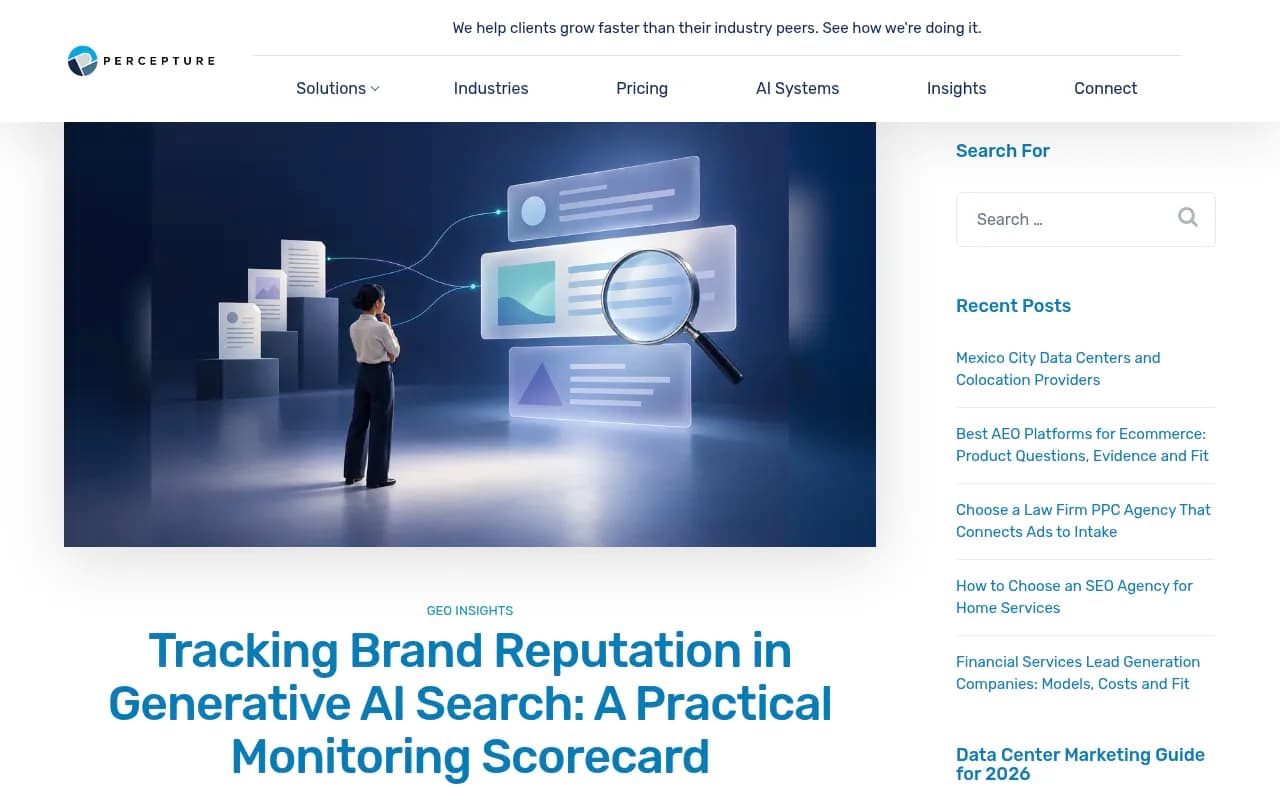
The Percepture scorecard makes a point I agree with: pick buyer questions first, tools second. A communications lead chasing an inaccurate description needs a different question set than a CMO trying to land on supplier shortlists.
Split your prompts into two groups and keep the results apart.
- Branded prompts name your company. "What are the pros and cons of working with [Brand]?" "How much does [Brand] cost?" "Is [Brand] support any good?"
- Unbranded prompts describe the problem or category. "Best project management tool for a 10-person agency." "Cheapest CRM with good support."
A branded answer is evidence of what AI believes about you. An unbranded answer is evidence of whether it brings you up on its own. Mixing them flatters you.
Kurt Krumme at Echo has a useful trick for the weak spots: write prompts aimed at where you're exposed. "Most cushioned running shoes for a beginner" tests whether AI connects your promise to a customer. "Running shoes that wear out fast" is where qualifiers like "overpriced" and "dated" come from. Ask your sales team for the objections they hear, and use those words verbatim.
Use personas, not just topics
A CFO asking about price and an IT admin asking about security get different narratives. If your tool supports personas, use them. Promptwatch's persona insights show visibility, position, and sentiment per persona against the general audience, and flag the persona with the biggest gap.
Step 2: capture enough context to reproduce the check
AI answers vary. As one operations leader quoted by Straight North said, if five people ask the same question the same way, they will likely get different outputs. So a single screenshot is an anecdote.
For each run, record:
- The exact prompt, plus any earlier conversation
- The AI surface and displayed model or mode
- Date, time, and time zone
- Language and location
- The full answer and every cited URL
- The passage that produced each finding
Run each prompt more than once, in clean sessions where you can. Straight North's survey of 100 marketers found 57% prioritized ChatGPT, 42% Gemini, 34% Google AI Mode, and 33% Google AI Overviews, so start where your buyers are rather than testing everything.
One technical point that trips people up: answers from the real consumer interface and answers from an API can differ. The API shows what a model believes from training data. The interface shows what a buyer actually sees, including live search and citations. Promptwatch collects from the real interfaces of ChatGPT, Google AI Overviews, Google AI Mode, Gemini, Perplexity and others, and tracks API models alongside. If you're running manual checks, note which one you used.
Step 3: classify claims, not moods
This is where most audits go soft. They produce a sentiment number and a vague sense of unease. Score claims instead.
| Field | What to record | Why it matters |
|---|---|---|
| Mention | Whether the right organization is named | Separates absence from presence |
| Citation | The source and whether it supports the claim | Finds the evidence gap |
| Recommendation | Whether you're suggested, and for whom | Shows fit, not just inclusion |
| Factual status | Accurate, inaccurate, or unclear | Decides whether it's a correction task |
| Tone | Positive, neutral, negative, mixed, per claim | Tells you if it's fair |
Three rules I'd hold to.
First, tone and correctness are separate. A glowing statement about a service you don't offer is a factual error. A harsh but accurate statement about slow support is not an error just because it stings.
Second, a citation is not proof. A linked page may not support the sentence around it. Open it. Check the company, product, and time period.
Third, don't average away disagreements on material facts. If two analysts split on whether a claim is accurate, record why. Percepture's scorecard says the same: resist compressing everything into one reputation number, because leadership needs to see whether the problem is missing visibility, a wrong claim, weak evidence, or a bad recommendation.
Mentioned versus chosen
AI tends to hedge. Krumme's observation is that models mention their preference first and let order do the talking: "For X, Y and Z, this brand is a great choice. You could also look at..." That's the winner versus the runner-up. So record position in the answer, not only presence. In Promptwatch terms this is the Position metric (lower is better), read next to Share of Voice and Visibility Score. The Academy metrics overview explains how they fit together.
Step 4: trace each claim to its source
This is the step that turns a monitoring exercise into something you can act on. Every claim you flagged came from somewhere. Usually one of these:
- Your own pages, stale or inconsistent
- Review platforms like G2, Capterra, and Trustpilot
- Reddit threads and forums
- Third-party listicles and comparison articles
- Press coverage and old announcements
- Employee review sites, which feed reputation claims
Pricing is the clearest case. Promptwatch Data tracked every page ChatGPT cited on July 6, 2026 for 90 days. In the content half-life report, 78% of landing pages and 76% of docs were still cited after 30 days, and about 69% and 67% after 60. Pricing pages are classified as landing or product pages, so an old price can sit in answers for months. The report's practical advice is blunt: keep prices, features, and positioning accurate on landing, docs, and pricing pages.
News is the opposite. Half of cited news pages were gone after 36 days. A bad press cycle fades faster than a wrong pricing page does.
Also keep the slot count in mind. Promptwatch's sources-per-response data shows ChatGPT citing about 5 sources per web-search answer, while Google AI Overviews and Perplexity cite about 10. With so few slots, which page gets cited and which claim is attached to it matters as much as whether you're cited at all.
On the Reddit question, don't assume it's the villain. Promptwatch's data on Reddit citations in ChatGPT shows reddit.com's share falling from roughly 4% to 0.5% on August 14, 2026, and social media citation data shows ChatGPT drawing just 0.46% of citations from social platforms against 12.2% for Google AI Overviews between Sep 28 and Oct 4, 2026. Which model is repeating the claim changes which source to go after.
Check whether your own site is even readable
Sometimes the wrong claim exists because AI couldn't read the right page. Crawler logs tell an access problem from a content problem. Promptwatch's AI crawler logs are IP-verified, so spoofed bots are filtered out, and show which pages GPTBot, ClaudeBot, PerplexityBot and others read and where they fail. The free Agentic Readiness Check is a quick first look.
Step 5: fix the source, not the symptom
You can't email ChatGPT and ask it to change its mind. You change what it reads. Match the fix to the claim type.
Wrong pricing
Update the pricing page and put the current numbers in plain text, not only in images or interactive widgets. Then hunt down the third-party pages that carry the old number: comparison listicles, directory profiles, review site listings. Ask them to update. Add a short pricing FAQ that answers the questions buyers actually phrase: free tier, annual discount, what's included.
Wrong features or capabilities
Update docs and feature pages first. If a product was sunset or renamed, say so explicitly on a page that is easy to cite. Category ambiguity is a real cause. Directive's point that a wrong AI narrative is rarely a model problem alone, and usually comes from stale sources, inconsistent descriptions, thin proof, or category ambiguity, matches what I see.
Support complaints
First decide if they're true. If they are, fix support and then generate fresh evidence: recent reviews, public response-time commitments, a documented support page. If they're outdated, make sure current reviews outnumber the old ones. Sagefrog's advice is sensible here: build a repeatable process for requesting feedback after successful engagements, because a credible profile is one that shows consistent evidence of strong experiences, not a perfect score.
Reputation and trust
This takes the longest. Independent evidence beats volume. Directive's point is that publishing more brand content isn't the fix if the wider source environment still tells the old story. Original research, case studies, trade coverage, and honest participation in the communities where your buyers talk all feed the digital consensus AI draws from. Respond transparently on Reddit and forums. Correct facts, don't pitch.
Choose the right response level
Not every inaccuracy deserves the same escalation. A direct correction request to a publisher, a public statement, and executive escalation are three different tools. Using the loudest one on a minor error can make a small problem bigger.
Fact checking: closing the loop on a specific claim
Once you've got a list of claims, you need to mark each as accurate or inaccurate and find which of your own pages is teaching AI the wrong thing. Promptwatch's Fact Check does that: you mark a claim Accurate or Inaccurate, and it reads the pages crawled from your site to find the ones that state the claim or its opposite, with quotes and a recommended next step. It's available on Business, Agency Scale, and Enterprise, and uses Agent Credits.
From there the Action Board turns findings into a prioritized to-do list, and the Content Agent (Business and Enterprise) can write and publish corrective pages to WordPress, Webflow, or Framer. Brand Book analysis instructions help with a quieter problem: when your brand name is also a common word, they define what counts as a mention.
Tools for tracking narrative and reputation
The category is crowded, and the tools differ a lot in what they do after the report. Here is how I'd sort them for this specific job.
| Tool | Narrative or claim-level view | Source tracing | Helps fix it | Best for |
|---|---|---|---|---|
| Promptwatch | Brand Narrative claims by theme, Fact Check | Citations, crawler logs, offsite mentions | Action Board, Content Agent, CMS publishing | Teams that want to track and fix in one place |
| Profound | Sentiment in answer engines | Source and citation views | Claims-correction workflow in its marketing | Enterprise teams, higher price point |
| Otterly.AI | Mentions and visibility | Basic citations | Mostly monitoring | Budget monitoring |
| Peec AI | Visibility and sentiment | Source data | Mostly monitoring | Small teams starting out |
| Waikay | Brand perception focus | Limited | Light | Perception checks |
| LLM Pulse | Visibility and reputation | Citations | Light | Reputation-first monitoring |
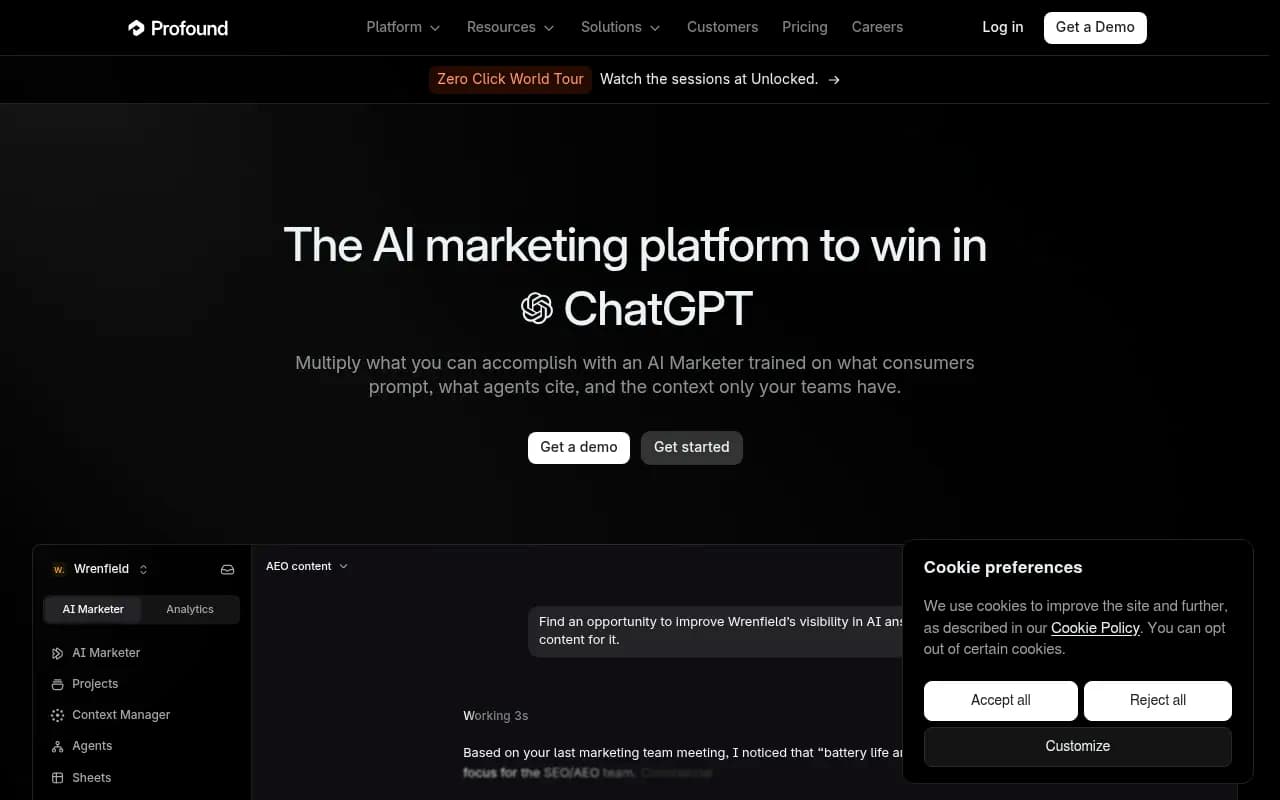
Profound's own site says it traces inaccurate claims back to the publishers repeating them, drafts a personalized correction for each, and tracks which ones updated. That is vendor marketing copy and I haven't verified it, but the idea is the right one, and worth asking any vendor about.





The difference I'd weigh most is whether a tool stops at "here's your score." Most monitoring tools do. Promptwatch is built as a loop: monitor, trace sources, act, then measure whether the page was crawled, cited, and sent traffic. If you're comparing vendors, the Promptwatch vs Profound and Promptwatch vs Peec pages go through the specifics, and the GEO software directory at bestgeosoftware.com lists more options. Pricing starts at $95/month on Essential and Brand Narrative is on every plan; confirm current numbers at promptwatch.com/pricing.
Can you do this by hand?
Yes, to start. Write about 15 buyer questions, run them in ChatGPT, Gemini, Copilot, Perplexity, and AI Overviews in fresh chats, and log whether you appear, whether you're recommended, and whether the facts are right. That's what one Quora respondent recommends, and it's a fair baseline. It stops scaling the moment you want monthly reruns across several models and countries.
Step 6: recheck without fooling yourself
After you fix a source, rerun the same baseline with the same prompts, same surfaces, same location. Report what you saw.
A few habits that keep the reporting honest:
- Keep a stable denominator. If 25% of brand-mention answers in your sample repeated a wrong price, say that. It's not 25% of all buyers or all AI answers.
- Don't count repeated answers about one issue as separate problems.
- If the claim disappears, record that next to the source change. Don't say the edit caused it unless you have evidence.
- Keep referral and pipeline numbers in their own section. Where you can't connect a commercial outcome, leave it unconnected.
On the traffic side, note that ChatGPT stopped sending a referrer on October 8, 2026, so visits can be undercounted unless you tag links with utm_source=chatgpt.com. See the guide to attributing AI traffic for how to handle it.
What to report to leadership
Show decisions, not a mood chart. A useful monthly report has:
- Which buyer questions were checked, and on which surfaces
- The material findings, each with its evidence and source
- Unresolved factual errors, listed apart from fair criticism and from visibility gaps
- Who owns each next action
- Baseline-to-follow-up observations and any changes to the monitoring setup
If your team lacks the time to run this loop, that is where an outside specialist helps. 1001 SEO Media runs this kind of AI visibility and reputation work for clients, using Promptwatch for the monitoring side.
A 30-day plan
- Week 1: write 20 to 30 prompts, split branded and unbranded, include your sales team's worst objections. Run a baseline.
- Week 2: extract claims, group them into pricing, features, support, and reputation. Mark each accurate, inaccurate, or unclear.
- Week 3: trace each inaccurate claim to its source. Fix your own pages and check crawler access. List third-party pages to contact.
- Week 4: publish corrections, request updates, rerun the baseline, and write up what changed and what didn't.
Then do it again next month. Narrative drifts, models update, and a page that was fixed in October can be undermined by a new listicle in December. The free AI visibility report is a no-login way to see where you stand before committing to a process.