Key takeaways
- bydefault, Rankshift, and Ranksmith are all built for smaller teams that want to know whether ChatGPT, Gemini, or Perplexity mention their brand, without the five-figure annual contracts that enterprise AI visibility suites charge.
- None of these three tools do much beyond monitoring. You get a visibility score and a list of mentions. You do not get crawler logs, content generation, or traffic attribution.
- Ranksmith is the most polished of the three for straightforward prompt tracking across multiple models; Rankshift leans into simplicity and speed of setup; bydefault is the leanest option and shows its limits once you need more than a handful of prompts.
- If your team starts asking "why aren't we visible" instead of just "are we visible," all three tools will feel thin. That's the point where a fuller platform like Promptwatch starts to earn its higher price tag.
- Budget for $0-$50/month if you just need a pulse check. Budget for $95+/month once you need action, not just a dashboard.
Why lightweight AI visibility trackers exist
Somewhere around 2025, a lot of marketing teams had the same unpleasant realization. One Reddit thread put it well: a team was ranking #3 on Google for their main keyword, and when they tested the identical query across ChatGPT and other AI platforms, their brand wasn't mentioned at all. Good Google rankings and good AI visibility turned out to be two different games, scored by two different referees.
That gap created demand for a whole category of tools, and the category split fast into two tiers. On one end you have enterprise-grade platforms with crawler log analysis, content generation, and revenue attribution, often priced at $300-$800+ a month. On the other end you have a wave of smaller, scrappier trackers built by solo founders or tiny teams, charging anywhere from free to $50 a month, that answer one question: does my brand show up when someone asks an AI model about my category?
bydefault, Rankshift, and Ranksmith sit in that second tier. They're worth comparing because growing teams, the kind with a marketing hire or two and a budget that still needs sign-off from finance, are exactly the audience these tools are built for.
What each tool actually does
Ranksmith
Ranksmith positions itself straightforwardly as an AI search ranking and visibility platform. It runs a set of prompts against major AI models on a schedule, logs whether and how your brand gets mentioned, and gives you a visibility trend over time. The interface is built around the question most small teams actually ask first: "show me if we're mentioned, and show me the competitors who are mentioned instead."
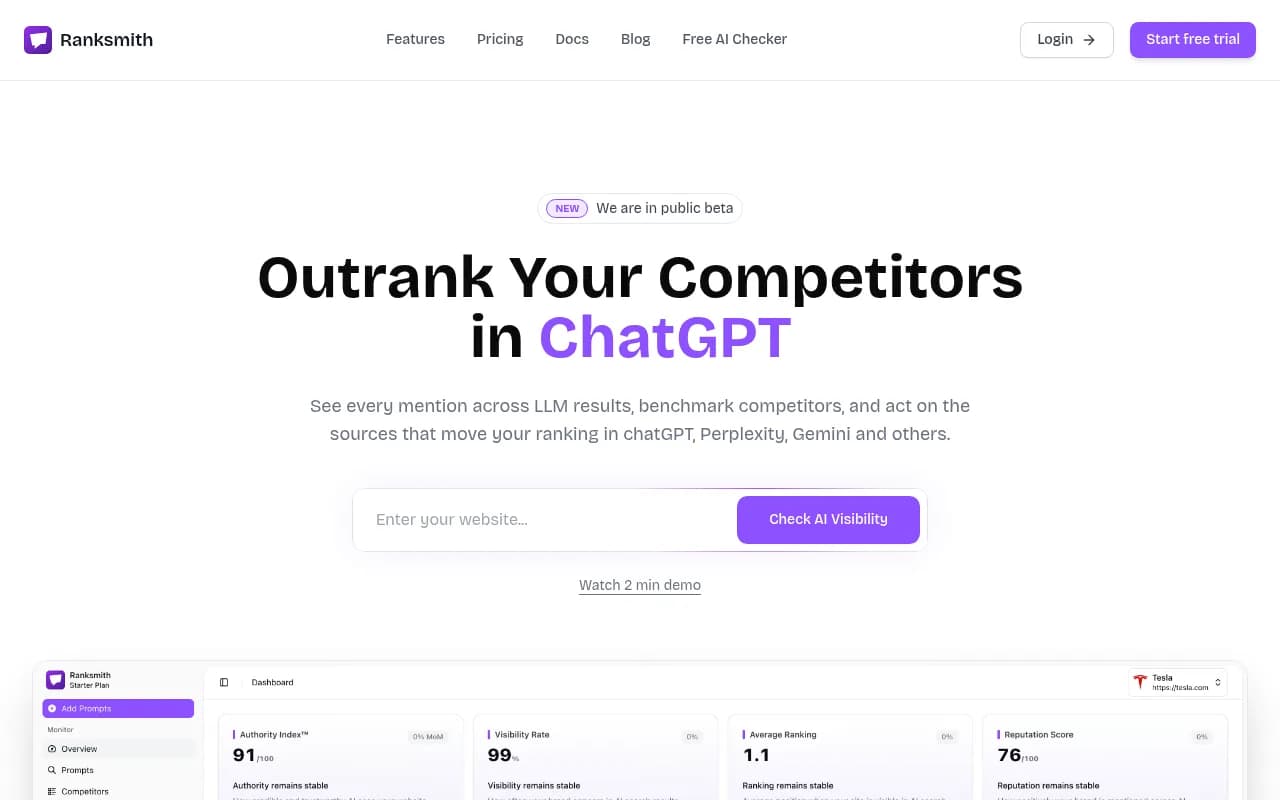
What stands out with Ranksmith compared to the other two is that it treats competitor comparison as a first-class feature rather than an afterthought. You set up your brand and a handful of competitors, and the tool tracks share of mentions across your prompt list. That's useful if your main worry isn't "are we invisible" but "is our biggest competitor eating our lunch in ChatGPT answers."
Rankshift
Rankshift is built around speed of setup. You plug in your domain, it suggests a starter list of prompts based on your site content, and you get a dashboard within minutes rather than hours. It doesn't try to be everything. There's no content generation, no crawler log ingestion, no agency white-labeling. It's a monitoring layer, full stop.
The tradeoff is that Rankshift's prompt suggestions and reporting are fairly surface level. You get a visibility percentage and a timeline, but the breakdown of why a citation happened, or what source AI pulled the answer from, is thinner than what you'd get from tools built around citation analytics.
bydefault
bydefault is the leanest of the three. It's aimed at founders and very small marketing teams who want a basic check rather than an ongoing program. Setup is minimal, the prompt counts are small, and the reporting is intentionally simple: a mention count, a rough visibility trend, and not much else. It's the tool you reach for when you want a yes/no answer this week, not a quarterly AI visibility strategy.
That simplicity is also its ceiling. Once you want to track more than a handful of prompts, segment by region or persona, or understand which pages are actually getting cited, bydefault runs out of road fast.
Side-by-side comparison
| Factor | bydefault | Rankshift | Ranksmith |
|---|---|---|---|
| Best for | Quick pulse checks, solo founders | Fast setup, simple ongoing monitoring | Competitor-focused tracking for small teams |
| Setup time | Minutes | Minutes | Under an hour |
| Prompt volume | Low (a handful) | Low to moderate | Moderate |
| Competitor benchmarking | Minimal | Basic | Stronger than the other two |
| Citation source detail | Very limited | Limited | Moderate |
| Content generation | No | No | No |
| Crawler log analysis | No | No | No |
| Traffic attribution from AI platforms | No | No | No |
| Pricing feel | Free or near-free tier | Budget-friendly, entry tier | Entry to mid tier |
None of these three are trying to compete with the full-stack AI visibility platforms, and that's by design. They're built to be cheap, fast to set up, and understandable by a non-technical marketer in five minutes. If you need that and nothing more, any of the three will do the job. The differences between them matter less than whether this category of tool fits your stage at all.
What all three leave on the table
Here's the honest part of this comparison: lightweight trackers answer "were we mentioned" and stop there. They don't tell you:
- Why a specific page did or didn't get cited
- Whether AI crawlers are even reading your site correctly (robots.txt issues, JavaScript rendering problems, blocked paths)
- What actual traffic and conversions AI platforms are sending you, versus just mentions
- What content to create next to close a gap, and whether that content actually got published
That last point matters more than it sounds. A Medium piece comparing AI visibility trackers put it bluntly: the comparison that matters isn't which tool has more features, it's which tool actually helps a business act on what it finds. Monitoring-only tools are good at producing a dashboard. They're not built to close the loop between "here's a gap" and "here's the content that fills it, published to your CMS."
This is also where Promptwatch's own data on citation behavior becomes useful context, not just marketing copy. Promptwatch's research on ChatGPT citation share by domain rank bucket shows that citation patterns shift week to week as models change how they fan out queries and which domains they trust, which means a one-time snapshot from a lightweight tracker goes stale fast. If you're only checking in monthly, you're often looking at outdated signal.
When a lightweight tracker is genuinely the right call
To be fair to bydefault, Rankshift, and Ranksmith: there's a real case for starting here.
- You're a solo founder or a two-person marketing team and you just want to know if you have a problem before you invest in a fix
- You haven't published much AEO-focused content yet, so there's nothing to optimize against
- Budget is genuinely $0-$50/month, and a $95-$245/month platform isn't realistic right now
- You want a gut check before pitching leadership on a bigger AI visibility program
In these cases, pick whichever of the three fits your workflow. Ranksmith if competitor comparison matters most to you. Rankshift if you want the fastest possible setup with no frills. bydefault if you genuinely just want a number this week and nothing else.
When to graduate to a full AI visibility platform
The signal to move on is usually one of these: you've confirmed you have a visibility gap and now need to know why, your prompt list has grown past what the lightweight plan supports, or leadership wants to see AI-driven traffic and conversions, not just mention counts.
That's the gap platforms like Promptwatch are built to close. Instead of stopping at "you were mentioned 12% of the time," it shows crawler logs of when AI bots actually visited your pages, which specific pages get cited and which don't, Reddit and YouTube citation data most lightweight trackers ignore entirely, and real visitor analytics tracking actual AI-driven traffic to your site. Its Content Agents can then generate and publish GEO-optimized content straight to Webflow, Framer, or WordPress to close the gaps it finds, and Unified Actions turns all of that into a prioritized to-do list instead of a wall of charts.

Promptwatch tracks ChatGPT, Gemini, Claude, Perplexity, Grok, DeepSeek, Copilot, Mistral, Meta Llama, Google AI Overviews, and Google AI Mode, with plans starting at $95/month for a single site and 50 tracked prompts, scaling up to Business and Agency tiers for larger teams. It's rated 4.7/5 on G2 with over 1,840 customers, including Duolingo, Yelp, and Shutterstock, and its data set spans more than 4.5 billion citations analyzed.
A simple decision framework
If you're still unsure which tier to start in, use this:
- If you've never checked your AI visibility at all, start with a free check or a lightweight tracker. You need a baseline before you need a strategy.
- If your baseline shows a clear gap and you're already publishing AEO content regularly, move to a platform that connects monitoring to action, not just another monitoring tool with more prompts.
- If you're an agency managing this for multiple clients, skip the lightweight tier entirely. You'll need white-label reporting and multi-client dashboards that bydefault, Rankshift, and Ranksmith aren't built for.
For teams exploring more options in this space, the GEO software directory at bestgeosoftware.com lists a wider range of platforms by use case and budget, which is worth a look before committing to any single tool for more than a quarter.
Bottom line
bydefault, Rankshift, and Ranksmith are fine starting points, not destinations. Ranksmith edges out the other two if competitor tracking is your priority. Rankshift wins on setup speed. bydefault wins on simplicity and cost, with the caveat that you'll hit its ceiling quickly. None of the three will tell you why you're invisible or help you fix it. That's a different category of tool entirely, and it's worth knowing the difference before you build a quarter of strategy on top of a tool that was only ever meant to be a smoke test.