Key takeaways
- Scrunch was acquired by Sitecore for a reported $225 million in June 2026 and restructured its pricing into two tiers: Core at $250/mo (only 4 engines, 125 prompts, 5 seats) and a custom Enterprise plan that unlocks Claude, Gemini, and its AXP feature.
- Finseo is a small, bootstrapped German company (roughly $220K ARR, two employees) that starts at about €84/mo, gives unlimited seats on every plan, and lets you pick any 3 models freely from a list of 10+, including Claude, at the entry tier.
- Both platforms lean toward monitoring first, optimization second, but they take different paths there: Scrunch concentrates its "fix it" tooling into an Enterprise-only Agent Experience Platform, while Finseo spreads content and crawlability tools across its mid tiers.
- If model flexibility and seat count matter more to you than brand-name backing, Finseo is the cheaper, more flexible pick. If you need enterprise support, a larger customer base, and are fine paying for it, Scrunch (now under Sitecore) is the safer bet.
- Pricing on both sides has shifted multiple times in 2026. Don't trust a comparison page (including this one, eventually) without checking the live pricing page first.
Why these two keep getting compared
Finseo and Scrunch show up in the same breath a lot, and it's not hard to see why. Both position themselves as AI visibility monitoring tools first, with some amount of "now go fix it" tooling bolted on. Neither is a pure content-generation platform like Frase or Clearscope, and neither is a full-stack GEO platform that treats content production as the main event. They sit in the middle: track your brand across ChatGPT, Gemini, Perplexity, and friends, show you where you're losing ground, and give you some (but not unlimited) help closing the gap.
That middle-ground positioning is exactly why picking between them is confusing. On paper they look similar. In practice, 2026 turned into a big year for both, for very different reasons, and the details matter more than the marketing pages let on.
What happened to Scrunch in 2026
The single biggest story here: Scrunch AI was acquired by Sitecore, a large digital experience platform vendor, in a deal reported at $225 million and announced June 3, 2026. Scrunch says it will keep operating as a standalone product while integrating with Sitecore's DXP stack. Founder Chris Andrew has called it an acceleration of the roadmap rather than a pivot, which is the kind of thing every founder says after an acquisition, fair or not.
What's more concrete, and more relevant if you're shopping right now, is that Scrunch's pricing structure changed. Older comparison articles (including some cited in research for this piece) still describe a Starter plan at $250-300/mo with 350 prompts and 7 engines. That's stale. As of the live pricing page in September 2026, Scrunch runs two tiers:
- Core: $250/mo, 125 unique prompts, 5,000 responses/month, 5 site audits/month, 1 brand workspace, 5 user licenses, and only 4 LLMs tracked (ChatGPT, Perplexity, Google AI Overviews, Copilot). No Claude, no Gemini, no Grok. No AXP, no API, no Looker Studio access.
- Enterprise: custom pricing, custom prompts and responses, full site audits, 9 LLMs (adds Claude, Gemini, Meta AI, Google AI Mode, Grok), unlimited countries, personas and languages, custom competitors, API access, SSO, and the AXP feature.
That's a meaningfully smaller entry tier than what used to be advertised, both in prompt count (125 vs the old 350) and engine coverage (4 vs 7). If you're comparing Scrunch to anything based on an article published before August 2026, assume the numbers are wrong and check the source.
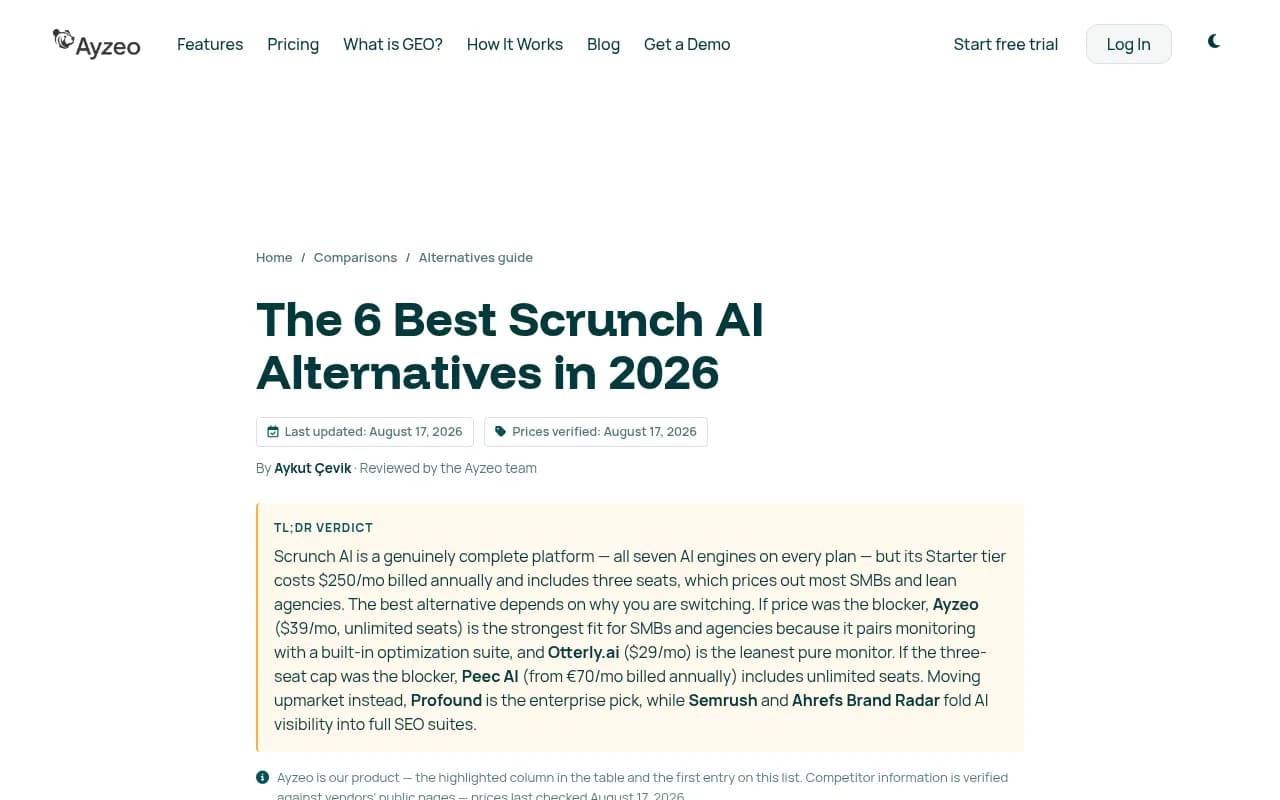
Scrunch's flagship differentiator is AXP, the Agent Experience Platform: it serves a parallel, AI-optimized version of your site invisibly to AI crawlers while human visitors see the normal site. It's gated entirely to Enterprise. Scrunch's own help center has a standing FAQ that basically preempts the obvious question: "Is this considered cloaking? Will we be penalized?" That's worth sitting with for a second. When your product documentation has to proactively reassure customers that a core feature isn't cloaking, it's a reasonable thing to ask about before you commit budget to it, regardless of how Scrunch answers it.

What's going on with Finseo
Finseo is the opposite story in almost every way. It's built by Finseo GmbH, a German company founded in 2025 by David Mühlenweg and Maurice Marinelli, headquartered in Gaildorf. It's bootstrapped, profitable, and reportedly running on about $220K in ARR with two employees. That's not a knock, plenty of useful software gets built by tiny teams, but it's a real contrast to a platform that just got bought for $225 million by a DXP giant. If you're an enterprise buyer weighing vendor risk, that gap is worth naming out loud.
Finseo's pricing, as of its live site in September 2026:
- Starter: about €84/mo (€70 billed yearly), 50 tracked prompts, 3 models picked freely from 10+, roughly 4,500 AI answers a month, 1 project.
- Business: about €210/mo (€175 yearly), 150 prompts, still 3 models, roughly 13,500 answers, 15 articles included, crawlability checks.
- Growth: about €479/mo (€399 yearly), 350 prompts, 3 models, roughly 31,500 answers, 5 projects, 50 articles.
- Enterprise / Managed Service: custom, up to 11 models concurrently, unlimited projects, a dedicated success manager, and an option to have Finseo's own team run your prompt strategy and content production for you.
Team seats are unlimited on every Finseo plan, including Starter. That's a genuine point in its favor against Scrunch's 5-seat cap on Core.
Model coverage is where Finseo pulls ahead at low tiers in a way that actually matters. Every paid plan, even Starter, lets you pick any 3 models from a list that includes ChatGPT, Gemini, Google AI Overviews, Google AI Mode, Claude, Perplexity, Copilot, Grok, DeepSeek, and Mistral, plus regional models like Naver AI Briefing and Qwen on higher tiers. Scrunch's Core plan, by contrast, locks you into a fixed bundle of 4 engines with no Claude at all unless you go Enterprise. If Claude visibility matters to your brand (and for a lot of B2B SaaS and technical audiences, it does), Finseo gets you there for roughly a third of Scrunch's entry price.

One caveat worth flagging, because it applies to Finseo just as much as Scrunch: pricing pages and plan names for both vendors have shifted repeatedly through 2026. Third-party listings for Finseo (OMR Reviews, for example) still show older plan names like Creator and older price points that don't match the current site. Always check finseo.ai/pricing directly before you buy.
Head-to-head comparison table
| Dimension | Scrunch (Core) | Scrunch (Enterprise) | Finseo (Starter) | Finseo (Growth) |
|---|---|---|---|---|
| Entry price | $250/mo | Custom | ||
| Prompts | 125 | Custom | 50 | 350 |
| Models tracked | 4 fixed (ChatGPT, Perplexity, AIO, Copilot) | 9, incl. Claude, Gemini, Grok | 3, freely chosen from 10+ | 3, freely chosen from 10+ |
| Seats | 5 | Custom | Unlimited | Unlimited |
| "Fix it" tooling | None on Core | AXP (agent-served pages) | None on Starter | Content, Tasks, crawlability, API |
| Owner/backing | Sitecore ($225M acquisition, June 2026) | Same | Bootstrapped, ~2-person team | Same |
| Claude access | Enterprise only | Yes | Yes, at entry | Yes |
Where each one actually makes sense
Scrunch's case is strongest for teams that already have enterprise budget and want a vendor with institutional weight behind it. Being owned by Sitecore means there's a much bigger company that can fund the roadmap, support integrations, and (presumably) stick around. Scrunch also claims a case study with Akamai showing a 364% increase in brand presence for non-branded prompts, and lists a customer roster (Lenovo, ADP, Publicis, Seer Interactive) that skews large-agency and enterprise. If you're the kind of buyer who cares about vendor stability and dedicated account teams more than getting the cheapest per-prompt rate, Scrunch's Enterprise tier is built for you, not the $250 Core plan, which feels underpowered relative to what it used to include.
Finseo's case is strongest for smaller teams, agencies with client volume, and anyone who wants Claude and Gemini coverage without paying enterprise prices to get it. The unlimited-seats model on every tier is genuinely useful if you've got a content team, an SEO lead, and a couple of stakeholders who all want dashboard access. The tradeoff is company size: a two-person, ~$220K ARR company is a different kind of bet than a Sitecore subsidiary, and support responsiveness or long-term roadmap commitment is a fair thing to ask about before signing an annual contract, especially on the agency-tier plans which carry a 6-month minimum term.
The bigger question: monitoring vs actually fixing visibility
Both platforms are, at their core, monitoring tools with some optimization features layered on top, and it's worth being honest that monitoring alone doesn't move the needle. Knowing that your brand only shows up in 12% of relevant ChatGPT answers is useful information. It doesn't write the content, fix the crawlability issue, or close the citation gap by itself.
Scrunch concentrates its answer to that problem in AXP, which serves AI-optimized pages to crawlers separately from what humans see, an approach that's drawn some skepticism (including from competitors like Profound, whose comparison content should be read as biased vendor material, not neutral analysis, but the underlying "is this cloaking-adjacent" question is a fair one regardless of who's asking it). Finseo spreads its answer across Business-tier-and-up features: Tasks, Content & Crawlability, Attribution, and an in-app "Finseo Agent" that reads tracked prompts and generates content. Neither approach is dramatically more mature than the other yet; both are relatively new additions to what used to be pure-play monitoring products.
This is one reason it's worth looking at platforms built from the ground up around the full loop of monitoring plus execution, rather than monitoring products that added execution features later. Promptwatch tracks brand visibility across ChatGPT, Gemini, Claude, Perplexity, Grok, and Google AI Overviews and AI Mode the same way these two do, but it also logs AI crawler activity (ChatGPTBot, ClaudeBot, PerplexityBot and 400+ others) hitting your site, tracks real visitor and conversion data from AI platforms, and runs Content Agents that plan, write, and publish GEO-optimized content directly to your CMS on a schedule. Crisp, one of its customers, scaled to 5-10 published articles a day using that workflow and saw AI traffic convert at roughly twice the rate of traditional channels. That's a different model from bolting a content feature onto a prompt tracker after the fact.
How AI engines cite sources matters here too, and it changes often enough that static comparison articles age fast. Promptwatch's own data shows ChatGPT cites around five sources per web-search answer on average, while Perplexity sits closer to ten and Google AI Overviews averages roughly ten as well (average sources per response data). With citation inventories that small, the difference between tracking 4 fixed engines (Scrunch Core) and freely choosing from 10+ (Finseo) is not a minor spec, it directly affects how much of the real competitive picture you're actually seeing.
A few other tools worth a look
If neither Finseo nor Scrunch feels like the right fit, a handful of adjacent platforms are worth a quick look depending on what you're optimizing for. Ahrefs Brand Radar builds its prompt set from real "People Also Ask" data rather than synthetic prompts, which is a meaningfully different data foundation.

Profound leans heavily into agentic action layers on its higher tiers, and Otterly.AI is worth a look if budget is the main constraint, starting around $29/mo with unlimited seats.


For a wider sweep of options, the AI visibility tool directory at bestgeosoftware.com is a reasonable place to keep browsing by category and price point.
Bottom line
If you're choosing purely on entry price and flexibility, Finseo wins: cheaper, unlimited seats, and free choice of models including Claude from day one. If you're choosing on backing, scale, and enterprise support, Scrunch, now under Sitecore, wins, but only if you're prepared to pay Enterprise pricing to unlock the features (Claude, Gemini, AXP) that make the platform worth it. The $250 Core tier sits in an awkward middle: not cheap enough to be a no-brainer starter plan, not feature-complete enough to compete with what Finseo gives you at a third of the price.
Whichever you pick, verify the numbers against the live pricing page first. Both vendors changed their plans multiple times in 2026, and the comparison article you read last spring, including some of the sources referenced here, is very likely already out of date.