Key takeaways
- You can get a useful read on your AI visibility for free in an afternoon, using a mix of manual prompts and free checkers.
- Free checkers from Ahrefs, HubSpot, Omnia, Astiva, SearchIntel and MarketBetter each cover different engines, so pick the ones that match where your buyers search.
- One snapshot is a weak baseline. Results vary by engine and change over time, so repeat the same prompts for several weeks.
- ChatGPT cites about 5 sources per web-search answer, while Google AI Overviews and Perplexity cite about 10, according to Promptwatch Data. Measure each engine separately.
- Use what you learn to decide whether you need a paid tool at all, and which features matter.
Why test before you buy
AI visibility tools are not cheap, and the category is crowded. The tools catalog on this site alone lists well over a hundred products that track brands in ChatGPT, Gemini, Perplexity and friends. Most of them will happily sell you a dashboard before you know whether you have a problem.
So start with free. A few hours of testing tells you three things: whether AI mentions you at all, whether what it says is accurate, and which competitors it names instead. If the answer to all three is fine, you may not need to pay for anything yet. If it is not fine, you walk into a demo knowing exactly what to ask for.
Method 1: the manual prompt audit
This is the most honest check, and it costs nothing. Open ChatGPT, Gemini, Perplexity, Claude and Google AI Mode in separate tabs. Use a logged-out or private window where you can, so your own history does not skew the answer.
Prompts worth running
Mix prompt types. Buyers do not only ask one kind of question.
- Category prompts: "best [your category] tools", "best [category] for small businesses"
- Use-case prompts: "what should I use for [specific job]"
- Comparison prompts: "[your brand] vs [competitor]"
- Brand prompts: "what is [your brand]", "is [your brand] worth it", "what are the downsides of [your brand]"
- Year-tagged prompts: "best [category] 2026"
That last one matters more than it looks. Promptwatch's ChatGPT query fanout data shows that ChatGPT turns one prompt into short, keyword-like web searches (the average query length was in the 50s to 80s of characters by spring 2026). So the searches behind the answer look a lot like old-school keyword queries, not like your long conversational question.
Score it in a spreadsheet
Keep it simple. One row per prompt per engine, with these columns:
| Column | What to record |
|---|---|
| Prompt | The exact text you used |
| Engine | ChatGPT, Gemini, Perplexity, Claude, AI Mode |
| Mentioned | Yes or no |
| Position | Where you appear in the list of brands |
| Cited | Whether your own domain appears in the sources |
| Accuracy | Anything wrong about pricing, features or positioning |
| Competitors named | Who showed up instead |
Ten to fifteen prompts across five engines is 50 to 75 rows. That is an afternoon of work, and it is the baseline everything else gets compared against.
Why you must separate engines
Promptwatch Data on average sources per response shows ChatGPT cites about 5 sources per web-search answer, Google AI Overviews about 10, and Perplexity almost exactly 10 every day. Copilot swung from under 2 to nearly 17 within a few weeks before settling low. In practice that means you have roughly 5 slots in ChatGPT and 10 in AI Overviews or Perplexity, and doing well in one engine tells you little about another. Do not average everything into one number.
Method 2: free automated checkers
The manual audit is slow and you only see a handful of prompts. Free checkers run more queries for you. Each one has different coverage and different limits, so I would try two or three rather than trust any single score.
Ahrefs AI Visibility Checker
Ahrefs queries ChatGPT, Gemini, Perplexity, Copilot and Google AI Overviews with search-backed prompts, meaning questions derived from what people actually search for, then checks whether each platform mentions your brand. It needs no signup, works with product names, personal brands and competitor names, and returns results in seconds. The free version also covers Google AI Mode, according to Ahrefs.
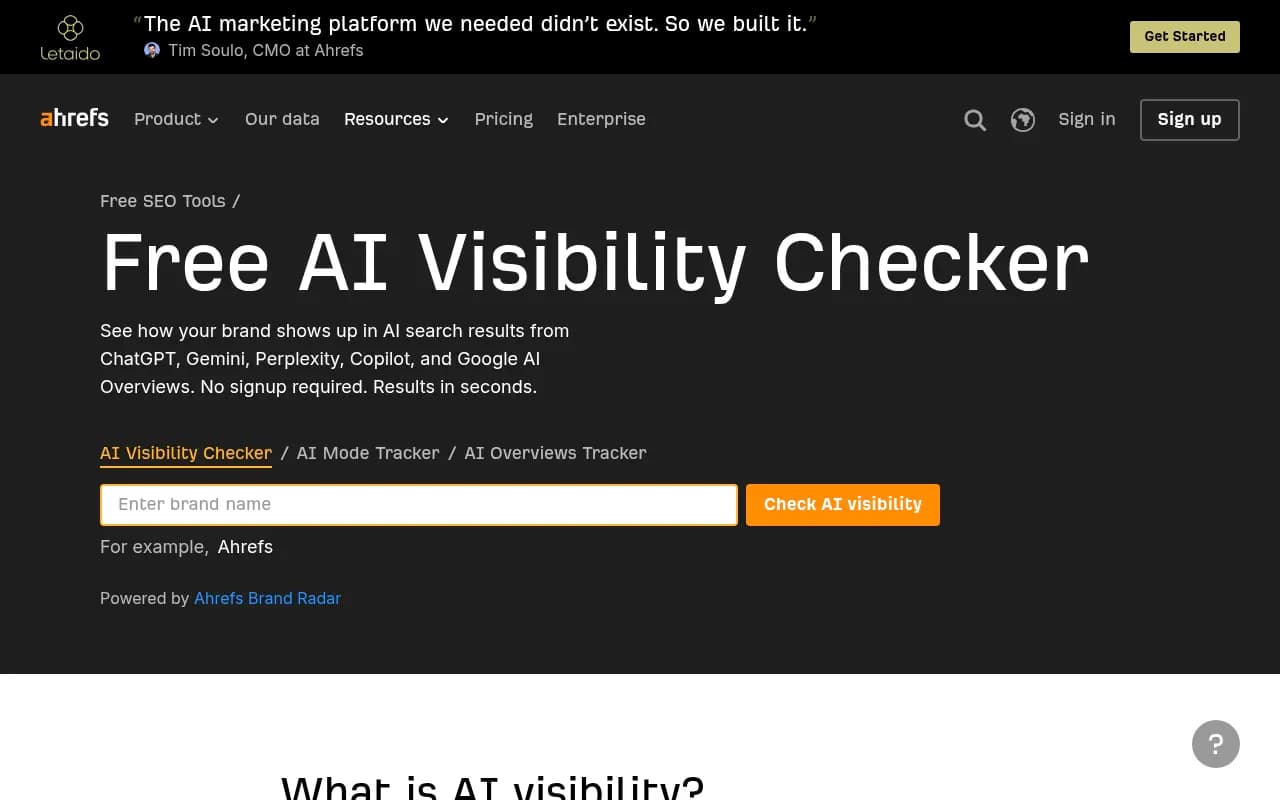
The paid version is Ahrefs Brand Radar, which adds YouTube and Reddit visibility (in beta), search demand and web visibility reports.

HubSpot AI Search Grader
HubSpot's grader is a free one-time check. It asks for your company name, location, product or service and industry, then reports what ChatGPT, Perplexity and Gemini say about you based on their training data. It scores five dimensions: sentiment, presence quality, brand recognition, share of voice and market position, with a written interpretation. No account is required.
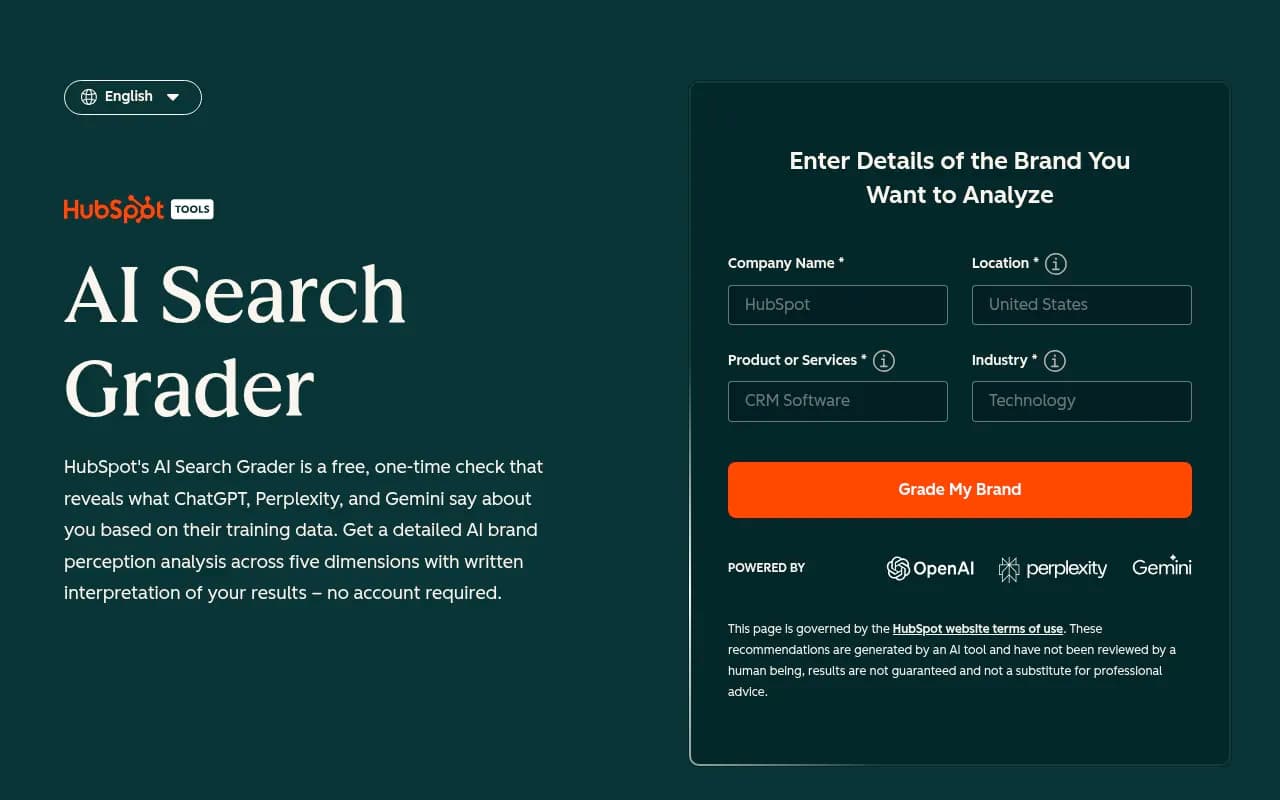
The useful bit is the training-data angle. It tells you what the models believe about you without live search, which is a different question from what they cite today. HubSpot also notes the output is AI-generated and not human-reviewed, so treat the scores as directional.

MarketBetter, Omnia, Astiva, SearchIntel and Topify
These are smaller free checkers. From their own pages:
- MarketBetter's brand visibility checker queries multiple AI models and shows how each describes and positions you, with no signup. Its guide pairs it with a manual 10-prompt audit.
- Omnia checks ChatGPT and Google AI Mode, and emails a report in 3 to 5 minutes with share of voice, cited sources and two suggested actions. You enter a domain and email.
- Astiva scans ChatGPT and Perplexity with buyer queries and reports mention rate, citation position and sentiment, delivered to a dashboard in under 5 minutes.
- SearchIntel queries ChatGPT, Claude, Gemini, Perplexity and Google AI Mode and gives a numeric score.
- Topify builds a brand profile showing how AI models describe your industry, positioning, audience and USPs, no signup.
I have not verified limits or accuracy beyond what these pages say, so expect some to nudge you toward a paid plan or an email list. That is fine, as long as you know the trade.
Quick comparison
| Checker | Engines covered | Signup | What you get |
|---|---|---|---|
| Ahrefs | ChatGPT, Gemini, Perplexity, Copilot, AI Overviews, AI Mode | No | Mentions per platform |
| HubSpot AI Search Grader | ChatGPT, Perplexity, Gemini | No | Five scored dimensions, written analysis |
| Omnia | ChatGPT, Google AI Mode | Share of voice, sources, 2 actions | |
| Astiva | ChatGPT, Perplexity | Dashboard | Mention rate, citation position, sentiment |
| SearchIntel | ChatGPT, Claude, Gemini, Perplexity, AI Mode | Not stated | Numeric score |
| MarketBetter | Multiple models | No | How each model positions you |
| Topify | Multiple models | No | Brand profile and competitors |
Method 3: free tools from AI visibility platforms
Some paid platforms give away real diagnostics. Promptwatch has a free AI visibility report that scans how ChatGPT, Gemini and Perplexity talk about your brand with no login, plus a crawler access check and a list of what to fix. It also offers an Agentic Readiness Check that shows which AI crawlers can read your site, and a free GEO Inspector Chrome extension that shows ChatGPT's query fan-outs and cited sources while you browse.

The crawler check deserves attention. If AI bots cannot read your site, no amount of content work fixes your visibility. Checking your robots.txt and CDN rules is free, and the AI crawler URL inspector tests a specific page.
What to look for in the results
Are you mentioned at all?
If not, you have a coverage problem. AI does not know you exist for those prompts. Look at which competitors show up and which sources get cited. Those pages are your targets.
Is it accurate?
Wrong pricing, outdated features, a discontinued product still listed. These are common and fixable. Note which engine says what, and try to find the page it learned it from. Often it is a third-party listing or an old comparison article, not your site.
Are you cited or only mentioned?
A mention without a link to your domain usually means AI knows of you from elsewhere. That points to a content or crawlability gap on your own site. Promptwatch's citations vs mentions guide explains the difference.
Which sources win?
Source type varies a lot by industry. Promptwatch Data shows ChatGPT leaning on GitHub, Microsoft docs and G2 for software prompts (Sep 28 to Oct 4, 2026), while travel prompts favor Skyscanner, Going and Tripadvisor. If review sites and directories dominate your category, your listings there matter as much as your own pages.
The trap: a single snapshot
Free one-time checks are a snapshot, and AI answers move. In Promptwatch's data, Copilot's citation counts swung widely over a few weeks, and ChatGPT's search behavior shifted noticeably between December and April. A score you get today may not hold next month, and different checkers can disagree with each other.
So repeat it. Run the same prompt set weekly for four to six weeks, record each engine separately, and look at the trend rather than any one number. If your mention rate bounces around wildly, you are not stable in that engine yet.
When free stops being enough
Free methods break down in predictable places:
- You need more than 20 or so prompts, or several countries and languages.
- You want daily tracking without redoing it by hand.
- You need to know which pages AI crawlers actually read, and whether AI traffic converts.
- You manage clients, and need reports.
- You want someone, or something, to fix the gaps and not just point at them.
At that point, a paid tool earns its keep. The category splits roughly into three groups. Monitoring-focused trackers such as Otterly.AI, Peec AI and Rankscale are cheap and simple. SEO suites such as Semrush and Ahrefs Brand Radar add AI tracking to existing workflows. End-to-end platforms like Promptwatch add crawler logs, visitor analytics and content generation on top of tracking.


Promptwatch starts at $95 per month for Essential, with a 7-day free trial on monthly billing; confirm current plans at promptwatch.com/pricing. For more options, the GEO software directory at bestgeosoftware.com and the rank tracker list at ai-rank-tools.com are good places to compare.
Questions to ask before paying
- Does it use the real interfaces of ChatGPT and Google AI Overviews, or only APIs? Answers can differ.
- Can I pick country and language per monitor?
- Does it show which pages AI crawlers read?
- Can I export raw responses and citations?
- Does it help me fix gaps, or just report them?
- What counts as a prompt, and what happens when I go over?
A simple one-week plan
- Monday: write 10 to 15 prompts across category, use-case, comparison and brand types.
- Tuesday: run them manually across ChatGPT, Gemini, Perplexity and AI Mode, and log the results.
- Wednesday: run Ahrefs and HubSpot's grader, and one more checker of your choice. Compare against your spreadsheet.
- Thursday: check crawler access with a free robots.txt and AI crawler test.
- Friday: list inaccuracies, missing prompts and the sources competitors win from.
- Following weeks: repeat the same prompts weekly and track the trend.
After a month you will know whether your visibility is stable, where it is weak, and whether the work needs a tool or just a few content fixes. If you do decide to buy, you will be buying against a specific problem, not a vague fear.
If you would rather have a team handle the tracking and the fixes, agencies such as 1001 SEO Media, which publishes this site, run GEO programs for brands. That is optional. Plenty of teams get far with the free methods above.