Key takeaways
- Gauge Growth ($599/mo) runs 600 prompts daily across ChatGPT, Google AI Mode and Microsoft Copilot, and includes 18 publish-ready articles a month.
- Google AI Overviews, Gemini and Perplexity are Enterprise-only on Gauge. Promptwatch tracks all supported models on every plan, starting at $95/mo.
- Promptwatch adds IP-verified AI crawler logs, visitor analytics and Search Console data next to citations. Gauge's published plan table lists none of the crawler-log side.
- Gauge is the better fit if you want a managed-feeling, prompt-heavy program with strategy sessions. Promptwatch is the better fit if you want the whole monitor, trace, act and measure loop in one tool.
- Check both pricing pages before buying. Plans change, and Promptwatch is running a Black Friday discount through November 30, 2026.
What each tool is trying to be
These two products start from different ideas, and that matters more than any feature checkbox.
Gauge calls itself "The Agent-Led Growth Platform", and its AI visibility product is Gauge Chat. The pitch is prompt-level intelligence: run a lot of prompts, every day, and show you exactly how you appear in each answer. A content engine and an agent chat (Ask Gauge) sit on top.

Promptwatch is built around a loop. It monitors what AI says, traces which pages and third-party sources AI cites, helps you act on gaps with content agents and an action board, then measures whether the fix got crawled, cited and clicked.

One naming warning. Gauge also sells Gauge Agents, a separate product that evaluates coding agents (free hosted plan, paid from $499/mo, plus an open-source CLI). It has nothing to do with brand visibility, so ignore it for this comparison.
Side-by-side comparison
| Gauge (Growth) | Promptwatch (Professional) | |
|---|---|---|
| Entry price | $599/mo | Essential from $95/mo, Professional $245/mo |
| Prompts | 600 daily (54,000 answers/month) | 150 prompts, 18,000 responses/month |
| Core engines | ChatGPT, Google AI Mode, Microsoft Copilot | All supported models on every plan, including ChatGPT, Gemini, Perplexity, AI Overviews, AI Mode, Copilot, Claude |
| Other engines | AI Overviews, Gemini, Perplexity on Enterprise only; Claude and Grok via your own API key | Included |
| Content | 18 articles/month | 5 AEO articles on Professional; Content Agent from Business ($579/mo) |
| CMS publishing | Webflow, Framer, Sanity, GitHub | WordPress, Webflow, Framer |
| AI crawler logs | Not in the published plan table | Yes, from Professional (25M logs) |
| Visitor analytics | GA4 integration | Built-in AI visitor analytics plus Search Console and Bing |
| Seats | 3 | Unlimited |
| Locations | Single | Country on every plan; state/city on Business and up |
| Sentiment and exports | Enterprise only | Sentiment on all plans; exports from Professional |
Volumes are not apples to apples. Gauge counts an answer as one prompt on one platform, so 600 prompts times 3 platforms times 30 days gives 54,000. Promptwatch's response allowances are lower on paper, but you pay roughly a fifth of the price at the comparable tier, and every model is included.
Where Gauge is strong
Volume and a clear cost-per-answer story
Gauge's argument is that cheap-looking tools get expensive once you count answers. Its own comparison pages put it at about $11.09 per 1,000 answers and claim Ahrefs Brand Radar costs far more per answer. Those are Gauge's marketing numbers, so treat them as a starting point, but the math on Growth is real: 54,000 answers a month is a lot of daily signal on three engines.
Daily runs of 600 prompts give you a steady trend line, which helps if you are reporting to a leadership team that dislikes noisy charts.
Content included at a useful volume
Eighteen publish-ready articles a month on Growth is more content than Promptwatch's Professional tier (5 articles, with add-ons up to 50). Publishing to Sanity and GitHub is also something Promptwatch does not list, which matters for headless and docs-as-code teams.
A hands-on relationship
Enterprise includes recurring strategy sessions with the Gauge team. One customer quote on the site, from the VP Marketing at Compt: "It's the most expensive tool we have, but we happily pay them every month." That is a vendor-selected quote, but the sentiment fits the product: it is priced as a premium, high-touch service.
Where Promptwatch is stronger
Engine coverage at the price you actually pay
On Gauge Growth you get three engines. If your buyers use Perplexity, Gemini or Google AI Overviews, you need Enterprise. Promptwatch tracks all supported models on every plan, collected from the real interfaces of ChatGPT, Gemini, Perplexity, AI Overviews, AI Mode and Copilot rather than APIs only, in the countries and languages you pick. User-facing answers and citations can differ from API output, which is why the interface-level approach matters.
Crawler logs, so you can tell access problems from content problems
This is the biggest gap in the published plans. If AI never cites a page, is it because the content is weak or because GPTBot got a 403? Promptwatch's AI crawler logs are IP-verified (spoofed bots filtered out), show which pages each bot read, what errors it hit, and join crawls to citations per page. Without that, you are guessing.
The loop closes
Promptwatch's Action Board prioritizes what to fix, the Content Agent (Business and up) writes and publishes against visibility gaps, and Page Tracker plus visitor analytics show whether the page got cited and sent traffic. Crisp, for example, reports 2x higher conversion rates from AI traffic than from traditional channels while scaling to 5-10 articles a day. Gauge generates content too, but its measurement leans on GA4 and Search Console integrations rather than a built-in crawl-to-citation path.
Query fan-outs
Prompt-level tracking has a blind spot: the model does not search your literal prompt. Promptwatch Data's ChatGPT query fanout report tracked average web searches per response falling from about 2.15 in early December to about 1.84 by early March, with fanouts returning in April at exactly 1.0 per response. Average fanout query length dropped from roughly 117 characters to the high 80s, then about 53 characters in April. The intro on that page still says a prompt can trigger 3-8+ searches, which does not match the tracked averages, so trust the averages.
The practical point: you win by matching the short queries ChatGPT generates, not the long prompt a user typed. Promptwatch shows fan-outs per model alongside prompt visibility. Its recommendations are simple: headings that read like short search queries, entity and category up front in titles and H2s, focused pages for comparisons, pricing and alternatives, and a heading re-audit after major ChatGPT updates.
Honest caveats on Promptwatch
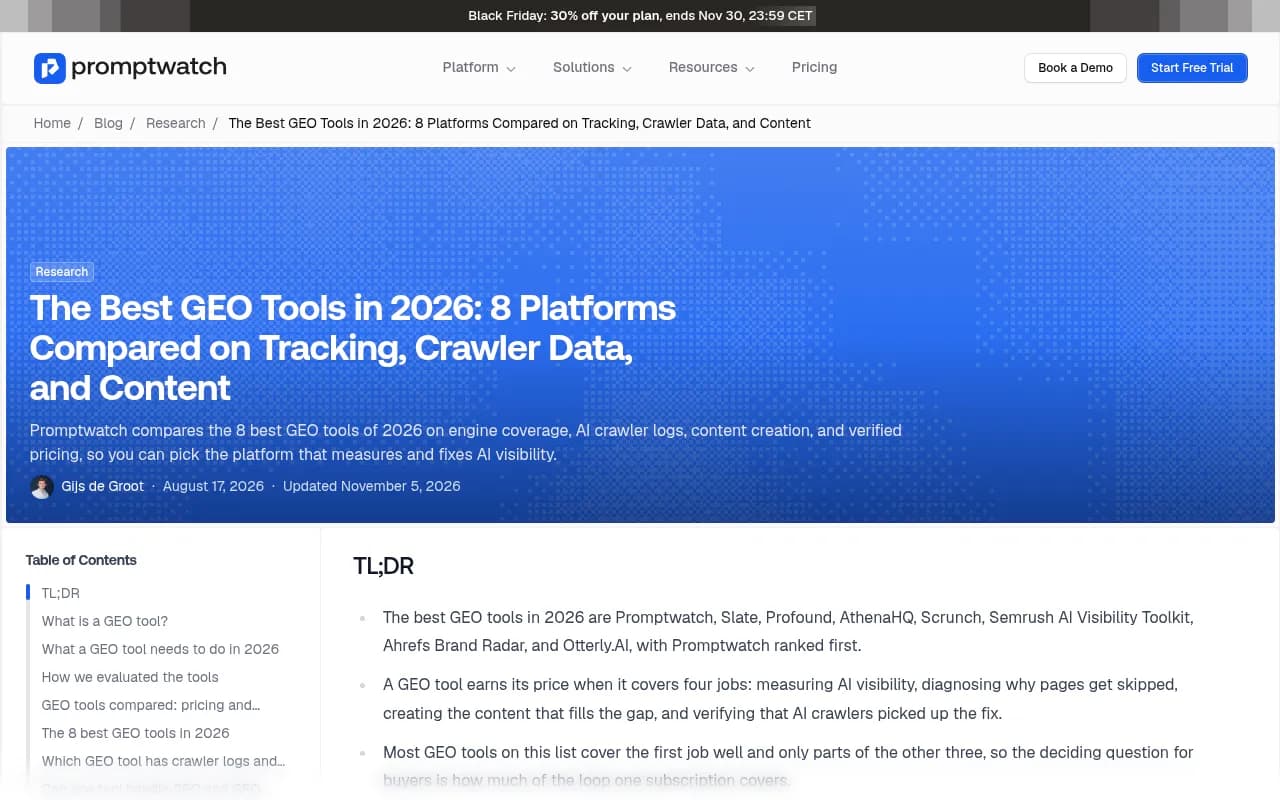
Promptwatch is not perfect value at every tier, and competitors say so. BrandAxis, a rival, points out that crawler logs, city-level tracking and custom reports start at $245/mo, and that the $95 Essential plan includes no AEO articles. That is accurate: Essential is 1 project, 50 prompts and 6,000 responses with no crawler logs. The Content Agent is Business-only at $579/mo. A Reddit commenter in r/b2bmarketing also described it as leaning toward monitoring and management, which fits if you only ever use the tracking tier.
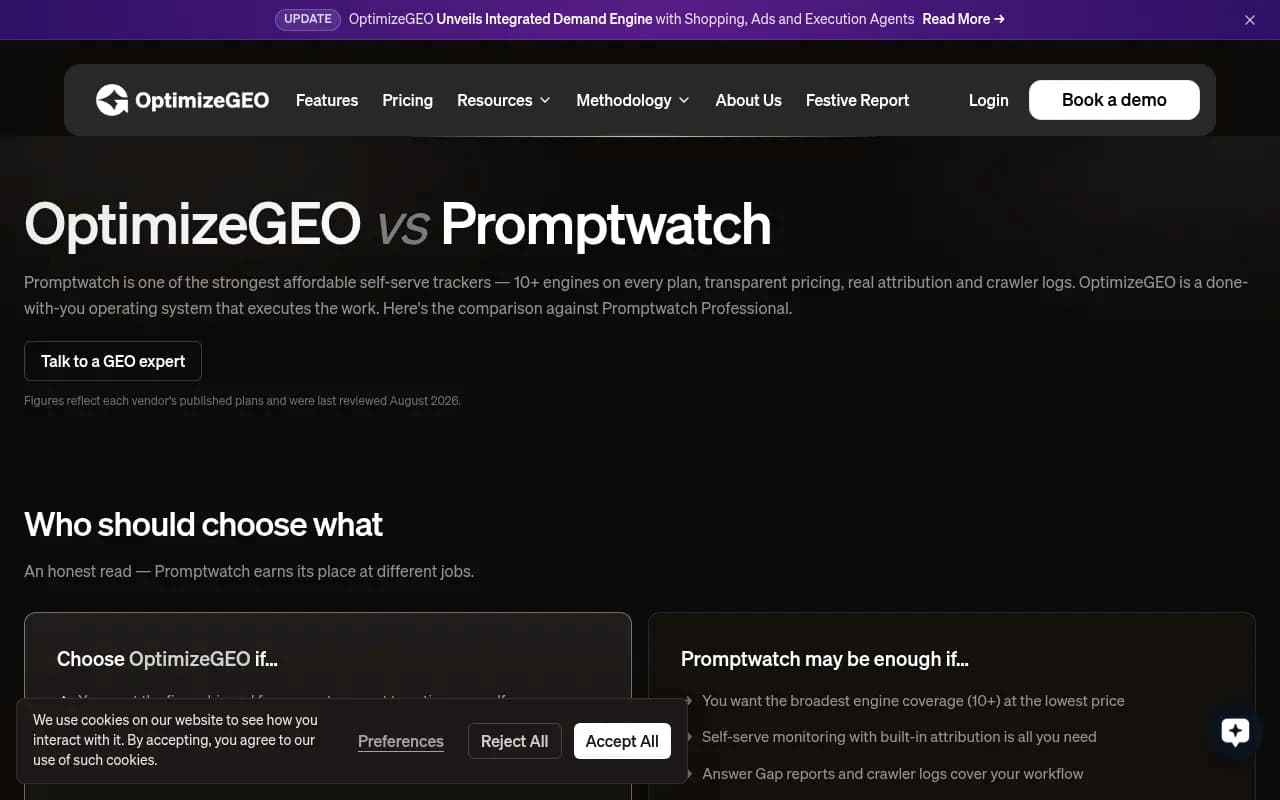
OptimizeGEO's comparison page makes a similar point from the other side: Promptwatch is a strong self-serve tool, but you run it yourself. If you want a named owner shipping fixes for you, that is a managed-service decision. Promptwatch's answer is Agentic AI Search Optimization, included with Business, where agents monitor, optimize and publish continuously. Gauge's equivalent is the strategy-session relationship on Enterprise.
Also note that a vendor's own comparison is marketing. Promptwatch's best-GEO-tools guide ranks Promptwatch first and says so; Gauge's guides rank Gauge first. Verify claims against pricing pages.
Pricing, side by side
| Budget | Gauge | Promptwatch |
|---|---|---|
| Under $100/mo | Nothing | Essential, $95/mo (50 prompts, all models, no crawler logs) |
| About $250/mo | Nothing | Professional, $245/mo (150 prompts, crawler logs, 5 AEO articles) |
| About $600/mo | Growth, $599/mo (3 engines, 18 articles) | Business, $579/mo (350 prompts, Content Agent, local targeting, Fact Check, Ads Radar, hourly tracking option) |
| Enterprise | Custom (6 engines, sentiment, exports, strategy sessions) | Custom (SSO, white label, managed workflows) |
At roughly the same monthly spend, Business gets you more of the platform around the prompts, while Growth gets you more prompts and more articles. Prices are from the vendors as of this writing. Confirm at promptwatch.com/pricing and Gauge's pricing page. Annual billing on Promptwatch gives 12 months for the price of 10.
Which one should you pick?
Choose Gauge if:
- You mainly care about ChatGPT, AI Mode and Copilot, and can live without the other engines until you hit Enterprise
- You want a high volume of daily answers and 18 articles a month under one roof
- You publish to Sanity or GitHub
- You like a premium, relationship-driven vendor
Choose Promptwatch if:
- You need every major engine without an enterprise contract
- You want to know whether AI bots can even read your pages
- You want citation trends, Reddit, YouTube and LinkedIn citation tracking, and Search Console data next to AI data
- You want to start at $95 and grow into content automation, or need unlimited seats
- You run an agency (Kick-off, Growth and Scale plans start at $199/mo with unlimited projects)
If you are undecided, run the free test first. Promptwatch has a 7-day free trial and a free AI visibility report that scans how ChatGPT, Gemini and Perplexity describe your brand and checks crawler access. It takes minutes and tells you whether your problem is visibility, access or content.
Other options worth a look
If neither fits, the field is wide. Profound and Scrunch skew enterprise, Otterly and Peec are lighter trackers, and Slate pairs tracking with content operations.




For a broader list, browse the GEO software directory at bestgeosoftware.com.
The bottom line
Gauge is a prompt-volume play with content attached. Promptwatch is a loop: see it, trace it, fix it, prove it. If your question is "how does our brand appear across thousands of daily answers on three engines?", Gauge answers it well. If your question is "why isn't AI citing this page and did our last fix work?", Promptwatch is the one built to answer that, and it starts at a sixth of Gauge's price.