Key takeaways
- Gauge and Wellows represent two different theories of AI visibility: Gauge bets on prompt intelligence at high volume (108,000 AI answers tracked per month at its $599 Growth tier, all six engines included), while Wellows bets on citation tracking tied to outreach (every plan includes unlimited outreach opportunities, but multi-engine coverage only starts at $297/domain/month).
- Wellows is dramatically cheaper to start ($37/domain/month) but pricing is per domain, which adds up fast for agencies. Gauge is flat-fee with unlimited domains and competitors.
- Wellows' explicit vs. implicit citation framework is genuinely distinct: it finds third-party pages AI already cites where your brand is missing, then helps you contact those publishers. Gauge has no comparable outreach layer.
- Gauge bundles content generation and CMS publishing into its single tier; Wellows' content optimization is still in beta.
- Neither tool has a mature review base on G2 (Gauge has 4 reviews, Wellows too few to score), so trial both before committing.
Two different theories of AI visibility
Most AI visibility tools look the same from a distance. They all promise to tell you where your brand shows up in ChatGPT, Perplexity, and Google's AI answers. Get closer and the differences get sharp, and Gauge and Wellows are about as far apart as two tools in this category can be while still competing for the same budget.
Gauge is a prompt intelligence platform. Its whole model is: run a large set of prompts daily across six engines, understand what gets cited and what doesn't, then generate and publish content to close the gaps. It sells answer volume. Its Growth tier runs 600 prompts daily across ChatGPT, Google AI Overviews, Google AI Mode, Gemini, Perplexity, and Microsoft Copilot, which works out to roughly 108,000 AI answers tracked per month, and Gauge markets this as $0.0055 per answer.
Wellows is a citation tracker with an outreach engine bolted on. Its model is: find every page AI engines cite for your prompts, split them into explicit citations (your brand, named and linked) and implicit citations (third-party pages covering your topic where your brand should be but isn't), then turn those implicit citations into an outreach list. It finds contact emails, drafts email sequences, and pushes you to earn placements on pages AI already trusts.
Neither approach is wrong. They just answer different questions. Gauge answers "what should I publish to become visible?" Wellows answers "who already has the visibility, and how do I get into their pages?"
The scarcity of citation slots explains why both approaches can work. Promptwatch's data on average sources per response shows ChatGPT cites only about 5 sources per web-search answer, the smallest inventory of any major engine, while Google AI Overviews and Perplexity each cite around 10. When there are five slots and one of them is a competitor's comparison article, you can either publish your own content to compete for a slot (Gauge's play) or get inserted into the article that already holds the slot (Wellows' play).
Gauge: prompt intelligence with a content engine

Gauge's three-stage pitch is Track, Understand, Act. Tracking covers ChatGPT, Claude, Gemini, Perplexity, Copilot, AI Mode, and AI Overviews, with Claude and Grok available on any plan if you bring your own API key. The "Understand" layer analyzes what's cited versus omitted compared to competitors, including dedicated Reddit and YouTube views that rank which threads, subreddits, and channels drive citations in your category, including ones citing competitors but not you.
The "Act" layer is where Gauge earns its price. It auto-generates publish-ready articles (18 per month on Growth) and publishes directly to Webflow, Framer, Sanity, or GitHub. An "Ask Gauge" agent connects GA4, Search Console, and DataForSEO data so you can query your visibility without building reports. There's also an MCP server for Claude, Cursor, and ChatGPT clients, plus Slack integration.
A few things stand out in Gauge's public case studies: PostHog grew LLM-referred traffic 41x and became the most-cited domain in its space; Vellum went from 1.4% to 40.3% visibility in seven months, cited in 36.6% of AI answers in its industry. These are strong numbers, though they come from Gauge's own site, so treat them as vendor-reported.
One thing I appreciate about Gauge is its honesty about prompt volume claims. It openly argues that "real prompt volume" figures marketed by some competitors are unauditable extrapolations, and instead uses verified keyword search volume as a demand proxy. That's a more defensible position than most vendors take.
Where Gauge is weak
The entry price is $599/month, full stop. There's no cheaper tier on the current pricing page (some third-party reviews cite a legacy $99 Starter plan that no longer appears to exist, so verify before you buy). If you're a small brand wanting to test the waters, that's a lot of commitment. Its G2 rating of 4.8/5 comes from just 4 reviews, which tells you almost nothing. And there's no outreach layer at all: if a competitor's roundup article keeps taking your citation slot, Gauge will show you the problem but won't help you email the author.
Wellows: citation tracking that ends in an email
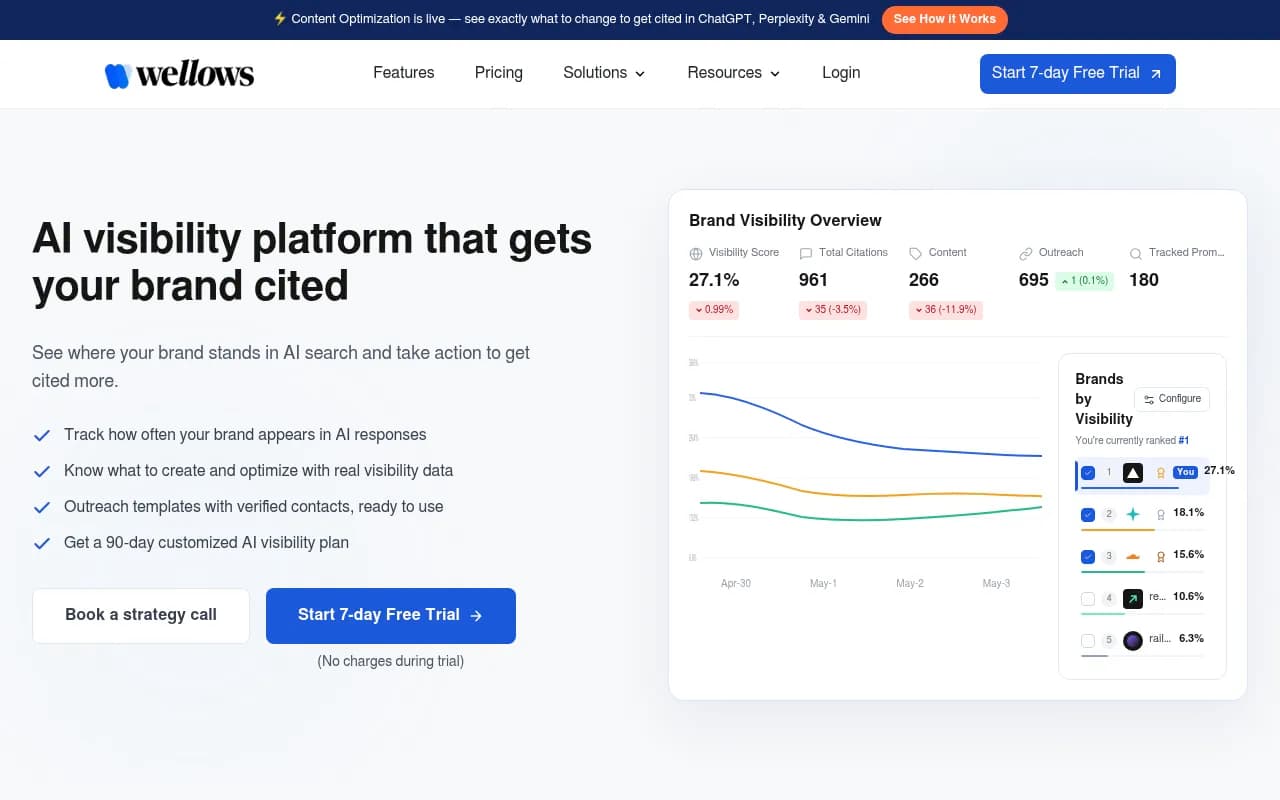
Wellows' explicit/implicit citation framework is its most interesting idea. Explicit citations are yours: the AI named your brand and linked your page. Implicit citations are the ones you're losing: the AI cited a review site, a Reddit thread, or a listicle that covers your category but doesn't include you. Wellows treats each implicit citation as an outreach target, and this isn't a manual prospecting exercise. The tool finds the publishers, finds verified contact emails, and drafts the email sequences.
This maps onto how AI citations actually behave. Promptwatch's citation type data for July 2026 shows product pages led ChatGPT citations at roughly a third of the total, with listicles the fastest-growing format within the month, and their guidance is blunt: inclusion in third-party "best of" roundups remains one of the most reliable routes into ChatGPT answers. That's exactly the surface Wellows' outreach workflow targets.
The Reddit angle matters here too. Promptwatch's social media citation data shows ChatGPT is a Reddit specialist, with 5.19% of its citations pointing to Reddit, over 20x its next-best social platform. A tool that surfaces which Reddit threads in your category cite competitors but not you, and helps you engage with them, is addressing a real channel. (Worth noting: Reddit's citation share in ChatGPT has been volatile, dropping sharply in mid-August 2026 per Promptwatch's tracking, so don't build your entire strategy on one platform.)
Wellows also includes strategic monthly calls on every plan, even the $37 tier. For a small team without an in-house GEO specialist, that human touch is unusual at this price point.
Where Wellows is weak
The pricing structure is the trap. It's per domain. Lite at $37/domain/month gets you ChatGPT only, 40 prompts, and 1,200 responses analyzed monthly. Essential at $97 gets you two engines. You don't reach five-engine coverage (ChatGPT, AI Overviews, Gemini, Perplexity, AI Mode) until Starter at $297/domain/month. An agency running 10 clients on Starter pays $2,970/month, which is a different budget conversation than "$37 tool." Meanwhile Gauge's $599 covers unlimited domains and competitors.
Also, Wellows' content optimization feature is marked beta on all plans. If your strategy leans heavily on publishing your own GEO-optimized content rather than earning placements in other people's, Wellows isn't there yet.
Head-to-head comparison
| Dimension | Gauge | Wellows | | --- | --- | | Core model | Prompt intelligence: high-volume prompt tracking plus content generation | Citation tracking: explicit/implicit citations converted to outreach targets | | Entry price | $599/mo (Growth, flat fee) | $37/domain/mo (Lite) | | Pricing structure | Flat, unlimited domains and competitors | Per domain, per month | | Engines at entry tier | All 6 (ChatGPT, AI Overviews, AI Mode, Gemini, Perplexity, Copilot) | ChatGPT only | | Full engine coverage | Included from day one | Starter tier, $297/domain/mo | | Answers tracked (entry) | ~108,000/month | 1,200/month | | Content generation | 18 publish-ready articles/mo, CMS publishing (Webflow, Framer, Sanity, GitHub) | Included but marked beta | | Outreach workflow | None | Built-in: contact discovery, verified emails, email sequences, unlimited on all plans | | Reddit/YouTube tracking | Dedicated views ranking threads and channels | Covered within citation tracking | | Integrations | GA4, Search Console, DataForSEO, MCP server, Slack | Google Search Console | | Human support | Email and Slack | Strategic calls on every plan (1-5/month by tier) | | Free trial | 1 week | 7 days | | G2 reviews | 4.8/5 from 4 reviews | Too few reviews to score |
Pricing scenarios
| Scenario | Gauge cost | Wellows cost | | --- | --- | | Single brand, ChatGPT-only tracking | $599/mo | $37/mo (Lite) | | Single brand, 5 engines, 400 prompts | $599/mo | $297/mo (Starter) | | Agency, 10 client domains, full engines | $599/mo | $2,970/mo (Starter x 10) | | Single brand, 1,000 prompts, max responses | $599/mo or Enterprise | $497/mo (Pro) |
The crossover is obvious. Below roughly 2 domains needing full engine coverage, Wellows is cheaper. Above that, Gauge's flat fee wins on arithmetic alone.
Which one fits your situation
Choose Gauge if
You're a single brand (or agency) that wants maximum data volume and believes the path to AI visibility runs through your own content. The 108,000 answers per month, all-engine coverage from day one, and bundled content generation make it a complete publish-and-measure loop. The PostHog and Vellum case studies suggest the loop works when you commit to it. You need the $599/month to make sense, and you need someone willing to feed the content engine.
Choose Wellows if
You're a single domain, budget-sensitive, and your gap is distribution rather than content. If AI engines already cite review sites, roundups, and Reddit threads in your category and you're simply absent from them, Wellows' outreach workflow attacks that problem directly, and no other tool at $37/month does this. The included strategy calls are a real differentiator for teams without GEO expertise. Just model your costs carefully if you'll ever need multiple domains or engines.
Consider both, or neither
Some teams will legitimately need both motions: publish authoritative content (Gauge's strength) and earn placements in already-cited third-party pages (Wellows' strength). If you'd rather not run two subscriptions, platforms that combine monitoring with execution exist in this space. Promptwatch, for example, pairs prompt tracking and citation analytics with automated content generation and CMS publishing, covering both the "what to publish" and "where am I cited" sides in one tool, and you can compare the full landscape in the GEO software directory at bestgeosoftware.com.
Honest caveats about both
Neither company has enough third-party reviews to validate its marketing claims. Gauge's 4.8/5 G2 score rests on four reviews. Wellows' G2 listing can't generate a reliable score at all. Both vendors publish their own comparison pages against bigger competitors (Gauge has vs-Profound, vs-Pecc AI, vs-Semrush pages; notably, neither publishes a vs-each-other page), so everything in this comparison comes from their pricing pages, feature documentation, and independent reviews rather than vendor framing.
Gauge's per-answer cost math ($0.0055/answer) is fair on its own terms but assumes you'll use all 108,000 answers. A brand tracking 100 prompts gets more value from Wellows' Essential tier at $97 than from paying for 600 daily prompts it doesn't need.
Wellows' "unlimited outreach" claim is generous but worth pressure-testing in a trial: unlimited opportunities only matter if the contact discovery actually finds reachable emails for the publishers in your niche.
The bottom line
Gauge and Wellows aren't really competitors; they're two halves of an AI visibility strategy sold separately. Gauge sells you the factory: prompts in, content out, measured across every engine, one flat price. Wellows sells you the sales pipeline for citations: find who AI already trusts, get in front of them, cheap to start, priced per domain. If your bottleneck is content production and you have $599/month, Gauge is the stronger machine. If your bottleneck is distribution and you have one domain and a tight budget, Wellows is the smarter entry point. Run both free trials against the same prompt set before deciding, because with review bases this thin, your own data is the only trustworthy verdict.