Key takeaways
- GetMint is a content-strategy-first platform: its strengths are the Content Studio, Competitor SWOT analysis, and the GetMint Score. Its weakness is tiered model coverage (2 models on Starter) and integrations gated behind Enterprise pricing.
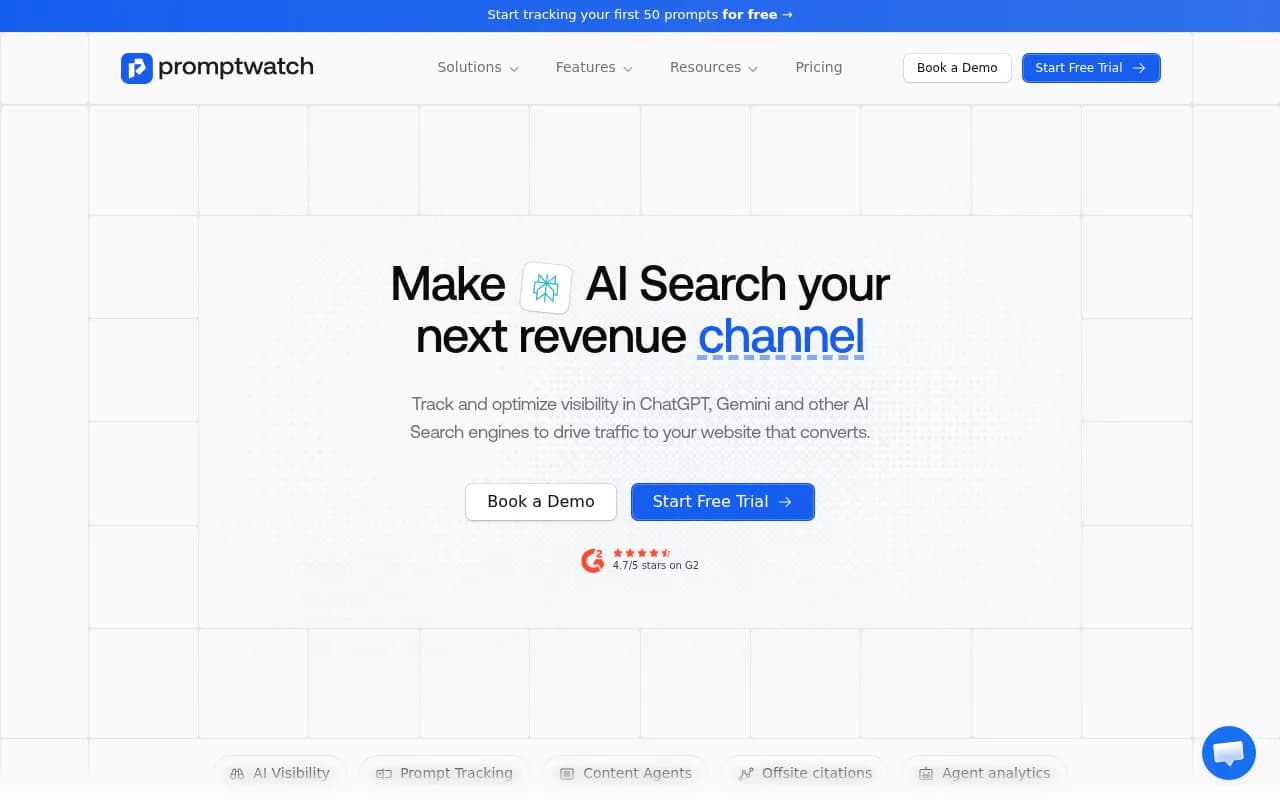
- Promptwatch is a full GEO optimization platform: 9 AI surfaces on every paid plan, AI crawler logs, visitor analytics, content gap analysis based on your own site index, and automated content generation with CMS publishing.
- Pricing is closer than you'd expect at entry level ($95 vs €74–99/mo), but the value gap widens fast: Promptwatch includes API, MCP, and all models at $95/mo, while GetMint locks those behind custom-priced Enterprise tiers.
- GetMint's public pricing has changed at least once since December 2025, so verify numbers on their live pricing page before deciding.
- Choose GetMint if your bottleneck is content production and competitor messaging. Choose Promptwatch if you need to understand why you're invisible and fix it end-to-end.
Two tools, two different problems
Both GetMint and Promptwatch sit in the GEO / AI visibility category, and both will tell you they run "the full loop" from tracking to content. But when you actually use them, they feel like different products built by teams with different instincts.
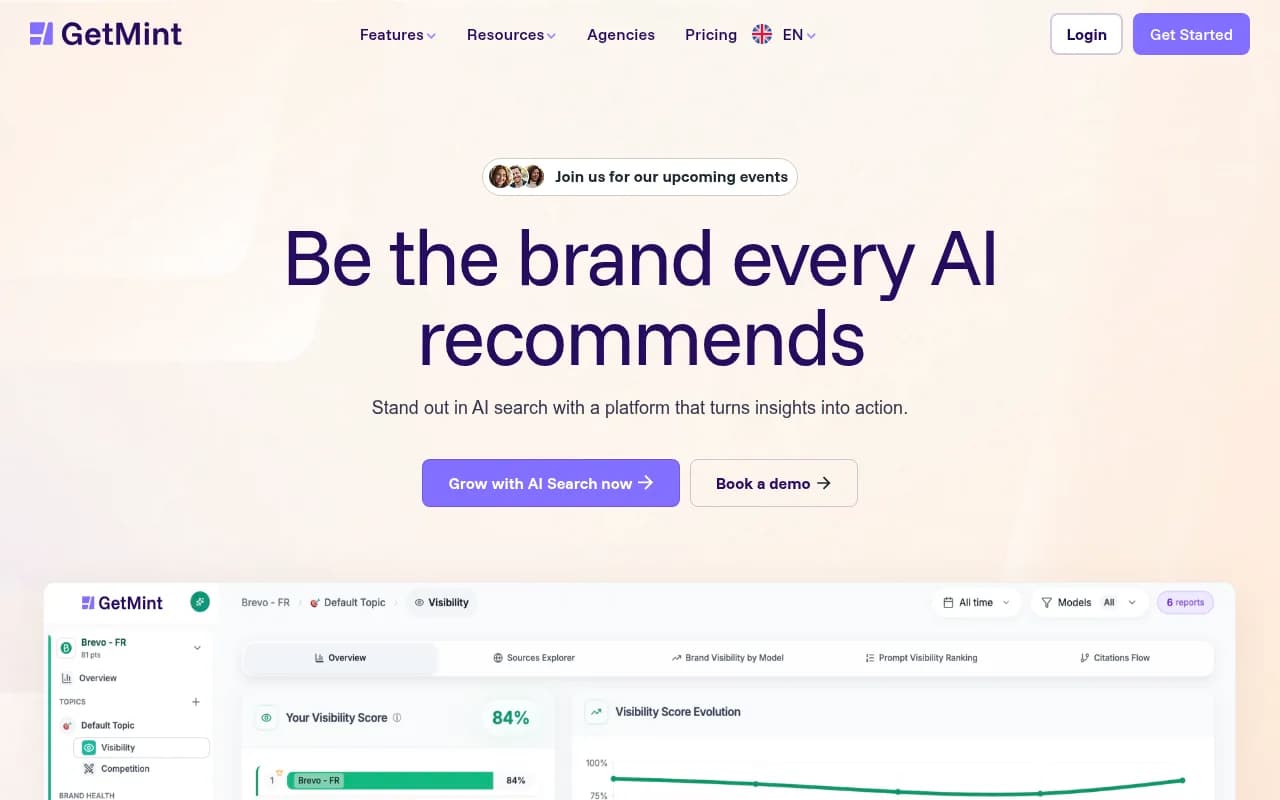
GetMint, out of Paris, raised a €4M pre-seed in December 2025 led by Founders Future and built a platform that leans heavily on content strategy. Its center of gravity is the Content Studio, the Competitor SWOT module, and the GetMint Score, a 0–100 health metric blending visibility, sentiment, and brand alignment. It's a tool that wants to sit next to your content team.
Promptwatch, headquartered in Amsterdam with over 1,840 customers including Yelp, Duolingo, and Shutterstock, approaches the problem from the data side. Its foundation is 26B+ analyzed citations, prompts, and responses collected by monitoring the actual user interfaces of ChatGPT, Gemini, Perplexity, Claude, and Google AI Overviews, plus real-time logs of 400+ AI crawlers hitting your site. The content generation and CMS publishing came later, built on top of that data.
That difference in origin shapes everything else in this comparison.
Quick comparison
| Dimension | Promptwatch | GetMint |
|---|---|---|
| Entry price | $95/mo (Essential) | €74–99/mo (Starter, annual vs monthly) |
| AI models tracked | 9 on every paid plan | 2 (Starter), 3 (Growth), custom (Enterprise) |
| API + MCP access | Included from $95/mo | Enterprise/custom only |
| Slack / Teams / Looker Studio | Included | Enterprise only |
| AI crawler logs | Yes, from Professional tier | Not available |
| Visitor analytics (AI traffic to your site) | Yes | Not available |
| Content gap methodology | Own-site index vs. tracked prompts | Competitor SWOT from AI responses |
| Content generation | Content Agents with CMS publishing (Webflow, Framer, WordPress) | Content Studio with publisher workflow |
| Reddit & YouTube citation tracking | Dedicated modules | Cited-sources view only |
| ChatGPT Shopping & Ads Radar | Business tier | SKU-level shopping on higher tiers; Ads tracking marketed prominently |
| G2 rating | 4.7/5 | 4.8/5 (main listing) |
A note on that last row: GetMint also has a second G2 listing showing 4.2/5 from just 3 reviews, which suggests the review base is still thin. Promptwatch's 4.7 comes from a larger customer base. Neither number is a reason to buy on its own, but the sample size difference is worth knowing.
Model coverage: flat vs. tiered
This is the most practical difference for most buyers.
Promptwatch tracks ChatGPT, Perplexity, Google AI Overviews, Google AI Mode, Claude, Gemini, Meta Llama, DeepSeek, and Grok on every paid plan, from the $95 Essential tier up. No add-on fees, no engine locked behind a higher tier. It also monitors AI coding assistants like Claude Code and OpenCode, which matters if your audience includes developers.
GetMint structures model coverage as a pricing lever: 2 AI models on Starter, 3 on Growth, custom (up to 10+ engines including Mistral, Copilot, and Meta AI) on Enterprise. If your buyers live in ChatGPT and Perplexity, Starter works. The moment you need Claude and Gemini too, you're pushed up the ladder.
There's a real argument for GetMint's approach if you're a small brand testing the waters. Why pay for nine engines when two cover 80% of your traffic? But the math flips as you scale. Per Promptwatch's own benchmarking (vendor-sourced, so take it with appropriate salt), Promptwatch Essential works out to roughly $1.90 per prompt and $0.016 per response, while GetMint Starter lands around $1.98 per prompt and roughly double the per-response cost for a quarter of the model coverage.
The data foundation: why crawler logs matter
Here's where the philosophical split becomes concrete.
When your brand doesn't show up in ChatGPT's answer, there are two possible reasons. Either the model never found your content, or it found it and chose something else. Those require completely different fixes. The first is a crawling and technical problem. The second is a content quality problem.
Promptwatch's Agent Analytics (AI crawler logs) show exactly when ChatGPTBot, ClaudeBot, PerplexityBot, and 400+ other crawlers visit your pages, what they read, and whether they hit errors. You get a crawl-to-citation path with a citation rate per page. Promptwatch has been ingesting server logs since August 2025, which matters because several competitors only turned logs on in 2026. If GPTBot has been hitting 403s on your product pages for six months, you'll know, and you'll know exactly which pages.
GetMint doesn't offer crawler logs. Its visibility data comes from running simulations against the AI engines and building probabilistic visibility scores, then layering competitor analysis on top. That's a legitimate methodology for answering "how often do I appear," but it can't answer "did the crawler even reach my page." For brands with technical SEO debt, that's a meaningful blind spot.
Promptwatch also tracks actual visitor analytics: real traffic and conversions from AI platforms to your website, not just mentions. GetMint's loop stops at mentions, citations, and share of voice. If your CFO wants to know whether AI search drives revenue, that attribution gap matters.
Content strategy: where GetMint is genuinely strong
Credit where it's due. GetMint's Content Studio is a good product, and its competitor intelligence is distinctive.
The Competitive Intelligence module works like an automated focus group. It extracts the common strengths and weaknesses AI models repeat about your competitors, model by model, so you can see that GPT-5 consistently praises a rival's pricing while Claude keeps flagging their weak documentation. That's the "Competitor SWOT" feature, and it's a smart way to mine AI responses for positioning insights.
The Content Studio reverse-engineers the sources AI engines cite and helps you write content that gets referenced, with persona customization for tone and modular reuse. The AI Visibility Gap module then builds an action plan: content to create, citations to earn, conversations to join, technical blockers to fix.
The catch is volume. GetMint's Starter plan includes just 1 content item per month (300 credits). Growth gets you 6 items (2,000 credits). For a content-led strategy, that's a trickle. And the gap analysis is derived from AI responses and competitor data rather than a crawl of your own site, so it tells you what the market says about you but not which of your existing pages are missing coverage.
Promptwatch's approach is different. Its content gap analysis is built on Promptwatch's own index of your site pages, matched against tracked prompts, so you get a literal coverage map: these 40 prompts matter, you have pages answering 12 of them, here are the gaps. Content Agents then plan, write, and publish GEO-optimized articles directly to Webflow, Framer, or WordPress on a schedule you control, with git-diff style update suggestions for pages that exist but underperform. Professional includes 5 AEO articles monthly, Business 10, and customers like Crisp scaled to 5–10 articles per day using the automated workflow.
Both platforms have an AI assistant: GetMint's "Minty" and Promptwatch's Agent Chat (also available in Slack). Functionally similar, both competent.
Pricing compared in detail
A warning before the numbers: GetMint's public pricing has shifted at least once between its December 2025 blog review and its current live pricing page, and G2 shows yet another set of figures. Verify on getmint.ai/pricing before committing. Annual billing saves roughly 17–20% on both platforms.
| Plan | Promptwatch | GetMint |
|---|---|---|
| Entry | Essential $95/mo: 50 prompts, 6,000 responses, all 9 models, API + MCP, Agent Chat | Starter €74/mo (annual): 50+ prompts, 2 topics, 2 models, 1 content item/mo, 5 competitors |
| Mid | Professional $245/mo: 150 prompts, 18,000 responses, crawler logs, 5 AEO articles, 2 sites | Growth €299/mo: 300+ prompts, 5 topics, 3 models, 6 content items/mo, 3 countries, 10 competitors |
| Higher | Business $579/mo: 350 prompts, 42,000 responses, city-level tracking, Shopping + Ads Radar, 5 sites | Enterprise €549+/mo (custom): custom prompts, 10 engines, API, dedicated strategist, role-based access |
| Agencies | Kick-off $199 / Growth $399 / Scale $799/mo, unlimited projects and prompts | Custom agency pricing |
| Free option | Explore: 10 prompts, ChatGPT only | Free tier with 1 seat (per G2) |
The integration story deserves its own line. Promptwatch includes REST API v2, MCP server, and Slack on every paid plan. GetMint marks Slack, Teams, Looker Studio, DataForSEO, and API access as unavailable on Starter and Growth; they only unlock at Enterprise. If your workflow involves piping visibility data into Looker Studio or connecting via MCP to Claude or Cursor, that's a $95 decision on Promptwatch and a custom-quote conversation on GetMint.
What the AI search data says about why this category got complicated
The GEO tool market exploded in 2026 for a reason: AI answers became commercial surfaces, fast.
Promptwatch's first-party data shows ChatGPT Search ads appeared in an average of 20.1% of citation-enabled responses over the 90 days from May 20 to August 17, 2026, after starting at 0% until May 27, then jumping past 30% on July 1 and peaking at 43.9% daily. Of those ad-bearing responses, 73.3% of ads appear on organic prompts, which means competitors can now bid for placement on prompts where you currently rank organically. Both platforms track this: GetMint markets its ChatGPT Ads tracking prominently, and Promptwatch's Ads Radar (Business tier) shows which competitors bid on your prompts, their ad copy, and positioning.
Shopping behavior is similarly volatile. ChatGPT shopping features attach to a low single-digit share of web-search responses overall, but Promptwatch's shopping usage data shows the rate roughly doubled overnight in late May 2026 before falling back weeks later, evidence that OpenAI actively tunes when product cards appear. For e-commerce brands, GetMint's SKU-level shopping tracking across Alexa, ChatGPT Shopping, AI Mode, and Perplexity is a real strength, and it's one of the few areas where GetMint's focus beats Promptwatch's broader approach.
The citation landscape keeps shifting too. Product pages overtook listicles as the most cited format in Google AI Overviews in late July 2026, and ChatGPT's citation behavior changed materially after the GPT-5.3 rollout in March 2026. Any visibility tool that only tracks a couple of engines is giving you a narrow window on a market that moves this fast.
Who should pick which
Choose GetMint if
- Your primary need is competitor messaging intelligence. The SWOT-from-AI-responses approach is genuinely differentiated and useful for positioning work.
- You're a European brand focused on ChatGPT and one or two other engines, with a small content team that produces a handful of pieces per month.
- You sell physical products and need SKU-level visibility in shopping surfaces like Alexa and ChatGPT Shopping.
- You prefer a guided, strategist-led experience (Enterprise includes a dedicated AI Search strategist).
Choose Promptwatch if
- You need to understand why you're invisible, not just that you're invisible. Crawler logs plus visitor analytics answer questions GetMint structurally can't.
- You want multi-engine coverage without paying more per engine, especially if your audience spans ChatGPT, Google AI Overviews, and Claude.
- Your content operation needs volume and automation: Content Agents publishing to your CMS on a schedule, with content gap analysis grounded in your actual site index.
- You need API, MCP, or Slack integration without an enterprise contract.
When neither is quite right
If budget is the constraint, lighter trackers like Otterly.AI or Peec AI cover basic prompt monitoring for less, though you give up content generation and crawler logs entirely. If you're enterprise-grade and want deep analytics with a sales-team relationship, Profound is the established name in that tier. And if you're already paying for Semrush or Ahrefs, their AI visibility add-ons might suffice before you buy a dedicated platform. The GEO software directory at bestgeosoftware.com has a fuller breakdown of the category if you want to explore beyond these two.
The honest verdict
GetMint is a good tool that is honest about what it is: a content strategy platform with AI visibility tracking attached. If your bottleneck is "what should we write and how should we position against competitors," it does that job well, and the Competitor SWOT module is worth the price of admission on its own for some teams.
Promptwatch is trying to be something more ambitious: the system of record for your entire AI search presence. Crawler logs, visitor analytics, citation trends across 11+ surfaces, Reddit and YouTube tracking, shopping and ads intelligence, and automated content execution, all connected. In Promptwatch's own 2026 comparison of 21 GEO platforms, GetMint ranked #18 overall, and the pattern in that data is consistent: GetMint covers the strategy layer well but lacks the measurement and technical depth that separates monitoring tools from optimization platforms.
That ranking is Promptwatch's own, so discount it accordingly. But the structural facts behind it are verifiable on both vendors' pricing pages: model coverage tiers, integration gating, no crawler logs, no visitor attribution. Those aren't opinions.
My read: if you're choosing one platform in 2026 and your goal is to build durable AI search visibility rather than just run content campaigns against competitor gaps, Promptwatch's end-to-end stack is the stronger foundation. If GetMint adds crawler logs, flattens its model tiers, and unbundles integrations, it becomes a genuinely interesting alternative, particularly for European e-commerce brands. Until then, it's the better content strategy tool in a comparison where the other product is a full GEO optimization platform.