Key takeaways
- These three tools sound similar in marketing but solve different problems: GetMint is an AI visibility measurement platform with content tools, Scalenut is an SEO content workflow platform that added AI tracking, and Outrank is a pure content production and publishing engine with no AI citation tracking at all.
- Outrank wins on price per article ($99/month for 30 auto-published pieces) but cannot tell you whether any of that content actually earned an AI mention.
- Scalenut bundles the most adjacent SEO tooling (keyword clusters, audits, internal linking) but its promotional pricing can be misleading about long-term costs.
- GetMint is the only one of the three purpose-built around measuring AI citations, sentiment, and share of voice, though its own pricing pages disagree with each other.
- Citation slots are scarce: ChatGPT cites roughly 5 sources per response, so if AI visibility is your goal, you need measurement, not just volume.
Three tools that aren't really in the same category
I've read a lot of comparison articles about "AI SEO platforms" this year, and most of them make the same mistake: they treat every tool with an AI feature as interchangeable. GetMint, Scalenut, and Outrank get lumped together constantly, and it's genuinely misleading for buyers.
Here's the honest framing. GetMint is an AI search analytics platform that bolted on a content studio. Scalenut is a content creation and optimization platform that bolted on AI visibility tracking. Outrank is an automated publishing engine that bolted on... nothing, actually. It has no AI tracking, and its position is essentially that AI mentions follow naturally from ranking well in Google.
That's a real philosophical difference, not just a feature checklist gap. And which philosophy is right depends on what you're trying to accomplish.
What AI search actually rewards in 2026
Before comparing tools, it helps to know what you're optimizing for. Promptwatch's data on ChatGPT citation types through July 2026 shows product pages became the single most-cited content type in ChatGPT Search at roughly 33% of citations, nearly double their share from four months earlier. Listicles were the fastest-growing format within the month, and comparison pages and how-tos both grew too. If your automated content strategy is churning out generic blog posts while AI engines are citing product pages and structured comparisons, you're optimizing for the wrong target.
The other thing to understand is scarcity. ChatGPT cites about 5 sources per web-search-enabled response, roughly half of Google AI Overviews' inventory of around 10, which makes each ChatGPT citation slot heavily contested. Perplexity sits at almost exactly 10 sources per answer, day after day. What this means practically: publishing 30 articles a month doesn't win you anything by itself. Getting cited does, and getting cited requires knowing which prompts matter, what's already being cited, and why.
That context shapes everything below.
GetMint: measurement first, content second
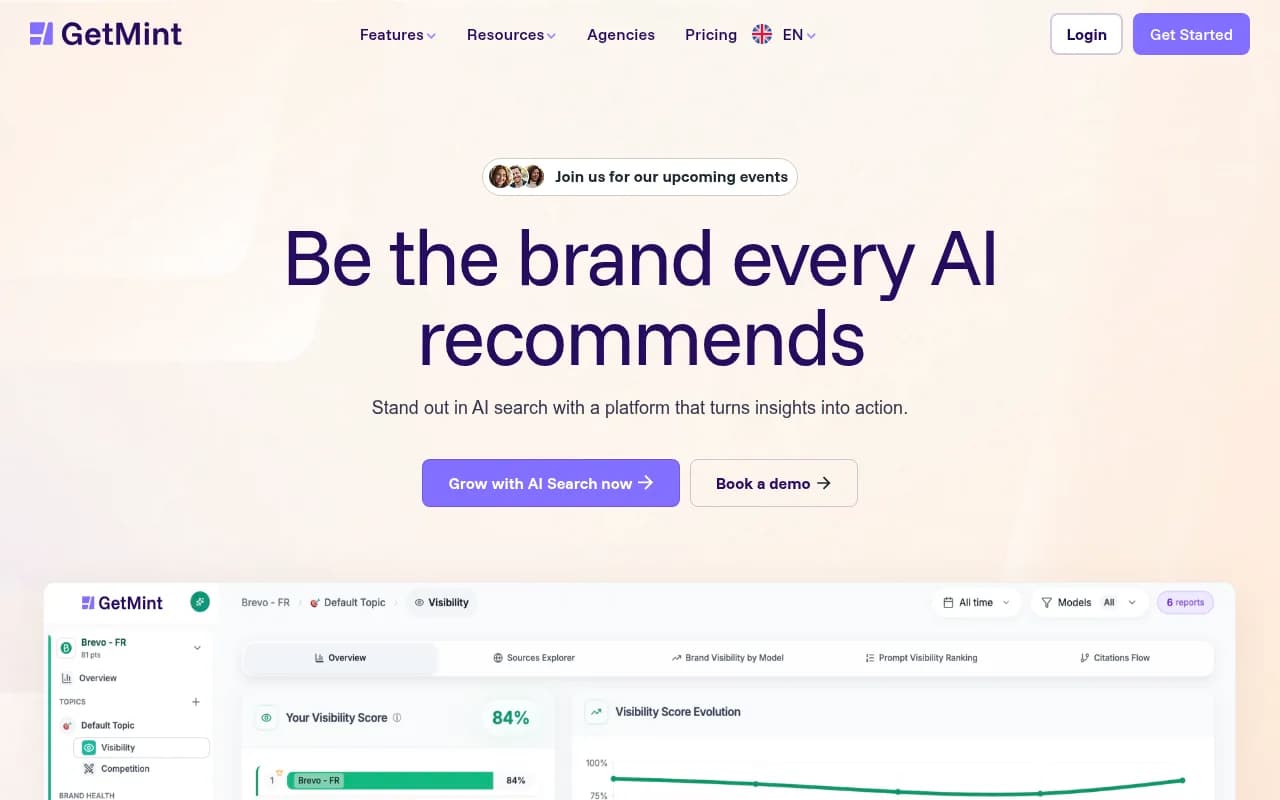
GetMint is a Paris-based startup (founded 2025, €4M pre-seed from Founders Future and others) serving 200+ companies, mostly in e-commerce and digital marketing. Its core product is the "GetMint Score," a 0-100 aggregate of visibility, sentiment, and brand alignment across AI engines including ChatGPT, Perplexity, Claude, Gemini, and Google AI Overviews.
What I find genuinely smart about GetMint's approach is the distinction it draws between AI mentions (unlinked, which it treats as awareness) and AI citations (linked, which it treats as a trust signal). Most tools mash those together, and they shouldn't, because an AI saying your brand name and an AI linking to your page are very different outcomes. The competitive intelligence feature is also more useful than it sounds: it aggregates AI answers to surface the strengths and weaknesses competitors get praised or criticized for, which is messaging ammo you can actually use.
The Content Studio is the newer addition, letting you work with GetMint's agent conversationally to produce content optimized for both SEO and GEO, then track whether it moved the needle. It's included on every plan, which is fair.
The pricing situation is messier. GetMint's own review page lists Starter at €99/mo, Growth at €299/mo, and Enterprise at €549/mo, while the live pricing page shows Starter at $80/mo (2 AI models, 50 prompts, 2 topics) and Growth at $349/mo (3 models, 300 prompts, 5 topics, unlimited users). Annual billing saves about 17%. I'd treat both sets of numbers as provisional and confirm on the live pricing page before committing, because the discrepancy between GetMint's own pages is exactly the kind of thing that catches buyers off guard.
Best for: teams whose primary question is "are we visible in AI answers, and can we prove it," with content creation as a secondary need.
Scalenut: the content workflow platform that added AI tracking
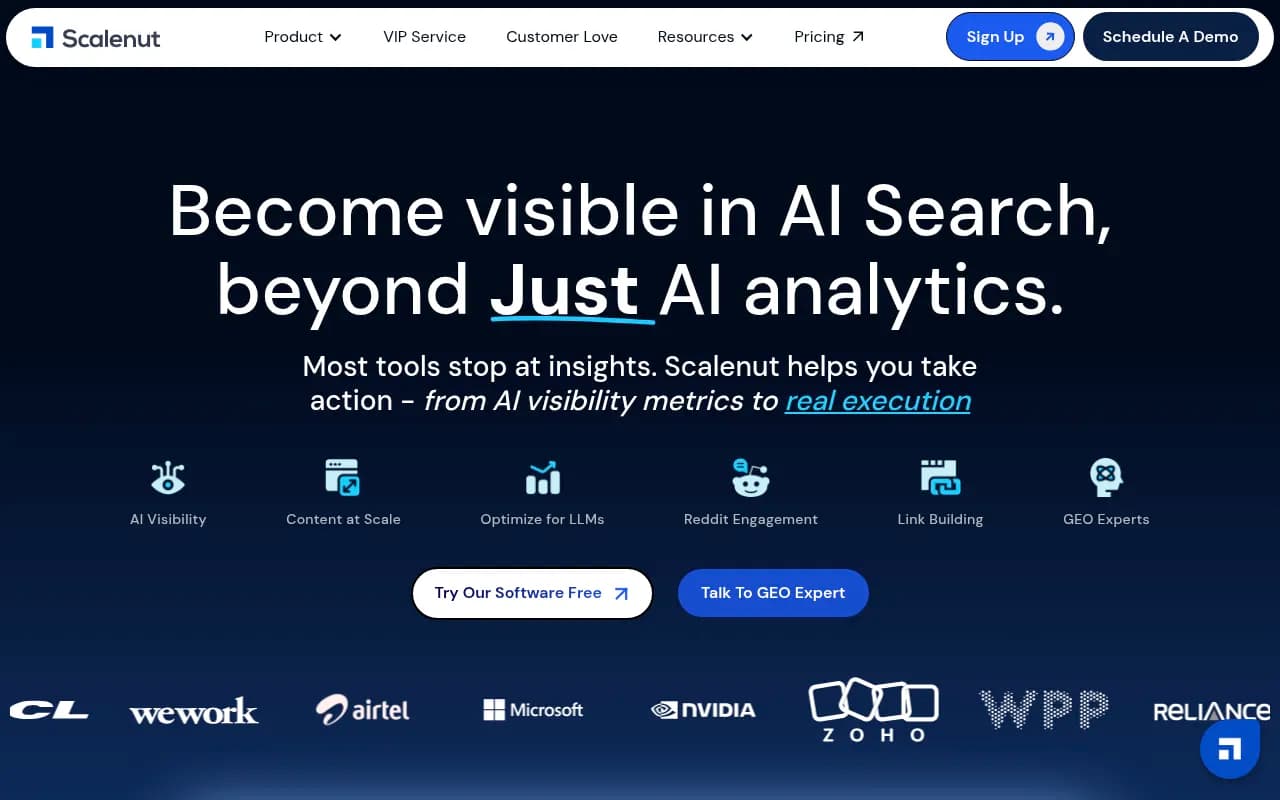
Scalenut has been around the content optimization space longer than the other two, and it shows in the breadth of the toolkit: AI writing, keyword clustering, SERP analysis, content briefs, site audits, internal linking, and now AI visibility tracking, all in one workflow. That bundling is its main pitch against point-solution trackers.
The AI visibility feature tracks a Visibility Score, average position within responses (early vs. late placement matters), share of voice, and a visibility heatmap. The catch is engine coverage varies by tier and even by which Scalenut page you're reading. Starter gets no Perplexity tracking and no auto-publishing to WordPress or Shopify. Plus adds weekly AI-visibility refresh across ChatGPT and Google AI Overviews. Professional ($199/mo) is where you get Perplexity tracking, 100 tracked prompts, and unlimited workspaces and seats.
Pricing deserves a warning label. The advertised rates are Starter $59/mo, Plus $89/mo, Professional $199/mo, but Scalenut runs aggressive time-limited promotions (60% off) that renew at full price. A competitor's analysis estimated the realistic monthly cost for around 17 published articles, once you factor in add-ons, QA time, and images, lands closer to €740/mo than the sticker price. Take that with appropriate skepticism since it comes from a competitor, but the general pattern is real: credit-based pricing with add-ons tends to balloon.
There's also a custom-priced VIP Service with a strategist, writers, and monthly technical audits if you'd rather not run the machine yourself.
Best for: content teams who want one platform for the whole research-to-publish workflow and are fine with lighter AI tracking than a dedicated GEO tool.
Outrank: maximum production, zero measurement

Outrank is the simplest pitch of the three: $99/month per site, 30 SEO-optimized articles generated and auto-published monthly at 1,200 to 1,700 words each, with meta tags, internal links, FAQs, AI images, and YouTube embeds included. Automated keyword research, a backlink exchange network, 150+ languages, and publishing to ten targets including WordPress, Webflow, Shopify, Wix, Framer, Notion, and Ghost. Unlimited users. That's the whole product, and at roughly $3.30 per article, nothing else in this category comes close on price per unit.
G2 reviewers praise the one-click setup and the ROI versus freelance costs (30 articles against $1,200+ in writer fees). The same reviews flag two recurring issues: inconsistent quality that requires manual review, and an aggressive billing experience after the trial. Add-ons exist for both problems, which is either convenient or telling: $1,399/mo for the Human Curated Service where a professional editor reviews everything, plus $85-160/mo for higher article volumes and $199-899/mo for premium backlinks.
The deal-breaker for AI search purposes: Outrank does not track AI citations or mentions across ChatGPT, Claude, Perplexity, or Gemini. Multiple independent comparisons confirm this. No prompt tracking, no citations, no sentiment, no rank tracker. Outrank's stated position is that AI mentions follow from ranking well in Google, so GEO is a byproduct rather than something you measure.
There's something to that argument, since AI engines do lean on pages that rank. But "something to it" isn't a measurement strategy. When ChatGPT is citing about 5 sources per response and product pages make up a third of those citations, flying blind on whether any of your 30 monthly articles earned a single citation is a real gap.
Best for: sites that want maximum content volume and backlinks at minimum cost, with editorial review capacity in place, and no need to report on AI visibility.
Head-to-head comparison
| GetMint | Scalenut | Outrank | |
|---|---|---|---|
| Core category | AI visibility measurement + content studio | SEO content workflow + AI tracking | Automated content production + backlinks |
| AI citation tracking | Yes, core feature (mentions vs. citations, sentiment, share of voice) | Partial (ChatGPT, Perplexity, AI Overviews depending on tier) | None |
| Content generation | Included on all plans, agent-driven | Strong, the platform's origin | 30 auto-published articles/mo included |
| Auto-publishing | Via Content Studio | WordPress/Shopify from Plus tier | 10 CMS targets, best in class |
| Backlinks | No | No | Yes, exchange network included |
| Starting price | $80/mo (live page) | $59/mo (promo pricing lower) | $99/mo per site |
| Realistic cost at scale | $349+/mo | $199/mo, potentially much more with add-ons | $99/mo + add-ons if you need curation |
| Free trial | Yes | 7 days | Yes |
Pricing reality check
All three of these companies have pricing pages that disagree with third-party reviews, older blog posts, or their own archived pages. Outrank's current single $99 plan replaced an older tiered structure (Starter $19 through Scale $179) that still shows up in reviews. GetMint's blog and pricing page list different numbers for the same plans. Scalenut's promotional discounts obscure the renewal price.
This isn't a knock on any one of them, it's just the state of fast-moving SaaS in 2026. The practical advice: always check the live pricing page the week you buy, and assume promotional prices are temporary.
Which one should you pick?
The decision comes down to one question: what's your bottleneck?
If you can't prove AI visibility to a boss or client, GetMint is the only one of the three built for that job. The GetMint Score, sentiment tracking, and share of voice give you a defensible before-and-after story.
If your bottleneck is workflow chaos, Scalenut pulls research, briefs, writing, optimization, audits, and internal linking into one place. The AI tracking is a bonus, not the headline.
If your bottleneck is budget and volume, Outrank delivers more published articles per dollar than anyone. Just budget time for editorial review, and accept that you'll have no idea whether AI engines are citing any of it.
The gap none of them fully closes
Here's the thing I'd want a buyer to understand before signing anything. Two of these three tools treat AI visibility measurement as either the whole product (GetMint) or a feature (Scalenut), and one ignores it (Outrank). But even the best measurement-first tools in this comparison stop at tracking and light content optimization.
If you want the full loop, measuring visibility, seeing which of your pages get cited, watching AI crawler behavior on your site, and then having content actually created and published to fix the gaps, a dedicated GEO platform like Promptwatch covers that end-to-end stack in a way none of these three do. It's a reasonable pairing: use Outrank or Scalenut for production volume if that's your strength, and a GEO platform for the measurement and optimization layer. If you're evaluating the broader category, the GEO software directory at bestgeosoftware.com and the agentic SEO tools directory at agenticseotools.com are good places to see the full field.

Common pitfalls when choosing between them
First, don't buy on promotional pricing. Scalenut's 60% off and Outrank's volume discounts are real, but the renewal price is what you'll actually pay, and add-on creep is documented across all three.
Second, don't assume "AI SEO" on a landing page means AI citation tracking. Outrank markets heavily toward AI search outcomes while shipping no tracking whatsoever. Read the feature list, not the headline.
Third, match the tool to your review capacity. Outrank's G2 reviews consistently mention quality inconsistency. Thirty auto-published articles a month with nobody editing them is a content farm, and Google's enforcement against low-quality AI sites has been visibly tightening. One human editor with a real workflow beats three times the volume with none.
Verdict
There's no single winner here because these aren't the same product. GetMint if measurement is the mission. Scalenut if you want the broadest content workflow under one roof. Outrank if you need volume cheap and will handle quality and measurement yourself. And if AI visibility is genuinely the goal rather than a nice-to-have, pair whichever production tool you choose with a platform that actually tracks citations, because in a world where ChatGPT cites about 5 sources per response, the only thing that matters is being one of them.