Key takeaways
- ChatGPT cites pages that describe what companies sell. Product and landing pages made up about 39% of ChatGPT citations from Sep 28 to Oct 4, 2026, according to Promptwatch Data.
- You do not need a DR 90 site. Mid-authority domains (DR 46-75) took about 46% of citations in August 2026.
- Landing pages, docs and comparison pages stay cited longest. News fades in about 36 days.
- A prompt list, a spreadsheet and a few cheap tools cover the first 90 days. Pay for a platform when manual tracking becomes the bottleneck, not before.
Why startups can win here
Enterprise GEO platforms are sold as if citations were something only large budgets can buy. They aren't. Citations come from pages that answer a question clearly, sit on a domain the model trusts enough, and get corroborated elsewhere on the web. A startup can do all three with a writer, a developer for an afternoon, and some patience.
The data backs this up. Promptwatch's ChatGPT citation share by domain rank report covers August 2026. Sites with domain rank 61-75 averaged 23.4% of citations, DR 46-60 got 22.6%, and DR 76-90 got 18.9%. The very top, DR 91-100, got just 4.4%, and it fell to about 3% after August 14. Mid-authority sites combined took roughly 46% of all citations. A solid site with relevant content is enough to get in the room.
One caveat from the research I looked at: no tactic guarantees a citation, and anyone who promises one is selling something. GEO does not replace SEO either. Pages that are crawlable, useful and well supported do better in both.
Step 1: Know what ChatGPT actually cites
Before writing anything, look at what gets cited. Promptwatch Data on ChatGPT citation share by content type (Sep 28 to Oct 4, 2026) gives this breakdown:
| Content type | Share of ChatGPT citations |
|---|---|
| Product pages | 22.4% |
| Landing pages | 16.8% |
| Listicles | 13.6% |
| How-to guides | 8.7% |
| Documentation | 7.5% |
| General articles | 6.1% |
| Comparisons | 5.9% |
| News | 5.7% |
| FAQ pages | 3.3% |
| Reviews | 1.7% |
The surprise for most startups: your own product and landing pages are the biggest citation surface, bigger than the blog. Many early-stage sites have a thin homepage, a pricing page with no context, and a blog full of opinion posts. That is backwards for ChatGPT.
The split changes by prompt type:
- Commercial prompts like "best CRM for small businesses": product pages 26.0%, landing pages 20.6%, listicles 15.0%, comparisons 7.9%. Those four types are almost 70% of commercial citations.
- Informational prompts: how-tos (10.7%) and documentation (8.5%) matter more.
- Branded prompts: reviews hit 5.6%, more than three times their overall share, and FAQ pages reach 4.8%.
So the work divides cleanly. Fix the pages describing what you sell, get into the roundups, publish a few real how-tos, and collect reviews.
Step 2: Make your product and landing pages quotable
ChatGPT cites chunks, not whole pages. Each section should make sense on its own.
Rewrite the pages that describe what you sell
Open your homepage, product page and pricing page and check for these:
- A plain sentence saying what the product is, who it is for, and what it costs. "We help teams unlock growth" gives a model nothing to quote.
- Specs, integrations, limits and prices written as text, not buried in images or tabs that don't render.
- Specific numbers in place of vague quantifiers. "Used by 74% of customers" beats "used by many customers", if the number is true and you can source it.
- Answers placed at the top of each section. One of the studies in the research notes found 44.2% of LLM citations come from the first 30% of a page's text. Treat that as one study, not law, but leading with the answer is good writing anyway.
- A named author or owner and a clear About page, so the entity behind the claims is verifiable.
Add an FAQ page
Branded prompts cite FAQ pages disproportionately. Write one page covering the questions buyers ask about your company: pricing, security, alternatives, integrations, who it is not for. Keep each answer short and unhedged.
Keep docs public
If you sell software, documentation is a citation magnet. Promptwatch's software citation data shows documentation and help centers earning the largest share for software prompts. Don't put yours behind a login.
Step 3: Fix crawlability first (it's free)
A great page nobody can read is wasted. Check these on a free budget:
- Open your robots.txt and make sure you are not blocking OAI-SearchBot, ChatGPT-User or GPTBot by accident. Many default security settings and CDN rules do.
- Make sure key content renders without JavaScript. View the page source. If your pricing is empty there, a crawler may see nothing.
- Submit an XML sitemap and fix broken links and orphan pages.
- Add schema markup (Organization, Product, FAQPage) so the entity is unambiguous.
- Optionally add an llms.txt file. It is cheap, but treat it as a bonus rather than a lever. Promptwatch's data shows markdown files are only 0.05% of AI search citations, so don't expect it to move much.
Free checkers help here. Promptwatch offers an Agentic Readiness Check and an AI Crawler URL Inspector at no cost, and Google's own AI optimization guide is worth an hour of reading.
Step 4: Get into the roundups and review sites
Listicles are 13.6% of ChatGPT citations overall and 15.0% on commercial prompts. If "best [your category] tools" prompts cite five roundups, and you are in none of them, you are invisible on the prompts that matter most.
The approach:
- Run your buyer prompts in ChatGPT with search on and write down every URL it cites.
- Sort them into roundups, review sites, forums and vendor pages.
- Pitch the roundup authors with something real: a free account, a data point, a specific use case where you beat the incumbents.
- Claim profiles on the review sites that show up. For software, G2 appears often; Promptwatch's software citation data shows GitHub, Microsoft's docs and G2 leading in the week of Sep 28 to Oct 4, 2026.
- Aim PR and guest posts at DR 61-90 sites rather than only chasing the biggest names. That is where the share is.
Then publish your own comparison pages. Comparisons are 5.9% of citations overall and 7.9% for commercial prompts. Be honest in them. A comparison page that admits where a competitor is better gets quoted more readily than a sales page in disguise.
Step 5: Use Reddit carefully
The Reddit story changed in 2026. Promptwatch's data shows reddit.com's share of ChatGPT citations falling from roughly 4% to 0.5% on August 14, 2026. And in the week of Sep 28 to Oct 4, ChatGPT drew just 0.46% of its citations from social platforms, while Google AI Overviews drew 12.2%.
A lot of the playbooks written in early 2026 tell startups to go all in on Reddit for ChatGPT. That advice is already stale. Reddit threads still matter for Perplexity and Google AI Overviews, and for real customer conversations, so keep answering questions honestly where you have something useful to say. Just don't make it your ChatGPT strategy. Spend that time on pages you own and roundups.
If you do participate, the manual workflow from the research is sound: find threads in your category with roughly 30 to 100 replies, read what is unanswered, and write a direct, specific reply with real data. Disclose who you are.
Step 6: Plan for how long content lasts
Not all content decays at the same rate. Promptwatch's content half-life study tracked every page ChatGPT cited on July 6, 2026 for 90 days.
| Content type | Still cited after 30 days | Still cited after 60 days |
|---|---|---|
| Landing pages | 78% | 69% |
| Docs | 76% | 67% |
| Comparisons | 72% | 63% |
| Listicles | not reported | 60% |
| Product pages, reviews, how-tos | not reported | 55% |
| News | not reported | 41% |
Product pages, reviews and how-tos hit their half-life at 74 to 77 days. News hits it at 36 days, and almost a quarter of news pages are never cited again after the first day.
For a startup with limited hours, that translates to a simple budget:
- Spend most effort on landing pages, docs, pricing and comparison pages. They last.
- Refresh product pages and how-tos every couple of months.
- Treat press releases and news-style posts as short bursts, not a foundation.
Step 7: Measure with a cheap stack
You need three things: a fixed prompt list, a way to run it, and a way to see traffic.
Build the prompt list
Write 20 to 50 prompts a real buyer would type. Mix commercial ("best X for Y"), informational ("how do I do Z"), branded ("is [your brand] any good") and comparison ("[you] vs [competitor]"). Lock the list and record the start date. Without a baseline you can't prove anything changed.
Run it on a schedule
Answers vary from run to run, so one screenshot proves nothing. Run the list weekly in ChatGPT with search on, plus Perplexity and Google AI Mode, and log which domains are cited. A spreadsheet works.
Watch referrals
In GA4, look for referral sessions from chatgpt.com and perplexity.ai. That shows when a citation becomes a visit.
Tools that cost less than an enterprise platform
When the spreadsheet gets tedious, there are lighter options. Prices change, so confirm on each vendor's site.
| Tool | What it does | Fit for a startup |
|---|---|---|
| Promptwatch | Prompt tracking across real AI interfaces, crawler logs, content gap analysis | Free tier tracks ChatGPT only; paid plans start at $95/mo |
| Otterly.AI | Basic brand mention monitoring | Cheap, monitoring only |
| Peec AI | Prompt tracking with suggestions | Light, monitoring focused |
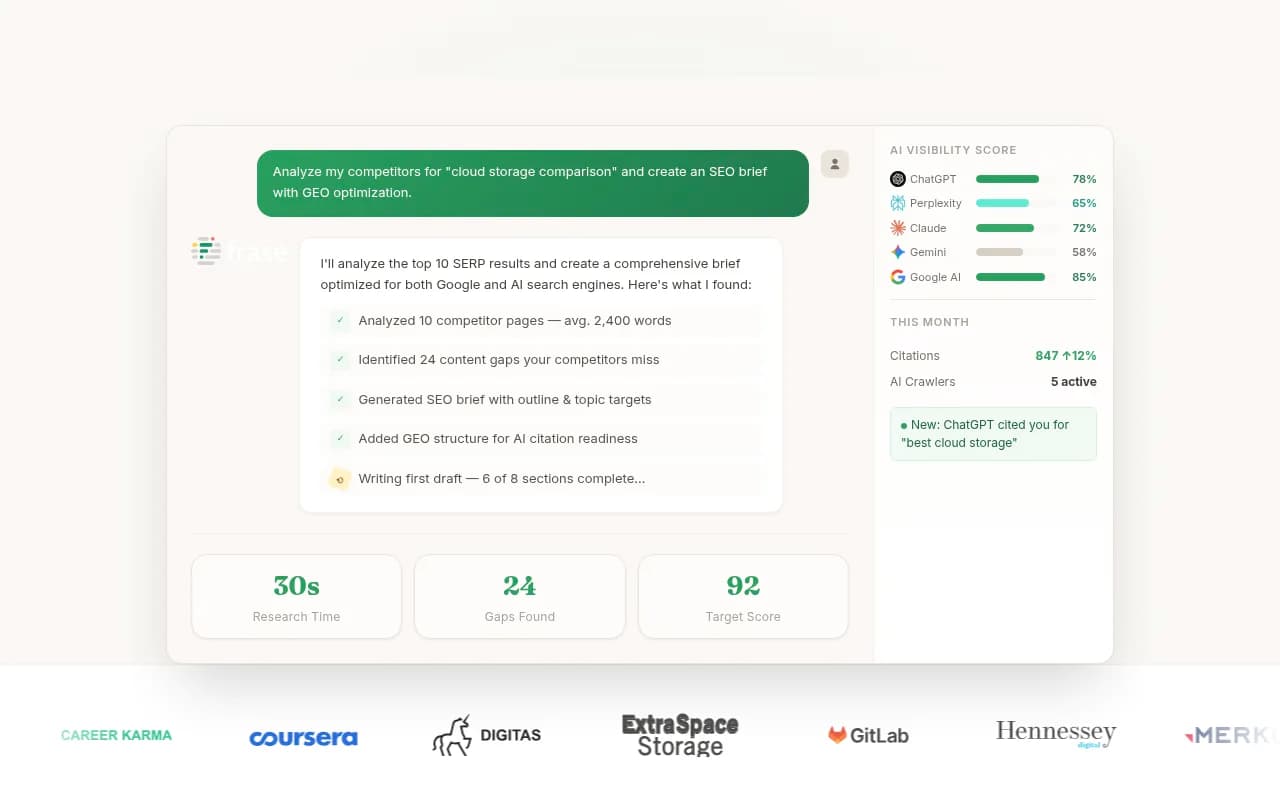
| Frase | Content optimization with a free GEO score | Good for rewriting pages |
| Ahrefs Brand Radar | Brand mentions across AI engines | Useful if you already pay for Ahrefs |
Promptwatch is the one I would look at first if you want more than a mention counter. The free Explore plan covers 10 prompts on ChatGPT, and the Essential plan at $95/mo adds all models, country tracking, a site audit and content gap analysis, so you can see which prompts you are missing and which pages to fix. Check promptwatch.com/pricing before buying.

For pure monitoring on a tight budget, Otterly.AI and Peec AI are the usual picks.


Frase has a free GEO score and helps you restructure pages so answers lead.
If you want to compare more options, the GEO software directory at bestgeosoftware.com lists many of them.
A 30-day plan
Week 1: baseline and access
- Write and lock your 25 prompts.
- Run them everywhere and log the cited URLs.
- Check robots.txt, rendering and sitemap.
Week 2: fix the pages you own
- Rewrite the homepage, product pages and pricing page so each states what you sell, for whom, and at what price.
- Publish an FAQ page.
- Add Organization, Product and FAQ schema.
Week 3: earn corroboration
- Claim profiles on the review sites that appear in your cited-URL log.
- Pitch five roundup authors.
- Publish one honest comparison page against your biggest competitor.
Week 4: re-measure
- Rerun the prompt list and compare against the baseline.
- Note which pages got cited and which prompts still cite only competitors.
- Pick the next three gaps.
Expect to wait. One agency source claims live-retrieval engines can cite a strong new page within days to a couple of weeks once crawled, but I would plan for a couple of months before judging.
When you actually need a platform
Skip the paid platform until one of these is true: you track more than about 100 prompts, you need crawler logs to see whether AI bots hit errors, you publish more than a few pages a week and need to prioritize, or you report to a board that wants dashboards. Until then, the spreadsheet and the pages above do most of the work. If you later want outside help running this, an SEO agency such as 1001 SEO Media covers GEO alongside technical SEO and content, but ask any agency for a locked prompt list and before-and-after data.
What to do on Monday
Pick your five most commercial prompts. Run them in ChatGPT. Open every cited page. Then rewrite your own product page so it could sit next to those, with real specs, real prices and a direct answer in the first paragraph.