Key takeaways
- No AI detector clears 85% accuracy across GPT-5.4, Claude Opus 4.6, and Gemini 3.1 outputs, and every major tool's accuracy drops 20-30% once the text gets even lightly edited
- Google has said repeatedly that it evaluates content quality, not whether a human or a model typed it, which means the March 2026 core update hit thin AI output for being thin, not for being AI
- AI search engines are citing fewer sources per response than Google ever did, and they're rewarding how-tos, documentation, and comparison content over generic listicles
- Watermarking (Google's SynthID) and provenance metadata (C2PA) are quietly becoming more reliable signals than detector scores, especially for images and video
- The practical publisher playbook in 2026 isn't "beat the detector." It's disclosure, named human accountability, and content that demonstrates real expertise
The detector arms race nobody's winning
Here's the uncomfortable thing about AI detectors in 2026: they're everywhere, and they're still not very good. Originality.ai, the tool most independent testers rank as the most consistent performer, lands around 76-88% real-world accuracy depending on which benchmark you trust, against a vendor claim of 99%+. GPTZero claims a 0.08% false positive rate and still gets described by reviewers as "shaky" on blended human-and-AI documents. Copyleaks sits somewhere in between.
That gap between marketing claims and independent testing is the whole story. A detector doesn't read for meaning. It's a statistical pattern-matcher trained to notice things like burstiness (humans mix short and long sentences more than models do) and perplexity (how "surprised" a language model would be by the next word). Those signals are real, but they're fragile. Restructure a few sentences, drop in some domain-specific terminology, blend a human paragraph with an AI one, and confidence scores fall 20-30 points. Heavy editing that adds original insight pushes accuracy below 50% for every tool tested in one recent benchmark.
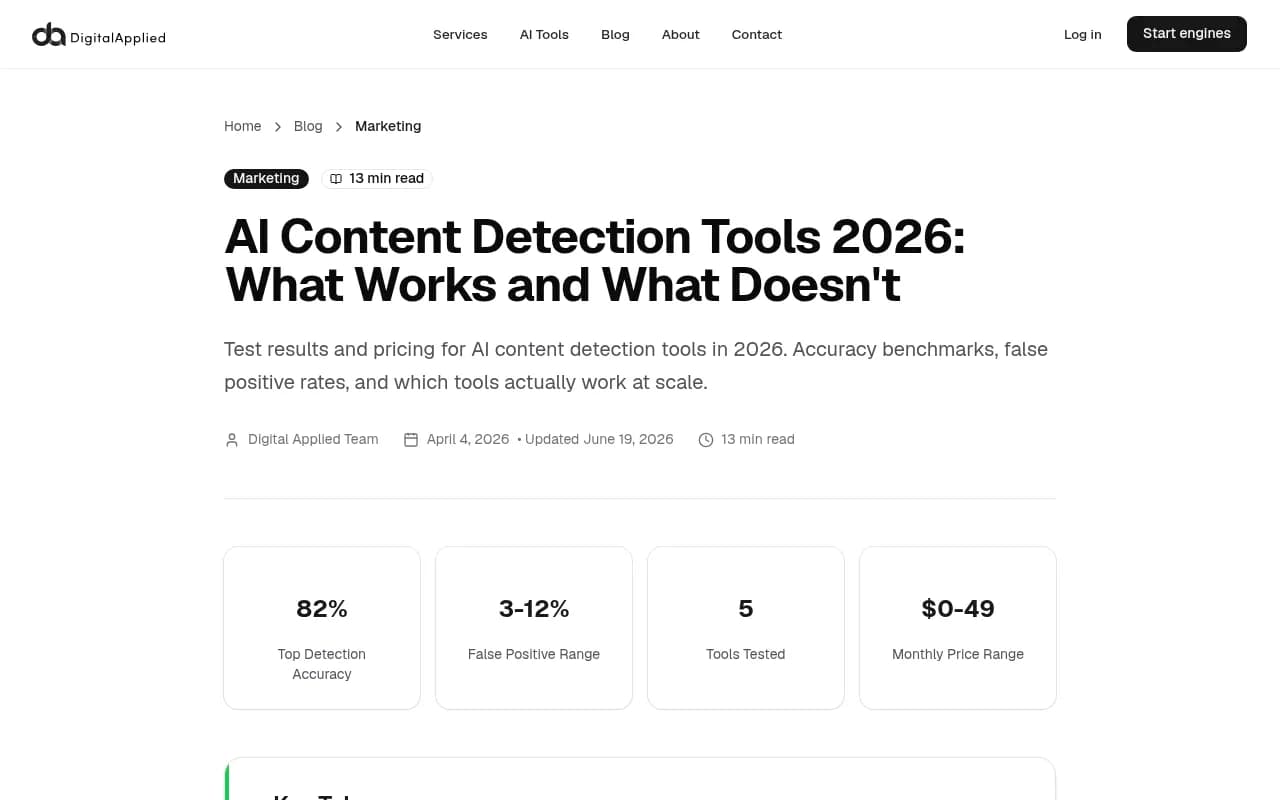
False positives are the part that should worry editors more than false negatives. Rates run 3-12% across the major tools, and the errors aren't evenly distributed: non-native English writers and technical authors get flagged disproportionately because their sentence structures happen to look "too uniform" to a classifier tuned on a narrower training set. I've seen the scenario play out in a content team's Slack channel more than once. Freelancer swears they wrote every word. Editor believes them, mostly, but still burns an hour figuring out what to do with a flagged draft. That's not a hypothetical, it's a normal Tuesday for anyone managing contributors at scale.
What's replacing pure detection
Because classifier scores are so unreliable on their own, 2026's more sophisticated systems have shifted from a single percentage to graded, multi-signal assessment: entropy and burstiness combined with model-specific fingerprinting (matching patterns against known GPT-5, Claude, or Gemini outputs), plus an explanation of which signal drove the decision. Even that ensemble approach degrades badly against iterative human-AI collaboration, where someone drafts with a model, edits heavily, then runs the result through a second model. The honest conclusion from researchers working in this space is that detection measures statistical resemblance, not provenance. There is no way to prove authorship from text alone with certainty.
That's pushed some of the weight onto a different kind of signal: watermarking and provenance metadata. Google's SynthID is embedded by default into Gemini output and survives light editing, though substantial paraphrasing or translation destroys it. OpenAI built a text watermarking tool for ChatGPT but never shipped it, so as of this writing, ChatGPT text carries no watermark at all. Anthropic's version is optional rather than default. On the visual side, C2PA (Content Credentials) has over 6,000 member organizations, Nikon's Z9 and Z8 cameras embed it at the firmware level, and outlets like the AP, the New York Times, and the BBC are piloting it in newsrooms. Text provenance is years behind image and video provenance, and probably will stay that way, because there's no hardware equivalent to a camera sensor for a sentence.
Why detection matters less for SEO than people think
Here's where a lot of content teams get confused. Google has said, multiple times and pretty bluntly, that it evaluates content quality, not whether AI wrote it. The March 2026 core update backs that up empirically rather than just rhetorically: thin content, templated affiliate comparison pages, and generic AI output dropped 30-50% in organic visibility, while pages showing original research, named expert authorship, and genuine first-hand experience gained 15-25% (Ahrefs tracking data cited an average +22% visibility bump for the quality winners). The update is widely believed to be the first to use a Gemini-based semantic filter operating at scale to spot low-quality AI output, not by running a detector against the text, but by evaluating whether the content actually says anything useful.
An independent read of the same update from Amsive found messier, less consistent patterns, with YouTube taking the biggest visibility hit and broad declines hitting the social, aggregator, and reference sites that had anchored search results for a decade. Worth flagging because it's a genuinely different take from the "quality wins" framing, and the truth is probably both: Google is rewarding depth and demonstrable expertise while also reshuffling which kinds of domains get default trust.
A related follow-up comparing the March and May 2026 update cycles found 24.1% of previously-ranking pages fell below rank 100 after the March cycle. The framing that's stuck across multiple analysts is "authority over interchangeability," meaning Google increasingly consolidates rankings around a smaller set of domains it already trusts, rather than treating competing pages as roughly equivalent. If that's accurate, the cost of publishing something mediocre just went up, whether or not AI touched the draft.
What AI search engines are actually citing
This is the part that changes the calculus even more than Google's core updates, because AI search doesn't have 10 blue links to spread credit across. Promptwatch's data on average sources per response shows ChatGPT citing around 5 sources per web-search-triggered response, roughly half of what Google AI Overviews cites (about 10) and what Perplexity holds steady at (also about 10). Microsoft Copilot is still all over the place, its average swinging from under 2 to nearly 17 sources per response within a matter of weeks, which tells you Microsoft is still rebuilding its retrieval and attribution pipeline rather than running something settled.
Fewer slots per response means a much higher bar. Being "pretty relevant" doesn't cut it when there are only five seats at the table instead of ten.
Promptwatch's breakdown of ChatGPT's citation content types over August 2026 shows where the bar is moving. Product pages still lead at roughly a quarter to a third of citations, but how-to content more than doubled its share over the month, climbing from 4.3% to 9.1%, and documentation nearly tripled, from 3.3% to 8.2%. Listicles ended the month around 11%, and comparisons, news, and FAQs each gained ground. Social posts, meanwhile, collapsed from 4.4% to under 1%, the same week Reddit's citation share in ChatGPT crashed from roughly 4% to 0.5% (a drop Promptwatch tracked in detail in its Reddit citations report).
Read those two trends together and the message is pretty clear: generic, thin, or social-sourced content is losing ground in AI answers, and content that demonstrates process (how-tos), reference-grade depth (documentation), and structured judgment (comparisons) is gaining it. That's not a coincidence next to what's happening in traditional organic search. It's the same underlying shift, just showing up in a different surface first.
The five-layer stack publishers are actually adopting
Most serious newsrooms and content operations aren't trying to outrun detectors anymore. The more durable approach that's emerged across publisher policy work in 2026 looks roughly like this:
- A written, public editorial AI policy, so readers and regulators know the rules before a dispute happens
- C2PA provenance attached to visuals, since image and video credentialing is mature enough to actually work
- AI detection used only as a triage signal for internal workflow, never as a verdict on a specific piece
- A named human accountable for every published piece, which is why AI-only bylines remain rare even at outlets that use AI heavily in drafting
- An internal audit trail documenting what was AI-generated, human-written, or tool-assisted, so the publication can answer questions later if it needs to
Major outlets including the New York Times, the Guardian, the Washington Post, and the Atlantic have published policies requiring disclosure when an article is substantially AI-generated with minimal human editing, though enforcement runs mostly on the honor system. Platforms have their own rules layered on top: LinkedIn penalizes low-quality AI content in its feed algorithm and requires disclosure for AI-primary posts; YouTube requires disclosure for synthetic voices and can restrict monetization without it; TikTok actively runs detection on uploads and requires AI labels.
Academic publishing tells an almost funny cautionary tale about how much policy alone accomplishes. A PNAS study analyzing over 5,100 journals and more than 5.2 million papers found that about 70% of journals had adopted AI-usage disclosure policies by January 2025. Researchers' use of AI writing tools kept climbing anyway, and the study found no meaningful difference in AI-assisted writing rates between journals that had a policy and journals that didn't. Policies without enforcement mechanisms don't change behavior much. That's worth remembering before anyone assumes a published AI policy is doing real work on its own.
Comparing the detection tools you might actually use
If you're running an editorial team and need something to triage submissions, here's how the main options stack up on cost and reliability right now.
| Tool | Pricing | Claimed accuracy | Independent accuracy | Notable strength |
|---|---|---|---|---|
| Originality.ai | $30 one-time (3,000 credits) or $14.95/mo Pro | 99%+ | 76-88% | 96.7% on paraphrased/humanized text (RAID benchmark) |
| GPTZero | Free tier; ~$14.99/mo Individual | 99.76%, 0.08% false positive | Reliable on pure text, shaky on blended | Best academic workflow controls |
| Copyleaks | ~$13.99-16.99/mo Personal; ~$75-100/mo Pro | Not independently benchmarked here | Comparable to peers | 30+ languages for AI detection, 100+ for plagiarism |
None of these numbers should be treated as a verdict generator. Use them the way the better newsroom policies suggest: as a triage flag that sends a piece to a human editor, not as an automated yes/no gate.
What this means for how you actually publish in 2026
If you're producing content for search or AI visibility, chasing a clean detector score is largely a wasted effort, because the systems deciding whether your content gets seen (Google's ranking algorithm and the retrieval layers behind ChatGPT, Perplexity, and AI Overviews) aren't running your draft through GPTZero. They're evaluating depth, specificity, and whether a real person with real expertise appears to be behind the piece.
That pushes the practical priorities in a specific direction: invest in first-hand experience and named authorship rather than generic AI output, build out how-to and documentation-style content since that's exactly where AI search citation share is growing fastest, and keep an internal record of your editorial process in case anyone asks. For AI-specific visibility, tools like Promptwatch can show you which of your pages AI search engines are actually citing and why, tracking things like crawler behavior and citation trends across ChatGPT, Gemini, Perplexity, and Google's AI surfaces.

If you want a broader view of the GEO tooling market before picking a platform, the directory at bestgeosoftware.com covers a wider range of options at different price points. And if the real gap on your team is production capacity rather than measurement, there's a large field of AI writing and content-optimization tools worth a look, including Surfer SEO for search-grounded optimization and Clearscope for content grading against live data.


None of that replaces editorial judgment. The publishers doing well in 2026 aren't the ones with the cleanest detector scores. They're the ones whose content would survive a human fact-check even if every AI-detection tool on the market disappeared tomorrow.