Key takeaways
- Sitecore acquired Scrunch AI in June 2026, folding it into the Sitecore DXP ecosystem -- which means standalone access is increasingly tied to a Sitecore contract
- If you're not a Sitecore customer, your Scrunch setup is on borrowed time
- Promptwatch covers everything Scrunch did (monitoring, citations, shopping tracking) and adds content generation, AI crawler logs, and traffic attribution that Scrunch never had
- Migration is straightforward: export your prompts, rebuild your tracking setup, and use Promptwatch's Answer Gap Analysis to find what you were missing all along
- The free trial means you can run both in parallel before committing
What actually happened with Scrunch
On June 3, 2026, CMSWire reported that Sitecore had acquired Scrunch to give its customers tools to monitor and shape how their brands appear in AI-generated answers. The deal made sense on paper -- Sitecore is a digital experience platform, and AI search visibility is the obvious next layer for any DXP.
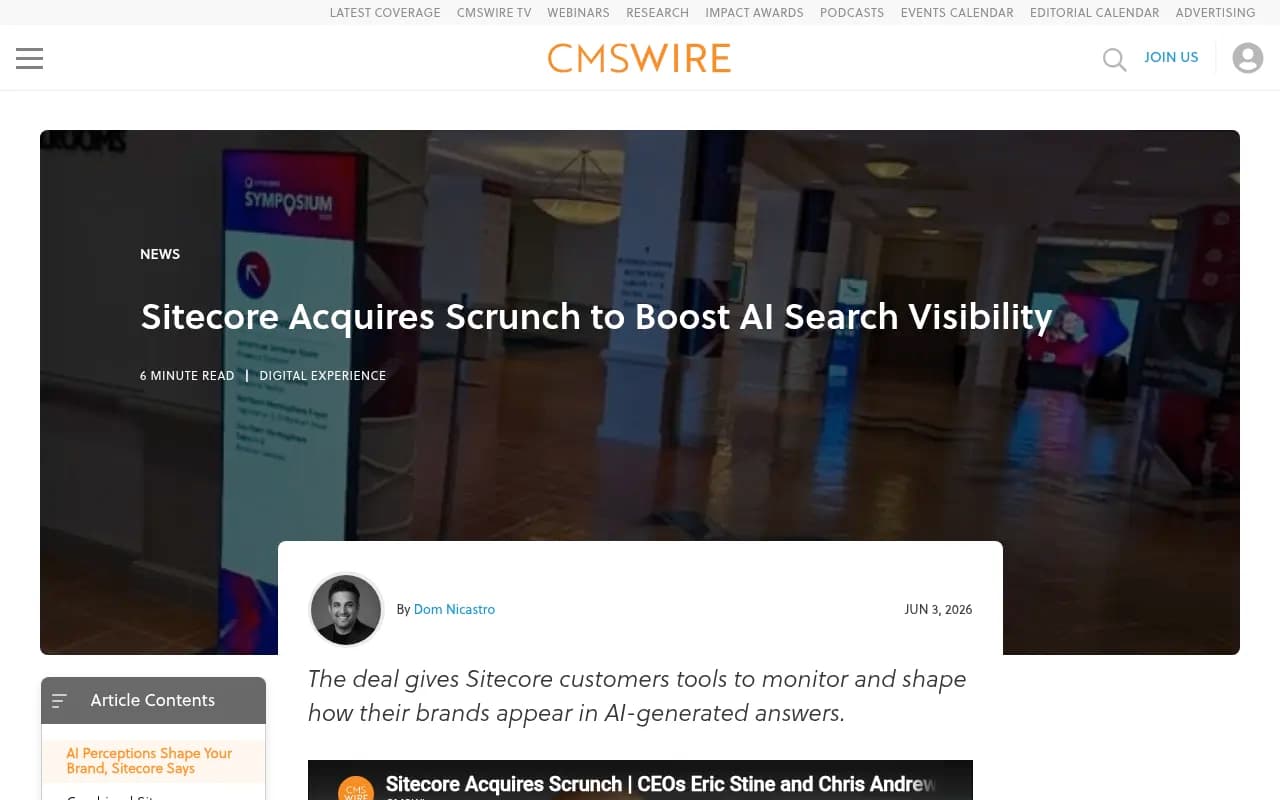
But here's the practical reality for anyone who signed up for Scrunch as a standalone product: you're now using a tool that's being absorbed into a much larger, more expensive enterprise platform. Sitecore's webinars are already framing Scrunch as part of a combined offering -- "combining the power of Sitecore and Scrunch to orchestrate content for humans, AI agents, and systems." That's great if you're a Sitecore shop. If you're not, the writing is on the wall.
Scrunch itself was a solid monitoring tool. Its data on AI-influenced buyer behavior was genuinely interesting -- the company found that when an AI platform recommends your brand to someone new, that person becomes roughly 182% more likely to search you on Google afterward. That's the kind of insight that made Scrunch worth paying for. But monitoring insights alone were always Scrunch's ceiling, and now even that ceiling is moving behind a Sitecore paywall.

What you need to export before you lose access
Before you do anything else, pull your data out of Scrunch. Even if your account is still active, don't assume it will stay that way indefinitely.
Prompts and topics
Export every prompt and topic cluster you've been tracking. This is your most valuable asset -- it represents months of work figuring out which queries matter for your brand. In Scrunch, these live under your monitoring setup. Download or copy them into a spreadsheet organized by topic, intent, and priority.
Competitor visibility data
If you've been tracking competitors through Scrunch, export those comparison snapshots. You won't be able to recreate historical data in a new tool, but having a baseline gives you something to compare against once you're up and running elsewhere.
Citation and source data
Pull any citation reports showing which domains, pages, or external sources AI models were citing when your brand appeared. This tells you where your authority is coming from -- useful context when you're rebuilding your strategy.
Shopping and product tracking
If you were using Scrunch's shopping feature to track product-level AI visibility, export those product lists and any performance data you have. You'll want to re-enter these in your new platform.
Why Promptwatch is the right landing spot
There are several GEO and AI visibility tools on the market in 2026. Some are worth considering. But if you're migrating from Scrunch specifically, Promptwatch is the most complete replacement -- and in several areas, it goes meaningfully further.
Here's the honest comparison:
| Feature | Scrunch (standalone) | Promptwatch |
|---|---|---|
| AI model monitoring | Yes (multiple LLMs) | Yes (10 models: ChatGPT, Perplexity, Gemini, Claude, Grok, DeepSeek, Copilot, Meta AI, Google AI Overviews, Google AI Mode) |
| Citation tracking | Yes | Yes, with page-level breakdown |
| Shopping / product tracking | Yes | Yes (ChatGPT Shopping) |
| AI crawler logs | Yes (Agent Traffic feature) | Yes (real-time crawler logs with error detection) |
| Content gap analysis | Limited (Insights feature) | Full Answer Gap Analysis with competitor comparison |
| Content generation | No | Yes (Content Agents grounded in prompt data) |
| Traffic attribution | No | Yes (connects AI visibility to actual revenue) |
| Reddit / YouTube tracking | No | Yes |
| Prompt volume and difficulty scoring | Partial (Topic Prompt Optimizations) | Yes, with query fan-outs |
| Multi-language / multi-region | Yes | Yes |
| Standalone pricing | Was available, now Sitecore-tied | Yes, from $99/mo |
The gap that matters most: Scrunch was always a monitoring tool. Promptwatch is built around a loop -- find gaps, generate content, track results. Scrunch could tell you where you were invisible. Promptwatch tells you why, then helps you fix it.
Step-by-step migration guide
Step 1: Start your Promptwatch trial
Go to promptwatch.com and start the free trial. You don't need to cancel Scrunch first -- run them in parallel for a week or two while you get oriented. The Essential plan ($99/mo) covers one site and 50 prompts, which is enough to validate the setup before committing.
Step 2: Add your domain and connect your site
Promptwatch supports several integration methods: Cloudflare, Fastly, Vercel, server logs, Google Search Console, or a tracking snippet. Pick whichever fits your stack. The Cloudflare and GSC integrations are the fastest to set up -- most teams are live within 30 minutes.
The crawler log integration is worth doing even if it feels like extra work. This is the feature that shows you exactly which AI crawlers are hitting your site, which pages they're reading, and whether they're encountering errors. Scrunch had an Agent Traffic feature that covered similar ground, so you'll feel at home here.
Step 3: Rebuild your prompt library
Take the prompts you exported from Scrunch and import them into Promptwatch's prompt tracking. Don't just copy them wholesale -- use this as an opportunity to review them. Some prompts you were tracking in Scrunch may have been low-value; others may be missing entirely.
Once your initial prompts are in, run the Answer Gap Analysis. This is where Promptwatch earns its keep: it shows you which prompts your competitors are visible for that you're not. You'll almost certainly find gaps that Scrunch's monitoring never surfaced, because Scrunch wasn't built to proactively hunt for them.
Step 4: Set up competitor tracking
Add the same competitors you were monitoring in Scrunch. Promptwatch's competitor heatmaps show you who's winning for each prompt across each AI model. If a competitor is consistently appearing in Perplexity for a topic you care about, you'll see it clearly.
Step 5: Configure shopping and entity tracking
If you were using Scrunch's shopping feature, set up ChatGPT Shopping tracking in Promptwatch. Add your products and brand entities. This takes maybe 20 minutes and gives you visibility into when your brand appears in ChatGPT's product recommendations and shopping carousels.
Step 6: Run your first content gap report
This is the step Scrunch couldn't take you to. Once your prompts and competitors are configured, pull a full Answer Gap Analysis report. You'll see:
- Which prompts you're missing entirely
- Which prompts where competitors appear but you don't
- The specific content angles and topics AI models want answers to but can't find on your site
Use this to brief your content team or, if you're on the Professional or Business plan, use Promptwatch's Content Agents to generate articles directly from the gap data. The content is grounded in real prompt data, citation patterns, and competitor analysis -- not generic SEO filler.
Step 7: Set up multi-region and persona tracking
If you were using Scrunch's multi-language monitoring, replicate that setup in Promptwatch. You can configure custom personas that match how your actual customers prompt -- by region, language, and role. This matters because AI responses vary significantly by geography, and a persona-aware setup gives you much more accurate data than a one-size-fits-all query.
What you'll notice immediately
A few things will feel different right away, mostly in a good way.
The crawler logs are more detailed than what Scrunch's Agent Traffic feature showed. You can see not just that a crawler visited, but which specific pages it read, whether it hit any errors, how often it returns, and the timeline from crawl to citation. If you've ever wondered why a page you published isn't getting cited, this is where you find out.
The prompt volume and difficulty scoring is also something Scrunch didn't really have. Scrunch launched "Topic Prompt Optimizations" in Q1 2026 to help users find the right mix of prompts per topic, but Promptwatch goes further with actual volume estimates and difficulty scores per prompt, plus query fan-outs that show how one prompt branches into sub-queries. This lets you prioritize high-value, winnable prompts instead of spreading your effort across everything.
Traffic attribution is the other big one. Promptwatch connects AI visibility to actual site traffic and revenue. If you've been making the case internally for GEO investment, this is the data that makes that argument.
Other tools worth considering
Promptwatch is the strongest like-for-like replacement for Scrunch, but it's worth knowing what else is out there if you have specific constraints.
Profound is a solid enterprise option with strong analytics. It's priced higher than Promptwatch and lacks content generation, but it's a credible choice for large organizations with dedicated analytics teams.
AthenaHQ is monitoring-focused and works well for teams that just want clean dashboards. It doesn't do content generation or crawler logs, but the interface is clean and the setup is fast.

Otterly.AI is the budget option. It covers basic brand monitoring across AI models and is genuinely affordable. If your needs are simple and you don't need content optimization, it's worth a look.

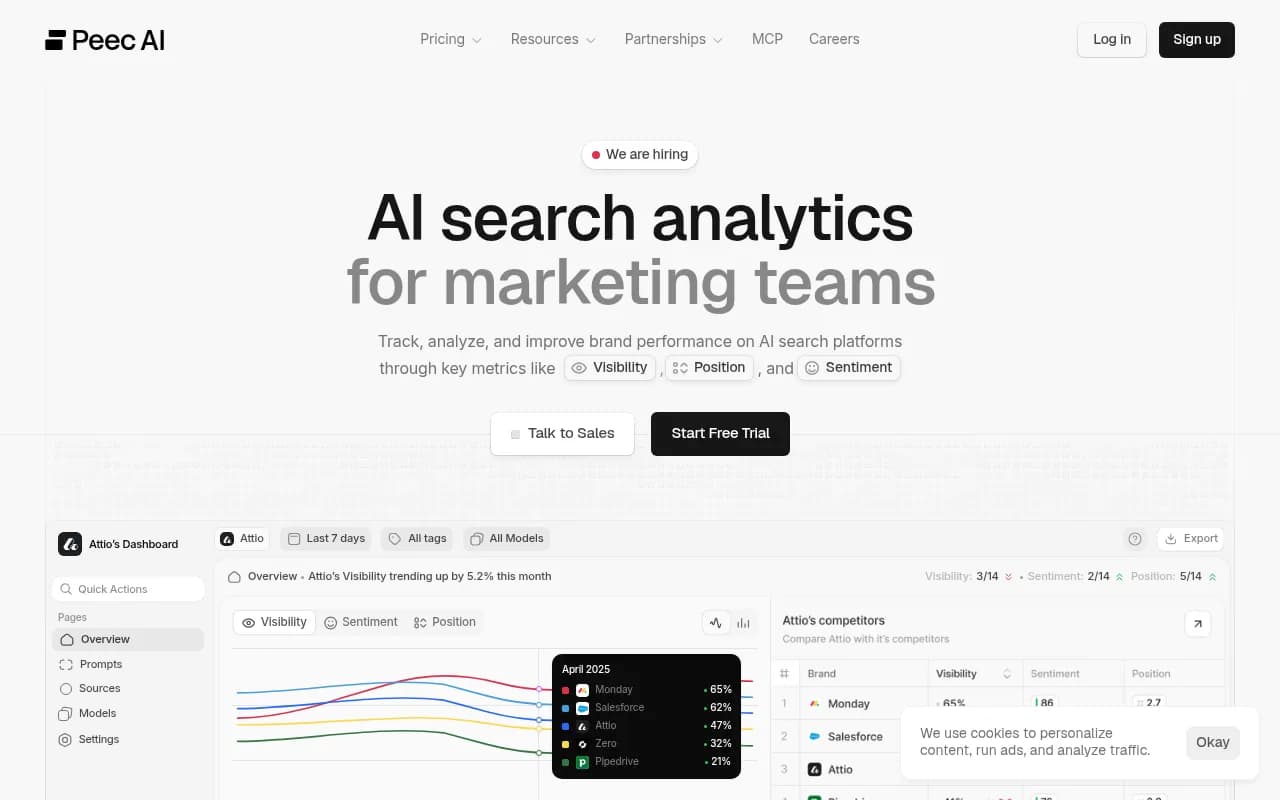
Peec AI sits in a similar space -- lightweight monitoring with some suggestions, but no content generation or crawler logs.
For most teams migrating from Scrunch, none of these close the gap the way Promptwatch does. The combination of monitoring, crawler logs, content generation, and traffic attribution in one platform is what makes the difference.
A note on timing
The Sitecore acquisition closed in early June 2026. As of now, Scrunch's standalone product is still accessible, but the product roadmap is clearly moving toward Sitecore integration. New features will be built for Sitecore customers first. Pricing and access terms for standalone users haven't been formally announced, but acquisitions like this rarely end with standalone pricing staying the same.
The smart move is to migrate now, while you can do it on your own timeline, rather than waiting until access changes force your hand. Running Promptwatch in parallel for a few weeks costs very little and gives you a clean handoff.
Final thought
Scrunch built something genuinely useful. The prompt-to-purchase research was some of the best data in the GEO space, and the platform was well-designed. But it was always a monitoring tool, and now it's a monitoring tool inside a $100K+ enterprise DXP. For most marketing and SEO teams, that's not where you want to be.
Promptwatch covers the monitoring Scrunch did, adds the content optimization Scrunch never had, and gives you a clear path from "we're invisible in AI search" to "we're getting cited and tracking the revenue from it." That's the migration worth making.