Key takeaways
- Otterly.AI, Scrunch, Search Party, and AthenaHQ are all legitimate AI visibility monitoring tools -- but monitoring is where most of them stop.
- None of these four platforms close the loop from "you're invisible here" to "here's the content that will fix it."
- Scrunch is the most expensive of the group and the closest to offering optimization, but its content tools are limited compared to full GEO platforms.
- If you need to actually rank in AI search -- not just watch your numbers -- you need a platform built around content gap analysis and content generation, not just dashboards.
- Promptwatch is the only platform in this space rated as a "Leader" across all GEO categories in 2026, specifically because it closes the monitoring-to-optimization gap.
There's a pattern that keeps showing up in the GEO space right now. A brand signs up for an AI visibility tool, spends a few weeks staring at dashboards, and then asks: "Okay, so what do I actually do with this?"
It's a fair question. And for Otterly.AI, Scrunch, Search Party, and AthenaHQ, the honest answer is usually: not much. These platforms are built to show you where you stand. They're not built to help you move.
That's not a knock on them -- monitoring has real value. But if you're evaluating these tools in 2026 and expecting them to help you rank in ChatGPT, Perplexity, or Google AI Overviews, you should know upfront what you're getting.
This guide breaks down each platform honestly, compares them side by side, and explains why the monitoring-only model has a ceiling.
What these four platforms actually do
Before getting into the comparison, it's worth being clear about what "AI visibility monitoring" means in practice. These tools send prompts to AI models (ChatGPT, Perplexity, Gemini, etc.), capture the responses, and track whether your brand appears -- and how often, in what context, and alongside which competitors.
That's genuinely useful. A year ago, most brands had zero visibility into how AI search engines talked about them. Now you can at least see the problem.
The gap is in what comes next.
Otterly.AI
Otterly.AI launched in late 2024 and grew quickly by being the most affordable entry point in the space. It's aimed at SEO and growth teams who want basic AI search monitoring without enterprise pricing.
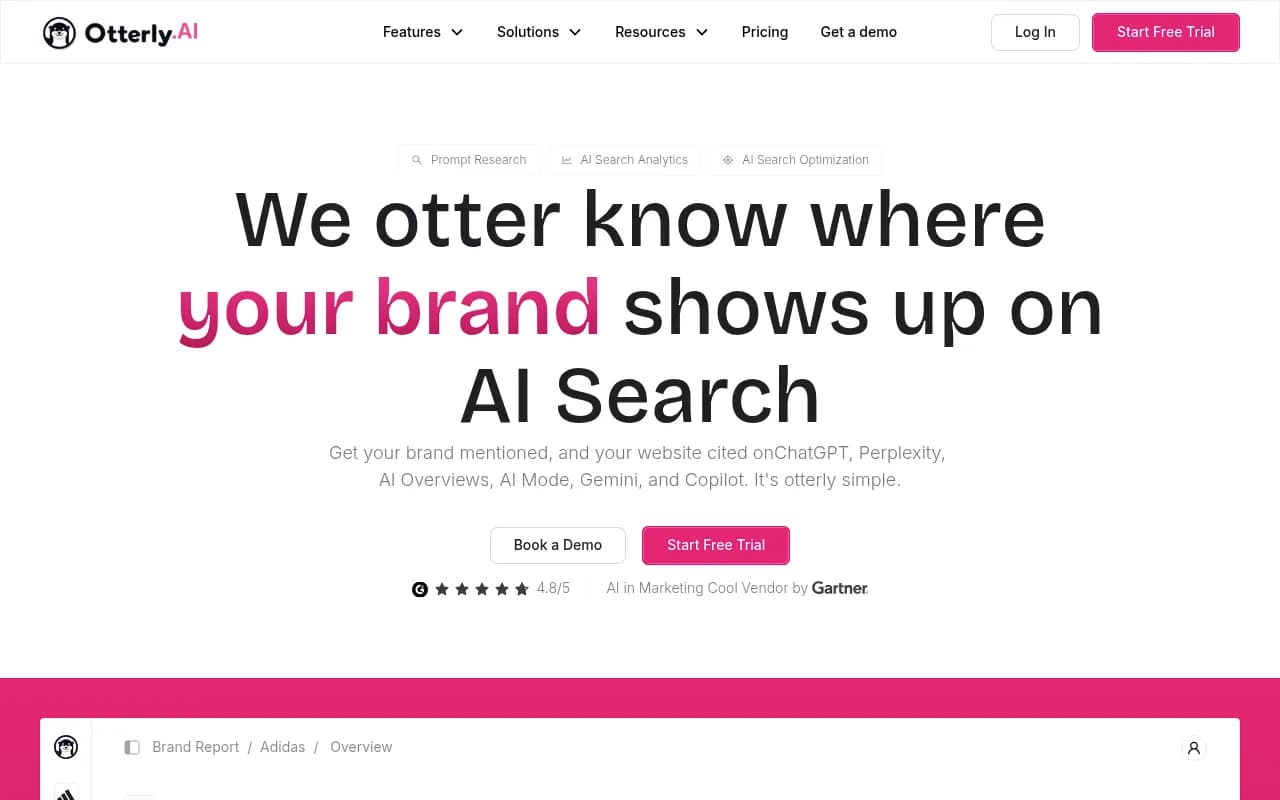
It covers the core monitoring pillars: prompt tracking, citation analysis, multi-engine coverage (ChatGPT, Perplexity, Gemini, Google AI Overviews, Claude), and competitor benchmarking. There's an MCP server integration that lets AI-native teams query brand data without leaving their workflow, which is a genuinely clever feature for developer-adjacent teams.
Where Otterly.AI falls short is depth. Visitor analytics are limited. Crawler logs are in beta. Content optimization tools are minimal. It's a solid entry-level tracker, but if you're trying to move the needle on AI visibility, you'll hit its ceiling fast.
Pricing is accessible compared to the rest of this group, which is its main competitive advantage.
Scrunch AI
Scrunch is the most enterprise-oriented of the four. It raised $19 million in funding and serves 500+ brands including Lenovo and Penn State. SOC 2 Type II compliance, detailed prompt-level analytics, GA4 integration, persona and funnel-stage tagging -- it's built for teams that need governance and reporting structure.
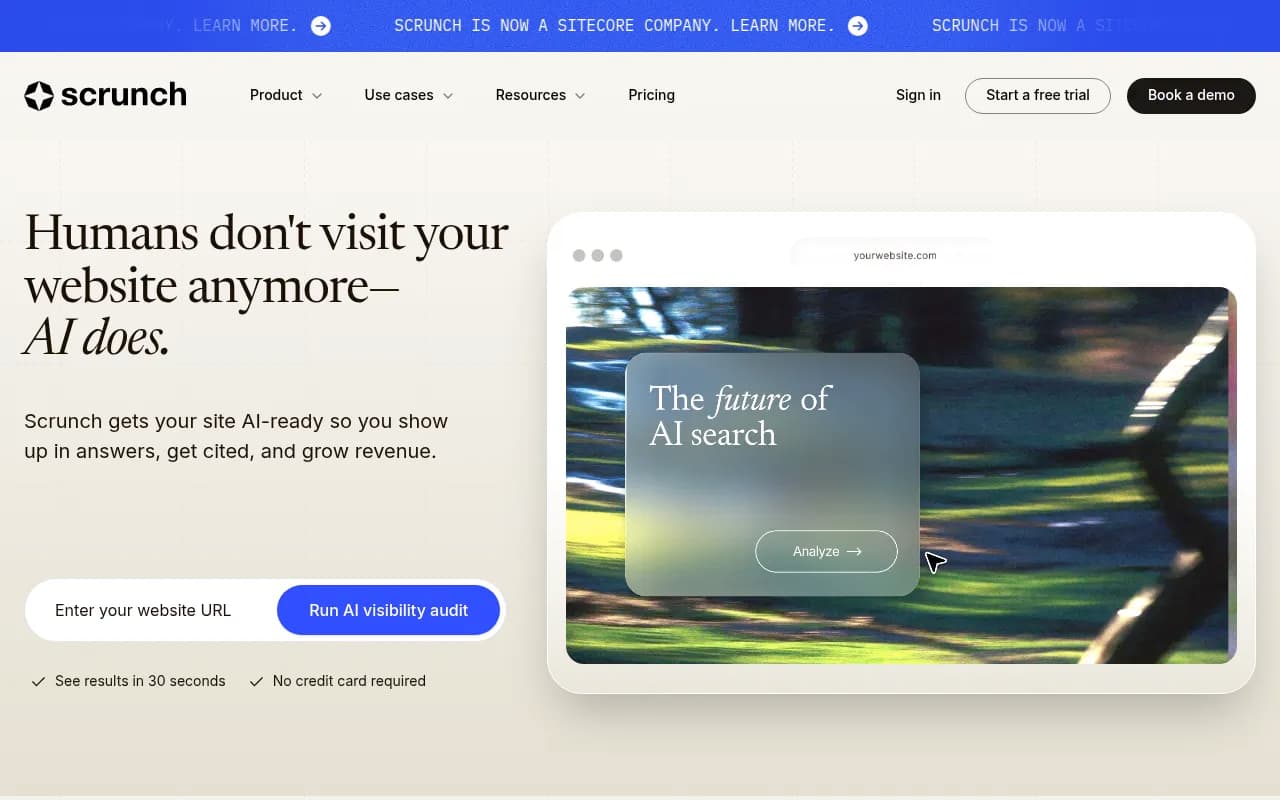
Scrunch also claims to offer content optimization, which puts it slightly ahead of the other three in theory. In practice, its content tools are limited -- more "recommendations" than actual generation. The Agent Experience Platform (AXP) for serving AI-optimized content to crawlers was still in pilot phase as of early 2026.
The pricing is steep: $300/month for the Starter plan (350 prompts, 3 users), $500/month for Growth. No free trial. For what you get, that's a lot to pay for a platform that still leaves content creation entirely up to you.
Search Party
Search Party is agency-focused. It's built around client reporting workflows, white-labeling, and managing multiple brands under one account. If you run an agency and need to show AI visibility data to clients, it's a reasonable choice.
The monitoring features are solid: prompt tracking, citation analysis, competitor benchmarking. But prompt metrics are limited compared to platforms like Scrunch or Promptwatch, and there's no content gap analysis. The platform is good at showing clients a dashboard. It's not built to help you figure out what content to create next.
AthenaHQ
AthenaHQ positions itself around technical SEO and AI search monitoring. It covers the standard bases -- prompt tracking, citation analysis, multi-engine coverage, competitor benchmarking -- and has a clean interface.
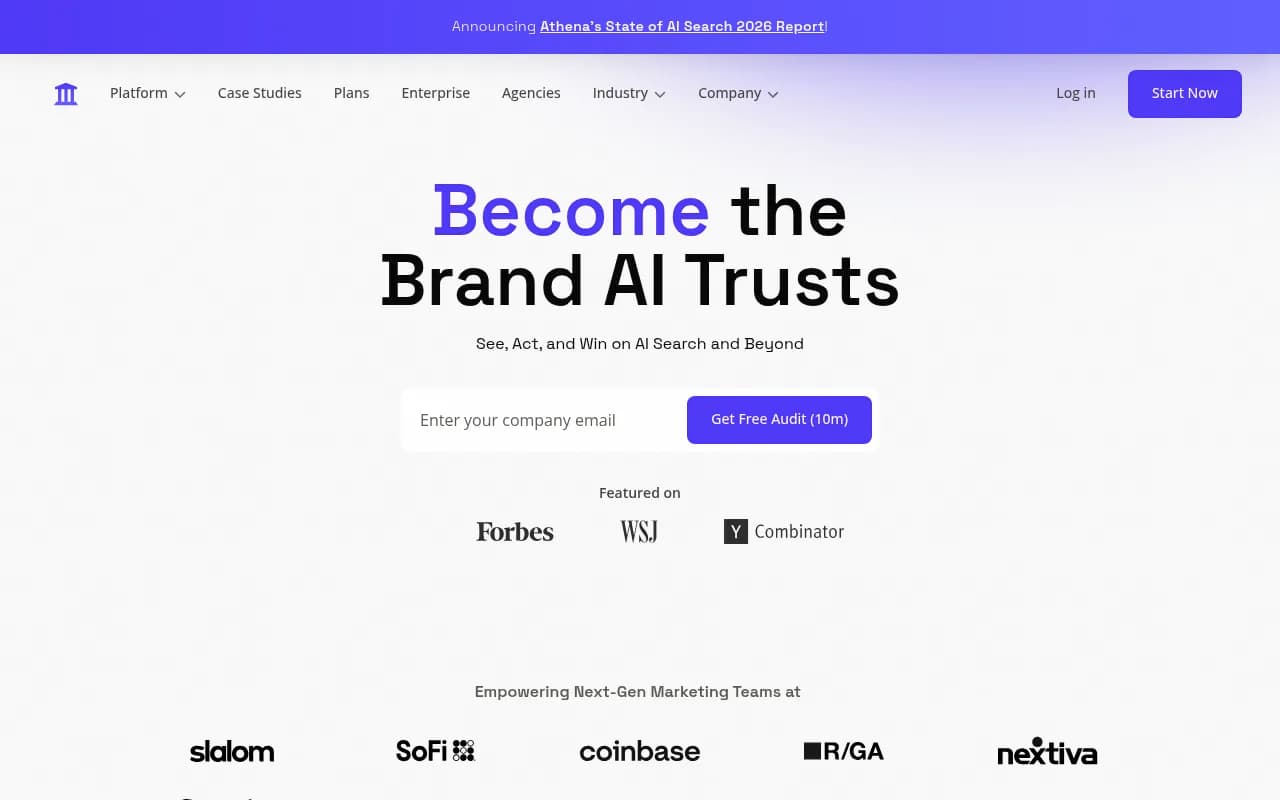
But it's monitoring-only in the strictest sense. No crawler logs, no visitor analytics, no content generation. It's a reasonable choice for teams that want structured data about AI visibility and have a separate content workflow. As a standalone optimization tool, it doesn't go far enough.
Side-by-side comparison
Here's how the four platforms stack up across the features that matter most for teams trying to improve AI visibility, not just measure it.
| Feature | Otterly.AI | Scrunch | Search Party | AthenaHQ |
|---|---|---|---|---|
| Prompt tracking | Yes | Yes | Yes | Yes |
| Citation analysis | Yes | Yes | Yes | Yes |
| Multi-engine coverage | Yes | Yes (7 models) | Yes | Yes |
| Competitor benchmarking | Yes | Yes | Partial | Yes |
| Crawler logs | Beta | Yes | No | No |
| Visitor analytics | Limited | Yes | No | No |
| Content gap analysis | No | No | No | No |
| Content generation | No | Limited | No | No |
| Reddit/YouTube tracking | No | No | No | No |
| ChatGPT Shopping tracking | No | No | No | No |
| Prompt volume/difficulty | No | No | No | No |
| Free trial | Yes | No | Limited | Yes |
| Starting price | Low | $300/mo | Custom | Custom |
| Best for | Budget monitoring | Enterprise reporting | Agencies | Technical SEO teams |
The pattern is obvious. Every platform does monitoring. None of them close the loop.
The monitoring ceiling: why data alone doesn't move rankings
Here's the thing about AI search visibility that's easy to miss: knowing you're invisible doesn't make you visible.
If Otterly.AI tells you that a competitor appears in 73% of responses to "best project management software for remote teams" and you appear in 4%, that's useful information. But the dashboard doesn't tell you why they appear more, what content they have that you don't, or what you should write to close that gap.
That's the monitoring ceiling. You can see the problem clearly. You just can't fix it from inside the tool.
This matters more in AI search than it did in traditional SEO. With Google, you could look at a competitor's page, reverse-engineer their keyword targeting, and write something better. With AI search, the citation logic is less transparent. AI models pull from a mix of your own pages, third-party mentions, Reddit threads, YouTube videos, and other sources. You need to know which of those are driving citations -- and which gaps in your content are causing AI models to skip you entirely.
Monitoring tools show you the output. They don't show you the inputs.
What a full GEO platform looks like
The difference between a monitoring tool and an optimization platform comes down to one question: does it help you create content that AI models will cite?
A real GEO platform does three things in sequence:
- Finds the specific prompts where competitors are visible and you're not (answer gap analysis)
- Generates content designed to fill those gaps -- articles, comparisons, listicles -- grounded in real prompt data, citation patterns, and competitor analysis
- Tracks whether that new content gets crawled, cited, and drives traffic
Most platforms in this space only do step one. Some do step one and a half. Very few do all three.
Promptwatch is the platform that closes this loop most completely. Its Answer Gap Analysis shows you exactly which prompts competitors rank for that you don't. Content Agents then generate content engineered to fill those gaps -- not generic AI writing, but articles built around real prompt volumes, citation data, persona targeting, and competitor analysis. Page-level tracking then shows which pages are being cited, by which models, and how often.

That's a fundamentally different product from a monitoring dashboard. The monitoring is still there -- Promptwatch tracks 10 AI models including ChatGPT, Perplexity, Google AI Overviews, Gemini, Claude, Grok, DeepSeek, and others. But the monitoring feeds into action, not just reporting.
Profound is another platform worth mentioning here. It has strong enterprise analytics and crawler logs, and it goes deeper than the four platforms in this comparison on the analytics side.
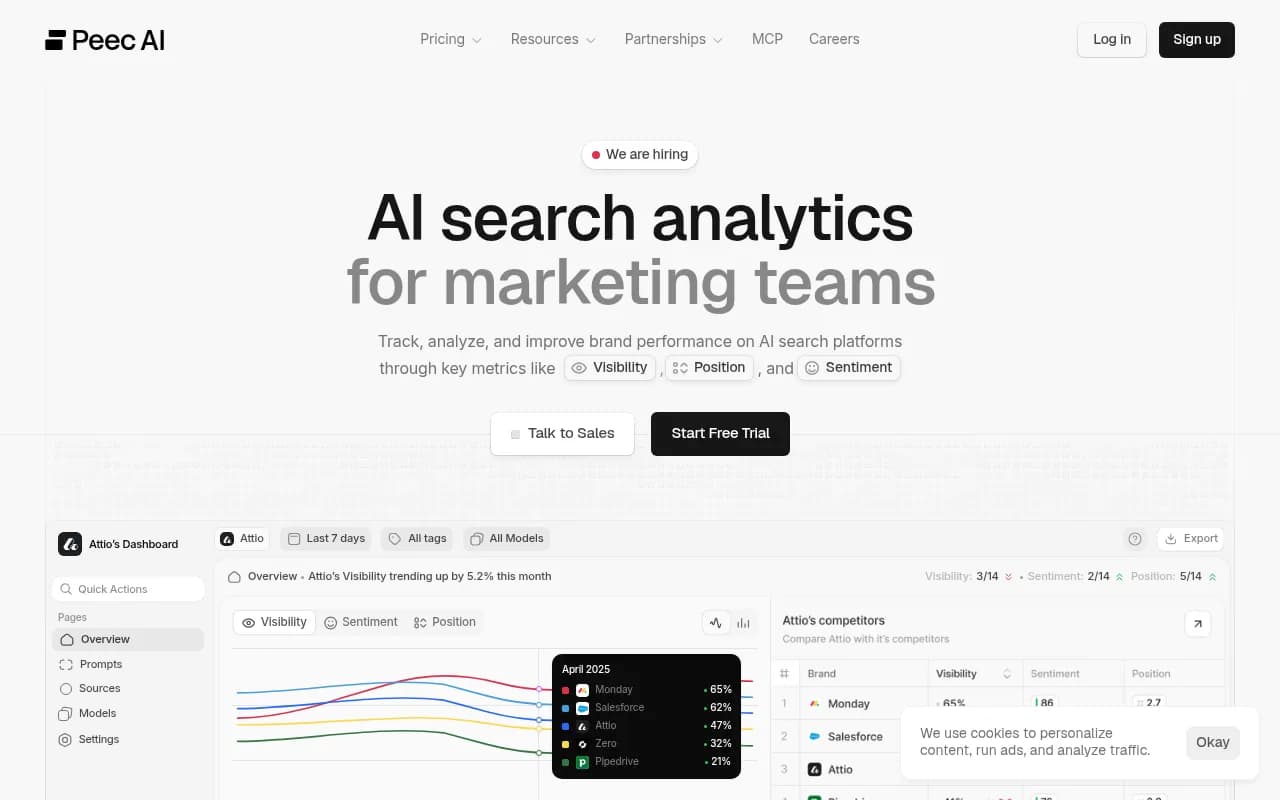
Peec.AI sits somewhere in the middle -- monitoring with some content suggestions, but not full generation.
Who should use each platform
Despite the limitations, these tools aren't useless. Here's when each one makes sense.
Otterly.AI makes sense if you're just starting to understand AI search visibility, have a limited budget, and want a simple way to track brand mentions across AI models. It's a good starting point before you invest in a full GEO platform.
Scrunch makes sense for enterprise teams that need SOC 2 compliance, detailed governance, and structured reporting. If your main goal is internal reporting and stakeholder dashboards rather than actively improving rankings, the premium is defensible. Just know you'll still need a separate content workflow.
Search Party makes sense for agencies that need to report AI visibility data to multiple clients. The white-labeling and multi-brand management are genuine strengths. It's not built for optimization, but it's built for client communication.
AthenaHQ makes sense for technical SEO teams that want clean, structured AI visibility data and have a strong in-house content operation. If your content team is already producing high-quality material and you just need better data to direct them, AthenaHQ can work.
None of them make sense if your primary goal is to actually rank in AI search. For that, you need a platform with content gap analysis and content generation built in.
A note on pricing transparency
One thing worth flagging: pricing transparency varies a lot across these platforms.
Scrunch publishes its pricing ($300/month Starter, $500/month Growth, custom Enterprise). Otterly.AI is similarly transparent. Search Party and AthenaHQ both lean toward custom pricing, which makes comparison harder.
The research from That's Noble's 2026 roundup notes that Scrunch's per-user pricing scales quickly, which is worth factoring in for larger teams. At $300/month for 3 users and 350 prompts, you're paying roughly $1/prompt per month before you even start optimizing.
For context, Promptwatch's Professional plan at $249/month includes 150 prompts, crawler logs, and content generation -- a different value equation entirely.
The bottom line
Otterly.AI, Scrunch, Search Party, and AthenaHQ are all legitimate tools for what they do. If you need to monitor AI search visibility, any of them will give you data you didn't have before.
But monitoring is not optimization. Knowing your visibility score is low doesn't raise it. Seeing a competitor's citation rate doesn't tell you what content to write. Getting a weekly report doesn't fix the gaps in your site that AI models are skipping over.
The GEO space in 2026 has split into two categories: tools that show you the problem, and tools that help you fix it. The four platforms in this comparison are firmly in the first category. If you're evaluating them, go in with clear eyes about what you're buying -- and what you're not.
If you want to actually move the needle, look for a platform that closes the loop from gap analysis to content creation to citation tracking. That's where the real work happens.