Key takeaways
- Shopping and product recommendation queries are among the hardest AI prompts to track -- most platforms don't distinguish them from informational queries at all.
- Promptwatch is the only platform in this comparison with dedicated ChatGPT Shopping tracking, offsite citation analysis, and a content generation layer to act on gaps.
- Profound has strong enterprise-grade shopping insights and sentiment analysis, but it's priced for Fortune 500 teams and lacks content creation tools.
- Peec AI is a solid entry-level monitor but stops well short of shopping-specific tracking or optimization.
- Relixir is not a widely documented platform in the current GEO tooling landscape -- where it appears, it's positioned as a lightweight monitoring play with no verified shopping-specific features.
When someone types "what's the best noise-cancelling headphone under $200?" into ChatGPT or Perplexity, they're not browsing -- they're about to buy. These purchase-intent prompts are the new product search, and right now most brands have no idea whether they're showing up in those answers or not.
That's the gap this guide addresses. Not AI visibility in general, but specifically: which platforms can track, analyze, and help you improve how your brand appears when AI engines make product recommendations.
The four tools we're comparing -- Promptwatch, Profound, Peec AI, and Relixir -- represent different philosophies about what an AI visibility platform should do. Some track. Some analyze. One actually helps you fix the problem.
Why shopping queries need their own tracking category
Most AI visibility tools treat all prompts the same. You enter a query, they show you whether your brand appears in the response. That works fine for informational content ("how does X work?"), but it misses what makes shopping queries different.
Product recommendation prompts have a few unique characteristics:
- AI engines often generate structured outputs: ranked lists, product cards, price comparisons, or shopping carousels. Whether your brand appears in a list at position 1 vs. position 5 matters enormously.
- ChatGPT has a dedicated shopping mode that pulls product data differently from standard responses. Tracking standard responses won't capture what happens in shopping mode.
- The citations driving product recommendations often come from review sites, Reddit threads, YouTube videos, and third-party listicles -- not your own website. Offsite citation tracking is essential.
- Sentiment matters. An AI engine might mention your brand but describe it negatively or as a runner-up. Knowing the context of a mention is different from knowing the mention exists.
With that framing, here's how each platform handles it.
Promptwatch
Promptwatch is the most complete platform in this comparison for shopping and product recommendation tracking. It's the only one with a dedicated ChatGPT Shopping tracker that monitors when your brand appears in ChatGPT's product recommendation carousels -- a feature that's genuinely rare in this space.

Beyond the shopping-specific feature, Promptwatch's broader architecture is well-suited to purchase-intent queries:
Offsite citation analysis shows which external pages -- Reddit threads, YouTube reviews, comparison articles, third-party listicles -- AI engines are citing when they recommend products in your category. For e-commerce and consumer brands, this is often more actionable than tracking your own pages, because the citations driving AI product recommendations frequently live off your domain.
Answer Gap Analysis identifies specific prompts where competitors are being recommended but you're not. For shopping queries, this means you can see exactly which "best X for Y" prompts your competitors are winning and you're not -- and get a clear view of what content is missing.
Content Agents then generate articles, comparison pages, and product briefs grounded in that gap data. This is where Promptwatch separates from every other tool in this list: it doesn't just show you the problem, it helps you create content engineered to close it.
Prompt Intelligence includes volume estimates and difficulty scores per prompt. For shopping queries, this lets you prioritize: high-volume "best [category]" prompts with lower difficulty are the ones worth targeting first.
AI Crawler Logs (available on Professional and Business plans) show which pages AI crawlers are actually reading on your site, how often they return, and when a crawled page moves to a citation. For product pages and buying guides, this is the feedback loop that tells you whether your optimization is working.
The platform monitors 10+ AI models including ChatGPT, Perplexity, Google AI Overviews, Google AI Mode, Gemini, Claude, Grok, and DeepSeek. Pricing starts at $99/month (Essential), with the Professional plan at $249/month unlocking crawler logs and more prompt slots.
Profound
Profound is the enterprise end of this market. It processes over 5 million citations daily across 7+ AI engines and is built for organizations running large-scale AI visibility programs -- think Fortune 500 marketing teams or agencies managing dozens of brands.
For shopping and product recommendation tracking, Profound has a few genuine strengths. It offers dedicated AI shopping insights as a feature category, which means it's one of the few platforms that explicitly distinguishes shopping-mode responses from informational ones. It also includes sentiment analysis, so you can see not just whether your brand appears in a recommendation but how it's framed -- positive, neutral, or negative.
Prompt demand estimation is another useful feature for shopping use cases. Rather than just tracking prompts you've manually entered, Profound estimates the volume of real user queries in a category, which helps prioritize which product queries are worth optimizing for.
Where Profound falls short for most teams is on the action side. It's a monitoring and analytics platform. There's no content generation layer, no content briefs, no built-in tooling to help you create the pages that would improve your visibility. You get excellent data and then you're on your own to act on it. For enterprise teams with dedicated content resources, that's fine. For leaner marketing teams, it's a gap.
Profound is also priced at the enterprise tier -- it's not a platform you'd evaluate for a $300/month budget. If you're a mid-market brand or an agency managing multiple clients, the cost-to-value ratio gets harder to justify compared to Promptwatch.
Peec AI
Peec AI is a monitoring-focused platform positioned at the more accessible end of the market. It tracks brand mentions across AI engines and gives you visibility scores, competitor comparisons, and basic citation data.
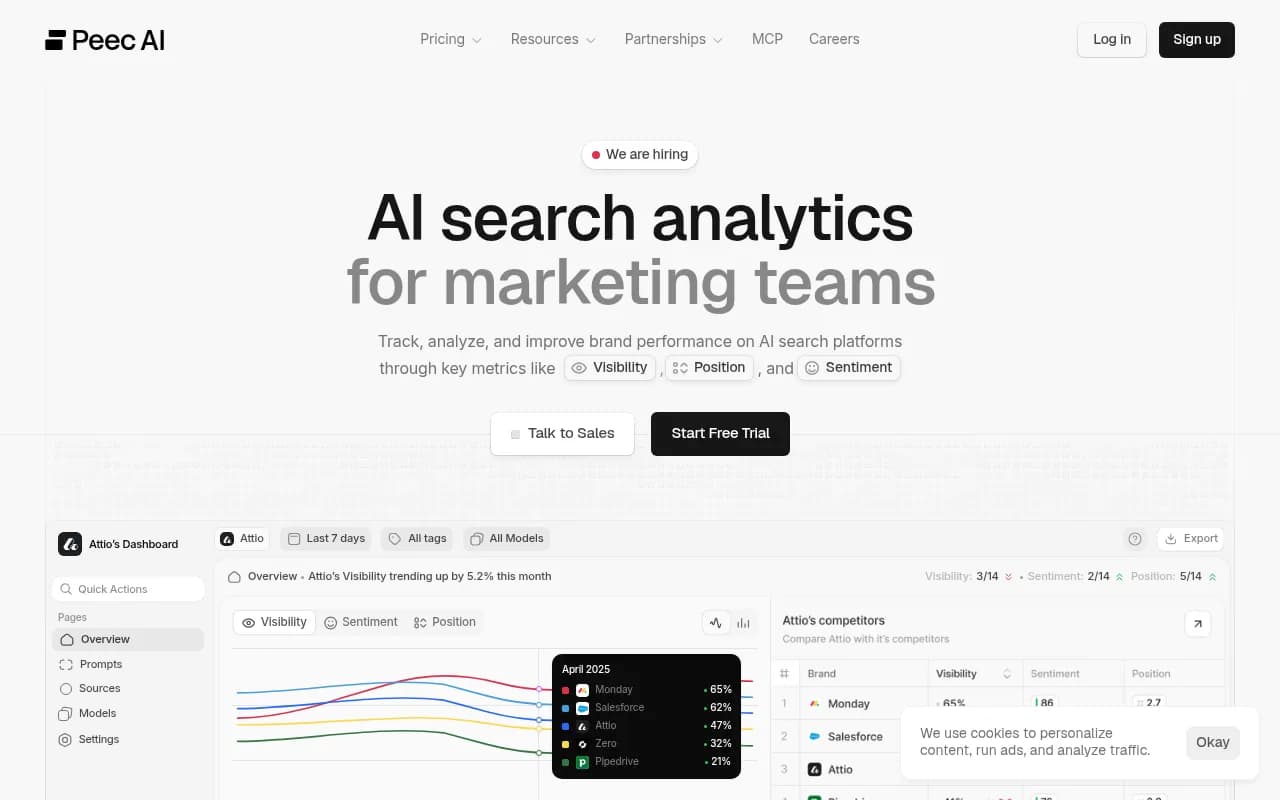
For general AI visibility tracking, it works. For shopping and product recommendation queries specifically, it's limited. There's no dedicated shopping mode tracking, no offsite citation analysis, and no content generation. You can enter product-related prompts and see whether your brand appears, but the platform doesn't distinguish between a shopping recommendation and an informational mention.
The prompt library and monitoring setup are straightforward, which makes Peec AI a reasonable starting point for teams new to AI visibility. But teams focused on e-commerce or consumer products will quickly find that the data doesn't give them enough to act on. You know you're not appearing in "best wireless earbuds" queries -- but Peec AI won't tell you why, or what to do about it.
It's worth noting that Peec AI lacks crawler logs, AI traffic attribution, and Reddit/YouTube citation tracking. For shopping queries, where third-party review content drives a lot of AI recommendations, the absence of offsite citation data is a real limitation.
Relixir
Relixir is a newer entrant in the GEO space. Based on available information, it's positioned as an AI visibility and optimization platform with some content generation capabilities, targeting teams that want to improve their presence in AI-generated answers.
However, Relixir doesn't appear in the major independent comparisons of GEO platforms (including Promptwatch's own 12-platform comparison or the broader third-party roundups from 2026). Its documented feature set for shopping-specific tracking -- ChatGPT Shopping monitoring, offsite citation analysis, purchase-intent prompt categorization -- isn't verified in public sources.
If you're evaluating Relixir for shopping query tracking specifically, the key questions to ask during a demo are: Does it distinguish shopping-mode responses from standard AI answers? Does it track citations from third-party review sites and Reddit? Does it have prompt volume data for product queries? And does it offer any content generation tied to shopping gaps?
Without clear answers to those questions, it's difficult to recommend Relixir for this specific use case over platforms with documented capabilities.
Head-to-head comparison
| Feature | Promptwatch | Profound | Peec AI | Relixir |
|---|---|---|---|---|
| ChatGPT Shopping tracking | Yes | Yes (AI shopping insights) | No | Unverified |
| Offsite citation analysis | Yes | Partial | No | Unverified |
| Sentiment analysis | No | Yes | No | Unverified |
| Prompt volume / demand estimation | Yes | Yes | Limited | Unverified |
| Content generation | Yes (Content Agents) | No | No | Partial |
| Answer gap analysis | Yes | No | No | Unverified |
| AI crawler logs | Yes (Pro+) | No | No | No |
| Reddit / YouTube citation tracking | Yes | No | No | No |
| Multi-model coverage | 10+ models | 7+ models | 5+ models | Unknown |
| Traffic attribution | Yes | No | No | No |
| Pricing entry point | $99/mo | Enterprise | ~$49/mo | Unknown |
| Best for | Mid-market to enterprise | Enterprise / Fortune 500 | Beginners / SMBs | Unclear |
Which platform fits which team
The right choice depends on what you actually need to do with the data.
If you're an e-commerce brand or consumer product company that needs to understand and improve AI product recommendations, Promptwatch is the clearest fit. The ChatGPT Shopping tracker, offsite citation analysis, and content generation layer give you a complete workflow: find where you're missing, understand why, create content to fix it, track whether it worked.
If you're a large enterprise with a dedicated analytics team, significant budget, and a need for deep sentiment analysis and demand forecasting across AI shopping queries, Profound is worth evaluating seriously. Just go in knowing you'll need separate content resources to act on what it finds.
If you're just starting out with AI visibility and want a low-cost way to monitor whether your brand appears in AI answers, Peec AI is a reasonable first step. It won't give you shopping-specific insights, but it's a low-friction way to get oriented before investing in a more complete platform.
If you're considering Relixir, ask for a demo specifically focused on shopping and product recommendation queries before committing. The platform's capabilities in this area aren't well-documented enough to make a confident recommendation.
The part most teams miss: offsite citations drive shopping recommendations
One thing worth dwelling on: when AI engines recommend products, they're often synthesizing information from sources you don't control. A Wirecutter article, a Reddit thread in r/headphones, a YouTube review with 200k views -- these are frequently the citations behind "ChatGPT recommends X."
This means optimizing your own product pages, while necessary, isn't sufficient. You also need to know which external sources are driving recommendations in your category, whether your brand is mentioned in those sources, and whether the framing is positive.
Only Promptwatch in this comparison offers offsite citation tracking as a documented feature. For brands serious about AI shopping visibility, that's not a nice-to-have -- it's the mechanism by which most AI product recommendations actually get made.
What to look for when evaluating any platform for shopping queries
If you're running your own evaluation beyond these four tools, here's a short checklist:
- Does the platform distinguish between ChatGPT's standard mode and shopping mode? These produce different outputs.
- Can you track citations from third-party sites (Reddit, review platforms, YouTube), not just your own domain?
- Does the platform provide sentiment context for brand mentions, not just presence/absence?
- Is there prompt volume data so you can prioritize high-traffic shopping queries?
- Does the platform connect visibility data to actual traffic or revenue, so you can measure ROI?
- Is there a content creation or optimization layer, or do you need separate tools to act on the data?
Most platforms pass one or two of these. Very few pass all of them.
A note on the broader market
The AI visibility tool space has grown fast. There are now dozens of platforms claiming to track AI search, and the feature lists can look similar on the surface. The real differentiator for shopping use cases is whether a platform was built to handle the structural differences in how AI engines generate product recommendations -- not just whether it can run a prompt and return a yes/no on brand presence.
The platforms that built shopping-specific features (ChatGPT Shopping tracking, demand estimation for product queries, sentiment analysis in recommendation contexts) are still a small subset of the market. Promptwatch and Profound are the two with the most documented capabilities here. For most teams, Promptwatch's combination of shopping tracking, offsite citations, and content generation makes it the more complete choice -- particularly if you don't have a dedicated analytics team to interpret raw data and a separate content team to act on it.
For teams that want to explore the broader landscape of AI visibility tools beyond these four, the comparison below covers some of the other platforms worth knowing about: