Key takeaways
- Before a launch, AI has nothing to say about your product. After it, answers form from a handful of pages: your own, press coverage, reviews and forum threads. You can watch that happen if you set up tracking first.
- Track claims, not just mentions. Pricing, features, audience and comparisons are where wrong statements show up and stick.
- Branded prompts lean on your own product and landing pages (about 23% each of branded ChatGPT citations in Promptwatch Data), so fix those pages first.
- Press coverage fades fast in ChatGPT (news loses half its cited pages in about 36 days). Landing pages and docs last much longer.
- Run a baseline a week before launch, check daily for the first two weeks, then move to weekly.
Why launches are a special case for AI tracking
Normal brand monitoring is about drift. A launch is about birth. For a few days or weeks there is almost nothing in the training data about your new product, so the AI engines that search the live web (ChatGPT Search, Perplexity, Google AI Overviews, Gemini) assemble answers from whatever they can find and fetch. That might be your announcement post, a TechCrunch paragraph, a Reddit thread, an early review, or a competitor's comparison page that mentions you in passing.
That is the window where claims form. "Costs $49 per seat." "Only works with Salesforce." "Built for enterprise." Some will be right. Some will be a misread of your pricing page. Once a claim is repeated across a few cited sources it gets sticky, and correcting it later is slower than catching it in week one.
So the job during a launch is not "see if we show up." It is closer to watching a wire service: what is being said, by which engine, citing which page, and is it true.
Step 1: Build a launch prompt set before you announce
Start a week before launch. You want a baseline so you can say, with a straight face, "on day 0 we were mentioned in 0% of answers, on day 10 we were in 40%."
Group your prompts into four types:
- Branded: "What is [Product]?", "[Product] pricing", "Is [Product] any good?", "[Product] vs [Competitor]"
- Category: "best [category] tools for [audience]", the prompts you actually want to win
- Problem: "how do I [job your product does]"
- Competitor comparison: "[Competitor] alternatives", "[Competitor] vs [Product]"
Branded prompts matter most in launch week because they are the ones people type after seeing your announcement. They also behave differently from other prompts. In Promptwatch Data's ChatGPT citation share by content type report (Sep 28 to Oct 4, 2026), product pages made up 23.3% of citations on branded prompts and landing pages 22.8%. Reviews rose to 5.6%, more than three times their share across all prompts, and FAQ pages (4.8%), social posts (3.0%) and press releases (2.1%) also got a bigger slice.
Read that as a to-do list. For a brand-new product, AI will lean on your own product and landing pages, then on reviews and FAQs. If those pages are thin or ambiguous, the engines fill the gaps from elsewhere.
Write prompts like your buyers, not like your marketing team
Use real phrasing. Pull it from sales calls, support tickets, the questions in your launch Q&A and Search Console once data comes in. Short queries work better than polished ones. Promptwatch Data's query fan-out report shows average query length in ChatGPT's own searches falling from about 117 characters in December to about 53 in April, so the engines themselves are searching in short phrases. Writing headings that read like short search queries, with the entity and category first, is the report's advice.
Also use personas if your tool supports them. A CFO and a developer ask different questions about the same product, and the answers can differ.
Step 2: Decide what to measure
A single "visibility score" is not enough in a launch. Track these:
| Metric | What it tells you | Launch question it answers |
|---|---|---|
| Mention rate | Share of responses that name your product | Does AI know we exist yet? |
| Position | Where you land in the list of brands | Are we an afterthought or a lead pick? |
| Citations to your domain | Whether AI links to your own pages | Is it learning from us or from third parties? |
| Sentiment | Tone of the mentions | Is early reception good or lukewarm? |
| Claims | Specific statements about price, features, audience | Is what AI says actually true? |
| Sources | Which pages and threads feed the answers | Where do we go to fix it? |
The combination is diagnostic. Mentions without citations to your domain usually means AI is relying on press or reviews, not your site. A mention in late position with good sentiment is a prominence problem. Weak sentiment with early reviews cited is a reputation problem. Zero mentions across the board in week two often means a crawlability problem, so check that AI bots can read your launch pages at all.
Step 3: Track claims, not just mentions
This is the part most dashboards skip. A mention count tells you nothing about whether the answer says your product costs $10 or $100.
Do it manually at first. Once a day, run your branded prompts on each engine and log in a spreadsheet:
- The date, engine and prompt
- Each factual claim about your product (price, integrations, limits, target customer)
- Whether it is accurate
- Which source was cited for it
That is tedious but it is the only way to understand what "claims forming" looks like. After a week you will see patterns. A claim appears in one engine, then shows up in two more as the source page gets picked up.
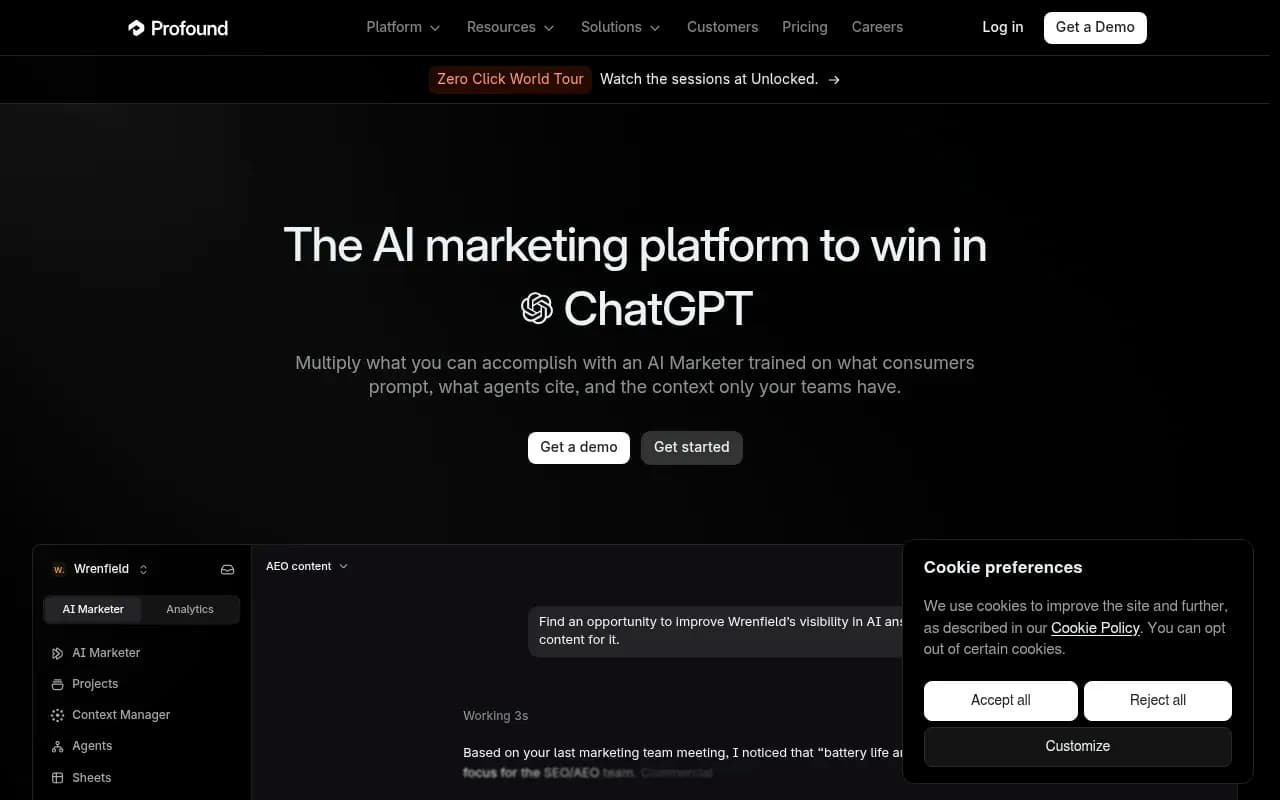
Some platforms automate this. Promptwatch's Brand Narrative extracts individual claims from tracked responses, groups repeats, shows which models say each one, and scores themes like Pricing, Features and Support against competitors. Its Fact Check feature lets you mark a claim accurate or inaccurate and then looks through your crawled pages for the one stating it. Waikay is built around the same idea of brand perception, and Profound describes a workflow that traces inaccurate claims back to the publishers repeating them and tracks which ones updated.
Step 4: Trace each claim to its source
A wrong claim is only fixable if you know where it came from. Look at the citations behind each answer. Typically you will find one of these:
- Your own page that is ambiguous (a pricing table that omits the annual discount, a features page that lists a roadmap item as shipped)
- A press article that simplified or misquoted you
- A review or listing on a third-party site with stale information
- A forum or social thread, though note the source mix varies a lot by engine: Promptwatch Data's social media citations report found ChatGPT drew 0.46% of citations from social platforms in the week of Sep 28 to Oct 4, 2026, versus 12.2% for Google AI Overviews. And reddit.com's share of ChatGPT citations fell from about 4% to 0.5% on August 14, 2026. So where you watch matters.
- A competitor's comparison page
Also check the AI crawlers. If GPTBot, ClaudeBot or PerplexityBot cannot fetch your launch page (a staging robots.txt left in place is a classic), the engines will never cite you however good the page is. Promptwatch's AI crawler logs show which bots read which pages and where they hit errors, and the free Agentic Readiness Check gives a quick read on which crawlers can see your site.
Step 5: Fix what is wrong, in the right order
Prioritize by durability. Promptwatch Data's content half-life report tracked pages ChatGPT cited on July 6, 2026 for 90 days:
| Content type | Still cited after 30 days | Still cited after 60 days |
|---|---|---|
| Landing pages | 78% | 69% |
| Docs | 76% | 67% |
| Comparisons | 72% | 63% |
| Listicles | n/a | 60% |
| Product pages, reviews, how-tos | n/a | about 55% |
| News | about 50% gone by day 36 | 41% |
The lesson for a launch is plain. Press coverage gives you roughly five weeks of visibility and then fades. Landing pages, docs and pricing pages are the long-term assets. So your correction order should be:
- Your own pricing, product and landing pages. Make them state price, features and target audience in plain sentences that an engine can quote. Fix ambiguity here first.
- Docs and FAQ. Add an FAQ page answering the exact questions your branded prompts reveal.
- Reviews and listings. Collect reviews on trusted sites, since reviews carry far more weight on branded prompts.
- Press and third-party articles. Email the publisher with the correct fact and a link to the source. This is slow and success is uneven, so do it after you have fixed your own pages.
- Comparison content. If a competitor page misdescribes you, publish your own honest comparison.
After each fix, re-run the affected prompts. Engines refresh at different rates, so expect days for live-search engines and longer for anything that depends on training data.
Step 6: Set a cadence
| Phase | Frequency | Focus |
|---|---|---|
| Week before launch | One baseline run | Baseline mentions, competitor positions, crawl access |
| Launch day to day 3 | Several times daily if your tool allows | Early claims, wrong facts, crawl errors |
| Days 4 to 14 | Daily | Claim spread, source tracing, corrections |
| Days 15 to 45 | Every few days | Press decay, review growth, category prompt wins |
| After day 45 | Weekly | Normal monitoring |
AI answers are noisy. The same prompt can give different results run to run, and Promptwatch Data has shown shifts such as the drop in citations per ChatGPT response around the GPT-5.3 rollout on March 4, 2026. Do not panic over one run. Watch trends across several days and several prompts, and note model updates in your log so you can separate your effect from the engine's.
Tools for tracking a launch
You can do a weak version of this with a spreadsheet and a few free chatbot accounts. It breaks down when you need multiple engines, countries, daily runs and claim-level analysis. Here is how the main options line up for launch work. I have not verified current pricing for every tool below, so check each vendor's page.
| Tool | Strength for launches | Gap to check |
|---|---|---|
| Promptwatch | Tracking plus claim extraction (Brand Narrative), Fact Check, crawler logs, content creation and visitor analytics in one place | Fact Check and faster-than-daily tracking start on Business |
| Profound | Enterprise monitoring and a workflow for tracing wrong claims to publishers | Verify pricing and plan limits |
| Waikay | Focus on brand perception | Verify engine coverage and depth |
| Peec AI | Straightforward prompt tracking | Mostly monitoring |
| Otterly.AI | Affordable monitoring | Mostly monitoring |
Promptwatch is the one I would reach for when the goal is to close the loop, meaning find the wrong claim, find the page it came from, publish or refresh the fix, and then confirm it worked. It collects answers from the real interfaces of ChatGPT, Gemini, Perplexity, Google AI Overviews and others, and its Action Board turns gaps into a prioritized to-do list. Its pricing starts at $95/month, with a 7-day free trial on monthly plans, and the free AI visibility report is a no-login way to see where you stand before launch.

Profound is the main enterprise alternative and describes tracing inaccurate claims back to the publishers repeating them.

Waikay is worth a look if brand perception is your main concern.

Peec AI is a lighter option for prompt tracking.

Otterly.AI is another budget-friendly monitoring option.

If you want to compare more options, the GEO software directory at bestgeosoftware.com lists many of them.
A launch week checklist
Before launch:
- Publish a pricing page, product page and FAQ that state price, features and audience in plain sentences
- Confirm robots.txt and CDN rules let AI crawlers in
- Build 25 to 50 prompts across branded, category, problem and comparison types
- Run the baseline and save it
Launch week:
- Check branded prompts daily on every engine you track
- Log every factual claim and mark it accurate or not
- Trace each wrong claim to its cited source
- Fix your own pages first, then contact third parties
Weeks two to six:
- Watch press-driven visibility fade and expect it, rather than treating it as a failure
- Add reviews and comparison content to hold position
- Shift toward category prompts, where the real growth is
- Check AI-referred visitors in your analytics. Note that ChatGPT stopped sending a referrer on October 8, 2026, so tag links with utm_source=chatgpt.com where you can.
What I would not bother with
A single visibility score on launch day. It will be near zero for everyone and tells you nothing. The useful signals in week one are claims, sources and crawl access. Scores become meaningful once you have a few weeks of data and a baseline to compare against.
The broader point: a launch gives you a short window where AI answers are being written from a small pool of pages. Own as many of those pages as you can, keep them accurate, and watch what the engines do with them.
If you are choosing a partner to run this for you rather than doing it in-house, 1001 SEO Media runs GEO and AI search work for brands and uses Promptwatch for its own AI visibility tracking.