Key takeaways
- Yes, Perplexity is worth tracking, but as one engine in a multi-engine set, not as a standalone program. Estimates put it near 8% of the AI search market versus roughly 31% for ChatGPT.
- Perplexity cites almost exactly 10 sources per answer, which leaves room for mid-authority sites. ChatGPT averages about 5 per web-search answer.
- Published Perplexity citation numbers disagree wildly. Some measure the share of answers that cite a site, others the share of all citations. Know which one you are reading.
- B2B, SaaS, research-heavy, developer and regulated-industry brands should prioritize it. Local and impulse-purchase brands can usually wait.
- Perplexity's source mix can shift in a day. Track rates across many prompts, not single answers.
The short answer
Perplexity is worth tracking if your buyers research before they buy. It is not worth a dedicated budget line if your customers never ask an AI assistant anything.
That is less satisfying than "yes, everyone should" or "no, it's hype", but it is what the evidence supports. Perplexity is smaller than ChatGPT and Gemini by most estimates. It also behaves differently enough that your results on those engines tell you very little about your results on Perplexity.
The rest of this guide covers what the numbers say (and where they conflict), what makes Perplexity distinct, who should care, and how to track it.
How big is Perplexity, really?
The commonly quoted figures are old. DemandSage put Perplexity at 780 million queries per month by mid-2025, up from 230 million a year earlier, and Business of Apps reported 45 million monthly active users. Those numbers are over a year stale as of late 2026, so treat them as a floor rather than a current reading.
For relative size, several 2026 tracking guides estimate Perplexity at roughly 8% of the AI search market, against about 31% for ChatGPT and 22% for Gemini. Those are third-party estimates, not audited figures, but the ordering is consistent: Perplexity is a distant third, not a rival to ChatGPT for raw volume.
So why bother? Two reasons.
- The audience skews toward researchers, developers and early adopters, people who are comparing options when they ask.
- The engine is structurally different, which means it is a separate optimization problem and a useful one.
One vendor-reported claim deserves caution: Everything-PR says Perplexity-referred traffic converts at 3.1x Google organic. That is a single source with no disclosed methodology I could verify, so check your own analytics before building a business case on it. Referral data from your own site beats any benchmark.
What makes Perplexity different
It cites a lot of sources, and the count is stable
According to Promptwatch's data on average sources per response, Perplexity cites almost exactly 10 sources per answer, day after day, with barely a decimal of movement. ChatGPT cites about 5 per web-search answer, and Google AI Overviews about 10.
Ten fixed slots matter. In a five-slot engine, only the strongest domains get in. With ten, mid-authority sites have a real path to a citation. This fits what Promptwatch's ChatGPT citation share by domain rank data shows more broadly: domain rank 46-75 earned almost half of ChatGPT citations in August 2026, while DR 91-100 fell to about 3%.
It also makes Perplexity a decent test bench. Because its citation count barely moves, a change in how often you get picked up is more likely to reflect your content than engine noise.
Its source mix can change overnight
Searchable reported that YouTube appeared in 13.8% of matched Perplexity answers between July 20 and August 10, 2026, then dropped to 0.6% between September 14 and 27. The drop happened on August 12, and Facebook and Instagram fell with it while Reddit and LinkedIn held steady.
Promptwatch's social media citations by AI model report points the same direction for the period Sep 28 to Oct 4, 2026: YouTube on Perplexity sat at 0.79% of citations, down from 2.67% in the earlier report.
A brand whose Perplexity visibility came mostly through YouTube would have lost most of it in a day. That is the strongest argument for ongoing tracking. You cannot audit once and move on.
Reddit and LinkedIn: read the numbers carefully
This is where the sources fight, and where lazy articles get it wrong.
| Source | Reddit on Perplexity | LinkedIn on Perplexity | What it measures |
|---|---|---|---|
| Searchable (Sep 14-27, 2026) | 10.8% | 8.3% | Share of unbranded answers that cite the site |
| Promptwatch Data (Sep 28-Oct 4, 2026) | 0.86% | 0.86% | Share of all citations |
| Everything-PR (June 2026, citing other studies) | 20-24% | n/a | Share of citations, aggregated from several studies |
These do not contradict each other as much as they look. A site cited in 10.8% of answers can still be under 1% of all citations if every answer carries ten links and most are spread across other domains. They also cover different weeks, and Reddit's share in ChatGPT collapsed in August 2026 (see Promptwatch's Reddit citation data), so older comparisons against ChatGPT are shaky.
The Everything-PR figure of 20-24% is a consolidation of other studies with different methods. I would not plan around it.
What holds across all of them: community and professional platforms matter on Perplexity, and LinkedIn is now on equal footing with Reddit. Promptwatch's own recommendation for Perplexity is to publish on LinkedIn as well as Reddit, and to keep X out of AI search plans. One more useful detail from Everything-PR: for Perplexity, 59% of LinkedIn citations reportedly come from Company Pages rather than personal posts, which is a surface a brand fully controls. Treat that as directional.
It leans on tier-1 editorial and reference sources
Everything-PR's June 2026 index lists Reddit, Wikipedia, YouTube, LinkedIn, Reuters, the NYT, Bloomberg, the Washington Post and similar outlets near the top, plus .gov and .edu sources for health, finance and policy. It also claims Perplexity heavily weights tier-1 journalism. That is useful as a to-do list, even if the exact ranks are shaky. SeoProfy and GrowByData make similar points about freshness and third-party validation: Perplexity often prefers independent reviews and comparisons over brand-owned pages.
Who should prioritize Perplexity
| Brand type | Priority | Why |
|---|---|---|
| B2B SaaS and software | High | Comparison and alternatives queries are common, and review sites like G2 and Capterra are frequently cited |
| Developer tools and APIs | High | Technical audience, strong reliance on GitHub, docs and Stack Overflow |
| Finance, health, policy | High | Perplexity favors .gov, .edu and primary sources, so accurate, well-cited content has an edge |
| Publishers and research firms | High | Original data and tier-1 coverage get cited |
| Ecommerce | Medium | Depends on category. Check where your products show up before investing |
| Local businesses | Low to medium | Other surfaces such as maps and AI Overviews usually matter more |
| Impulse or low-consideration products | Low | Buyers are not doing research prompts |
A simple test: ask five customers whether they use Perplexity to research purchases in your category. If two or more say yes, prioritize it. If none do, track it lightly alongside ChatGPT and Google and move on.
How to check whether it matters for you
Do not start with a tool purchase. Start with your own data.
- Check your analytics referrers for perplexity.ai over the last 90 days. Even a small number tells you whether the channel is alive for you.
- Look at your server or CDN logs for PerplexityBot and Perplexity-User. If you see nothing, you may be blocking them through robots.txt, a CDN or a WAF.
- Run 20 to 30 realistic prompts your buyers would ask, ideally unbranded, and note whether you are mentioned, cited, or absent.
- Compare against two or three competitors on the same prompts.
On crawler data, Promptwatch's AI crawler traffic report (June 8 to September 6, 2026) shows OpenAI at 79.8% of verified AI crawler requests in the week of Aug 31 to Sep 6, with the rest split among Anthropic, Google, Perplexity, Mistral and others. Its advice is a good rule of thumb: if a provider is a big share of the mix but near zero in your own logs, you are probably blocked.
Tracking Perplexity without fooling yourself
One manual check is close to useless. SparkToro found in January 2026 that ChatGPT and Google AI returned the same list of brands in fewer than 1 in 100 runs. That study was not about Perplexity, but the lesson transfers: answers vary, so you need rates across many prompts.
Also watch for the API versus interface gap. A Surfer study of August 2026 data found brand overlap of only 15.5 to 23.8 percent between API answers and consumer-UI answers. If a tool tracks through the API, it may be showing you something users never see.
Metrics worth keeping separate:
- Citation rate: how often your domain is linked as a source. This is the one tied to clicks.
- Mention rate: how often your brand is named without a link. This is awareness.
- Competitor share on the same prompts.
- Which URLs get cited, and from which prompts.
- Referral sessions and conversions from perplexity.ai in your analytics.
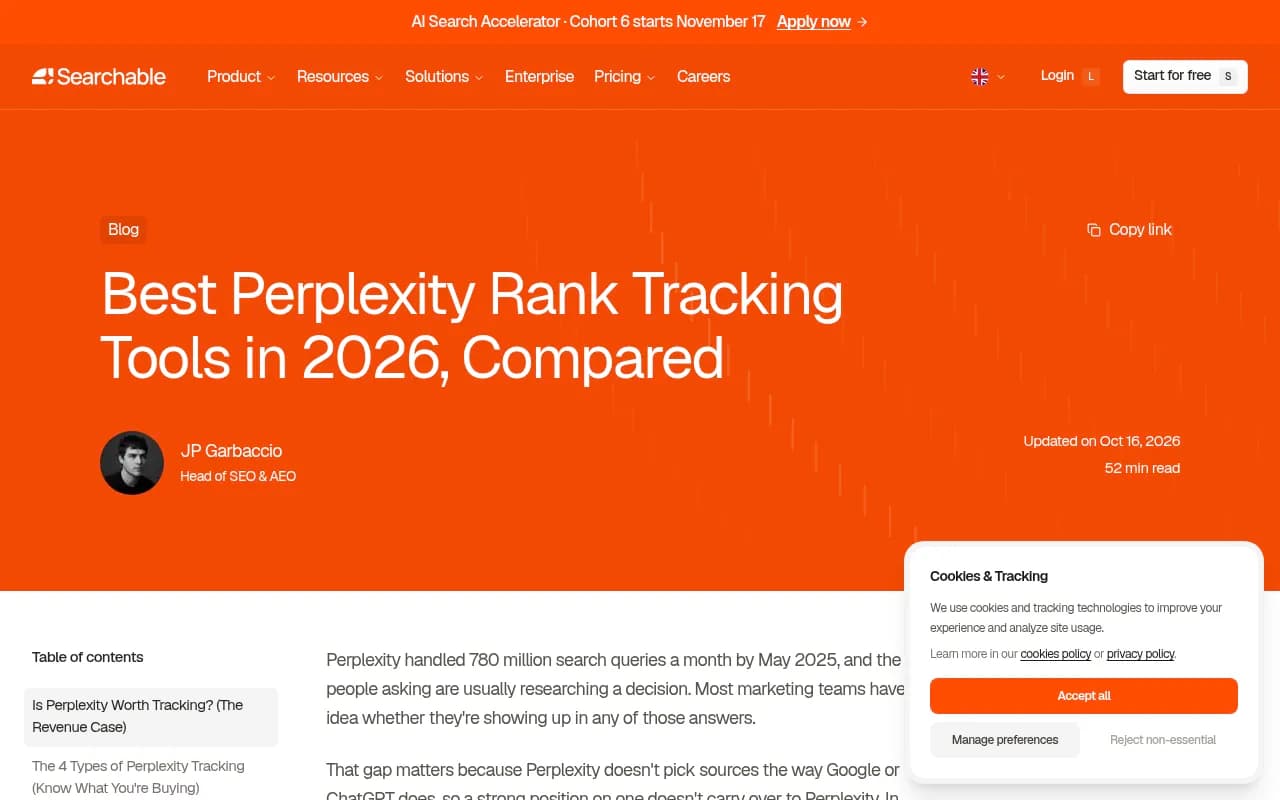
Searchable's framework of four tracking types (citation, crawler, brand mention, prompt-level) is a helpful way to read vendor claims. Most tools cover one or two of them.
Tool options
Perplexity-only trackers are rare and, given its market share, rarely a good buy. Multi-engine tools are the sensible route. Here is how the main options line up, with the usual caveat that vendor prices change and you should check the vendor's own pricing page.
| Tool | Approach | Notes |
|---|---|---|
| Promptwatch | Real-UI tracking across all major engines, crawler logs, AI traffic attribution, content generation | Covers Perplexity alongside ChatGPT, Gemini, AI Overviews and more, and connects visibility to crawls and traffic |
| Peec AI | Prompt tracking with position metric and query fan-outs | Starter at $95 a month for 50 prompts on 3 engines (vendor, July 2026) |
| Searchable | Citation, mention and prompt tracking | Publishes the Perplexity source data cited above |
| Otterly.AI | Lightweight citation and mention monitoring | Budget-friendly entry point |
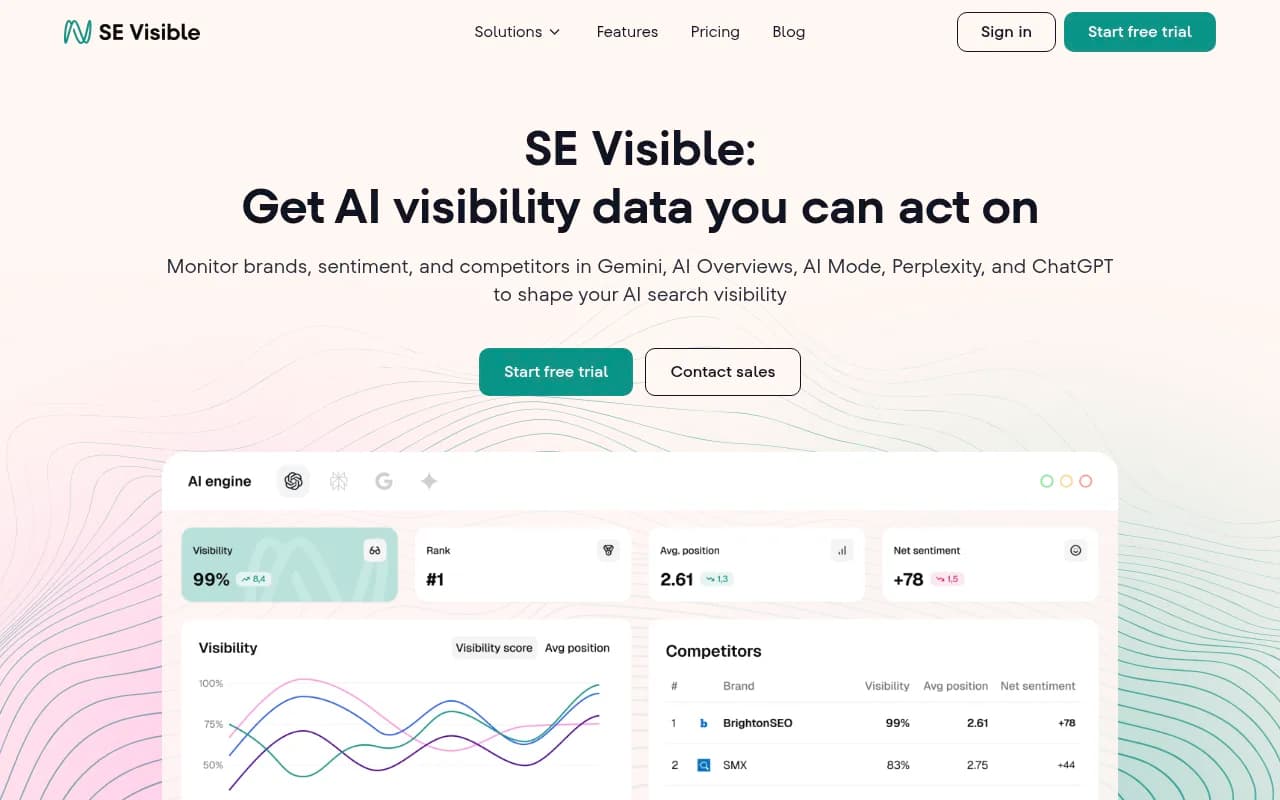
| SE Ranking Visible | AI visibility inside an SEO suite | Tracks Perplexity, ChatGPT, Gemini, AI Mode and AI Overviews |
| LLM Pulse | AI visibility with traffic numbers beside it | Published euro pricing from EUR 49 a month |
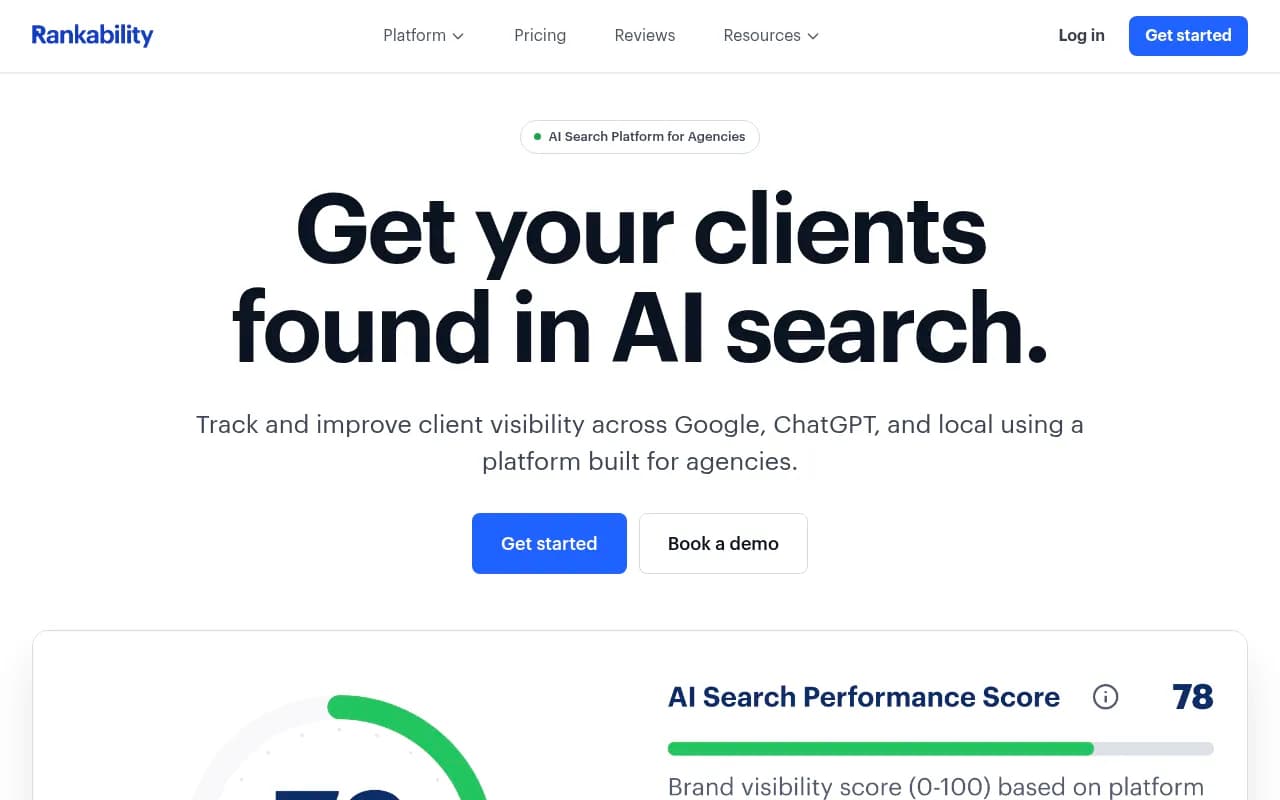
| Rankability | Tracking plus content optimization for agencies | Agency plans with unlimited client workspaces |
I would pick based on what you will do with the data. If the goal is a dashboard for a report, almost any of them works. If you want to know why you are not cited and what to fix, you need crawler data, citation sources and content gap analysis in the same place.
Promptwatch is the one I would lean toward for that second case. It monitors Perplexity's actual interface rather than only API output, shows IP-verified crawler logs so you can confirm PerplexityBot is reaching your pages, and has a content agent that writes against the gaps it finds.





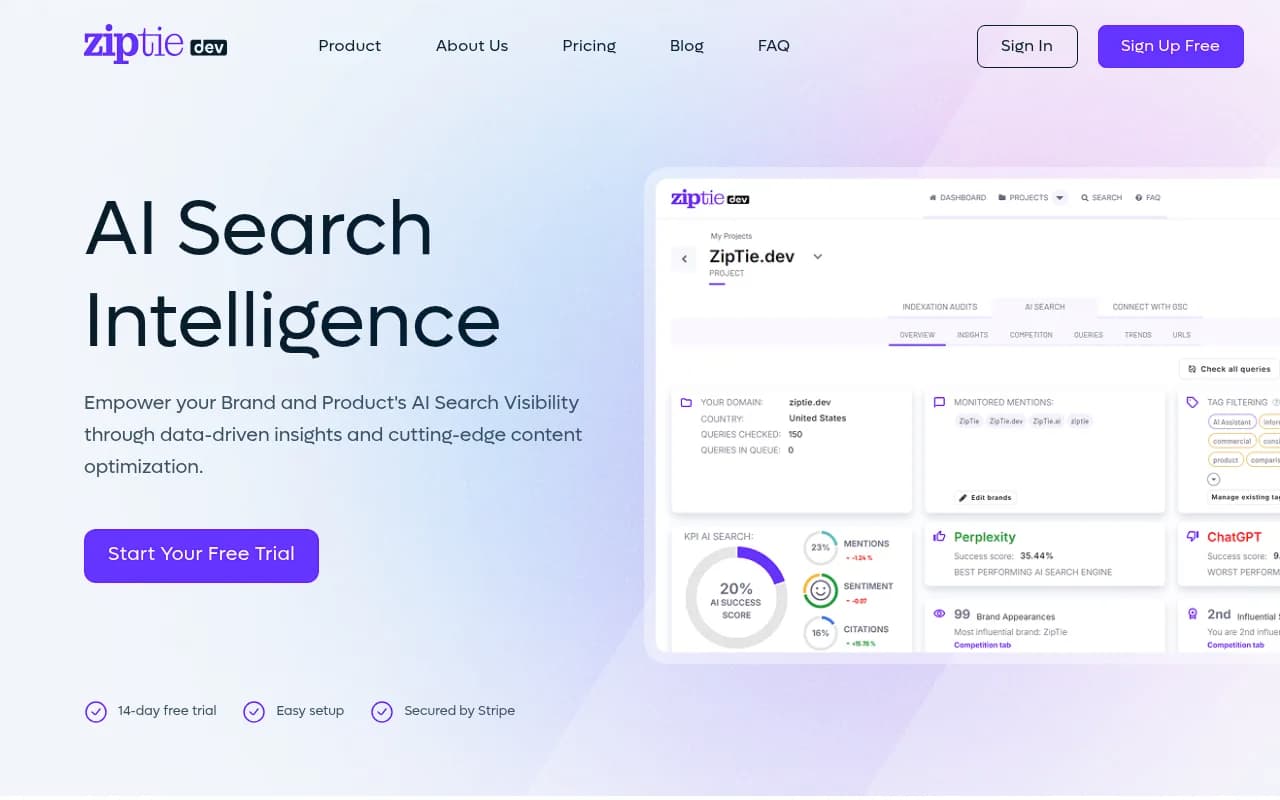
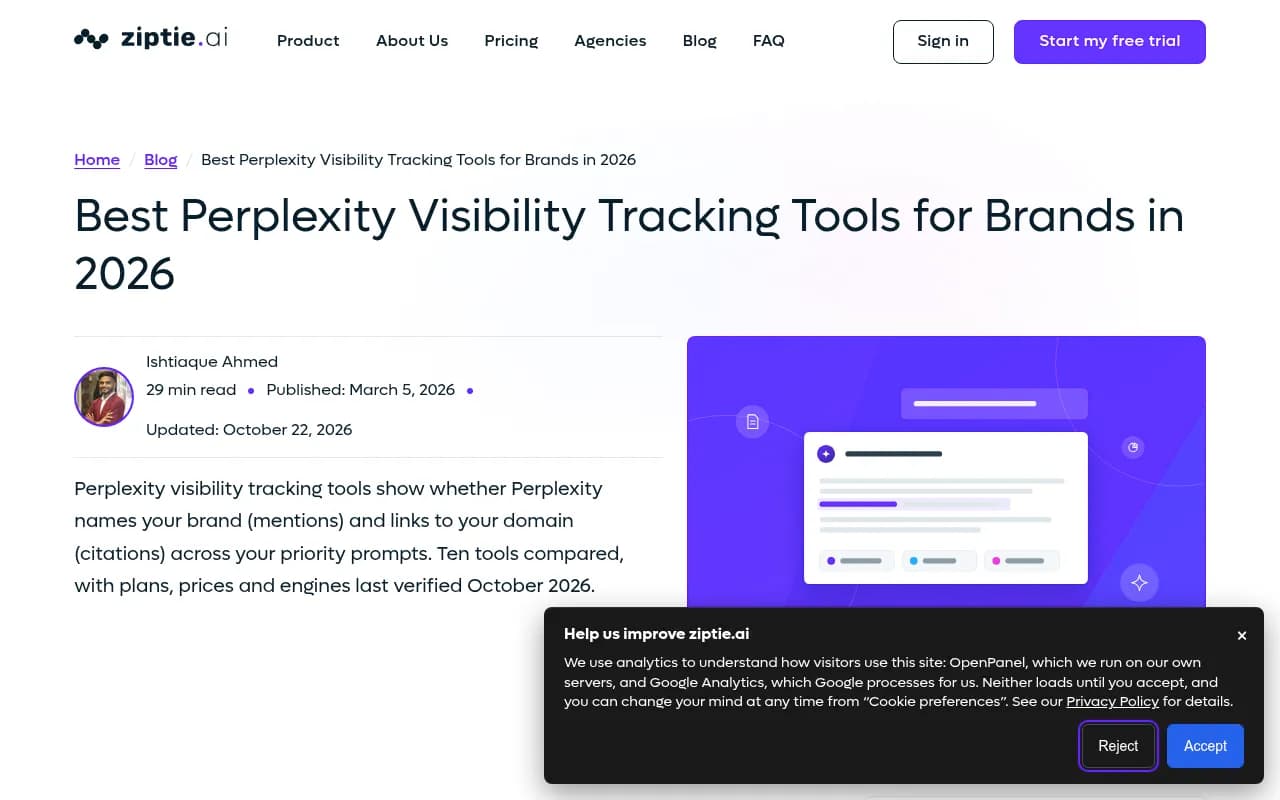
The ziptie.ai guide also covers ZipTie itself, and it discloses that it ranks itself first, so weigh its ordering accordingly.
If you want to browse more options, the GEO software directory at bestgeosoftware.com lists dozens of trackers by category.
What to do once you are tracking
Audit your presence on the sources Perplexity favors
Check whether you have a real footprint on the places it cites: Reddit, LinkedIn, Wikipedia, YouTube, tier-1 press, and review sites if you sell software. Everything-PR suggests that if you cannot account for presence on at least eight of the top 15 sources, Perplexity visibility is out of reach. That threshold is that publisher's rule of thumb, not a measured cutoff, but the audit itself is worthwhile.
Treat LinkedIn Company Pages as a publishing surface
Long, structured, dated posts from the company page are cheap to produce and are content you control. Promptwatch's data shows LinkedIn tied with Reddit on Perplexity, so it deserves the same attention.
Pitch earned media with first-party data
Perplexity's preference for independent reviews and tier-1 coverage means original numbers, surveys and benchmarks get picked up and then cited. Brand-owned pages compete with third-party sources and often lose.
Keep content fresh and structured
Several guides, including the Surfer Academy video on Perplexity, recommend fresh updates, structured comparisons, authoritative citations and clear takeaways near the top. Promptwatch's half-life study found news content lost half its pages within 36 days on ChatGPT, while landing pages and docs stayed cited longest. That is ChatGPT data, so verify on Perplexity, but the pattern suggests evergreen product and documentation pages deserve regular refreshes.
Fix crawler access
Check robots.txt, CDN and WAF rules for PerplexityBot and Perplexity-User. If crawlers cannot read your pages, nothing else matters.
Do not build around one volatile source
The YouTube drop is the cautionary tale. Spread effort across several citation surfaces so one engine tweak does not erase your visibility.
Common mistakes
- Reading a single study as fact. The Reddit and LinkedIn numbers above range from under 1% to over 20% depending on method.
- Tracking Perplexity alone. At roughly 8% of the AI search market, a Perplexity-only view leaves most of the picture blank.
- Using API-only trackers and assuming they match what users see.
- Counting mentions as if they were citations. Only citations send clicks.
- Using 2025 traffic figures in a 2026 business case.
So, is it worth it?
Track it if you sell to researchers, developers, B2B buyers or regulated-industry audiences, and fold it into a multi-engine program rather than treating it as its own project. Ten stable citation slots per answer, a LinkedIn and Reddit tie, and a habit of changing source preferences overnight make it a useful engine to watch even though it is a modest slice of volume.
If you are agency-side and need help deciding where AI search effort belongs, 1001 SEO Media does exactly that kind of prioritization work. Otherwise, start with the 90-day referrer check and the 25-prompt test. Both take an afternoon and will tell you more than any benchmark in this guide.