Key takeaways
- Profound's public pricing is murky. Brands get a 7-day trial and a custom Enterprise quote, while agencies pay $99/month plus $399/month per client workspace, according to ZeroRank's read of the pricing page.
- Almost every public Profound review comes from a competitor. Treat them as leads to verify, not verdicts.
- The real cost is often what happens after the dashboard: who writes, publishes and measures the fixes.
- Engine coverage changes by plan. Get the engines, countries, languages and prompt counts in writing.
- Run the seven questions below against your own prompts before renewing. If Profound can't answer them, you have your answer.
Why a renewal deserves a real test
Profound is the most talked-about company in this category, and money explains part of that. Honeyb reports a $96M Series C led by Lightspeed in February 2026 at a $1B valuation, with Bloomberg later reporting $1.8B in September. That is a lot of capital. It tells you the company will be around. It says nothing about whether the product earns its invoice for your team.

A caveat before we start. I went looking for independent Profound reviews and found almost none. Cognizo, ZeroRank, Honeyb, AEOLabs, Ryze and Maintouch all sell or promote an alternative. I also did not verify claims against Profound's own pricing page or G2 and Reddit reviews. So the numbers below are secondhand, and I have flagged them as such. The questions are the useful part, and they work whatever the answers turn out to be.
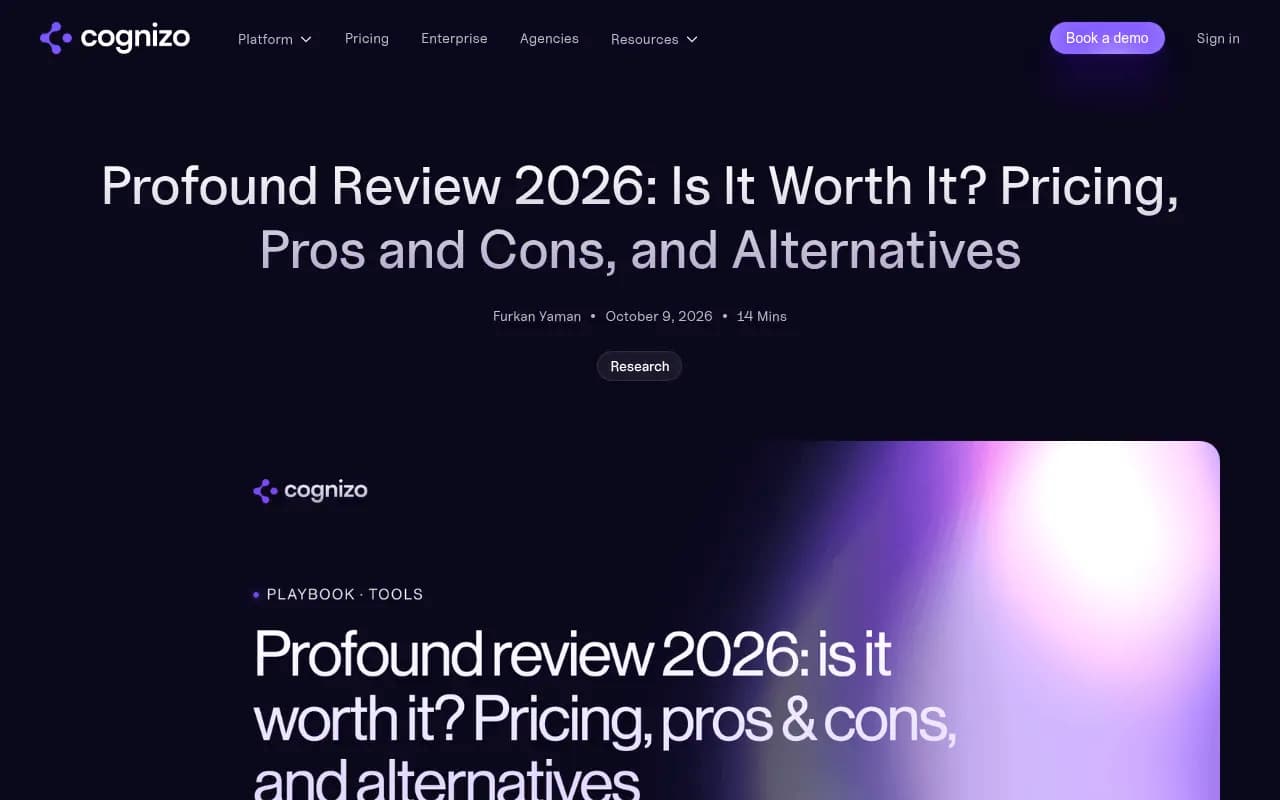
The screenshot above is from Cognizo, which openly states it is an alternative to Profound. Useful for a checklist, but read it like a sales page, because it is one.
Question 1: What exactly am I paying, and what does renewal cost?
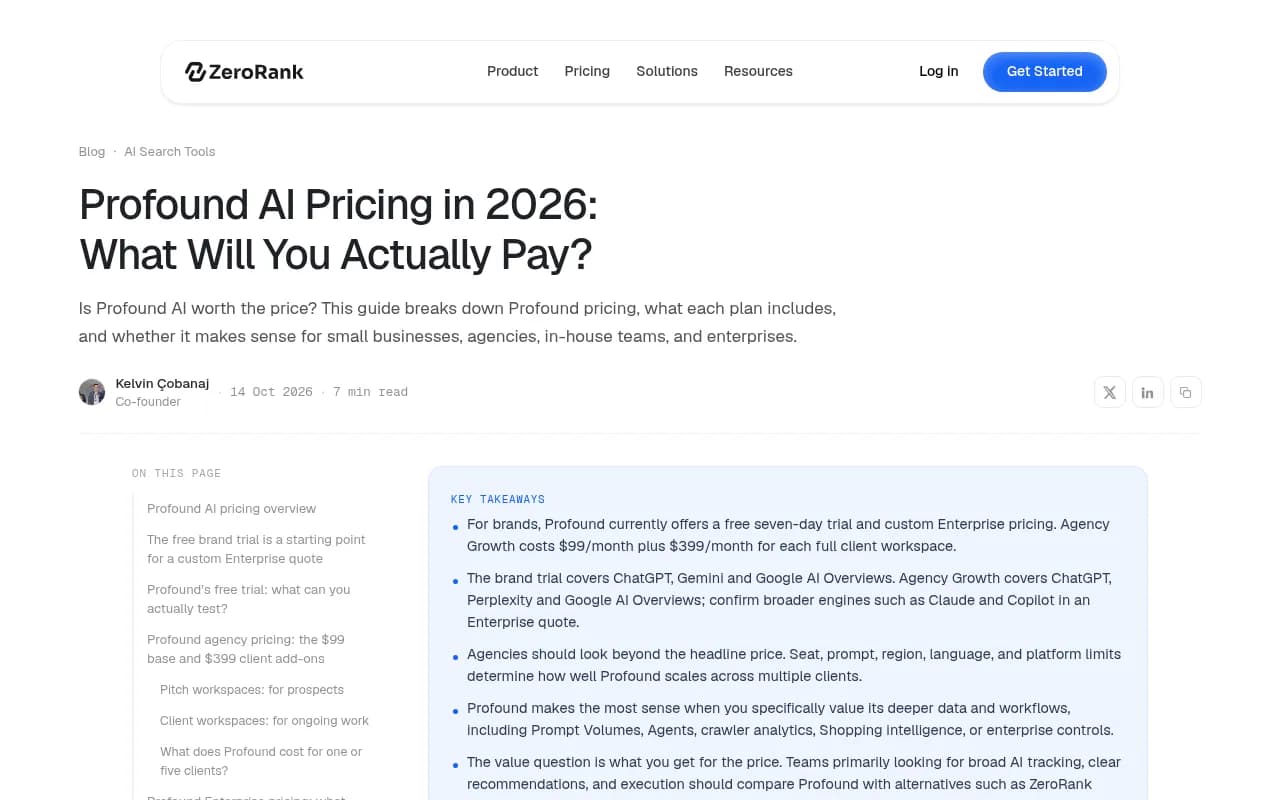
This is harder than it should be. From ZeroRank's summary of the public pricing page (published Oct 14, 2026):
| Plan | Published price | Notes |
|---|---|---|
| Brand trial | Free, 7 days | 50 prompts daily across ChatGPT, Gemini, Google AI Overviews. Uses Profound's recommended prompts, not yours. |
| Brand Enterprise | Custom quote | No universal starting price published |
| Agency Growth | $99/month | 10 pitch workspaces, 5 seats, no API access |
| Client workspace | $399/month each | 100 prompts daily, 400 Agent credits per month |
| Agency Enterprise | Custom quote |
Slate's write-up adds that the in-app checkout shows Starter at $99/month (50 prompts, ChatGPT only) and Growth at $399/month. Maintouch, meanwhile, discusses $399/month for a small team. These sources partly conflict, and I could not confirm which is current for brands. That conflict is itself a finding: if three reviewers can't agree on the price, get yours in writing.
Ask for these, per ZeroRank's quote checklist:
- Which brands, questions, countries and languages are tracked?
- How often does each prompt run, and on which platforms?
- How many credits cover research, writing and updates?
- Which exports, integrations, security controls and support are included?
- What are the contract term, renewal price and overage cost?
The math for agencies is simple but surprising. One client costs $498/month. Five clients cost $2,094/month. The $99 base only covers prospecting workspaces, not ongoing tracking for a paying client.
Question 2: Do the engines I care about come with my plan?
Coverage varies. The brand trial covers ChatGPT, Gemini and AI Overviews. Agency Growth lists ChatGPT, Perplexity and AI Overviews. Enterprise reportedly reaches up to nine engines, but ZeroRank says to confirm Claude and Copilot in writing.
Then check how the score is reported. Promptwatch's average sources per response data shows why a single blended number misleads. ChatGPT cites about 5 sources per web-search answer, while Google AI Overviews and Perplexity cite about 10. Copilot swung from under 2 to nearly 17 within weeks before settling low. Winning a slot in a 5-slot answer is a different job than appearing in a 10-slot one.
Ask to see visibility broken out per engine, and judge Copilot on monthly trends, not weekly snapshots.
Question 3: Can it track my prompts, not just its recommended ones?
The free trial reportedly runs Profound's recommended industry prompts and won't let you swap in your own. That is a poor way to evaluate a tool. ZeroRank's advice is right: ask Profound to demonstrate your own questions and planned content work before you agree to a paid package.
Bring a list of 20 to 30 real prompts. Include brand queries, competitor comparisons, and the long-tail questions your sales team hears. If the vendor stalls on that, note it.
Question 4: Do the prompt volumes and fan-outs reflect how AI actually searches?
This is the question most buyers skip. AI engines rewrite your prompt into several web searches, and those searches change over time. Promptwatch's ChatGPT query fanout data measured about 2.15 fanouts per response in early December, easing to about 1.84 by early March, with average query length falling from roughly 117 characters to the high 80s, and about 53 in April. Then in August, ChatGPT began using the site: operator at scale, jumping from about 0.4% to about 17% of fanout queries, per Promptwatch's site: operator report.
So ask Profound: how often do your prompt volumes refresh? Do they model fan-outs? When did your data last reflect the August 8 change? Prompts written as long conversational questions may no longer resemble what ChatGPT actually searches.
Question 5: Can I trust the crawler analytics?
Profound pitches crawler analytics, Shopping intelligence and Agents as the deeper layer. Fine. Ask how crawler hits are verified. Spoofed bots inflate numbers, and AI crawler traffic shifts fast. Meta-WebIndexer, for example, went from about 2% to nearly 38% of tracked AI crawler requests between mid-July and August 9, per Promptwatch's Meta-WebIndexer data. A tool that lumps all of that into one line is hiding things. The AI crawler traffic report is a decent benchmark for what a verified weekly breakdown looks like.
Promptwatch is one platform that logs IP-verified crawler requests, so you can see the difference in practice. Whichever vendor you pick, ask whether bots are IP-verified and whether you get crawl errors per page.
Question 6: Who does the work after the gap is found?
This is where the real cost lands. Maintouch puts it bluntly: at $399/month, a small team without a dedicated AEO owner will pay for insight and then have to hire around it to actually execute. I agree with the logic even though I couldn't confirm that $399 is a brand price.
Profound's Agent credits are charged by workflow complexity, so a prompt allowance doesn't tell you how many articles or refreshes you can produce. Run one real test in the demo. Pick a page, and have Profound show:
- the problem it found
- the proposed edit
- the approval flow
- how you would measure whether it worked
If the demo ends at a chart, you are buying a reporting tool. That may be fine, but price it as one.
Question 7: What would I pay elsewhere for the same job?
The category is crowded, so compare on the specific job you need done. Here is how the main options split.
| Tool | Strength | Best fit |
|---|---|---|
| Profound | Deep data, agents, enterprise controls | Enterprises with a negotiated scope |
| Promptwatch | Tracking plus content creation, publishing, crawler logs, AI traffic | Teams that want to fix gaps, not just see them |
| Peec AI | Simple prompt tracking | Small teams that want a lean tracker |
| Otterly.AI | Affordable monitoring | Budget-first monitoring |
| Scrunch | Monitoring plus agent-ready pages | Brands and agencies |
| Semrush AI Visibility Toolkit | AI tracking inside an SEO suite | Teams already on Semrush |
| Ahrefs Brand Radar | Brand tracking inside Ahrefs | Teams already on Ahrefs |
Where Promptwatch fits
If your answer to Question 6 was "we need help executing," look at Promptwatch. It pairs prompt tracking with a content gap analysis, a Content Agent that writes and publishes to WordPress, Webflow or Framer, and visitor analytics that attribute AI traffic. Published pages are tracked through crawls, citations and clicks, so you can see whether a fix worked. Plans start at $95/month for Essential, with Business at $579/month including the Content Agent. Confirm current pricing at promptwatch.com/pricing.

Other options worth a look
Peec AI and Otterly.AI are the usual picks when you only need monitoring and a lower bill.


Scrunch pairs monitoring with agent-ready pages.

If you already live in an SEO suite, the add-ons from Semrush and Ahrefs may be enough for a first year.

For a wider shortlist, the GEO software directory at bestgeosoftware.com lists dozens more. Note that Cognizo, ZeroRank and Slate each publish Profound comparisons while selling their own products, so apply the same skepticism.


A simple scoring sheet
Score each question 0 to 2 after your demo or trial. Zero means a vague answer, one means a partial answer, two means a clear answer with evidence.
| Question | What a 2 looks like |
|---|---|
| 1. Price and renewal | Written quote with term, overage and renewal price |
| 2. Engine coverage | Named engines per plan, visibility split per engine |
| 3. Your prompts | Your 20-30 prompts running in the trial |
| 4. Fan-outs and volumes | Documented refresh cadence, recent changes reflected |
| 5. Crawler data | IP-verified, per-page errors, spoof filtering explained |
| 6. Execution | One page refreshed end to end in the demo |
| 7. Alternatives | You priced at least two competitors on the same job |
A score of 11 or more means renew with confidence. Between 7 and 10, renew only on a shorter term or negotiate. Below 7, you are paying for a brand name.
So, is Profound worth it?
It depends on the plan and on who owns execution. For an enterprise with a dedicated AEO owner and budget to negotiate scope, Profound is a reasonable serious option. For a small team splitting time across priorities, the published signals point the other way: you will pay for insight and still need to buy the labor to act on it.
The honest limit of this guide is that I could not verify Profound's own pricing page or independent user reviews. Pull its current page and G2 reviews yourself, run the seven questions, and make the renewal decision on your own numbers.