Key takeaways
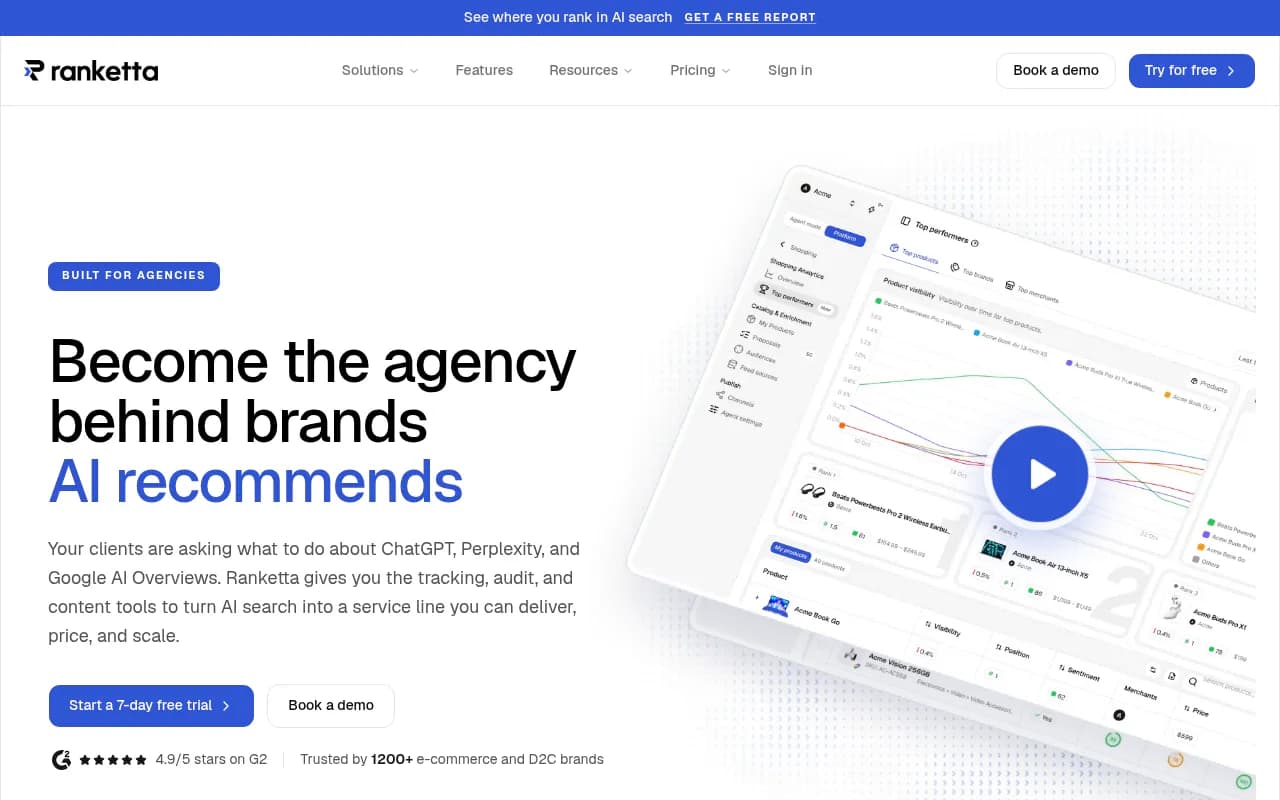
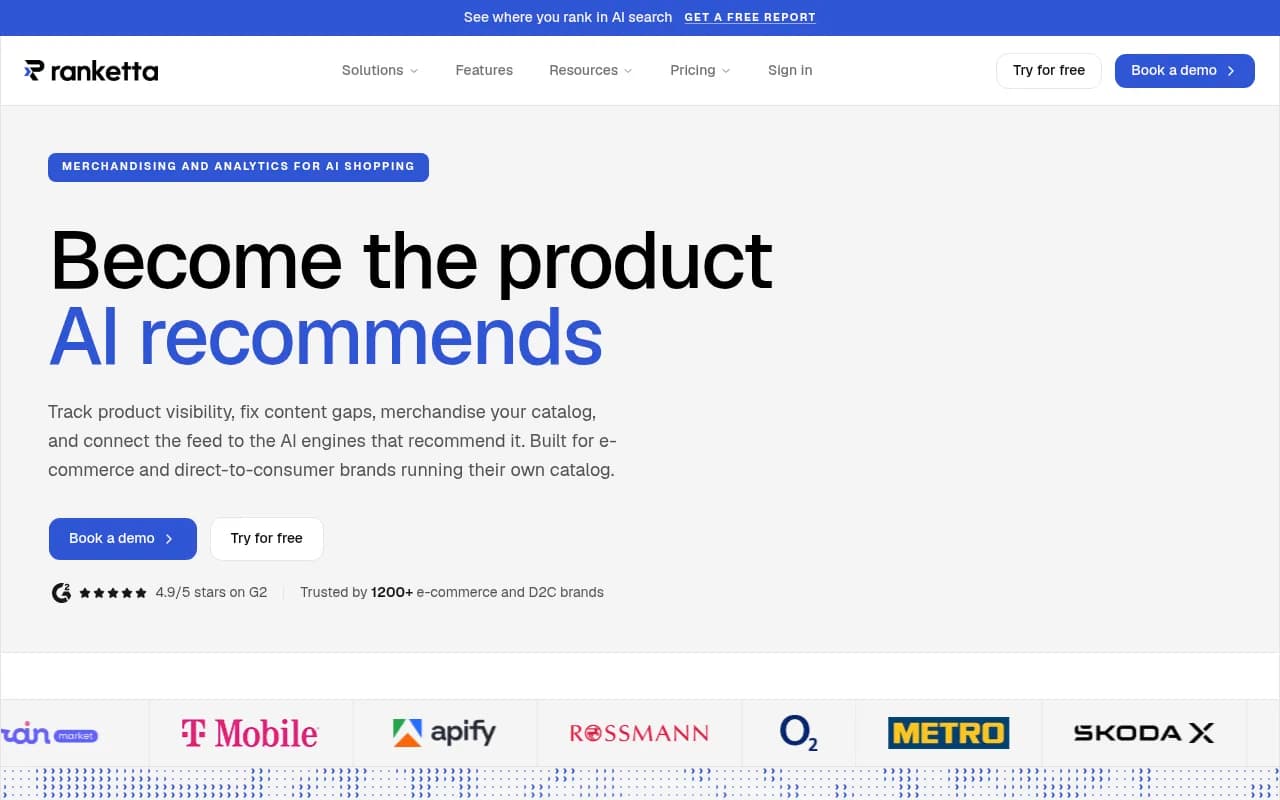
- Ranketta is a solid starting point for ecommerce and D2C teams: it claims 4.9/5 on G2 (21 reviews) and a 7-day free trial, and says it tracks UI data across 9 LLMs.
- A tracker answers "was I mentioned?" Eventually you need to know why, what to fix, and whether the fix worked.
- Eight signs you've outgrown a basic tracker: no crawler data, no traffic attribution, thin citation analysis, content gaps you fix by hand, per-engine blind spots, no local or shopping depth, reporting that eats your week, and an agency model that doesn't scale.
- You don't have to switch. If none of these signs apply, stay put.
Why this question comes up
Ranketta positions itself around product-level AI visibility for ecommerce, and it also pitches agencies on turning AI search into a service line. Its site says it is trusted by "1200+ e-commerce and D2C brands" and links to a 4.9/5 G2 rating. That's a good signal, though 21 reviews is a small sample, and I'd treat it as a signal rather than proof.
The question "is it good enough?" isn't really about Ranketta. It's about where you are. A tool that fits month one of an AI search program can feel thin by month nine. Here is how to tell.
What Ranketta does well
Based on its own materials, Ranketta covers AI visibility monitoring across models and prompts, a continuous site audit, prompt research with demand signals, content drafting, and citation tracking. A Reddit account attributed to the company says it tracks real UI data rather than APIs. That matters. User-facing answers and citations can differ from API outputs, so UI-based collection is the better approach.
I could not verify pricing. G2 lists a Growth tier, but the figures weren't visible, so check Ranketta's pricing page before budgeting.
For a store owner who wants to see whether products show up in answers, that's a sensible package. The trouble starts when the questions get harder.
Sign 1: You can't tell an access problem from a content problem
Your brand isn't cited. Is that because the content is weak, or because AI crawlers can't read the page? A basic tracker shows the outcome only. Without IP-verified crawler logs, you're guessing.
This is where you need crawler data: which bots hit which pages, what errors they hit, and whether a crawled page ever gets cited. Promptwatch's AI crawler logs do this, and its AI crawler traffic report shows how much the bot mix shifts week to week. Meta-WebIndexer, for example, went from about 2% to nearly 38% of tracked AI crawler requests between mid-July and August 9, 2026, per Promptwatch Data. If you can't see crawlers, you can't see shifts like that.
Sign 2: You can't connect visibility to revenue
A visibility score is nice in a slide deck. Your CFO wants to know whether AI sends visitors who buy. If your tracker stops at mentions, you need a second tool, or a different one, for attribution.
Things to look for:
- AI-referred visits and conversions by engine
- Handling of the missing ChatGPT referrer (ChatGPT stopped sending one on October 8, 2026, so UTM-tagged counting matters)
- Page-level views that join crawls, citations and clicks
Tools such as [tool:trakkr] and [tool:passionfruit] pitch revenue attribution as their core. Promptwatch includes visitor analytics alongside tracking.
Sign 3: Your citation analysis stops at a count
Knowing you were cited 40 times is thin. The useful questions are what kind of page got cited, where it sat in the source list, and how long it lasts.
Promptwatch's data shows why the details matter. Product pages were the most cited content type in ChatGPT at 22.4% of citations (Sep 28 to Oct 4, 2026), per the content type report. News lost half its cited pages within 36 days, while landing pages and docs lasted longest, per the content half-life study. A tracker that only counts mentions can't tell you which of your pages will decay.
Sources also move. reddit.com's share of ChatGPT citations fell from about 4% to 0.5% on August 14, 2026, according to Promptwatch's Reddit data. If your strategy leaned on Reddit, you'd want to see that the day it happened.
Sign 4: Every fix is manual
Monitoring tells you there's a gap. Someone still has to write the page, publish it, and check later. If that loop runs through spreadsheets and Slack threads, you've outgrown a dashboard.
Look for gap analysis tied to real prompts, content generation grounded in the pages AI already cites, CMS publishing, and a prioritized to-do list. Ranketta does draft content. Some others go further into execution: Promptwatch has a Content Agent that plans, writes and publishes to WordPress, Webflow or Framer, then tracks whether each page gets crawled, cited and clicked (Content Agent is on Business and up).

[tool:rankcontrol] and [tool:slate] sit in the content-first corner of this category.
Sign 5: One blended number hides engine differences
A single mention rate treats every engine the same. They aren't. Promptwatch's average sources report shows ChatGPT citing about 5 sources per web-search answer, while Google AI Overviews and Perplexity cite about 10. Copilot swung from under 2 to nearly 17 in a few weeks, then settled lower. Citation slots are scarce in one place and plentiful in another, so "40% visibility" means different things per engine.
Your tracker should break results out per engine and let you judge volatile ones like Copilot on monthly trends, not weekly snapshots.
Sign 6: You only test prompts, not how pages get retrieved
AI engines often rewrite your prompt into several searches. Promptwatch's query fanout report says a single prompt can trigger 3 to 8+ searches, but its own trend data shows a lower average: 2.15 per response in December 2025, about 1.84 by March 2026, and 1.0 in April. Those two don't match neatly, so treat the headline range as a ceiling, not a norm. What does hold is that queries got shorter and more keyword-like (about 117 characters in December, about 53 from April).
If your tool only tests the user's prompt, you miss the actual searches that decide whether your page is retrieved. Worth knowing too: ChatGPT started using the site: operator at scale on August 8, 2026, jumping from about 0.4% to about 17% of fanout queries, per Promptwatch Data.
Sign 7: Shopping, local and ads matter now
Ranketta's focus on products is a strength for ecommerce. But if you run physical locations, sell on marketplaces, or watch competitors bid on AI placements, you may need more depth.
| Need | What to look for | Example tools |
|---|---|---|
| Product visibility in AI shopping | Carousel and catalog tracking | Ranketta, Alhena AI, Yotpo Discover, Promptwatch |
| Local, near-me queries | Location-level tracking | Birdeye Search AI, BrightLocal, Promptwatch |
| Ads in AI answers | Advertiser and ad copy visibility | Promptwatch Ads Radar |
| Enterprise suites | Governance and breadth | Profound, Brandlight, Adobe LLM Optimizer |
Yotpo Discover
Promptwatch covers ChatGPT Shopping and Ads Radar, plus local targeting at exact coordinates on Business plans and up.
Sign 8: Reporting and client work eat your week
Agencies feel this one first. Once you manage ten clients, the question becomes how fast you can build a deck, not how pretty the dashboard is. Check for scheduled PDF reports, custom dashboards, Looker Studio, an API or MCP, and unlimited projects.
Ranketta sells an agency story, and I can't say how deep its reporting is because I couldn't verify it. Compare against agency-focused options such as [tool:search-party], [tool:scrunch-ai], or Promptwatch's agency plans (Kick-off $199/mo, Growth $399/mo, Scale $799/mo; confirm at promptwatch.com/pricing).
If you're weighing whether to build this capability in-house or hire help, an agency like 1001 SEO Media handles GEO strategy and execution for brands that don't want to run the tooling themselves.
Quick self-check
| Question | If the answer is "no", you may have outgrown a basic tracker |
|---|---|
| Can I see which AI bots read my pages? | Sign 1 |
| Can I show AI-sourced visits and conversions? | Sign 2 |
| Can I see citation type, rank and decay? | Sign 3 |
| Can I publish fixes from the same tool? | Sign 4 |
| Is data broken out per engine? | Sign 5 |
| Does it show fan-out queries? | Sign 6 |
| Does it cover my shopping, local or ads needs? | Sign 7 |
| Can I report to clients in minutes? | Sign 8 |
Score yourself. Zero or one "no": stay where you are. Three or more: start a trial elsewhere.
What to evaluate next
A useful reference here is the Searchable guide to AI visibility tracking. Its core point is sound: AI answers change between runs, so one check tells you little, and the number of runs behind a score matters. It cites a study of nearly 3,000 runs where the chance of two runs returning the same brands in the same order was about 1 in 1,000. Whatever you pick, ask the vendor how many runs sit behind each number.
Candidates worth a trial, depending on your gap:
- Full loop from monitoring to publishing and measurement: Promptwatch (7-day free trial on monthly billing, plus a free AI visibility report)
- Monitoring with lower cost: [tool:otterly-ai] or [tool:peec-ai]
- Enterprise breadth: [tool:profound]
- Revenue attribution: [tool:trakkr]
For more options, browse the GEO software directory.
Verdict
Ranketta is good enough if you are an ecommerce or D2C team that mainly needs to see whether your products appear in answers, and you have capacity to act on the findings yourself. The 7-day trial makes it cheap to find out.
It isn't enough once you need to prove revenue, debug crawler access, track per-engine citation behavior, and ship fixes without leaving the tool. At that point you want a platform that closes the loop rather than a dashboard that reports it. Run the eight-question check above, and let the answers decide.