Key takeaways
- Across 12,535 audited local business domains, the average AI visibility score was just 8.24%, meaning the typical business is mentioned by fewer than 1 in 10 AI engines checked, regardless of Google ranking.
- ChatGPT recommends only about 1.2% of local business locations in SOCi's 2026 Local Visibility Index, versus a 35.9% appearance rate in Google's local 3-Pack. Gemini (roughly 11%) and Perplexity (roughly 7.4%) are notably less selective.
- Industry matters enormously: HVAC/plumbing independents sit at roughly 87% invisibility, law firms almost never appear by name (directories like Avvo and Martindale-Hubbell dominate instead), and financial services outperform restaurants on every AI engine measured.
- 45% of consumers now use ChatGPT or similar tools to find local businesses, up from 6% a year earlier, so this gap is a revenue problem, not just a vanity metric.
- Reviews, specialization signals, and directory/association presence influence AI recommendations more than raw star count or Google ranking position.
Why local service businesses are mostly invisible to AI
Here's a thing that should worry every plumber, dentist, and divorce attorney reading this: ranking #1 on Google means almost nothing to ChatGPT. Local Dominator ran AI visibility checks on 12,535 real business domains across six engines (ChatGPT, Gemini, Google AI Mode, Perplexity, Claude, and Grok) and found an average score of 8.24%. That's the share of engines that mentioned the business at all. Most businesses in that dataset were confirmed invisible across the majority of them.
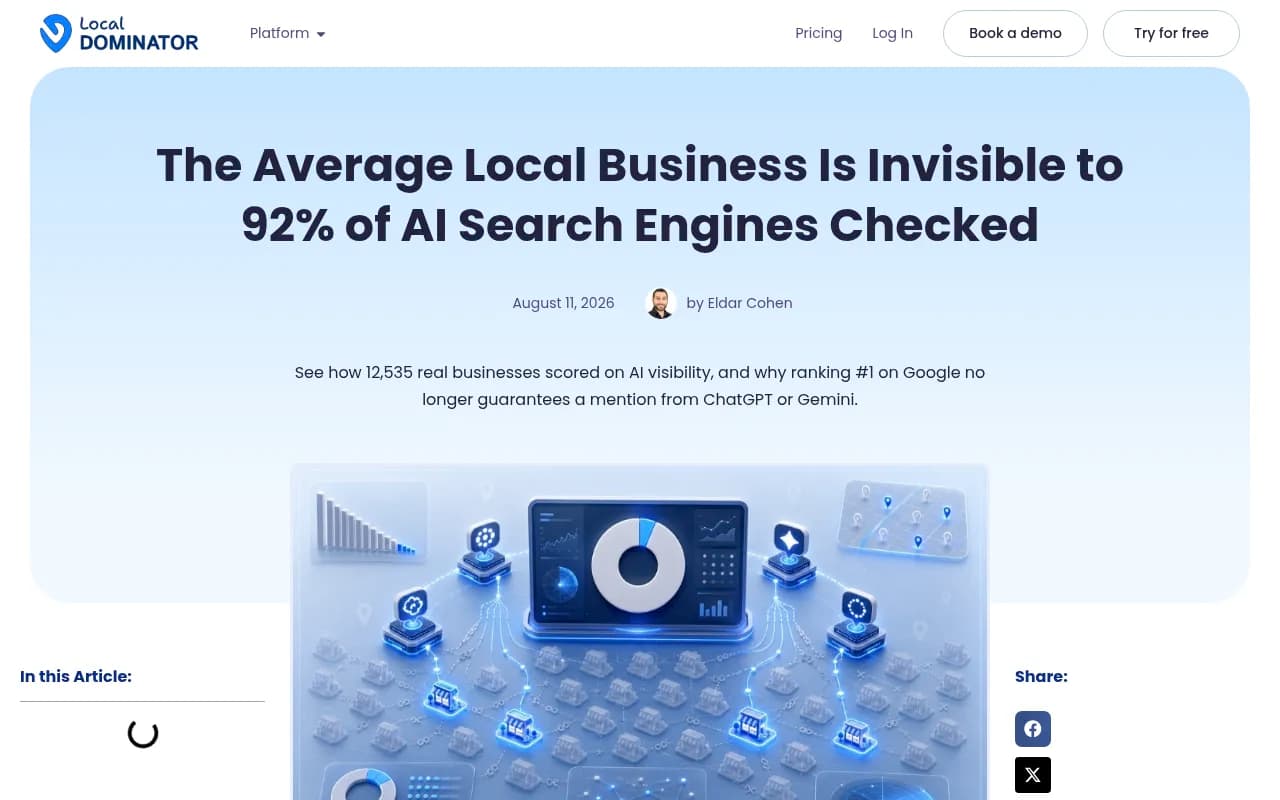
This isn't a fluke of one dataset. SOCi's 2026 Local Visibility Index, built on 296,000 to 350,000+ franchise locations and 35 million data points, found that ChatGPT recommends just 1.2% of locations analyzed, compared to a 35.9% average appearance rate in Google's local 3-Pack. That's roughly 30 times more selective. Gemini recommends about 11% of locations and Perplexity about 7.4%, so the engines aren't equally stingy, but none of them come close to matching traditional local search visibility. Less than half of businesses that lead Google's local results also show up in AI recommendations.
Why the gap? A few structural reasons. ChatGPT's answers are concentrated: when someone searches an organic, non-branded query like "best plumber near me," a little over half of responses still cite 10+ different domains, so there's real competition for space. But when a specific brand is named, citation counts narrow sharply (five sources is the single most common count), meaning the businesses that get established as "the answer" tend to stay the answer. New entrants have a hard time breaking in without the right signals.
The benchmark numbers by industry
Not every local category struggles equally. Franchise and multi-location data from SOCi breaks it down by sector, and the differences are stark.
| Metric | Retail | Restaurants | Financial services |
|---|---|---|---|
| Google 3-Pack presence | 49.5% | 24.3% | 44.0% |
| ChatGPT recommended | 10.2% | 5.3% | 3.1% |
| Gemini recommended | 18.3% | 7.1% | 16.4% |
| Perplexity recommended | 16.2% | 7.6% | 9.9% |
| Google profile completeness | 86.4% | 94.2% | 81.4% |
Restaurants have the worst AI recommendation rate of the three despite having the most complete Google Business Profiles, which tells you profile completeness alone doesn't move the needle much. Financial services does poorly on ChatGPT specifically but does comparatively well on Gemini, suggesting engine choice matters as much as industry choice when you're thinking about where to focus effort.
HVAC and plumbing: an 87% invisibility problem
The trade services data is the bleakest I've seen. 5WPR's HVAC & Plumbing AI Visibility Index, built from 65+ prompts run across ChatGPT, Claude, Perplexity, and Google AI Overviews in Q1 2026, found that roughly 87% of independent HVAC and plumbing contractors have effectively zero AI citation share in their own metro and category, even with 800+ five-star Google reviews and decades in business. Reviews just don't translate to AI visibility the way they translate to phone calls.
So who does get cited? Mostly franchise brands and trade software companies, not independents. Roto-Rooter leads at 11.5% share, followed by ARS/Rescue Rooter at 5.5% and Mr. Rooter at 4.8%. Interestingly, ServiceTitan (a trade software platform, not a consumer-facing contractor) tops the list at 14.0%, because it dominates "best HVAC software" comparison queries that bleed into contractor-adjacent searches.
The researchers describe an "entity-strength asymmetry" between franchise brands and independents of roughly 8x, the largest multiplier they measured in any consumer category. The mechanism is mundane but hard to fake: Wikipedia presence, Wikidata records, structured corporate disclosure, and trade-press coverage that independents simply don't have. Franchise brands under the same parent company (Neighborly's Mr. Rooter, Mr. Electric, and Aire Serv, for example) also cite each other in blog content, building a citation moat that a solo operator can't replicate by posting more Google reviews.
Legal: directories win, firms don't exist
Law firms have it worse in a different way. Zen Media ran 1,000 legal consumer prompts (4,000 responses total) across ChatGPT, Gemini, Perplexity, and Grok and found that no individual law firm appears among the top 20 highest-visibility names on any of the four assistants. The names AI actually surfaces are directories and associations: Avvo at 45% visibility, Martindale-Hubbell at 32%, Super Lawyers at 24%, FindLaw at 15%.
When AI answers do cite sources, state bar associations get cited 92% of the time, more than any other source type, followed by Avvo at 85% and Martindale-Hubbell at 78%. The themes AI consistently emphasizes in legal answers: credential verification (92%), specialization (87%), and fee transparency (85%). If your firm's website doesn't surface those three things clearly, you're fighting an uphill battle regardless of how good your actual legal work is.
One engine-level detail worth knowing: ChatGPT is the most concentrated and selective engine for legal queries, naming only 22 distinct companies across the whole study and averaging 1.5 mentions per response. Gemini named 38 companies and averaged 2.8 mentions per response. If you only have resources to optimize for one assistant, Gemini's wider net makes it a slightly easier target for a legal practice trying to get noticed at all.
What AI actually cites when it answers local-service queries
Promptwatch's citation-type data gives a useful cross-check on what kind of content gets rewarded, even outside the local-service niche specifically. Across all ChatGPT citations tracked in early October 2026, product pages are the single most-cited content type at 22.4%, with landing pages close behind at 16.8%, so close to 40% of citations go to pages that describe what a business actually sells or does. For commercial and comparison-style prompts, the kind closest to "best plumber near me," product and landing pages plus listicles and comparison pages account for nearly 70% of citations combined (ChatGPT's citation share by content type).
That means a vague "About Us" page with a stock photo of a handshake isn't doing you any favors. Dedicated, specific service pages (one per offering, with concrete detail about what's included) are closer to what gets cited.
Domain authority is less of a barrier than most small-business owners assume. Promptwatch's August 2026 domain-rank data found mid-authority domains (DR 46-75) earned 46% of all ChatGPT citations that month, while top-tier DR 91-100 domains collapsed from about 7% share in week one to roughly 3% by mid-month, ending behind even DR 0-15 sites (ChatGPT citation share by domain rank, August 2026). A small local business site with a modest domain rating genuinely has a shot at a citation if the content answers the question directly.
Social and review platforms matter less than people think, and the picture varies wildly by engine. ChatGPT has nearly abandoned social citations entirely (all platforms combined dropped to 0.46% of citations, with Reddit collapsing from over 5% to about 0.09% after an August 2026 shift) (social media citations by AI model). Google AI Overviews, by contrast, cites social media 26 times more than ChatGPT does, at 12.2% of citations, led by YouTube. If you're a local business deciding where to invest limited content time, that split matters: a YouTube presence helps you with Google's AI surfaces far more than it helps with ChatGPT.
Consumer behavior backs up the urgency
BrightLocal's 2026 consumer survey found that 45% of people now use ChatGPT or another generative AI tool to find a local business, up from just 6% a year earlier, a 7.5x jump that makes AI the third most popular recommendation source behind Facebook and Google. 40% of consumers say they trust AI platform recommendations, and 23% say they'd rely solely on an AI-generated review summary to decide, without reading the underlying reviews at all.
One detail that should change how you write your website copy: when ChatGPT Search sources answers for local queries, 58% of the time it's pulling from the business's own website, 27% from mentions of the business elsewhere, and only 15% from directories. Your own site is still the primary battleground, not your Yelp listing.
What good looks like: a practical benchmark table
Pulling the industry data together, here's roughly where "good" sits today versus where the average business actually is.
| Industry | Average AI recommendation rate | What top performers have |
|---|---|---|
| HVAC/plumbing (independents) | ~13% have any citation share | Wikipedia/Wikidata presence, trade-press coverage, franchise affiliation |
| Law firms | Directories dominate, firms rarely named | Credential and fee-transparency content, bar association listings |
| Financial services (franchise) | 3.1% ChatGPT, 16.4% Gemini | Clean GBP, specialization pages, Gemini-friendly content |
| Retail (franchise) | 10.2% ChatGPT, 18.3% Gemini | Consistent NAP data, Best-Of list placements |
| Restaurants (franchise) | 5.3% ChatGPT, 7.1% Gemini | Still the weakest category across every engine measured |
Across categories, recommended businesses average 4.3 stars on ChatGPT, 4.1 on Perplexity, and 3.9 on Gemini. Meanwhile, 31% of consumers now ignore businesses rated below 4.5 stars, and 74% weight only the last 90 days of reviews, so review freshness and volume both matter more than they used to.
How to actually benchmark and improve your own visibility
If you run or market a local service business, the first step is simply finding out where you stand, because "we rank #1 on Google" tells you nothing about AI visibility. A few approaches worth considering:
Run a direct AI visibility check against the major assistants (ChatGPT, Gemini, Perplexity, Claude at minimum) using your actual service categories and city names as prompts, not your brand name. If AI doesn't mention you for "emergency plumber in [your city]," that's your real baseline, not a vanity number.
For broader AI search visibility tracking and content optimization, tools like Promptwatch monitor citations across ChatGPT, Gemini, Claude, Perplexity, and Google's AI surfaces, and go further by showing which of your pages actually get crawled and cited, then generating and publishing optimized content to close the gaps.

For businesses specifically focused on local and location-level tracking, Birdeye Search AI and Local Dominator's AI Tracker (checking the six engines mentioned at the top of this guide) are built for that narrower local use case rather than enterprise brand monitoring.
| Tool | Focus | Starting price | Best for |
|---|---|---|---|
| Promptwatch | Full-stack AI visibility, crawler logs, content generation | $95/mo | Businesses wanting monitoring plus execution |
| Local Dominator | Local/multi-location AI tracking, GBP management | $39/mo | Single-location or small multi-location operators |
| Birdeye Search AI | Location-level AI visibility tied to reputation | Custom | Multi-location brands already using Birdeye for reviews |
Beyond tracking, the actual fixes that move the needle, based on what's cited above, are not exotic. Build dedicated pages per service rather than one generic services page. Get listed on the directories and associations that AI actually trusts in your category (state bar for lawyers, trade associations for contractors). Pursue trade-press coverage, since it feeds the Wikipedia-and-citation signals that franchise brands exploit against independents. And treat regulatory or industry news (tax credit changes, licensing updates) as a reason to publish fresh content fast, since AI engines reward recency on fast-moving topics.
If your business operates in a crowded or regulated vertical like legal, medical, or financial services, it's also worth getting a second opinion from people who do this for a living. 1001 SEO Media works with local and multi-location brands on exactly this kind of technical and content optimization for AI search, alongside traditional SEO.
The businesses showing up in AI answers today aren't necessarily the best at what they do. They're the ones with the clearest, most specific content and the strongest third-party validation trail. That's a fixable problem, but only if you know where you actually stand, and most local businesses, per every dataset in this guide, still don't.