Key takeaways
- Otterly.AI is a lightweight monitor with a low entry price ($29/mo). Every plan except Enterprise is capped at 3 of its 7 listed engines.
- Promptwatch tracks all supported models on every plan, collects answers from the real AI interfaces, and adds crawler logs, visitor analytics, and content agents on top of monitoring.
- Otterly is cheaper per prompt on paper. Promptwatch's per-prompt cost is higher, but it includes all models, country tracking, and Agent Chat from $95/mo.
- Otterly's own "compared 2026" page ranks itself #1 and contains claims about Promptwatch (like no MCP integration) that conflict with Promptwatch's pricing page. Treat vendor comparisons with suspicion, including this one's sources.
- Pick Otterly if you only need simple monitoring on a small budget. Pick Promptwatch if you want to measure, fix, and prove the impact of AI visibility work.
What this comparison covers
Both tools answer the same starting question: when someone asks ChatGPT, Perplexity, or Google AI Overviews about your category, does your brand show up? They diverge on what happens after that answer.
Otterly.AI describes itself as an AI search monitoring platform. Promptwatch positions itself as an end-to-end AI visibility platform that monitors, traces, acts, and measures. I'll be upfront: this site is published by 1001 SEO Media, which uses Promptwatch as its GEO platform. I've tried to stick to verifiable facts from both vendors' pricing pages, and to flag where a claim comes from a vendor with a stake in the outcome.


The core difference: how the data is collected
This is the part that matters most and gets discussed least.
There are two ways to see what an AI engine says about your brand. You can call the model through an API, or you can query the actual consumer interface the way a person does. They are not the same product. User-facing answers, citations, and shopping results can differ from API output, because the interface adds web search, retrieval, and formatting layers that a bare model call doesn't.
Promptwatch states that it collects data from the real user interfaces of ChatGPT, Google AI Overviews, Google AI Mode, Copilot, Gemini, Perplexity, Alexa, Meta AI, and others, per country and language. Its pricing FAQ says it collects data by scraping the UI interfaces. API models like Claude, DeepSeek, Mistral, and Grok are tracked alongside to show what models believe from training data.
Otterly's collection method isn't stated on the pages I reviewed. I also couldn't find an independent accuracy test comparing UI-scraped and API-based answers, so I can't tell you one is measurably more accurate. What I can say is that if the method isn't documented, ask the vendor before you buy.
Why this shows up in query fan-outs
ChatGPT doesn't just run your prompt. It spins off its own web searches. According to Promptwatch Data's ChatGPT query fanouts report, a single prompt can trigger 3 to 8+ separate searches, and the average fell from about 2.15 searches per response in early December 2025 to roughly 1.84 by early March 2026. Fan-out data like that comes from watching real ChatGPT behavior. A monitor that only records the typed prompt and the final answer can't show it.
A related change: ChatGPT started using the site: operator at scale on August 8, 2026, jumping from about 0.4% to about 17% of fan-out queries overnight. Tracking that kind of behavioral shift needs interface-level data.
Pricing compared
Both vendors price in tiers, but they count different things. Otterly uses credits, where prompts times engines times frequency consumes the budget. Promptwatch uses prompts and responses per plan. Confirm current numbers at otterly.ai/pricing and promptwatch.com/pricing before buying.
| Plan | Price | Prompts | Engines | Notable inclusions |
|---|---|---|---|---|
| Otterly Lite | $29/mo | 20 | 3 of 7 | Daily tracking, citation sources, ChatGPT Ads tracking; no API/MCP, no agent analytics |
| Otterly Standard | $189/mo | 160 | 3 of 7 | 2,000 API and 2,000 MCP requests/mo, 200k agent analytics events, Data Studio connector |
| Otterly Premium | $489/mo | 535 | 3 of 7 | 5,000 API and MCP requests/mo, 1M agent analytics events, onboarding |
| Promptwatch Essential | $95/mo | 50 (6,000 responses) | All supported models | Daily tracking, Agent Chat, Brand Narrative, country tracking, MCP and API |
| Promptwatch Professional | $245/mo | 150 (18,000 responses) | All supported models | Content writing, Knowledge Base, 25M crawler logs, custom reports, Looker Studio |
| Promptwatch Business | $579/mo | 350 (42,000 responses) | All supported models | Content Agent, hourly tracking options, state/city tracking, Fact Check, Shopping, Ads Radar |
Otterly annual billing is 15% off. Promptwatch annual billing gives 12 months for the price of 10 (about 17% off), and monthly plans include a 7-day free trial on Essential, Professional, and Business.
Cost per prompt, honestly
On simple division, Otterly is cheaper: roughly $1.45 per prompt on Lite, $1.18 on Standard, and $0.91 on Premium. Promptwatch works out to about $1.90 on Essential, $1.63 on Professional, and $1.65 on Business.
But that comparison hides two things. First, every Otterly plan below Enterprise covers 3 of its 7 engines, so one prompt checked on three engines is not the same as one prompt checked everywhere. Second, Promptwatch's plans count responses (6,000 on Essential), and its prompts run across every supported model, country, and language you choose. Dividing by prompt alone flatters whichever tool has the narrower coverage. If you need a handful of prompts on ChatGPT, Perplexity, and AI Overviews, Otterly's price is hard to argue with.
Feature comparison
| Capability | Otterly.AI | Promptwatch |
|---|---|---|
| Prompt tracking | Yes | Yes, with volumes, difficulty, personas, and query fan-outs |
| Engines per plan | 3 of 7 (all on Enterprise) | All supported models on every plan |
| Data source | Not documented on pages reviewed | Real UIs of AI platforms, plus API models |
| Citation tracking | Yes | Yes, with 22 content types and 20 source types |
| Competitor monitoring | Yes | Yes, with auto-discovered competitors and heatmaps |
| AI crawler logs | Listed as beta by Otterly | IP-verified logs, on Professional and above |
| Visitor analytics | Agent analytics events on higher plans | AI traffic and conversions on every plan |
| Content creation | Recommendations | Content Agent, content refresh, CMS publishing (Business and up) |
| MCP / API | Yes on Standard and above | Yes on every plan |
| Brand claims analysis | Brand profiling | Brand Narrative on every plan, Fact Check on Business and up |
Otterly's real strengths are worth stating plainly. It has a clean, quick-to-learn interface, ChatGPT Ads tracking on the cheapest plan, and an MCP server that lets AI-native teams query brand data from their own workflow. Those are genuine advantages for a small team.
Taking vendor comparison pages with a grain of salt
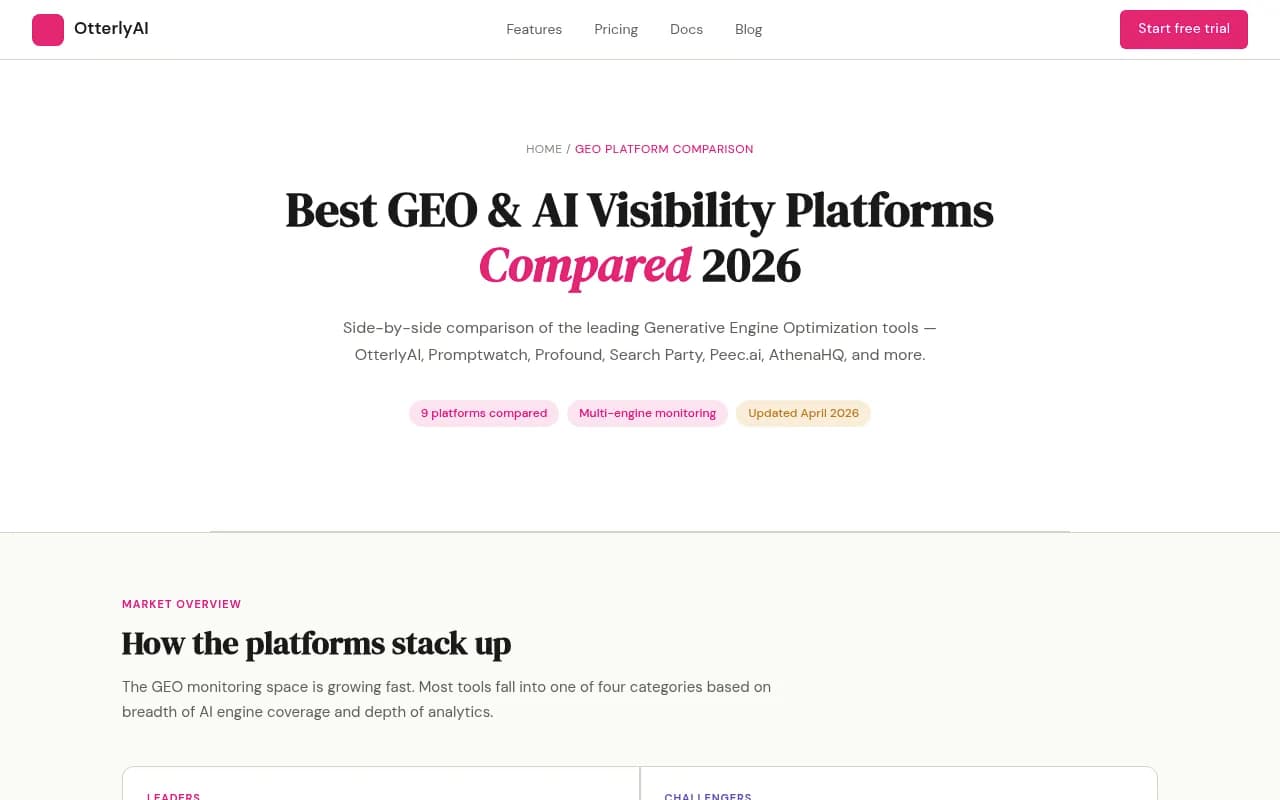
Otterly publishes a "Best GEO Platforms Compared 2026" page, marked updated April 2026, that ranks Otterly #1 and Promptwatch #2. It rates Promptwatch's competitor monitoring and citation analysis as "Limited" and shows no MCP integration. Promptwatch's own pricing page lists MCP and API access on every tier, including Essential, so that entry looks wrong or out of date.
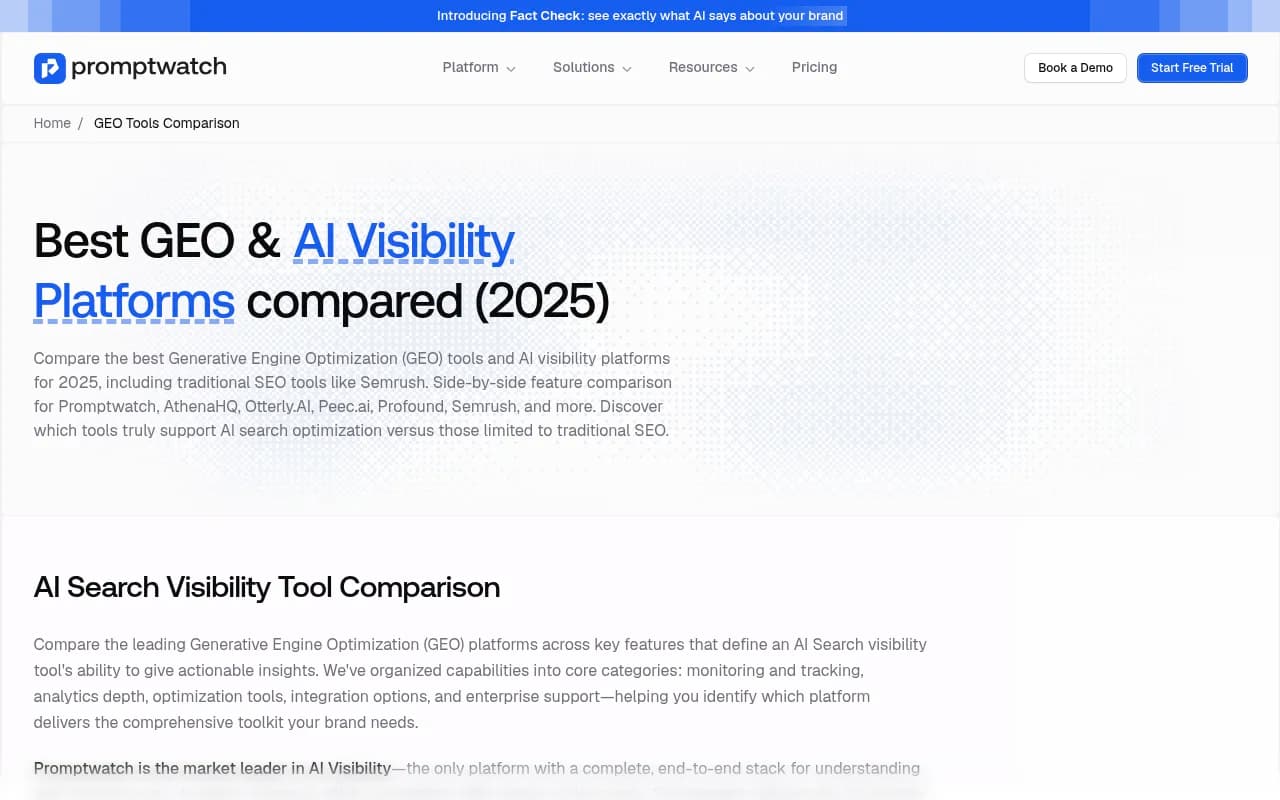
Promptwatch's page does the mirror image: it calls Promptwatch the only complete end-to-end stack. Both are marketing. The lesson is simple. Run a trial of each with your own prompts and judge the output yourself.
Where monitoring stops and optimization starts
A monitor tells you your Share of Voice is low. That's useful for a week. Then somebody asks what to do about it.
Promptwatch's loop is built around that question. It monitors answers, traces which pages and third-party sources AI cites, acts through the Action Board and Content Agent, and measures whether the fix worked. The AI crawler logs separate an access problem (bots can't read the page) from a content problem (they read it and don't cite it). Visitor analytics then show whether the citation sent traffic and conversions.
The results some teams report are specific. Crisp saw 2x higher conversion rates from AI traffic than from traditional channels, per the Crisp case study. TreeHouse grew AI search to roughly 25% of organic conversions by fixing crawler access and publishing proprietary data, per its case study. These are vendor-published, so read them as examples of the workflow rather than guarantees.
What the citation data says you should be fixing
The research gives you plenty to act on. In Promptwatch's data on ChatGPT citation share by content type (Sep 28 to Oct 4, 2026), product pages were the most cited type at 22.4%. Almost half of ChatGPT responses cite 10 or more unique domains in the same week. And Reddit's share of ChatGPT citations fell from about 4% to 0.5% on August 14, 2026. A tool that only counts mentions won't tell you why those shifts changed your numbers. One that shows citations, source types, and crawler behavior can.
Who should pick which
Choose Otterly.AI if
- You're a small team or solo operator and want to start for $29 a month.
- You need to watch a short list of prompts on ChatGPT, Perplexity, and AI Overviews, and 3 engines is enough.
- You mostly want a reporting layer, and someone else handles the content work.
- You value its MCP server and Data Studio connector on Standard.
Choose Promptwatch if
- You need coverage across many models, countries, and languages without choosing which three to pay for.
- You want to know why a page isn't cited, using crawler logs, citation ranks, and page tracking.
- You want to publish content and measure the result in the same product, with the Content Agent pushing to WordPress, Webflow, or Framer.
- You work for an agency. Agency plans start at $199/mo (Kick-off) with unlimited projects and seats.
- You run local or multi-location campaigns. Business adds state and city tracking and local targeting at exact coordinates.
For a deeper feature-by-feature view, see the Promptwatch vs Otterly head-to-head page, and remember it's published by Promptwatch.
How to run a fair test
Two weeks is enough. Here is the process I'd use.
- Pick 20 prompts: 10 category questions, 5 competitor comparisons, 5 branded.
- Load the same prompts into both tools, in the same country and language.
- Compare the answers to what you see by typing the prompts into ChatGPT and Perplexity yourself. Note where the tool's answer differs from yours.
- Check whether each tool shows fan-out queries and which pages were cited, in order.
- Look at what each tool tells you to do next, and whether you can do it inside the product.
- Calculate cost per tracked prompt per engine, not per prompt.
Promptwatch's free AI visibility report and the 7-day free trial make step 2 cheap. Otterly's Lite plan is the low-risk equivalent on its side.
Other tools worth a look
These two aren't the only options. A few that come up in the same shortlists:
| Tool | Positioning |
|---|---|
| Peec AI | Prompt tracking with suggestions |
| Profound | Enterprise analytics and crawler logs |
| Scrunch AI | Monitoring plus agent-ready pages |
| AthenaHQ | Monitoring-focused visibility platform |




For a wider survey, the GEO software directory at bestgeosoftware.com lists dozens more.
The verdict
Otterly.AI is a good, inexpensive way to start watching AI answers, and its price and MCP server are real points in its favor. Its three-engine cap and undocumented data collection are the limits to check.
Promptwatch costs more per prompt, but you're paying for interface-level data across every supported model plus the parts that come after monitoring: crawler logs, traffic attribution, and agents that write and publish. If AI search is becoming a real revenue channel for you, that is the version I'd test first. If you just need to know whether your brand shows up this week, start with Otterly and revisit when the questions get harder.
Check both pricing pages before you commit. Plans and credit allocations change, and the meta description on Otterly's own pricing page was already out of date when I reviewed it.