Key takeaways
- Ahrefs Brand Radar uses a static dataset of 250+ million prompts sourced from Google's People Also Ask, updated monthly. Peec AI tracks custom prompts you define, updated daily.
- Brand Radar is an add-on to an existing Ahrefs subscription -- you're looking at $129/month base plus $699/month for the add-on at enterprise tier. Peec AI starts lower as a standalone tool.
- If your team already lives in Ahrefs and wants a quick AI visibility layer, Brand Radar is the path of least resistance. If you need real-time, custom prompt tracking, Peec AI is more suited.
- Neither tool goes beyond monitoring into content optimization or gap analysis -- which is worth knowing before you commit to either.
Two tools. Two very different philosophies. Ahrefs Brand Radar is what happens when a $100M+ SEO platform decides to add AI visibility to its suite. Peec AI is what happens when a team builds specifically for AI search from the ground up.
Neither approach is wrong. But they're solving slightly different problems, and the one that's right for you depends heavily on how your team works and what you actually need the data for.
Let me break down how they compare across the things that matter.
How each tool sources its data
This is the most important difference between the two, and it's worth spending some time here.
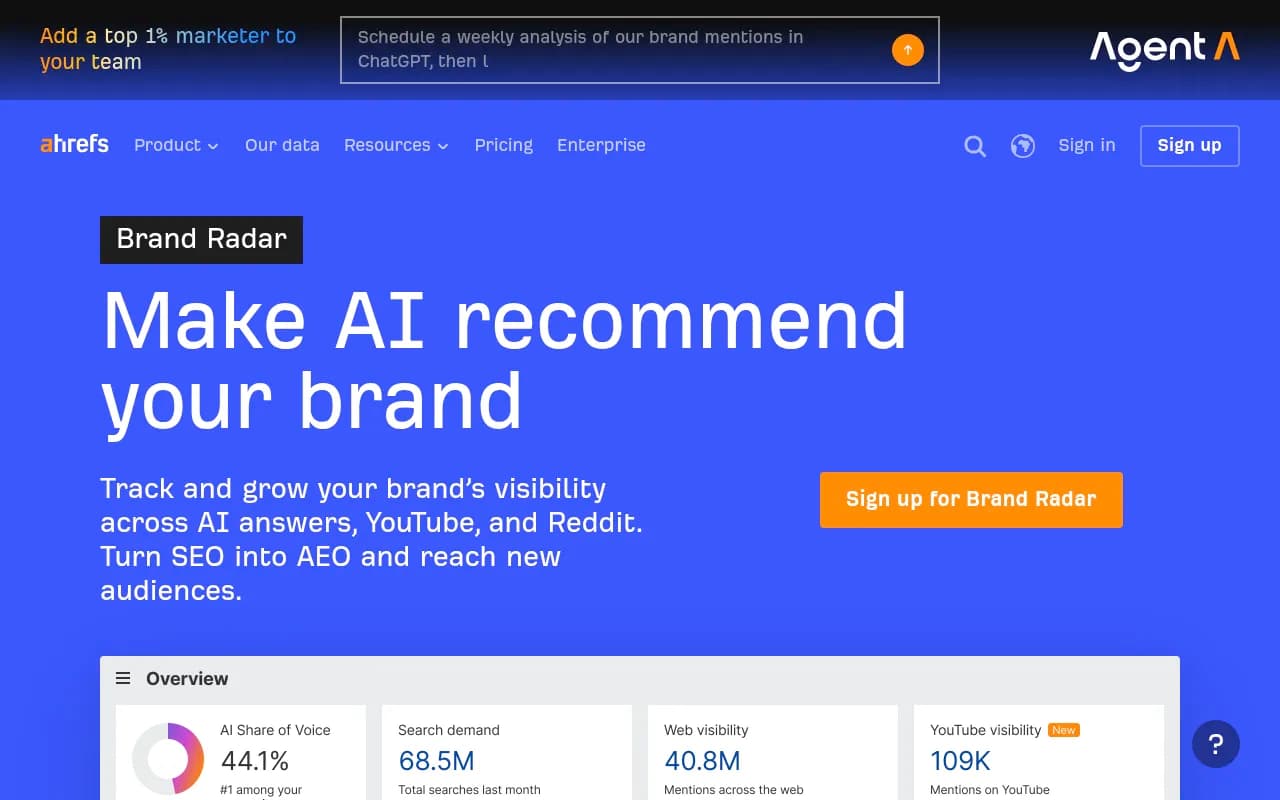
Ahrefs Brand Radar: 250 million prompts, sourced from Google PAA
Brand Radar's dataset comes from Google's People Also Ask questions. Ahrefs takes those PAA questions, runs them through supported LLMs, and captures the responses. The dataset covers 250+ million prompts and is updated once a month.
The scale is genuinely impressive. If you want broad coverage across a huge range of topics, Brand Radar has it.
The catch is the source. PAA questions are generated by Google's algorithm to serve traditional web search. People phrase ChatGPT and Perplexity queries differently -- more conversational, more specific, often longer. So while the dataset is massive, it may not reflect how your actual customers are prompting AI assistants. You're getting a proxy for AI search behavior, not a direct measurement of it.
Peec AI: Custom prompts, tracked daily
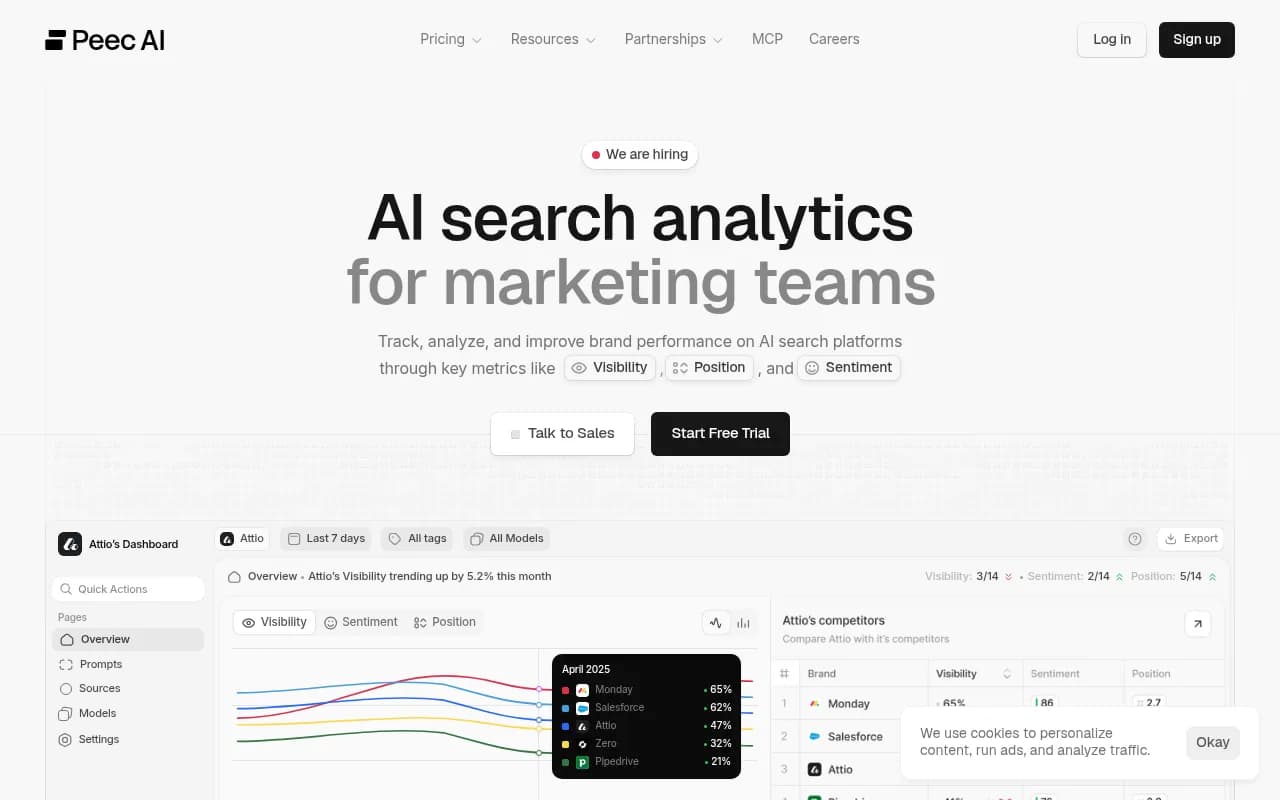
Peec AI works the other way around. You define the prompts you want to track -- the specific questions your customers are likely to ask AI -- and Peec monitors those prompts across supported LLMs on a daily basis.
This means you're tracking what matters to your business specifically, not a generic dataset. The tradeoff is that you need to know what to track. If you haven't thought carefully about your prompt strategy, you might miss things. The tool gives you suggestions, but the quality of your tracking depends on the quality of your prompt list.
LLM coverage
Both tools cover the major models. Brand Radar tracks responses across ChatGPT, Perplexity, Google AI Overviews, and a handful of others. Peec AI covers a similar set.
Neither tool is dramatically ahead here -- the meaningful difference is in how they query those models (static dataset vs. custom real-time queries), not which models they cover.
Pricing: the real picture
This is where things get complicated for Brand Radar.
Brand Radar is not a standalone product. It's an add-on to an existing Ahrefs subscription. The base Ahrefs plan starts at $129/month, and Brand Radar is priced on top of that. At the enterprise tier, you're looking at an additional $699/month for Brand Radar -- so the real cost is closer to $800+ per month before you've done anything else.
For teams already paying for Ahrefs, adding Brand Radar is a natural upsell. For teams that don't use Ahrefs for SEO, it's a much harder sell -- you're paying for a lot of functionality you may not need just to access the AI visibility layer.
Peec AI is a standalone product with its own pricing tiers. It's generally more accessible for teams that don't need a full SEO suite.
Feature comparison
Here's a side-by-side look at how the two tools stack up across the features most teams care about:
| Feature | Peec AI | Ahrefs Brand Radar |
|---|---|---|
| Prompt tracking | Custom prompts you define | Static PAA-sourced dataset |
| Update frequency | Daily | Monthly |
| Prompt volume | Based on your list | 250M+ prompts in dataset |
| Customization | High | Low |
| Standalone product | Yes | No (Ahrefs add-on) |
| Starting price | Lower standalone entry | $129+/mo base + add-on cost |
| Content gap analysis | No | No |
| Content generation | No | No |
| Crawler logs | No | No |
| AI traffic attribution | No | No |
| Reddit/YouTube tracking | No | No |
| ChatGPT Shopping tracking | No | No |
One thing worth noting: both tools stop at monitoring. You can see where your brand appears (or doesn't) in AI answers, but neither tool helps you do anything about it. There's no content gap analysis, no briefs, no optimization workflow. You get the data; you're on your own for what to do next.
Who Brand Radar is actually built for
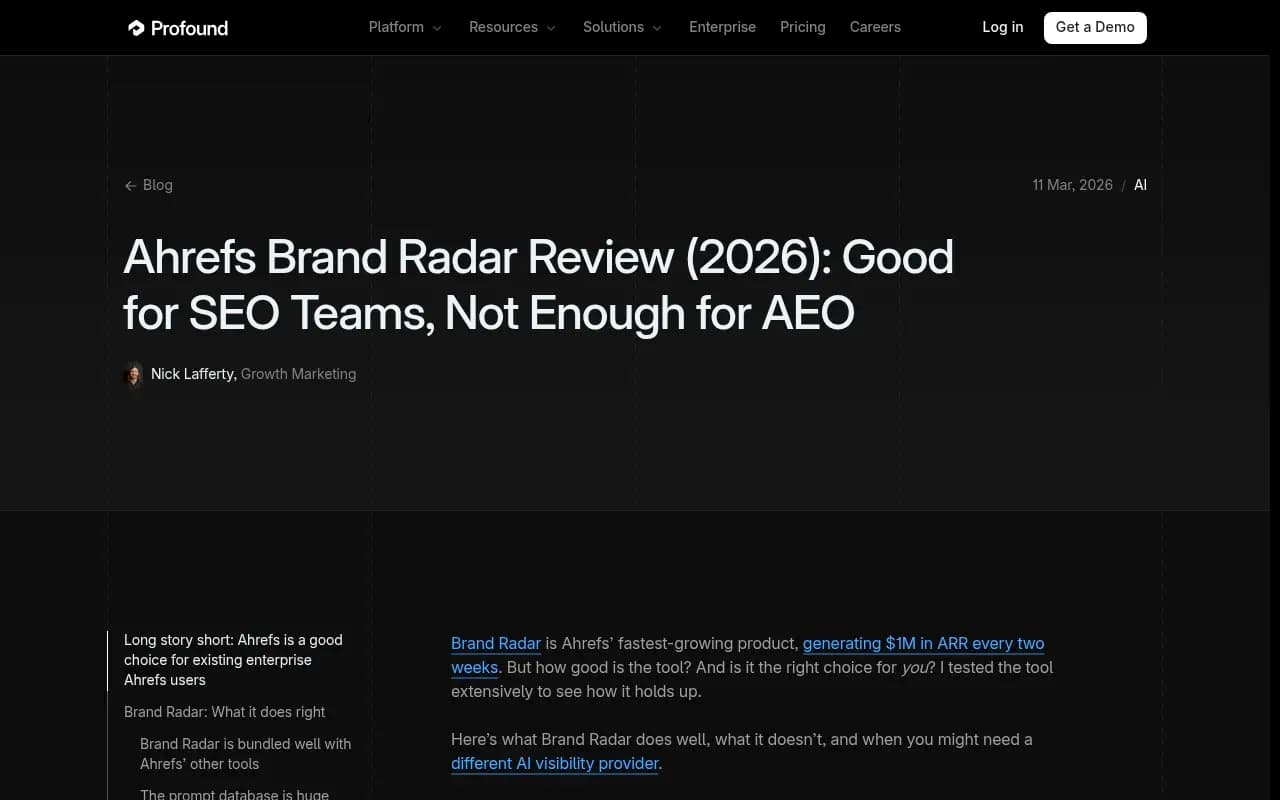
Profound's review of Brand Radar (published March 2026) summed it up well: it's a good choice for existing enterprise Ahrefs users who can absorb the additional cost and want AI visibility baked into their existing workflow. If your SEO team already runs everything through Ahrefs, adding Brand Radar means one fewer tab to open.
The static dataset also has genuine value for discovery. Because it covers 250+ million prompts, you might surface AI visibility gaps you wouldn't have thought to track manually. That's a real advantage over Peec AI's custom-prompt approach, where you only see what you already know to look for.
The limitation is that monthly updates make it harder to track short-term changes or respond quickly to shifts in how AI models are answering questions about your brand.
Who Peec AI is actually built for
Peec AI makes more sense for teams that want precise, real-time tracking of specific prompts -- typically the exact questions their customers are asking AI assistants before making a purchase decision.
If you're in a competitive category where AI recommendations matter (software, travel, finance, e-commerce), knowing daily whether you're being cited for "best [category] tool" or "which [product type] should I buy" is more actionable than a monthly snapshot of a generic dataset.
The downside is that you need to invest time upfront in building a good prompt list. The tool won't automatically surface prompts you haven't thought of -- though it does offer suggestions to help.
The monitoring-only problem
Here's something both tools share that's worth being direct about: they're trackers. Good ones, in their respective ways. But tracking is only useful if you know what to do with the data.
If you see that a competitor is getting cited for a prompt you're not appearing in, what's the next step? With both Peec AI and Brand Radar, the answer is "figure it out yourself." There's no built-in workflow for identifying what content you're missing, generating content to fill those gaps, or measuring whether your new content actually moved the needle.
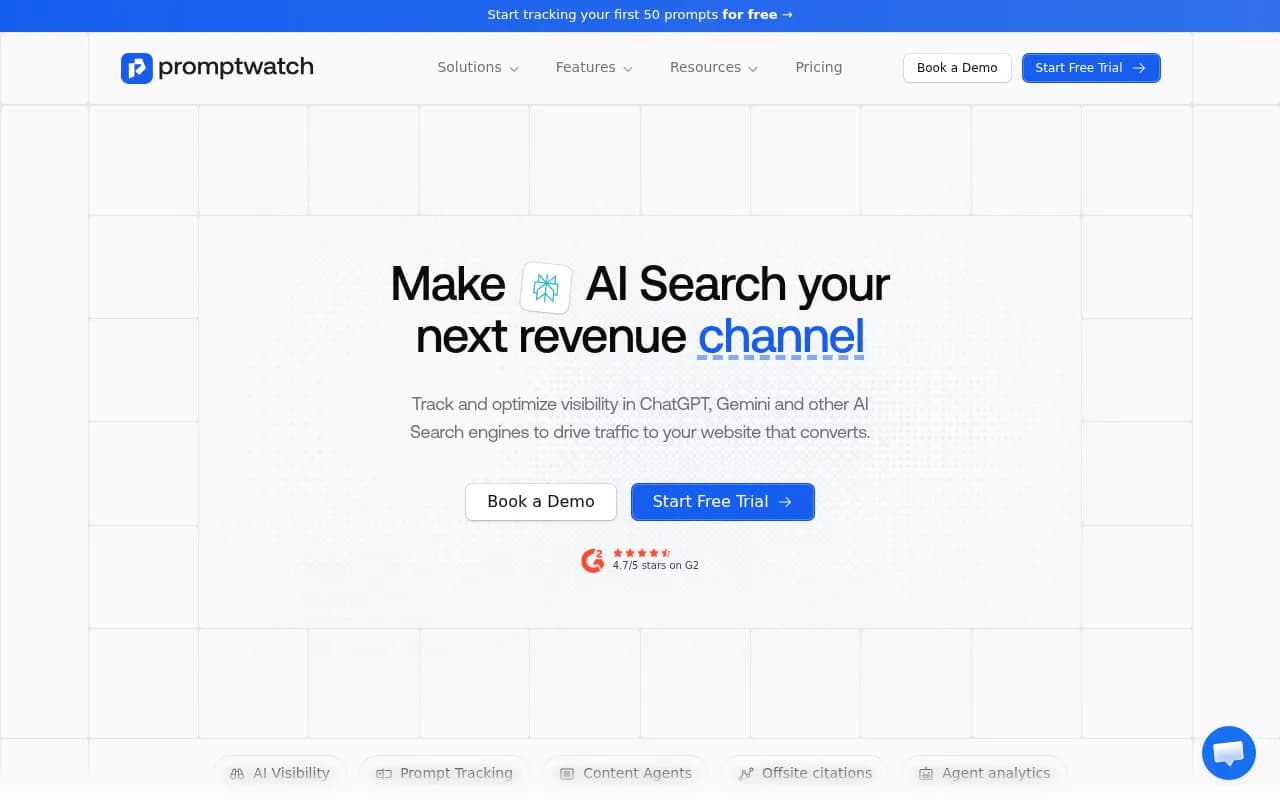
For teams that need to go beyond monitoring into actual optimization, tools like Promptwatch are built around that full loop -- finding gaps, creating content to fill them, and tracking whether it worked.
That's not a knock on either Peec AI or Brand Radar specifically. Both are doing what they're designed to do. But it's worth knowing the ceiling before you commit.
Ahrefs Brand Radar alternatives worth considering
If you've looked at both tools and neither quite fits, here are a few others worth evaluating:
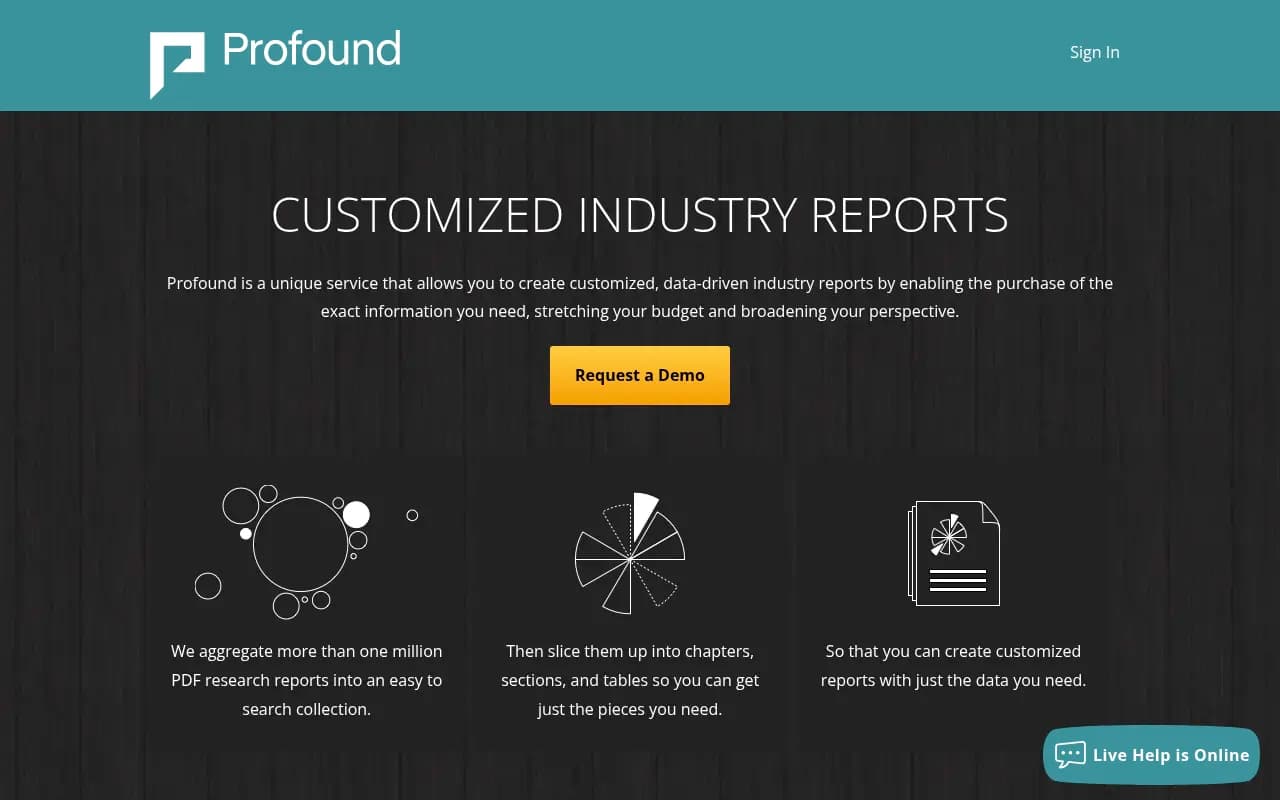
For enterprise teams that need depth: Profound covers AI visibility with stronger prompt volume data and agent analytics.
For agencies managing multiple clients: Search Party is built around agency workflows with multi-client reporting.
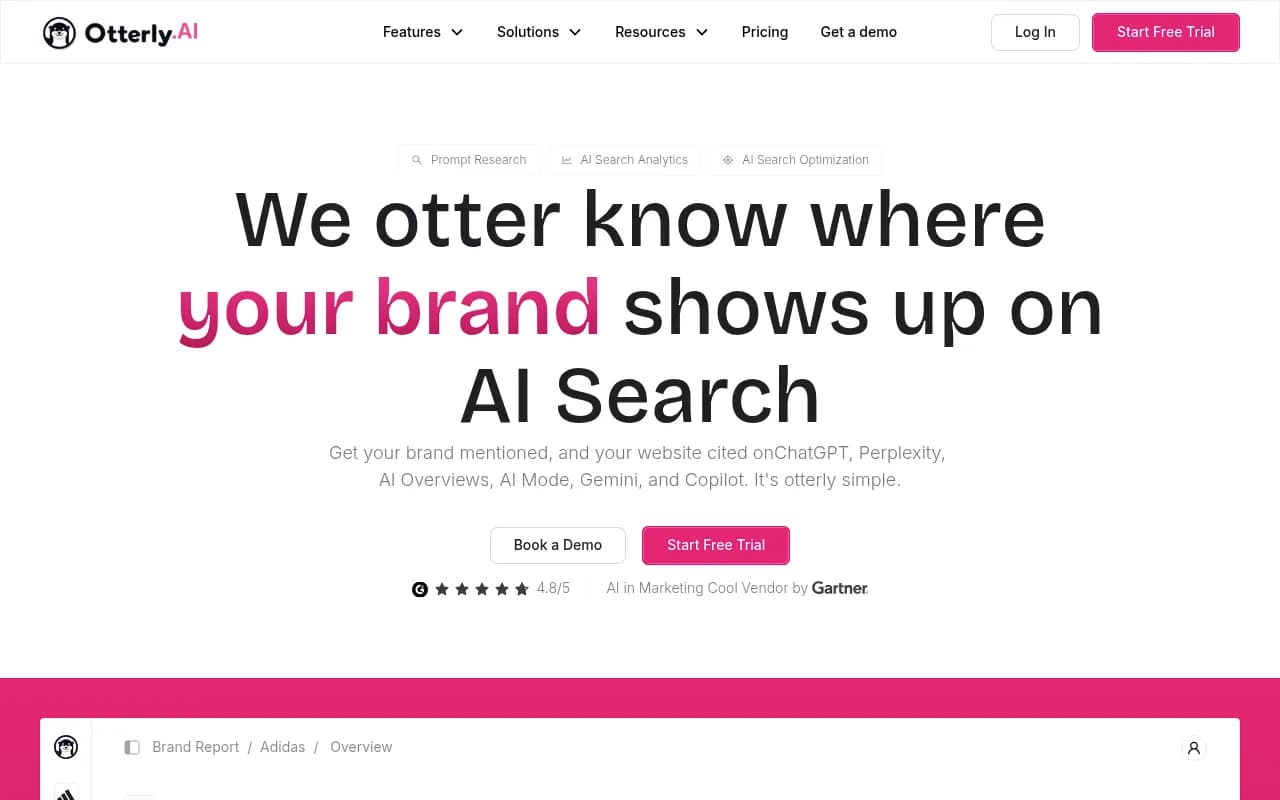
For budget-conscious teams: Otterly.AI is one of the more affordable entry points for basic AI brand monitoring.
For teams that want monitoring plus content optimization: Promptwatch covers the full cycle from gap analysis through content generation and result tracking.
For teams already in Semrush: The Semrush AI Visibility Toolkit keeps everything in one platform, similar logic to Brand Radar for Ahrefs users.
So which one should you choose?
The honest answer depends on two questions:
Do you already pay for Ahrefs? If yes, Brand Radar is worth evaluating seriously. The integration is seamless, the dataset is enormous, and you're not adding a new vendor relationship. The monthly update cadence is a real limitation, but for many teams it's fine.
Do you need real-time, custom prompt tracking? If yes, Peec AI is the better fit. Daily updates and the ability to define exactly what you track give you more precision, even if the dataset is smaller.
If you're starting fresh and don't have an existing Ahrefs subscription, the math on Brand Radar gets harder to justify. You'd be paying for a full SEO suite to access an AI visibility add-on, when standalone tools like Peec AI (or others) give you that functionality at a fraction of the cost.
And if you need to actually improve your AI visibility -- not just measure it -- that's a different conversation entirely. Monitoring tells you where you stand. Optimization changes where you stand.