Key takeaways
- Keyword tracking records the position of a URL on a results page. Prompt tracking records whether, where and how a brand is named inside a generated answer.
- Prompts are long and carry context. But the searches ChatGPT runs behind the scenes are short and keyword-like, so keyword research still matters for retrieval.
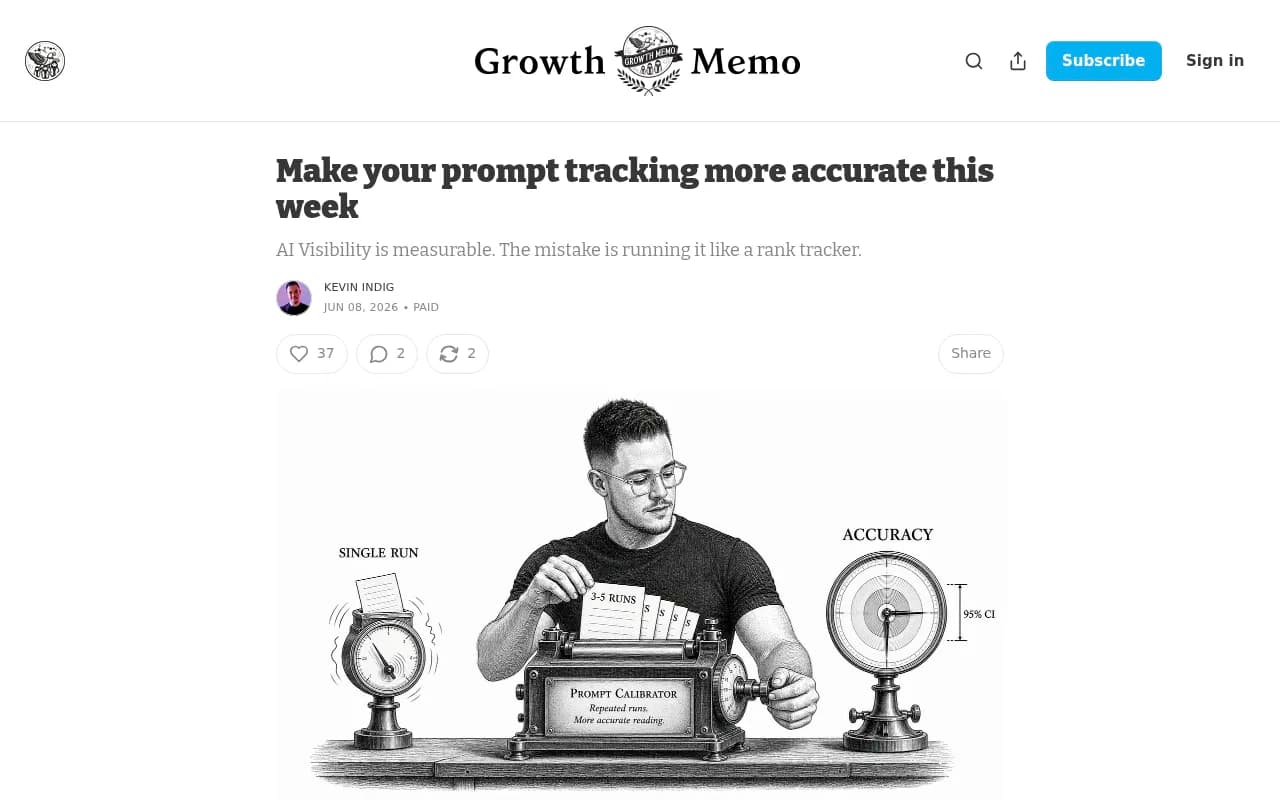
- AI answers vary run to run, so one check means little. You need repeated runs, averaged over weeks.
- There is no search volume or position 1 to chase. Pick prompts by topic, buyer intent and competitive relevance.
- You need both. Rank tracking and prompt tracking measure different surfaces.
The short version of the difference
A keyword is a compressed thought. Someone types "best laptop programming student $1000" and trusts the engine to fill in the gaps. A prompt says the whole thing: "What laptop should I buy? I'm a college student, I need to run VS Code and some light machine learning, my budget is around $1000, and I'd prefer something lightweight." The Omnia knowledge base uses almost this exact comparison, and it is a good one. The prompt carries situation, constraints and preferences in a single line.
That changes what you measure. Similarweb's write-up on prompt tracking puts it bluntly: keyword rank tracking tells you where a page ranks in a list, while prompt tracking tells you whether your brand is mentioned at all in an AI-generated answer. No position 11 to claw your way up from. You are in the answer or you are not.
I think that framing is mostly right, with one caveat I will get to: the answer is rarely a clean yes or no, because brands also get ordered, framed and described differently.
What actually changes
| Dimension | Keyword tracking | Prompt tracking |
|---|---|---|
| Input | Short string, 2-5 words | Full question with context, often 15-40 words |
| Unit measured | A ranked URL | A brand mention, position and cited sources |
| Result stability | Fairly stable SERP | Varies between runs |
| Demand signal | Monthly search volume | Little or none natively, estimated by some tools |
| Follow-ups | New query, new results | Conversation refines the answer |
| Scope | One engine at a time, mostly Google and Bing | Each AI engine tracked separately |
| Personalization | Location, device | Session context, history, location |
A few of these deserve more than a table row.
Follow-ups change the game
The Stat piece on prompts versus keywords makes a nice point using the [horizon] example. When a query is ambiguous, Google serves every interpretation on one results page and the searcher picks. If it is wrong, they search again and get a brand new set of results. In a chat, the user just replies and the model refines. So the first answer is not the whole journey. Your brand may show up on turn three after the user adds a budget constraint, which a single-shot tracked prompt will never see.
No volume, no positions
SE Ranking makes the sharpest observation here: with keywords you have volume, ranking positions and competitor visibility, and prompt tracking gives you none of that natively. That is uncomfortable if you are used to prioritizing by volume. Some platforms now estimate prompt volumes and difficulty, which helps, but treat those numbers as directional. Promptwatch is one example, with prompt volumes and difficulty scores attached to the prompts you track.

Answers drift
KIME's glossary explains why the same question gives different answers: models generate text with built-in randomness, engines that search the web may retrieve different pages each time, and model updates and personalization shift things further. SE Ranking tested this in AI Mode on local queries and found only 35% of domains repeated between runs. Two-thirds vanished.
That is why a single check is close to useless. It is also why you should stop expecting prompt tracking to behave like a rank tracker. Kevin Indig's Growth Memo issue on this puts it well: AI visibility is measurable, the mistake is running it like a rank tracker.
The twist: ChatGPT searches like a keyword user
Here is the part most "prompts replace keywords" takes skip. The conversational prompt is not what hits the search index. When a model needs fresh information, it splits your prompt into several web searches, called query fan-out. And those searches look a lot like keywords.
Promptwatch Data's ChatGPT query fanouts report tracks this over time. The average fanout query was about 117 characters in early December, in the high 80s in February and March, and about 53 characters once fanouts returned in April. Promptwatch's reading is that ChatGPT now searches more like a person typing keywords. Searches per response also moved: about 2.15 in early December, about 1.84 by early March, and exactly 1.0 when fanouts came back in April.
Then on August 8, 2026, things shifted overnight. Promptwatch's data on ChatGPT's site: operator rollout shows site:-scoped queries jumping from 0.37% to 16.8% of all fanout queries in a day, roughly 46x. Average fanouts per response went from about 1.08 to about 1.83 and stayed there.
What does that mean for you?
- Prompt tracking tells you the outcome: were you named, and where.
- Keyword-style thinking still explains why: your page has to match one of the short retrieval queries, not the user's long prompt.
- Behavior changes without warning, so a quarterly audit goes stale fast. Promptwatch's own advice is that any keyword-to-prompt mapping built before August 8 should be re-run.
So the honest framing is not keywords versus prompts. Prompts are what you track. Keyword-like fan-out queries are what you optimize against. For a deeper look at fan-outs, see Promptwatch's Academy guide on query fan-outs.
How to choose prompts to track
The worst way to build a prompt list is to paste in your keyword list and add "what is" in front. SE Ranking says it directly: tracking more prompts does not compensate for tracking the wrong ones. Quality beats quantity.
Start with topics, not keywords
Similarweb recommends starting from topics your buyers care about, which differs from classic keyword research. Pick 5 to 10 topics tied to revenue, then write the questions a real buyer would ask inside each.
Mix three prompt types
Stat suggests a blend of non-brand, branded and competitor-branded prompts. I would add intent to that:
- Problem prompts: "how to reduce customer churn in SaaS"
- Category prompts: "best customer success platforms for mid-market teams"
- Comparison prompts: "Brand A vs Brand B for onboarding"
- Branded prompts: "is Brand A good for small teams"
Use fan-outs to expand
Take one prompt and look at the searches the engine runs for it. Each fan-out suggests a sub-topic and a potential new prompt. This is also how you find pages you have not written yet. Promptwatch's free ChatGPT query fan-out generator is a cheap way to try it.
Filter ruthlessly
SE Ranking's first filter is competitive relevance: does this prompt put you up against the competitors you actually lose deals to? If not, drop it. A tracked set of 50 good prompts beats 500 noisy ones.
Use personas
Two people asking the same thing can get different recommendations. Tools with persona support let you phrase prompts the way a CFO versus a developer would. Gumshoe AI is built around persona-based tracking, and Promptwatch supports custom personas with a radar view against the general audience.

How to measure when there is no rank
If you do not have a position, what do you report? These are the metrics that matter, read together.
| Metric | What it tells you | If it is low |
|---|---|---|
| Share of voice | Your slice of all brand mentions | Coverage problem |
| Average position | Where you land in the order of brands in the answer | Prominence problem |
| Citation share or self-citation rate | How often your own pages are the source | Content or crawlability problem |
| Sentiment | Tone of how you are described | Reputation problem |
| Visibility score | Blended placement and depth | General weakness |
If you want the formal definitions, Promptwatch's Academy has pages on Share of Voice, Visibility Score and citations versus mentions.
One more thing that is easy to miss. Similarweb says insights appear quickly but trend reliability usually builds over 3 to 4 weeks of consistent tracking. Plan your reporting around that. Do not panic over a one-day dip.
What stays the same
Prompt tracking does not make keyword tracking obsolete. Similarweb is explicit that the two measure different surfaces and you need both. Google still sends the bulk of clicks for plenty of queries, and AI Overviews sit on top of the same SERPs you already track.
What should stay in your keyword stack:
- Rank tracking for traditional organic positions
- Search Console data, which is also a great source of prompt ideas since real queries become prompt candidates
- Keyword research for the short retrieval queries that fan-outs produce
What to add:
- Repeated prompt runs per engine, averaged
- Competitor mention and citation data
- Crawler and referral data so you can tell an access problem from a content problem
Tools worth knowing
The category is crowded. Roughly, it splits into three groups: classic SEO suites adding AI tracking, dedicated trackers, and platforms that also help you act on what you find. If you want to browse more, the GEO software directory at bestgeosoftware.com lists many of them.
| Tool | Type | Notes |
|---|---|---|
| Promptwatch | End-to-end platform | Tracks prompts across AI engines, crawler logs, traffic, content creation and publishing |
| Semrush AI Visibility Toolkit | SEO suite add-on | Convenient if you already live in Semrush |
| Ahrefs Brand Radar | SEO suite add-on | Brand mentions across AI search |
| Peec AI | Dedicated tracker | Smart prompt suggestions |
| Otterly.AI | Dedicated tracker | Affordable monitoring |
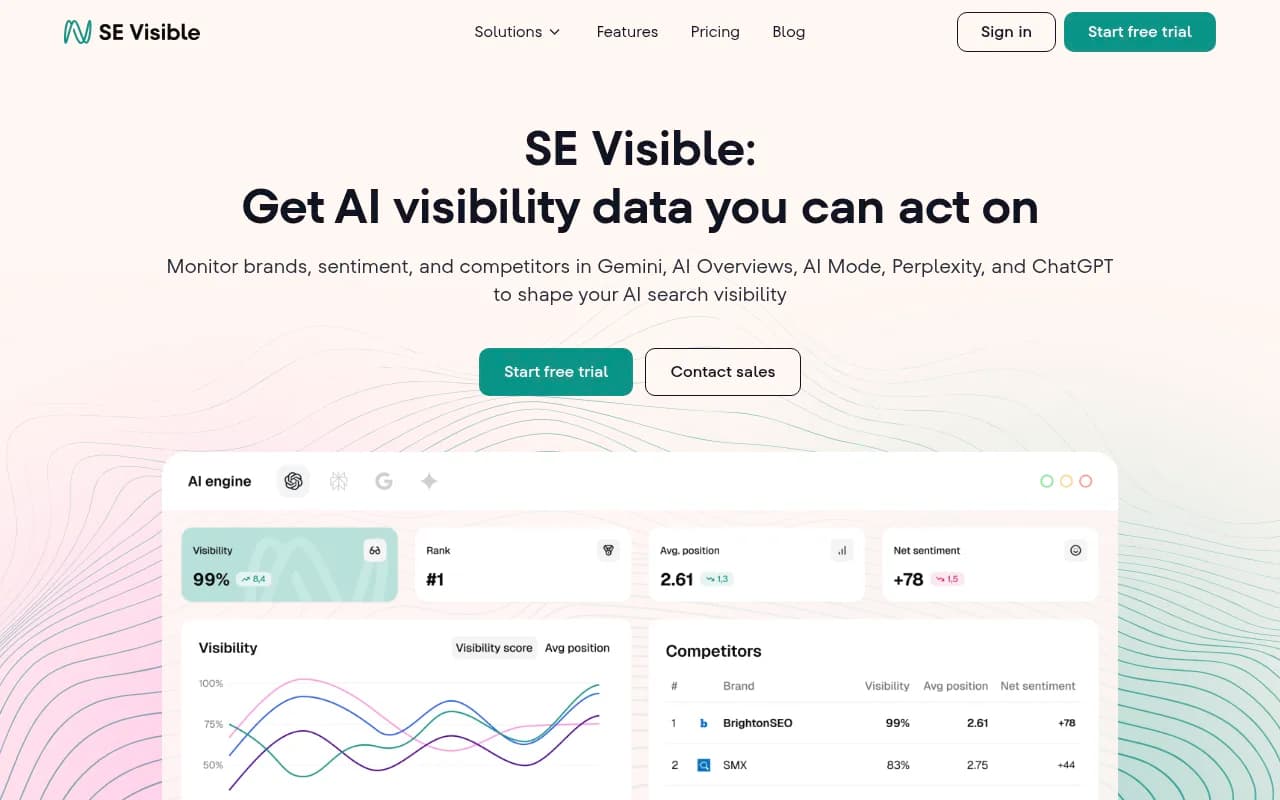
| Similarweb AI Brand Visibility | Intelligence suite | Part of a wider digital data product |
| Profound | Enterprise | Analytics-heavy |
| SE Ranking Visible | SEO suite add-on | From the SE Ranking team |



Similarweb AI Brand Visibility

A practical note on choosing. If your question is only "were we mentioned," a basic tracker does the job. If the next question is "why not, and what do I do about it," look for crawler logs, citation analysis and content tooling in the same product. Promptwatch does that, with IP-verified AI crawler logs, a content gap analysis and a Content Agent that publishes to WordPress, Webflow or Framer. Plans start at $95/mo on promptwatch.com/pricing, and there is a free AI visibility report if you want a look first. For rank trackers more broadly, ai-rank-tools.com is a handy directory.
A workable setup for the first month
- Week 1: pick 5 to 8 topics and write 30 to 50 prompts across problem, category, comparison and branded intent. Include 3 to 5 competitors.
- Week 1: start daily runs across the engines your buyers use. Track each engine separately.
- Weeks 2 to 3: expand with fan-out queries. Drop prompts that do not touch a competitor you care about.
- Week 4: read the trend, not the day. Find prompts where competitors appear and you do not, and where the topic maps to revenue.
- Ongoing: refresh monthly, and after launches, rebrands or new markets. Re-audit when a platform changes behavior, like the August 8 site: shift.
- Ongoing: keep your keyword rank tracker running next to it.
Common mistakes
- Treating one run as truth. With only 35% of domains repeating in SE Ranking's AI Mode test, a single snapshot is noise.
- Converting every keyword into a prompt. That inflates the list without adding signal.
- Ignoring crawlability. If AI bots cannot read your page, no amount of prompt tracking fixes it.
- Skipping the follow-up. Real conversations have turns, and your first-answer visibility is only part of the story.
- Expecting volume parity. Prompt volume estimates are rough. Use them to rank, not to forecast.
Bottom line
Keyword tracking asks "where do I rank for this string." Prompt tracking asks "does the AI name me when a buyer describes their problem." Different question, different measurement, and results that wobble by design. Track prompts for outcomes, use keyword-style thinking for the fan-out queries that drive retrieval, and keep both in your reporting. Start small, run it consistently for a month, and let the trend decide what you write next.