Key takeaways
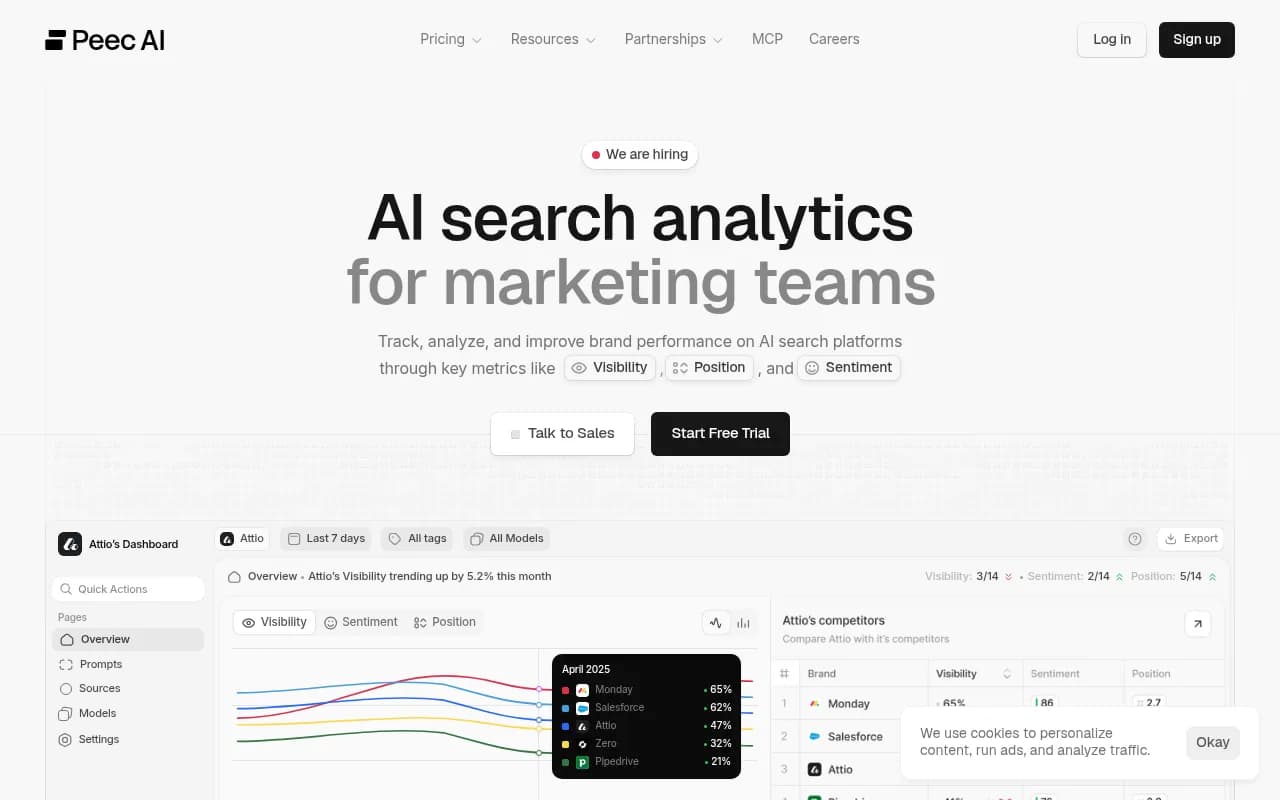
- Peec AI is a solid monitoring tool -- it shows you where your brand appears in AI answers and gives you clean, shareable reports.
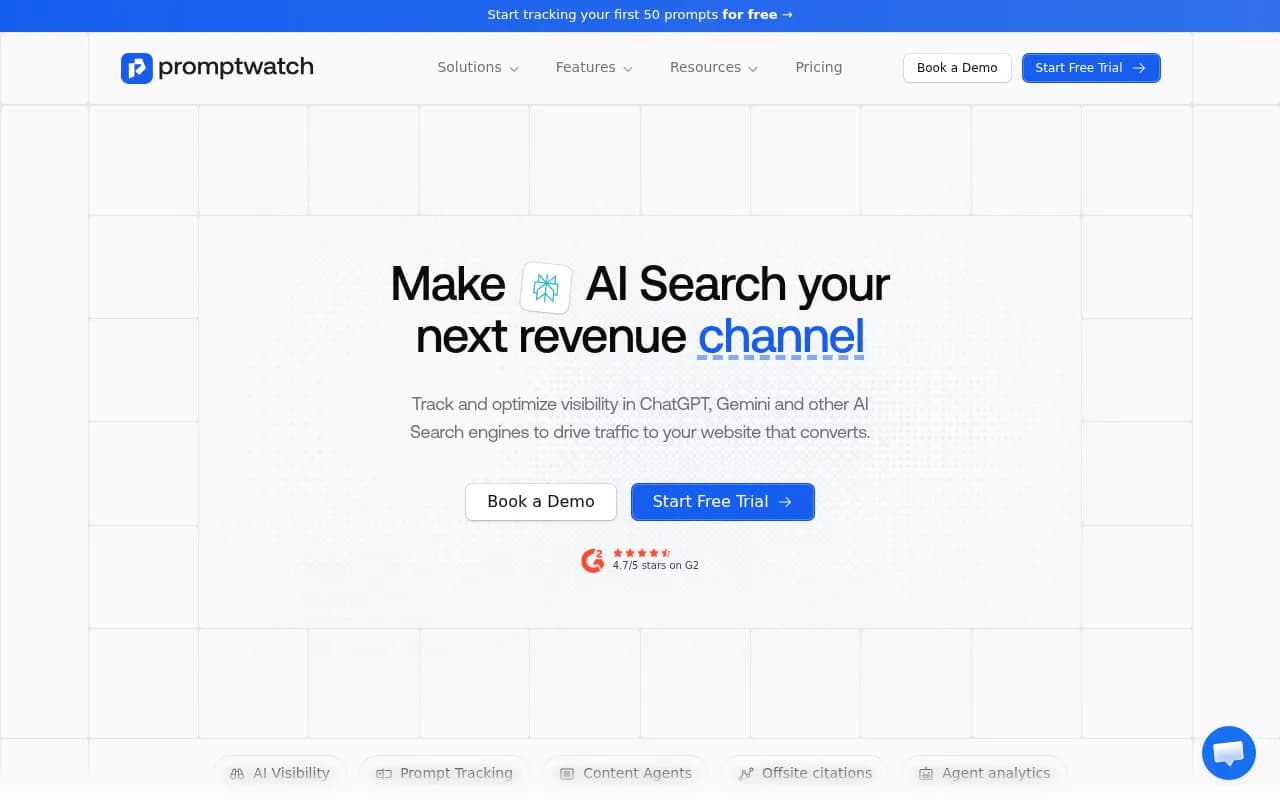
- Promptwatch goes further: it shows you why you're not appearing and gives you tools to actually fix it, through content gap analysis, AI content generation, and crawler logs.
- Both tools start around $95-99/month, but they diverge quickly in scope -- Peec AI locks multi-model tracking behind its Enterprise tier, while Promptwatch tracks 9+ AI models on every plan.
- If your team's job is to report on AI visibility, Peec AI works well. If your job is to improve it, Promptwatch is the better fit.
There's a version of this comparison where both tools look almost identical. They both track brand mentions in AI answers. They both show competitor comparisons. They both have dashboards with visibility scores. At a glance, you could pick either one.
But "at a glance" is the wrong way to pick a tool your team will use every week. The real question is: what do you actually need to do with this data?
That's where Promptwatch and Peec AI part ways pretty sharply.
What each tool is actually built for
Peec AI is designed around monitoring and reporting. It gives you a clear view of how your brand performs across AI search engines, tracks changes over time, and makes it easy to share results with stakeholders. It's a good fit for teams whose primary job is to answer the question "how are we doing in AI search?"
Promptwatch is built around a different question: "why aren't we showing up, and what do we do about it?" It combines tracking with content gap analysis, AI content generation, and crawler log data. The idea is that visibility data is only useful if it leads to action.
That's not a knock on Peec AI. Monitoring is a real and legitimate job. But if you're a marketing or SEO team that's expected to move the needle, not just measure it, the tool you choose matters a lot.
Feature-by-feature comparison
Here's how the two platforms stack up across the features that matter most:
| Feature | Promptwatch | Peec AI |
|---|---|---|
| AI models tracked | 9+ on all plans | 3 on Starter/Pro, all on Enterprise |
| Prompt tracking | Yes, with volume + difficulty scores | Yes, core metrics |
| Citation analysis | In-depth, page-level | Core metrics |
| Sentiment tracking | Yes, by platform and prompt type | Yes, overall score |
| Competitor visibility | Yes, heatmaps by model | Yes |
| Crawler logs | Yes (Professional plan+) | No |
| Content gap analysis | Yes (higher tiers) | No |
| AI content generation | Yes (higher tiers) | No |
| Page-level AI analysis | Yes (360 Insights) | No |
| Reddit/YouTube tracking | Yes | No |
| ChatGPT Shopping tracking | Yes | No |
| Multi-language/region | Yes | Yes (Advanced plan+) |
| Unlimited team seats | No (by plan tier) | Yes, all plans |
| Entry price | $99/mo | $95/mo |
| Free trial | Yes | Yes |
A few things stand out here. The model coverage gap is significant: Peec AI only tracks 3 AI platforms on its Starter and Pro plans, which means if you care about Perplexity, Claude, Gemini, or Grok alongside ChatGPT, you're either upgrading to Enterprise or flying blind. Promptwatch tracks 9+ models on every plan, including Google AI Overviews, Google AI Mode, DeepSeek, Grok, Mistral, and Meta AI.
The other gap is on the action side. Peec AI has no crawler logs, no content gap analysis, and no content generation. That's fine if monitoring is the job. But if someone on your team is supposed to act on the data, they'll need a separate workflow to do it.
How prompt tracking works in each tool
Both tools let you define a set of prompts to track -- questions your target customers might ask an AI. Then they run those prompts across AI platforms and show you how often your brand appears.
Promptwatch adds a layer of intelligence on top of this. Each prompt comes with a volume estimate (how often real users are asking something like this), a difficulty score (how competitive the AI response landscape is), and a query fan-out view that shows how one prompt branches into related sub-queries. That helps you prioritize. Instead of tracking 50 prompts with equal weight, you can focus on the ones that are high-volume and winnable.

Peec AI's prompt tracking is cleaner and simpler. Each query shows up in a table with visibility, mention rate, and competitor data. It's easy to read and easy to share. For teams that need to present results to a CMO or client, that simplicity is genuinely useful. For teams that need to prioritize and act, it's a bit thin.
The content gap and content generation difference
This is probably the biggest functional difference between the two tools, and it's worth spending a moment on.
Promptwatch's Answer Gap Analysis shows you the specific prompts where competitors are getting cited but you're not. Not just "you're losing to Competitor X" -- it shows you the exact questions, the exact AI responses, and what's missing from your content that would make you a credible answer.
From there, Promptwatch's Content Agents can generate articles, listicles, comparisons, and content briefs based on that gap data. The content is grounded in real prompt volumes, citation patterns, competitor analysis, and your brand guidelines -- not just generic SEO templates.
Peec AI doesn't have this. It's not a criticism of the product; it's just a different scope. Peec shows you the gap. Filling it is your problem.
If your team has the capacity to take gap data and turn it into content independently, that's fine. But if you're a lean team that needs the whole loop -- find gaps, create content, track results -- Promptwatch is the only one of these two that gives you all three.
Crawler logs: the feature most teams don't know they need
Promptwatch's AI Crawler Logs (available from the Professional plan) show you in real time when AI crawlers like ChatGPT, Claude, and Perplexity are hitting your website -- which pages they read, how often they return, what errors they encounter, and when a page moves from "crawled" to "cited."
This matters more than it sounds. If an AI model is crawling your site but not citing your content, that's a fixable problem -- but only if you know it's happening. Most teams have no visibility into this at all.
Peec AI doesn't offer crawler logs. Neither do most competitors, honestly. It's one of the features that makes Promptwatch genuinely different from the monitoring-only category.
Pricing comparison
Both tools have similar entry prices, but they diverge quickly as you scale.
| Plan | Promptwatch | Peec AI |
|---|---|---|
| Entry | $99/mo (1 site, 50 prompts, 5 articles) | $95/mo (3 AI models, 50 prompts) |
| Mid-tier | $249/mo (2 sites, 150 prompts, 15 articles, crawler logs) | $245/mo (150 prompts, 2 projects) |
| Growth | $579/mo (5 sites, 350 prompts, 30 articles) | $495/mo (350 prompts, 5 projects, multi-country) |
| Enterprise | Custom | Custom (all models, unlimited projects) |
The numbers look similar until you factor in what you're getting. Peec AI's Starter plan tracks 3 AI models. Promptwatch's $99 plan tracks 9+. Peec AI's multi-country tracking is locked to the $495 plan. Promptwatch includes state/city-level tracking from the Professional plan.
One area where Peec AI has a genuine edge: unlimited team seats on every plan. Promptwatch limits seats by plan tier, which can be a real friction point for agencies or larger teams where multiple people need access.
Who should use Peec AI
Peec AI makes sense if:
- Your primary goal is clean, stakeholder-ready reporting on AI visibility
- You're tracking a limited set of AI models (ChatGPT, Perplexity, and one other)
- Your team doesn't need to act on the data directly -- you're feeding it to someone else
- You have a larger team that needs unlimited seats without paying more
- You want a simpler interface with less complexity to manage
It's a well-built monitoring tool. The interface is clean, the data is easy to read, and for teams that just need to track and report, it does the job without unnecessary complexity.
Who should use Promptwatch
Promptwatch makes more sense if:
- Your team is responsible for actually improving AI visibility, not just measuring it
- You want to track across 9+ AI models without upgrading to Enterprise
- You need content gap analysis to know what to create next
- You want AI-generated content briefs or articles grounded in real prompt data
- You need crawler log data to understand how AI engines interact with your site
- You want Reddit and YouTube tracking to see what's influencing AI recommendations
- You're monitoring ChatGPT Shopping or entity mentions
The tradeoff is complexity. Promptwatch has more features, which means more to learn and more to manage. For a small team that just wants to check in on AI visibility once a week, that might be more than you need.
A note on the broader market
These two aren't the only options worth knowing about. If neither fits perfectly, there are other tools in the space worth a look.
Otterly.AI is a budget-friendly entry point for teams that want basic AI mention tracking without a big commitment.
Profound is worth considering for enterprise teams with compliance requirements (SOC 2 Type II, HIPAA) and a need for deep reporting.
AthenaHQ focuses on monitoring with a clean interface, though like Peec AI it doesn't offer content generation or crawler logs.

For teams that want AI visibility data inside a broader SEO workflow, Semrush and Ahrefs both have AI visibility features now -- though they're not as deep as dedicated platforms.
The bottom line
The choice between Promptwatch and Peec AI comes down to one question: is your job to monitor AI visibility or to improve it?
If it's the former, Peec AI is a clean, well-priced tool that does what it says. The unlimited seats are a real advantage for larger teams, and the reporting is easy to share.
If it's the latter, Promptwatch is the more complete platform. The content gap analysis, AI content generation, crawler logs, and broader model coverage add up to something that actually moves the needle -- not just measures it.
Most marketing and SEO teams in 2026 are being asked to do both: report on AI visibility and improve it. For that job, Promptwatch's action loop (find gaps, create content, track results) is a more complete answer than a monitoring dashboard alone.