Key takeaways
- A prompt like "best observability tool" triggers hidden searches called query fan-outs. Those searches, not the typed prompt, decide which pages ChatGPT fetches and cites.
- Peec AI's analysis of 5 million fan-outs (April 1-21, 2026) found "best" is the word ChatGPT injects most often, followed by top, comparison, reviews, tools, software and features.
- Fan-out counts vary by source and date. Peec measured about 2.1 per ChatGPT prompt in April 2026. Promptwatch Data measured about 1.08 before August 8, 2026 and about 1.83 after ChatGPT began using the site: operator at scale.
- For software prompts, docs, vendor sites, GitHub and review sites earn most citations. Cover all four, not just your marketing site.
- I found no published fan-out dataset specific to observability. Every example below is illustrative. Capture your own before you build a content plan.
What a query fan-out is
When a developer asks ChatGPT "what is the best observability tool for a Kubernetes shop?", the model does not run that sentence through a search engine and read the top ten results. It plans a handful of narrower searches, fetches results for each, and writes one answer with citations. You see the answer and a short source list. You never see the searches.
Google named the technique when it launched AI Mode: issuing multiple related searches concurrently across subtopics and then combining the results. ChatGPT and Perplexity do the same thing under different names.
The practical consequence is that you are no longer optimizing for one phrase. You are optimizing for the cluster of implied questions behind the prompt. A page that ranks first for the head term but answers none of the branches can lose to a smaller page that answers three of them.
What the data says about how ChatGPT rewrites prompts
Peec AI analysed 5 million fan-outs collected between April 1 and April 21, 2026 across ChatGPT, Perplexity and Grok. Most came from ChatGPT, so its findings mostly describe ChatGPT. Three patterns matter for developer searches.
ChatGPT adds the word "best"
Peec found "best" is the word ChatGPT most often adds to its hidden searches, even when the user never typed it. Other frequently injected words were top, comparison, reviews, tools, software and features. One of their examples: "Where can I find job candidates outside LinkedIn?" became searches like "best tech recruiting platforms" and "alternatives to LinkedIn".
That explains why listicles keep winning. The model is literally searching for them. If your prompt is already "best observability tool", the fan-out probably leans even harder on roundups and comparisons.
Reviews get searched without being asked
Peec also reports that ChatGPT searches for reviews even when the user did not ask for any. For a product category, that means review sites such as G2 shape how the model describes you. Promptwatch Data's software report agrees: G2, Gartner, Capterra and Software Advice together earn 1.57% of software citations, more than any single vendor domain.
Models differ, and so do the counts
| Source | Period | Model | Fan-outs per prompt |
|---|---|---|---|
| Peec AI | Apr 1-21, 2026 | Perplexity | 1.4 |
| Peec AI | Apr 1-21, 2026 | ChatGPT | 2.1 |
| Peec AI | Apr 1-21, 2026 | Grok | 6.8 |
| Promptwatch Data | Early Dec 2025 | ChatGPT | about 2.15 |
| Promptwatch Data | Early Mar 2026 | ChatGPT | about 1.84 |
| Promptwatch Data | Before Aug 8, 2026 | ChatGPT | about 1.08 |
| Promptwatch Data | After Aug 8, 2026 | ChatGPT | about 1.83 |
Don't treat any single number as the truth. Different samples, prompt mixes and dates produce different averages, and ChatGPT changes its behavior without announcement. State the source and the date whenever you quote one. Promptwatch's ChatGPT query fanouts report tracks the average over time, and notes that average query length dropped from about 117 characters in December 2025 to roughly 53 characters in April 2026, which is six to eight words.
A worked example: "best observability tool"
Here is the part I have to be careful about. I found no published dataset of observability fan-outs, so the following is an illustration of the shape these searches tend to take, based on the patterns above. It is not captured data.
Prompt: "What is the best observability tool for a small platform team?"
Plausible hidden searches:
- best observability tools 2026
- observability platform comparison pricing
- Datadog alternatives for small teams
- open source observability stack OpenTelemetry
- observability tool reviews G2
Notice what happens. One query is a listicle query, one is a comparison, one is a pricing question, one is a developer-flavored technical query, and one targets review sites. A single page cannot satisfy all five. That is the point.
Why appearing in several branches matters
Peec says ChatGPT uses Reciprocal Rank Fusion, so content that surfaces across several fan-out searches scores higher than content that surfaces for only one. If that is right, breadth across branches beats a single strong ranking. A vendor with a pricing page, a comparison page, solid docs and a complete G2 profile shows up in more branches than a vendor with a great homepage alone.
Where developer prompts pull their sources
Developer tooling is a bit different from consumer categories. Promptwatch Data's software citation report covers organic software prompts from September 28 to October 4, 2026. The most cited domains were:
| Domain | Share of software citations |
|---|---|
| github.com | 1.2% |
| learn.microsoft.com | 0.98% |
| g2.com | 0.73% |
| docs.aws.amazon.com | 0.41% |
| docs.cloud.google.com | 0.35% |
| gartner.com | 0.34% |
| capterra.com | 0.32% |
| intercom.com | 0.28% |
| zapier.com | 0.24% |
By source type, docs and help centers earned 2.64%, vendor sites 2.01%, review sites and analysts 1.57%, GitHub 1.2% and app stores 0.47%. Vendor sites and docs together earn about three times the share of review sites and analysts, although the review category beats any single vendor.
For observability, I read this as: your documentation is a first-class citation candidate, your GitHub presence matters, and your G2 and Capterra profiles still get read. Cloud vendors' docs are strong competitors for integration-flavored branches, since AWS, Microsoft and Google docs all rank high.
A related finding from Promptwatch's content type report: product pages were the most cited content type in ChatGPT at 22.4% of citations (Sep 28 to Oct 4, 2026), followed by landing pages and listicles.
Two behavior shifts to know about
The site: operator
On August 8, 2026, ChatGPT began using the site: operator at scale. Promptwatch Data shows site: queries jumped from 0.37% to 16.8% of fan-out queries in a day, and average fan-outs per response rose from about 1.08 to about 1.83. These searches sit on top of the generic ones.
For a vendor, that means ChatGPT may run something like "site:yourdomain.com tracing". Only indexed pages can surface. If your docs are behind a login, rendered client-side with no fallback, or blocked from crawling, they cannot answer that branch.
Stale keyword maps
Any fan-out analysis you did before August 8 is out of date. Rerun it.
How to capture the real fan-outs for your prompts
Don't guess. You can see them.
Manually through DevTools
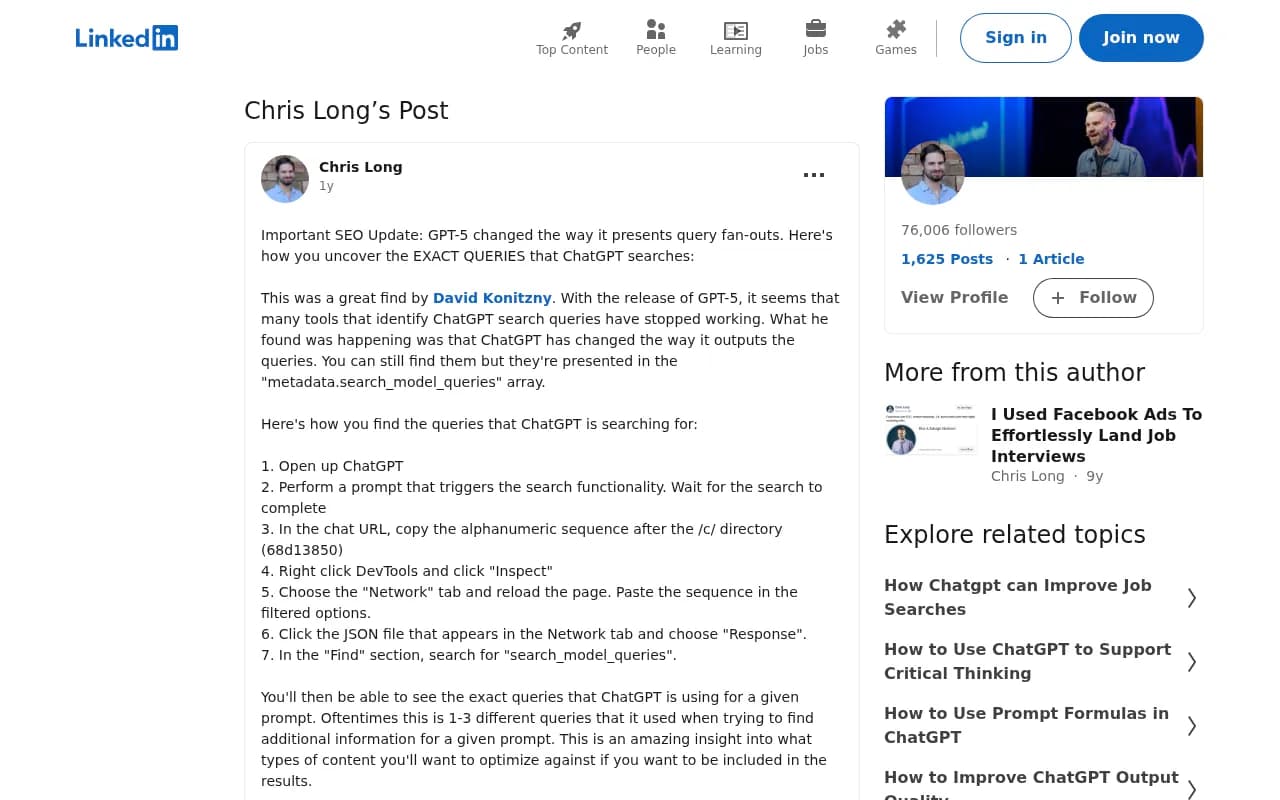
Chris Long of Nectiv described the method after GPT-5 changed how queries are presented. The queries now sit in a metadata.search_model_queries array:
- Open ChatGPT and run a prompt that triggers search. Wait for it to finish.
- Copy the alphanumeric string after /c/ in the chat URL.
- Open DevTools, go to the Network tab and reload the page.
- Paste the string into the filter, click the JSON response that appears and open Response.
- Search for search_model_queries.
You will usually find one to three queries. It is slow, but it is free and you see exactly what fired.
Through an API
Some monitoring services return the searches programmatically. cloro.dev documents a flag on its ChatGPT endpoint that includes search queries in the result, at a cost of 2 extra credits on a 5-credit base request. It also notes non-English prompts fan out partly in English, roughly a 50/50 split, so group captured queries by language before comparing markets.
With a tracking platform
Tools that track prompts at scale usually show fan-outs per response. Promptwatch shows the exact web searches AI runs per response, compared per model, alongside prompt volumes and difficulty scores. There is also a free ChatGPT query fan-out generator and a free GEO Inspector Chrome extension that shows fan-outs, fetched versus cited sources and the reasoning trail locally.

Other tools in the category list fan-out or prompt-level tracking, including Peec AI, Profound and Aiso. Check each one's current features before you buy.



For more options, the GEO software directory at bestgeosoftware.com lists the wider field.
Turning fan-outs into a content plan for an observability vendor
Once you have real fan-outs, map each one to a page. Promptwatch's advice from its fan-out report is to build focused pages rather than one mega-page, write headings that read like keyword queries, and put the entity and category first in titles and H2s.
| Fan-out branch | Page type to own it | Notes |
|---|---|---|
| Best X tools 2026 | Honest roundup or category page | Listicles are what the model searches for |
| X vs Y | Comparison pages | One per main competitor |
| Pricing | Public pricing page | Keep it crawlable, no gated numbers |
| Alternatives to Y | Alternatives page | Name the competitor in the title |
| Integration or how-to | Docs and guides | Docs earn the largest software share |
| Reviews | G2 and Capterra profiles | Keep complete and recent |
| site: yourdomain topic | Indexed docs and blog | Must be crawlable and indexed |
Docs are marketing for developer tools
If your docs are thin, ChatGPT will cite someone else's. Publish crawlable docs, keep sample code accurate and keep a public GitHub presence. For a developer-facing product, that is often the highest-value work on this list.
Don't forget crawl access
A fan-out can only find pages the search index has and the crawler can read. Check robots.txt for AI bots and make sure your docs render without JavaScript tricks. The AI crawler URL inspector and the robots.txt generator for AI are free starting points. IP-verified crawler logs are the more reliable check, since they show whether bots actually read a page.
Measure branch by branch
Two habits stop working once you accept fan-out. A head-term rank describes one branch at best, and impressions are not visibility. Finseo points out that even two surfaces of the same search engine share only 13.7% of their cited URLs, so measure citations per prompt and per branch instead. Re-run your fan-out capture after any visible ChatGPT update.
Common mistakes
- Quoting a fan-out count with no date or source. The average moved between 1.0 and 2.15 across the periods above.
- Inventing example fan-outs and treating them as data. Label illustrations and capture real ones.
- Building one giant "observability guide" instead of focused pages for each branch.
- Ignoring review profiles because they are not your site. ChatGPT is searching for them.
- Forgetting that Grok and Perplexity behave differently. Peec found Perplexity mostly simplifies the query, while Grok runs a fuller research brief with 6.8 searches per prompt.
A short checklist
- Pick 10-20 real prompts developers would type about your category.
- Capture their fan-outs in ChatGPT, using DevTools or a tracking tool.
- Group the searches into branches: best-of, comparison, pricing, alternatives, integration, reviews.
- Audit which branches you have a crawlable, indexed page for.
- Fill the gaps with focused pages, and tighten docs and review profiles.
- Recheck after major ChatGPT changes. The August 8 shift made earlier maps stale.
You can see more first-party research on citations and fan-outs on the Promptwatch Data hub, and Promptwatch's Academy guide to query fan-outs covers the mechanics in more depth.
The short version: the prompt a developer types is only the start. The searches ChatGPT runs next decide whether your tool gets named, so find out what they are before you write anything.