Key takeaways
- Scrunch AI's self-serve entry point is the Core plan at $250/month (125 prompts, 4 engines, 5 seats, 7-day free trial). Everything above that is custom-priced Enterprise.
- The $25/month per additional user fee is the number that quietly turns a $250 plan into a $1,000+ bill for teams of 15.
- Scrunch gates five of its nine engines (Claude, Gemini, Meta AI, Google AI Mode, Grok) plus API access, Looker Studio, and its Agent Experience Platform behind Enterprise. Agency Core starts at $500/month.
- Scrunch's pricing page churned through at least three packaging structures in 2026 alone, so any review older than a month or two may describe a plan that no longer exists.
- Several competitors now include unlimited seats at a lower entry price, which is why smaller teams increasingly look elsewhere.
What Scrunch AI actually costs in 2026
Scrunch has settled, at least for now, on a two-tier structure for brands and a matching pair for agencies. Here's what's on the table as of late 2026:
| Plan | Price | Engines | What you get |
|---|---|---|---|
| Core (brands) | $250/mo | 4 (ChatGPT, Perplexity, Google AI Overviews, Copilot) | 125 prompts, 3 personas, 5 site audits/mo, 5 user licenses, 1 workspace, 7-day trial |
| Enterprise (brands) | Custom | 9 (adds Claude, Gemini, Meta AI, Google AI Mode, Grok) | Custom prompts and seats, AXP content delivery, API, Looker Studio, SSO, dedicated team |
| Agency Core | $500/mo | 4 | Same shape as Core, packaged for client work |
| Agency Enterprise | Custom | 9 | Custom workspaces, seats, and prompt volume |

A few details matter more than the headline number. Core includes 5 user licenses, and each additional user costs $25/month, a figure corroborated by multiple independent third-party reviews. Core also caps you at 2 languages, 1 country, 5 competitors, and 1 page optimization per month. Annual Enterprise agreements paid upfront get the equivalent of two months free, which tells you something about who Scrunch is really courting.
There's also a 7-day free trial with no credit card required on Core. That's genuinely useful, and I'd take advantage of it before reading further, because everything in this category changes fast.
The pricing page that wouldn't sit still
If you've read other Scrunch reviews and noticed they disagree with each other, there's a reason. Earlier in 2026, Scrunch's pricing page A/B-tested a Starter/Growth ladder (roughly $250–$300 for Starter, $417–$500 for Growth, both on seven engines) alongside the Core plan. In mid-July, both layouts were live simultaneously for different visitors. By August, the Starter/Growth ladder was gone entirely and the page settled on the four-engine Core plan plus custom Enterprise.
Some older reviews still describe a $300/month entry point with 350 prompts. That structure existed. It doesn't anymore. Any pricing information in this market older than about six weeks deserves skepticism, this guide included.
The seat math that changes everything
Here's where enterprise-first positioning stops being a marketing choice and starts being a line item. Core includes 5 seats. Beyond that, it's $25 per user per month.
Run the numbers for a realistic team:
| Team size | Scrunch Core cost | Per-seat overage |
|---|---|---|
| 5 people | $250/mo | $0 |
| 8 people | $325/mo | $75/mo |
| 12 people | $425/mo | $175/mo |
| 15 people | $500/mo | $250/mo |
| 20 people | $625/mo | $375/mo |
A 15-person team lands at $500/month before touching a single Enterprise feature. Add the engines that matter to your audience (Claude, Gemini, Google AI Mode) and you're in Enterprise quote territory, where third-party estimates for comparable platforms routinely run into four figures. This is why the ZipTie alternatives guide and several other reviews keep citing the same math: a 15-person team on Scrunch's old Pro structure with per-user fees exceeded $1,000/month.
To be fair to Scrunch, this is a normal enterprise software pattern. Seat-based pricing with per-user add-ons is how most B2B tools work. The friction comes from the mismatch: a monitoring tool priced like enterprise software, marketed to a market where plenty of capable competitors charge $80–$100 with unlimited seats.
Why gating engines behind Enterprise matters
The four engines on Core are a reasonable starting set. But the five held back for Enterprise aren't fringe additions, and the stakes of engine coverage are not the same across the board.
According to Promptwatch Data, the number of citation slots per answer varies sharply by engine: ChatGPT cites roughly 5 sources per web-search response, while Google AI Overviews and Perplexity each cite around 10, and Microsoft Copilot has swung between under 2 and nearly 17 sources within the span of weeks. What this means practically is that missing an engine isn't a linear loss. If your audience lives in Gemini or Claude and those are Enterprise-only, you're not getting partial visibility, you're getting zero visibility into channels that may carry a disproportionate share of your AI-referred traffic.
It also means the value of Scrunch's 9-engine Enterprise coverage depends entirely on which engines your buyers actually use. A B2B SaaS team whose traffic comes mostly from ChatGPT and Google surfaces gets most of what it needs on Core. A consumer brand with heavy Gemini or Meta AI exposure has to negotiate an Enterprise contract just to see the data.
What smaller teams pay elsewhere
The competitive landscape has moved in the opposite direction from Scrunch. Several platforms now include unlimited seats at entry level, which makes the per-seat comparison stark:
| Tool | Entry price | Seats | Engines | Notable constraint |
|---|---|---|---|---|
| Scrunch AI | $250/mo | 5, then $25/user | 4 | API, Looker, 5 engines gated to Enterprise |
| Peec AI | $80/mo | Unlimited | 3 | 50 prompts at entry tier |
| Profound | $99/mo | Varies | 1 (ChatGPT only on Starter) | Price climbs fast at Growth ($399) and above |
| Promptwatch | $95/mo | Varies by plan | All major LLMs included | 50 prompts, 1 site at Essential |
| Otterly.AI | $29/mo | Varies | Limited | Basic prompt tracking, no crawler logs |
| AthenaHQ | $295/mo | Credit-based | Varies | 231% above the category median price |
| Semrush AI Visibility Toolkit | $99/mo per domain | Varies | Varies | 25 prompts per domain, no free trial |
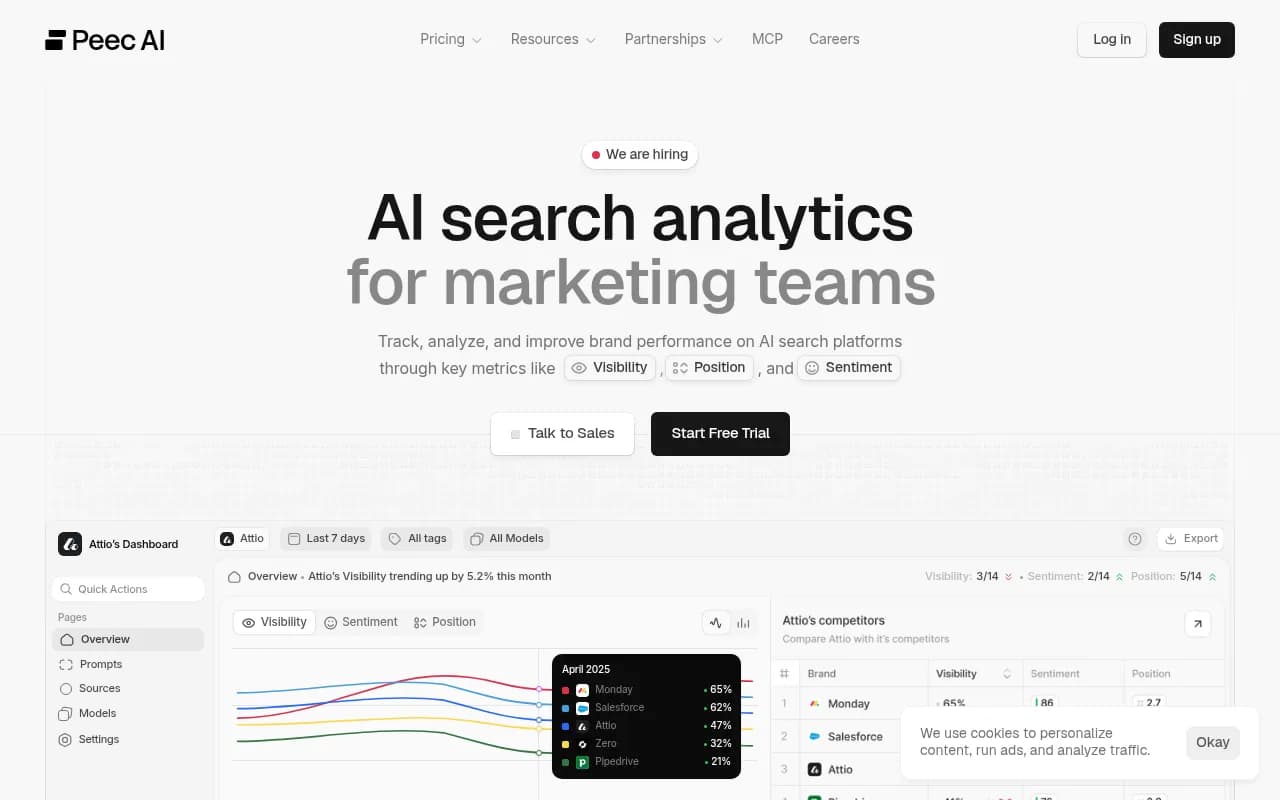
A few notes on that table. Peec's pricing shifted during 2026 from a €89 euro-denominated entry point to a $80 USD Starter tier with unlimited users, daily tracking, and 3 models. The category median for AI visibility tools sits around $89/month, which puts Scrunch's $250 entry at nearly 3x the middle of the market.
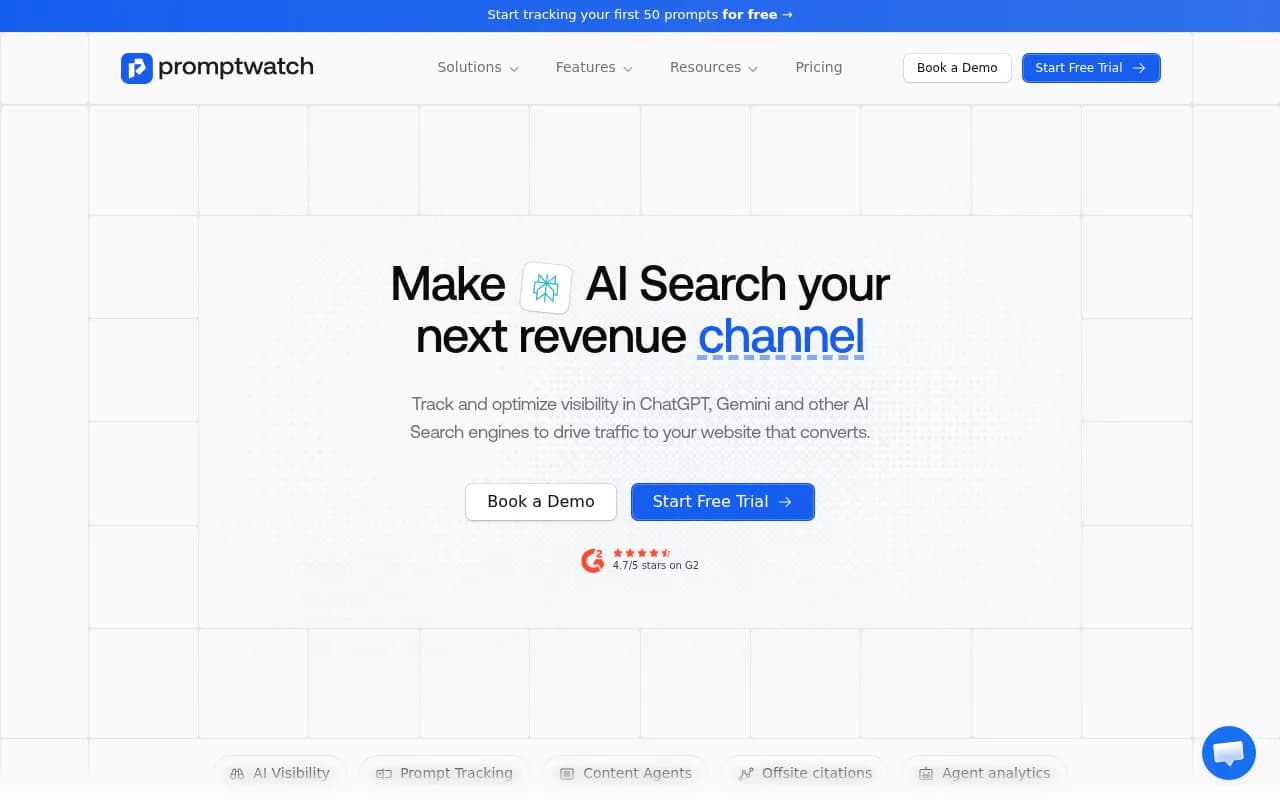
For teams that want monitoring and execution in one place, Promptwatch starts at $95/month with all LLM tracking included even at the entry tier, and its Professional plan at $245/month sits just under Scrunch's Core price while adding automated content generation, crawler logs, and CMS publishing. The philosophical difference is straightforward: Scrunch's Core is a monitoring product, while Promptwatch's agents plan, write, and publish optimization work for you.
If your budget is tighter and monitoring is all you need, Otterly.AI's $29 Lite tier and Peec's $80 Starter are honest options. If you're an agency, Peec AI with unlimited users and multi-project dashboards avoids the seat-counting exercise entirely.
And if you want the full lay of the land, the GEO software directory at bestgeosoftware.com maintains a current catalog of platforms in this category, which is worth a browse given how quickly new entrants appear.
When Scrunch is still the right call
None of this makes Scrunch a bad product. It doesn't. The multi-engine monitoring is genuinely broad at the Enterprise tier, the site diagnostics workflow is one of the more thoughtful implementations in the category, and the Agent Experience Platform (content delivery optimized for AI agents) is an interesting bet on where search is going. Since June 2026 it's also a Sitecore company, which matters if you're already in that ecosystem or need the procurement confidence a large vendor provides.
Scrunch makes sense when:
- You're an enterprise or large agency with a budget that makes seat fees irrelevant
- You need SSO, SOC 2-grade security review, and a dedicated account team
- Your buyers are spread across many engines, making 9-engine coverage worth the custom quote
- You want monitoring depth and are comfortable running execution in-house
It makes less sense when:
- Your team is 8+ people and seat fees start compounding
- Your audience concentrates in the four Core engines anyway
- You want the tool to help fix visibility gaps, not just report them
- Your monthly budget for this is under $300 all-in
On that last point about execution: the most common practitioner complaint about Scrunch isn't the price, it's that the tool tells you competitors are beating you without explaining how, and stops at "track these prompts" rather than "change these elements." If that gap is what drove you to research pricing in the first place, weigh it heavily. A cheaper tracker with the same limitation just disappoints you more slowly.
How to evaluate before you commit
Given how much pricing churned in 2026, a little process goes a long way:
-
Verify pricing on the vendor's live page. Scrunch's own site is the only reliable source, and even it has A/B-tested different structures this year. Confirm what you're actually served before comparing anything.
-
Price your real team, not the sticker. Multiply your seat count by the per-user fee before comparing plans. A $250 plan for a 12-person team is a $425 plan.
-
Match engines to your audience, not to the vendor's list. Check your analytics for where AI-referred traffic actually comes from. Paying for nine engines when your buyers use two is waste; getting four when your buyers use six is a blind spot.
-
Run the free trials against the same prompt set. Scrunch offers 7 days with no card. Several competitors do the same. Track identical prompts across tools for a week and compare what each surfaces.
-
Ask what happens after the dashboard. Before signing anything, get a concrete answer to: what does this tool tell me to change, and does it help me change it? That answer separates $250 well spent from $250 burned.
If you want help running the full program rather than just licensing a tool, 1001 SEO Media (the agency that publishes this site) handles GEO and AI search visibility work end to end, from technical optimization to content that gets cited in ChatGPT, Perplexity, and Google AI Overviews.
Frequently asked questions
How much does Scrunch AI cost in 2026?
The self-serve Core plan is $250/month for brands and $500/month for agencies. Enterprise is custom-priced for both. Earlier 2026 pricing pages showed a Starter/Growth ladder that has since been retired, so ignore any review citing $300 Starter or $417 Growth plans.
Does Scrunch AI charge per user?
Yes. Core includes 5 user licenses, and additional users cost $25/month each. A 15-person team pays $500/month in total before any Enterprise features.
Is there a free trial?
Yes, Core has a 7-day free trial with no credit card required. Enterprise requires a sales conversation.
What's the cheapest good alternative to Scrunch AI?
Otterly.AI starts at $29/month for basic tracking. Peec AI starts at $80/month with unlimited users, and Promptwatch starts at $95/month with all LLM tracking included. All three cost less than Scrunch's $250 entry point.
Why did Scrunch's pricing change so much in 2026?
Scrunch A/B-tested multiple packaging structures during the year, including a seven-engine Starter/Growth ladder that ran alongside the Core plan for a while. The company was acquired by Sitecore in June 2026, and enterprise-first positioning (fewer self-serve tiers, more custom quotes) appears to be the direction. Expect the current Core/Enterprise structure to be more stable, but verify on scrunch.com before budgeting.