Key takeaways
- SEO poisoning is a security attack: criminals rank malicious pages so searchers land on malware or fake login pages. The victims are the people who click.
- Negative SEO is sabotage: someone tries to drag down a competitor's rankings with spam links, scraping, or hacking. The victim is the targeted site owner.
- Parasite SEO is piggybacking: someone ranks content on a high-authority host site. Google calls the host-side version site reputation abuse. The host is the one who gets penalized.
- Which hurts you depends on who you are. Searchers and IT teams worry about poisoning. Site owners worry about negative SEO. Publishers who rent out their domain should worry about parasite SEO.
- Google's EEA enforcement of the site reputation policy changed on August 30, 2026, so the answer now depends partly on where the searcher is.
Why these three get confused
All three involve manipulating search results. All three sound like something a shady SEO would do. And all three get tossed around in forum threads as if they were synonyms.
They are not. The quickest way to separate them is to ask two questions. Who is the attacker, and who ends up hurt?
| Term | Who does it | Who gets hurt | Main goal | Primary fix |
|---|---|---|---|---|
| SEO poisoning | Cybercriminals | Searchers, IT teams, spoofed brands | Malware, credential theft, scams | Security controls, endpoint detection, download hygiene |
| Negative SEO | Competitors or bad actors | The targeted site's rankings | Lower a rival's visibility | Monitoring, cleanup, security hardening |
| Parasite SEO | Marketers or affiliates, with a host that allows it | The host site (penalty), search quality | Borrow authority to rank fast | Content governance, ownership audits |
The rest of this guide goes through each one, then helps you work out which deserves your attention.
SEO poisoning: search as a malware delivery channel
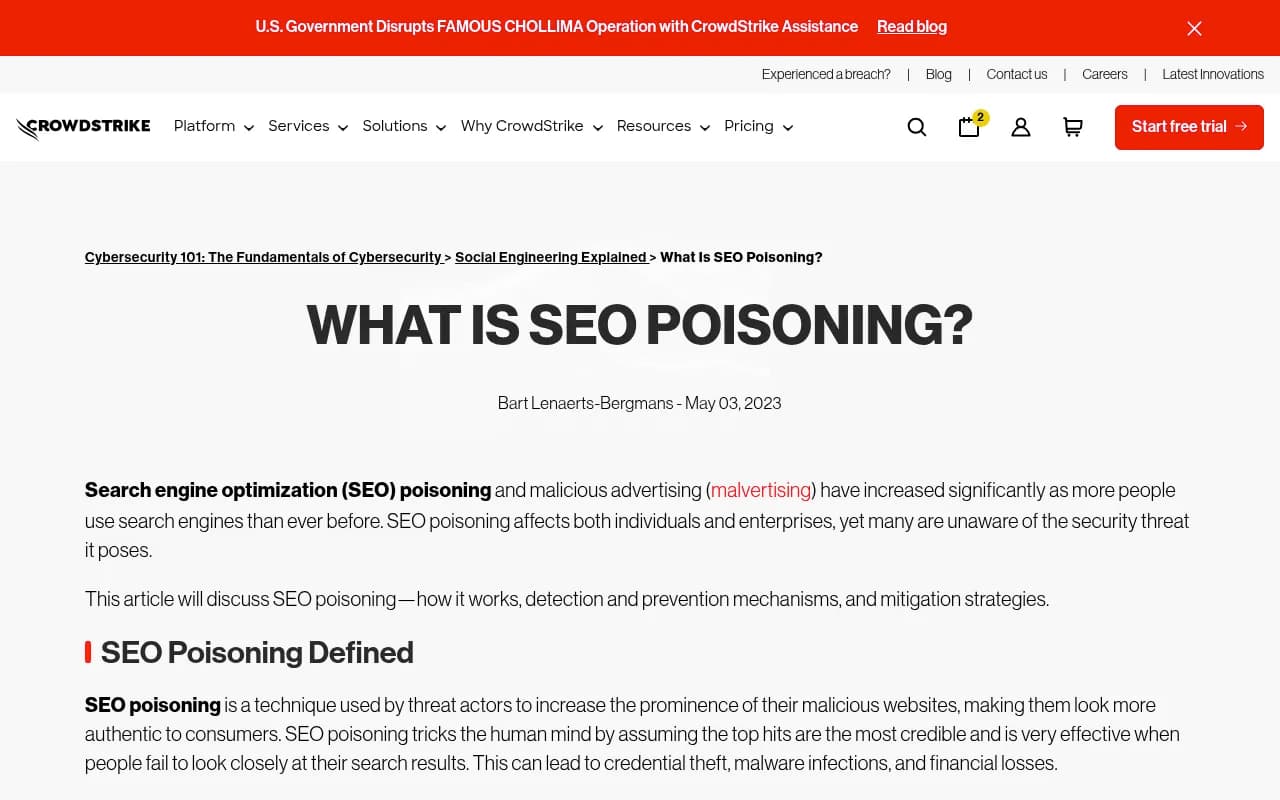
SEO poisoning is a security term, not a marketing one. Attackers manipulate rankings so a malicious page sits near the top of results for something people actually search for: a software download, a technical doc, a login page. The searcher clicks what looks like a trusted result and lands on a fake download, a credential-harvesting form, or a malware dropper.
Vectra AI describes it as a search-driven social engineering technique. The key difference from phishing is direction. Phishing pushes a lure into your inbox. SEO poisoning waits for you at the moment you need something. You started the interaction, you are in a hurry, and you assume the top result got vetted.

What it looks like in practice
Vectra reports that a single campaign aimed at IT administrators searching for PuTTY and WinSCP downloads compromised more than 8,500 systems, and cites ReliaQuest on a 60% rise in SEO poisoning attacks over six months. It also cites PurpleSec on campaigns that compromised around 15,000 sites. I could not independently re-verify those secondary figures, so treat them as reported numbers rather than settled benchmarks. The pattern, though, matches what other security vendors describe.
The techniques are borrowed from black hat SEO. CrowdStrike lists four:
- Keyword stuffing, to mislead ranking algorithms
- Cloaking, showing crawlers clean content and real users something else
- Ranking manipulation through fake clicks
- Private link networks that imitate real link building
Attackers also hack legitimate websites and inject content, which gives the malicious pages borrowed trust. Vectra's examples include BadIIS malware serving benign content to crawlers and WordPress plugin vulnerabilities used as an entry point.
How it differs from its cousins
Vectra's comparison table is useful here, because security teams often lump these attacks together:
| Technique | Where the victim meets it | Core method |
|---|---|---|
| SEO poisoning | Search results page | Ranking manipulation, cloaking, compromised sites |
| Phishing | Inbox or messaging app | Social engineering in the message |
| Malvertising | Search ads, display networks | Ad network abuse, redirects |
| Typosquatting | Direct navigation or search | Lookalike domains |
Campaigns chain these. Poisoning can bring the visibility, malvertising can add traffic, and a typosquatted domain can be where credentials finally get stolen.
Who it hurts
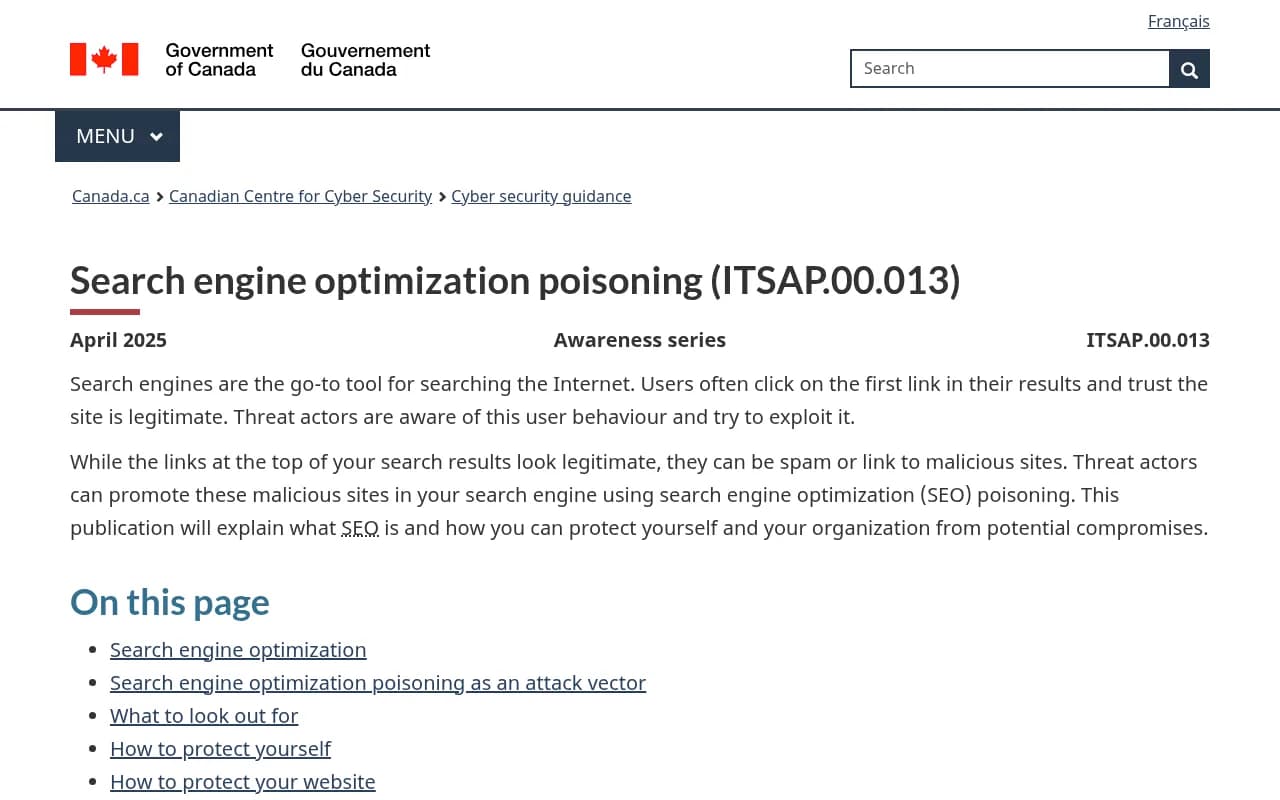
Mostly the person who clicks, and the organization that person works for. But there is a second victim that SEO people tend to forget: the legitimate brand being spoofed. The Canadian Centre for Cyber Security notes that spoofed sites can suffer lower search ranking, reduced traffic, and damage to brand integrity.
Defending against it
Because the lure changes daily, trying to predict which search result is bad is a losing game. Vectra's argument, which I find convincing, is to detect the behavior that follows a successful lure: a search-referred download, abnormal execution, persistence, odd identity activity. Practical steps:
- Control where software comes from. IT admins should download tools from vendor sites or internal repositories, not from whatever ranks first.
- Run endpoint detection and response. CrowdStrike points to EDR as a way to spot indicators of compromise and trace a malicious file's entry.
- Use digital risk monitoring to catch new lookalike domains as soon as they are registered.
- Train people to distrust links that look too good to be true or unrelated to the page, as the Canadian Centre advises.
- If you run a website, patch plugins and CMS software. Hacked sites are raw material for these campaigns.
Negative SEO: sabotage aimed at your rankings
Negative SEO is when someone deliberately tries to damage another site's search performance. Typical tactics people describe include blasting a site with spammy backlinks, scraping and republishing its content, hacking the site to inject spam, and filing fake removal requests.
Here is where I have to be careful, because this is the most contested of the three. Whether negative SEO actually works against well-maintained sites is an open argument.
What Google says
Google's line, as relayed by secondary sources, is that most sites do not need the disavow tool, and that a spike in suspicious backlinks is not proof of an effective attack. I have not verified that against Google's own documentation, so check there before you act on it. Marie Haynes' analysis of SpamBrain suggests Google tends to neutralize unnatural links rather than penalize sites for them. She says it is imperfect but keeps learning.
What practitioners say
Site owners in Google's help forum describe repeated ranking drops after link attacks, and some report that disavowing restored rankings. That is anecdotal and conflicts with Google's position. There is also a long Reddit thread in r/TechSEO arguing that Google enables negative SEO attacks, though I would treat any single analysis like that with caution until you have checked its data.
My read: a mature site with a clean link profile and decent authority probably shrugs off random spam links. A small, fragile, or already-penalized site is a different story. And the non-link vectors, hacking and content injection, are less about SEO theory and more about plain security failure. A hacked site really does lose rankings.
Who it hurts
The targeted site owner. It is the opposite of poisoning in one sense: the attacker does not care about your visitors, only about your rankings.
What to do
- Check Google Search Console for manual actions and security issues before assuming an attack.
- Watch your backlink profile for sudden unnatural spikes. Tools like Ahrefs and Semrush can flag these.

- Keep a baseline. If you do not know what normal looks like, you cannot tell an attack from noise.
- Harden the site: strong credentials, updated plugins, file integrity monitoring.
- Use disavow sparingly and only when you have clear evidence of manipulative links. Do not disavow because a number went up.
- Rule out ordinary causes first, like a core update, a technical regression, or lost links.
Parasite SEO: renting someone else's authority
Parasite SEO is ranking your content on a third-party site that already has strong search signals. Think of a coupon page on a university subdomain, a casino roundup on a medical publisher's site, or a payday-loan review section on an educational domain. The content ranks not because it is good but because the host's reputation lifts it.
There is a terminology wrinkle worth knowing. Siteimprove draws the line this way: parasite SEO is the tactic, and site reputation abuse is Google's enforcement term for what the host publisher did by renting out that authority.
Google's policy
Google's definition, as reported by Search Engine Roundtable, covers third-party content published on a host site primarily because of the host's ranking signals, which came mainly from its first-party content, with the goal of ranking better than the content could alone. Google's own examples include an educational site hosting third-party sponsored payday-loan reviews and a medical site hosting a low-quality third-party best-casinos page.
The timeline:
- March 2024: the policy arrives with the core and spam update.
- January 2025: enforcement begins in Europe.
- August 30, 2026: the EEA change takes effect.
The EEA split
This is the new part. After discussions with the European Commission, Google announced different outcomes depending on where the searcher is. It is the first time Google has applied different spam-policy outcomes by searcher location.
| Outside the EEA | Inside the EEA | |
|---|---|---|
| Manual action effect | Demotes the affected section of the host site | No ranking impact |
| What Google may do instead | n/a | Separate the section in its systems so it eventually ranks on its own merits |
| Site owner notified in Search Console | Yes | Yes |
| Previous manual actions | Remain | Lifted |
| Reconsideration | Standard process | New process with a committed short response time, plus CEDR mediation |
Two details matter. Separation is not automatic, and it does not immediately strip the section of the main site's signals. And publishers do not need to noindex content that received a manual action outside the EEA. Google also says European users are no less frustrated by parasite SEO and that it stands by the policy. Read that as: the tactic is still unwelcome in Europe, but the enforcement mechanism is different.
Google also trimmed its list of examples and added four site reputation abuse factors, which it says are not a checklist. It added likely and unlikely examples too. An unauthored affiliate article not integrated into the publication is likely to draw action. An authored, original affiliate article from a freelancer is unlikely to.
What is not automatically a violation
Siteimprove notes that syndication with real editorial control, clearly first-party sections, and third-party content with genuine user value (reviews, forums) are not automatically violations. Subdomains are not a safe harbor, though. Moving the spam to a subdomain does not fix it.
Who it hurts
The host, mainly. A site that rents out its domain risks a manual action that demotes the affected section outside the EEA. Searchers also lose out, since they get thin content ranking above better pages. The parasite itself, the third party, simply moves on to the next host.
It is worth noting that a casual forum comment describes parasite SEO as posting on web 2.0 and social sites, which mostly carry nofollow links. That is a looser use of the term than Google's policy, which is about hosted content that benefits from the host's ranking signals. When someone says parasite SEO, ask which meaning they intend.
What to do if you are the host
Siteimprove's remediation sequence is sensible:
- Check Search Console for manual actions first.
- If there is none, line up the traffic drop with known volatility windows.
- Audit content models and ownership seams, meaning anywhere third parties can publish at scale, rather than hunting individual pages.
- Remember Google's bar: stop the behavior, do not shuffle URLs.
- Know that actions can hit a directory, subdomain, or template footprint, and that one partnership can hit a whole content segment.
Which one hurts you?
It depends on your seat.
| If you are... | Biggest worry | Why |
|---|---|---|
| An IT admin or security lead | SEO poisoning | Your staff search for tools and click top results |
| A site owner with a small, young site | Negative SEO (plus hacking) | Less authority to absorb spam, and hacked sites do lose rankings |
| A brand with a recognizable name | SEO poisoning (as the spoofed party) | Fake download pages can borrow your name and erode trust |
| A publisher with partnerships, sponsored sections, or affiliate programs | Parasite SEO / site reputation abuse | Your own domain is what gets demoted |
| A marketer thinking about ranking on someone else's domain | Parasite SEO risk | Short-term gains, plus exposure when policy enforcement tightens |
In raw severity, SEO poisoning is the most dangerous, because it ends in compromised machines and stolen credentials rather than a traffic dip. Negative SEO is the most overhyped and the most disputed. Parasite SEO is the one with the clearest, best-documented policy and the clearest penalty path.
Diagnosing a sudden problem
If something looks wrong, sort it before you panic:
- Fake pages impersonating you, or reports of users getting infected after searching for your product: treat it as poisoning. Involve security and report the malicious pages to the search engine.
- A traffic drop with a surge of odd backlinks: check for manual actions, compare against a core update timeline, and be skeptical before blaming an attack.
- A traffic drop on a section where third parties publish: look at site reputation abuse first.
- Strange pages, redirects, or injected links on your own site: you have been hacked, which can feed both negative SEO and poisoning campaigns.
Does this matter for AI search?
A little, and it is worth keeping the claim modest. Poisoned and parasite pages can end up in the sources AI assistants pull from, and AI answers also lean on different sources than classic rankings. If you want to see where your brand shows up in ChatGPT, Gemini, and Perplexity, and whether odd third-party pages are being cited alongside you, tools like Promptwatch can track that. Promptwatch's citation data shows how heavily AI models draw on third-party sites, which is a reason to monitor what is being said about you off your own domain.

For a wider look at tools in this space, the GEO software directory at bestgeosoftware.com is a reasonable place to start.
Summary
SEO poisoning is a cyberattack that uses search rankings as a delivery channel. Negative SEO is an attempt to sabotage a rival's rankings, and how well it works is argued over. Parasite SEO is the borrowing of a host's authority, and Google punishes the host through its site reputation abuse policy, with enforcement that changed for the EEA on August 30, 2026.
If you remember one thing: ask who is the attacker and who pays the price. The answer tells you whether you need a security team, a link audit, or a content governance review.