Key takeaways
- Slate, Search Party and Promptwatch are not the same kind of product. Slate is positioned as an AI-search-first content operations platform, Search Party as an agency-focused tracking platform, and Promptwatch as a full tracking-plus-execution platform.
- Public information on Slate and Search Party is thin. Where I couldn't verify pricing, engine coverage or client limits, I say so instead of guessing.
- For agencies, white-label reporting, project limits and whether the tool can ship fixes matter more than the monthly sticker price. Tool cost is small next to a retainer.
- If you mostly need client-facing tracking dashboards, Search Party is worth a demo. If your bottleneck is producing content, look at Slate. If you want crawler logs, traffic attribution and publishing in one place, Promptwatch is the broadest of the three.
- Every vendor-published comparison, including the ones I cite, ranks its own product first. Treat them as inputs and run a trial on your own client prompts.
Why this comparison needs a disclaimer
Most "X vs Y vs Z" pages in this category are written by one of the three vendors, and you can tell. The comparison table is always shaped so that the author wins. This one has a similar problem, so here is the plain version: 1001 SEO Media publishes this site and uses Promptwatch as its own GEO platform. That is a bias. I'll try to offset it by being explicit about what is verified and what isn't.
Here is what I could verify. Search Party has issued a press release describing itself as a GEO platform to "track, analyze, and control" brand visibility in AI answers, with a feature called Response Receipts. The "most robust" claim in that release is the vendor's own. Slate shows up in one third-party roundup as the editorial pick for B2B SaaS teams that need analytics plus content execution, with agent-based content workflows and direct Webflow and WordPress publishing. That roundup is published on Slate's own blog, so it is not independent. I found no verified pricing for either one.
One naming warning: searchparty.be is a different company, a Belgian SEO, GEO and automation agency. Don't confuse it with the Search Party platform.
The three tools in one table
| Slate | Search Party | Promptwatch | |
|---|---|---|---|
| Positioning | AI-search-first content operations | Agency-focused AI visibility tracking | End-to-end tracking and optimization |
| Core strength | Content workflows, publishing to Webflow and WordPress | Tracking, citation analysis, client focus | Crawler logs, traffic attribution, Content Agent, Action Board |
| White-label | Unverified | Listed as supported in one vendor comparison | White-label workspace, client portal, scheduled PDF reports |
| Crawler logs and visitor analytics | Unverified | Shown as absent in one vendor comparison | Yes, IP-verified logs and visitor analytics |
| Publishes content to CMS | Yes (Webflow, WordPress, per its own blog) | Agency-delivered content, per one comparison | Webflow, Framer, WordPress |
| Public pricing | Not found | Not found | From $95/mo, agency plans from $199/mo |
| Best for | Small content teams needing execution | Agencies that want a tracking layer | Agencies that want to measure and fix |
Treat the Slate and Search Party columns as "what the vendors and secondary sources say," not as audited facts.
Search Party: the agency-shaped tracker
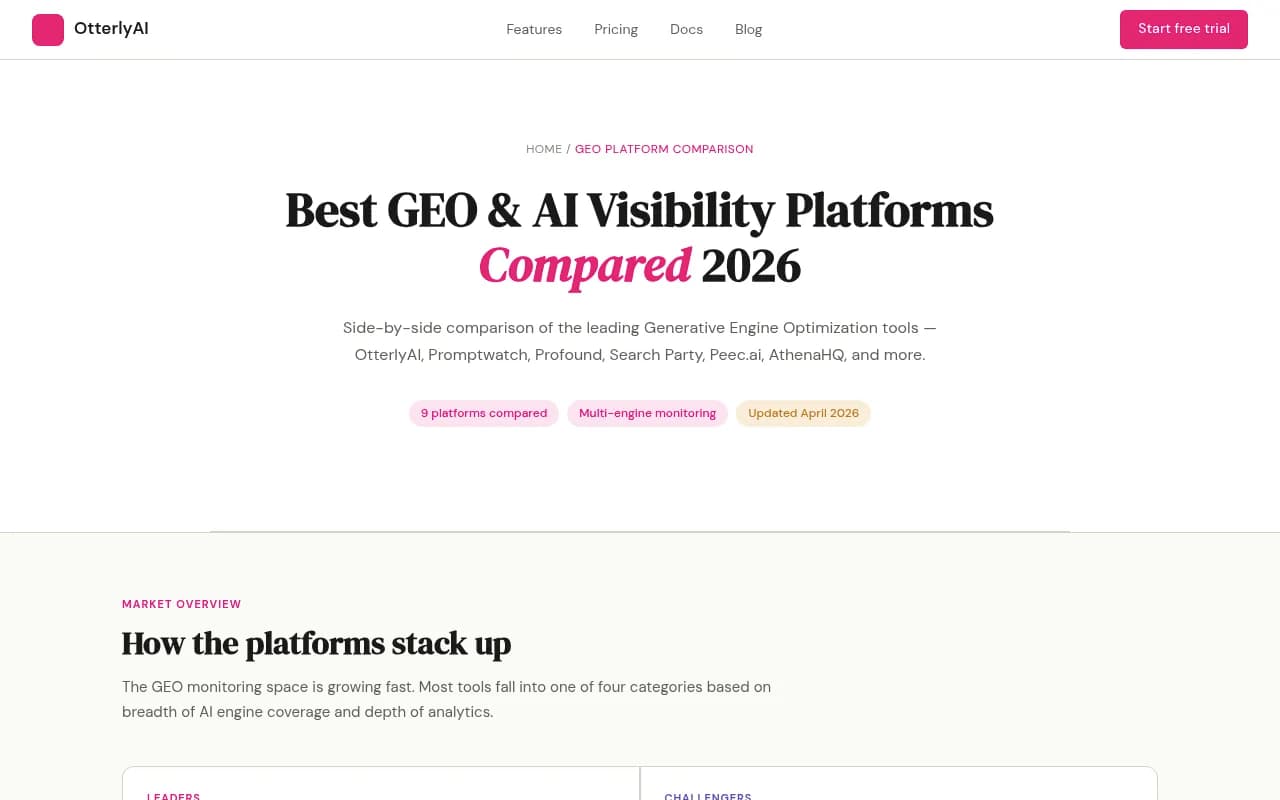
Search Party's pitch is built around agencies. In the Otterly-published comparison it lands as a challenger with solid tracking and an agency focus: prompt tracking, citation tracking and multi-engine coverage are all checked, competitor monitoring is partial, and crawler logs and visitor analytics are absent. The content tools column says "Agency" for optimization and generation, which I read as content being delivered through an agency relationship rather than generated inside the software. The same table shows white-label support and API access.
That comparison page is published by a competitor (Otterly), so it's not neutral either. Still, the shape is believable: a product that is strong at measuring and presenting, and lighter on diagnosing why you're invisible.
Where it likely fits: agencies that already have a content team and want a reporting layer to show clients how they appear in AI answers. Where it likely doesn't: teams that need to prove traffic and conversions from AI, since there are no visitor analytics shown in that comparison.
Questions to ask on a demo:
- How many client workspaces are included, and what happens when you add the 11th?
- Is the white-label output a branded PDF, a client login, or both?
- Are responses collected from real consumer interfaces or from APIs? The answers can differ.
- Can you export raw data, or only view dashboards?
Slate: content operations first

Slate describes itself as an AI-search-first content operations platform. Its own blog claims it surfaces content opportunities from real prompt data, runs agent-based workflows for researching, writing, optimizing and refreshing content, and publishes straight to Webflow and WordPress. The same article recommends Slate for teams of one to three people covering content and SEO, and for regulated industries, alongside Profound.
I can't tell you more than that with confidence. I couldn't confirm its engine coverage, its crawler log support, its agency features or its pricing from a source that isn't Slate. If you're an agency with 15 clients, the unknowns are the whole question: does it have multi-client workspaces, white-label reports, per-client brand voice controls? Ask before you trial.
If you land on Slate because the thing slowing your agency down is producing and refreshing pages, that is a reasonable instinct. Execution is where most monitoring tools fall short. Just don't assume agency readiness because the marketing is execution-flavored.
Promptwatch: tracking plus the fix
Promptwatch is the one I can describe in the most detail, partly because it publishes a lot and partly because 1001 SEO Media uses it. Treat that as a disclosure, not an endorsement of every claim.

The core idea is that tracking is the cheap part. It monitors real interfaces of ChatGPT, Google AI Overviews, AI Mode, Gemini, Perplexity, Copilot and others, then connects that data to IP-verified AI crawler logs, visitor analytics and a content gap analysis. The Content Agent writes and publishes to Webflow, Framer or WordPress, and the Action Board turns findings into a prioritized to-do list. Published pages are then tracked for crawls, citations and clicks.
For agencies the relevant pieces are:
- A white-label workspace and client portal, plus scheduled white-label PDF reports.
- Agency plans with unlimited projects and prompts, 10 seats and all models: Kick-off at $199/mo, Growth at $399/mo, Scale at $799/mo.
- Reddit, YouTube and LinkedIn citation reports, which matter when a client asks why a competitor keeps getting named.
- Agent Chat and a hosted MCP server for pulling client data into your own workflows.
It's worth being fair about the weak points. The Otterly-published table lists Promptwatch's competitor monitoring as limited and shows older information on crawler logs, so that page is out of date or biased, and the Promptwatch-published page says the opposite. That's the problem with vendor comparisons. Another reviewer described the demo UI as feeling dated, and one roundup said it's more technical than marketing-first tools. Breadth has a cost: there's more to learn than in a simple tracker. Confirm current plan details at promptwatch.com/pricing.
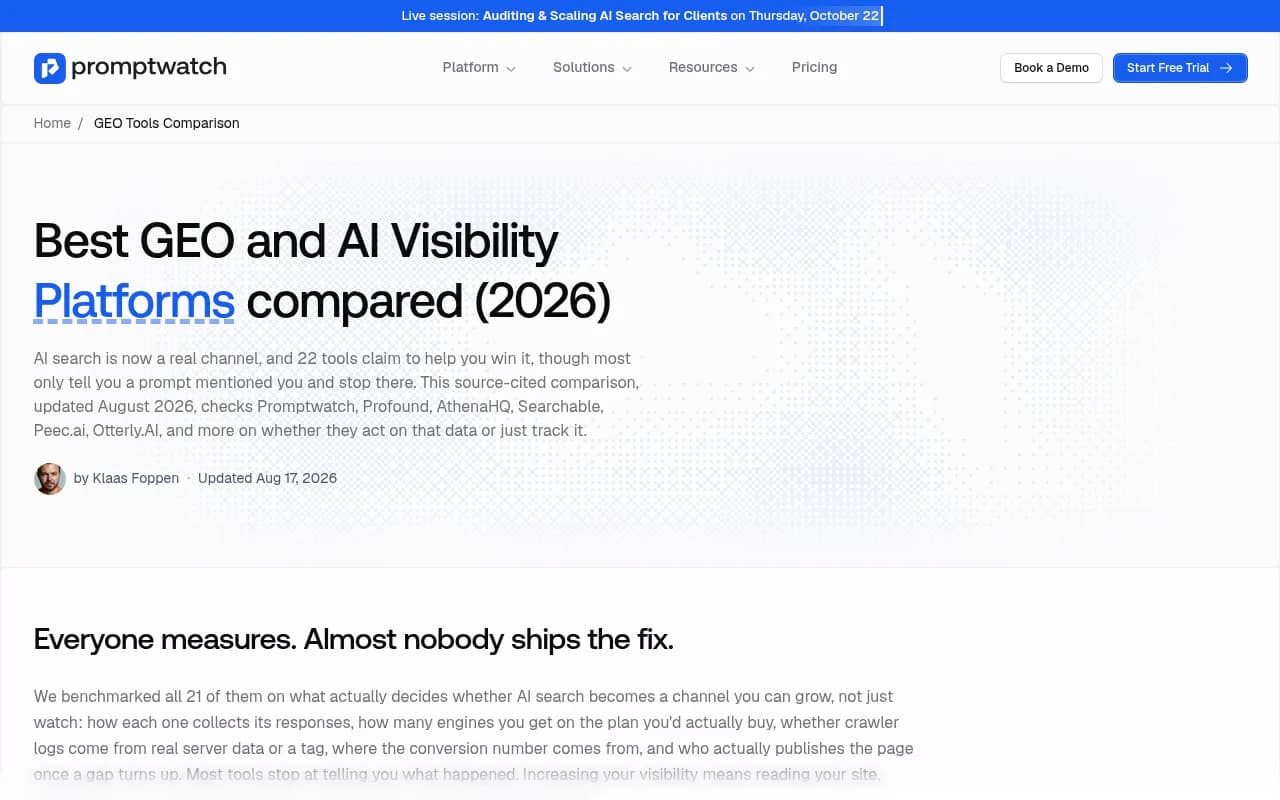
The screenshot above is Promptwatch's own comparison page. Read it with the same skepticism you'd apply to the Otterly one below, which ranks Otterly first.
What agencies should actually compare
Price is the least interesting axis. One third-party roundup puts agency-tier GEO platforms at roughly $99 to $780 a month, and argues that white-label, seats and engine coverage matter more than the price, since the tool cost is small next to the retainer. That source sells a competing tool, but the logic holds. Market guides put GEO retainers at $1,500 to $5,000 a month for small businesses and $5,000 to $25,000 for medium-sized ones. A $400 tool that saves ten hours a month is cheap. A $150 tool that can't white-label is expensive.
So evaluate on these:
| Question | Why it matters | What to look for |
|---|---|---|
| How are responses collected? | API outputs and real interfaces can differ in answers and citations | Real-UI capture, per country |
| Client scaling | Per-domain pricing breaks agency margins | Unlimited or pooled projects, seats |
| White-label | Clients want your brand, not the vendor's | Client portal, branded PDFs |
| Proof of impact | Mentions alone don't renew retainers | Visitor analytics, crawler logs, conversion data |
| Execution | Reports don't fix pages | Content publishing, action lists |
| Data portability | You'll switch tools eventually | API, CSV export, MCP |
On that grid, Search Party is a candidate for the first, third and partly fourth rows. Slate is a candidate for the fifth. Promptwatch is the only one of the three with public evidence for rows four, five and six together, though I'd still verify with a trial.
Context: why citations per response vary
A practical reason to care about collection method: AI engines cite very different numbers of sources. Promptwatch Data's Average Sources Per Response report shows ChatGPT citing about 5 sources per web-search answer, Google AI Overviews about 10, and Perplexity almost exactly 10 every day, while Copilot swung from under 2 to nearly 17 within a few weeks. A tracker that treats all engines the same, or relies on a single sample per prompt, will give you noisy numbers. Ask how each vendor handles repeat sampling.
Also, ChatGPT's own behavior shifts quickly. Promptwatch's data on ChatGPT's site: operator change shows ChatGPT jumping from about 0.4% to about 17% of fanout queries on August 8, 2026. A platform that shows fan-outs lets you see this. One that only shows mention rates won't tell you why your numbers moved.
Which one should you pick?
Pick Search Party if you are an agency whose content process is already solid and you need a client-facing tracking layer. Demo it, get the client limits and pricing in writing, and check whether the lack of crawler logs in that comparison still applies.
Pick Slate if you are a small team where writing, refreshing and publishing is the bottleneck, and you're comfortable validating agency features yourself. Its documentation is thin enough that you should run a real client project through the trial.
Pick Promptwatch if you want one system covering tracking, crawler logs, AI traffic attribution, content gaps, content publishing and white-label reporting, and you accept a larger surface area to learn. Agency plans start at $199 a month and there's a 7-day free trial on the monthly Kick-off and Growth plans.
And consider that you may not need to choose one. A plausible setup is a tracker for reporting and a separate execution tool, which is exactly the split the Slate blog itself recommends for teams already living in Semrush or Ahrefs.
Other places to look
If none of these fit, the GEO software directory at bestgeosoftware.com lists dozens of alternatives. Profound, Scrunch and Otterly are the names that come up most in agency conversations.



Whatever you shortlist, run the same 25 prompts for one real client in each tool for two weeks, then compare what you could act on. That tells you more than any comparison page, including this one.