Key takeaways
- Entry-level multi-engine AI visibility tools now run $95-$495/month per client, and agencies often stack two or three tools (monitoring, content, crawler logs) to cover the full job, pushing real tool cost into the $400-800/client range
- Profound's agency add-on model charges $399/month per client workspace on top of a base fee, so cost scales linearly with every client you add -- a very different economics than a flat per-seat tool
- Demand Local's agency benchmarks put tooling at $500-$2,500/month per client inside a delivery-cost stack that also includes labor, management, and overhead
- The fix isn't finding a cheaper tool, it's restructuring the retainer: separate one-time audit fees from monthly execution fees, and pick platforms where tool cost doesn't multiply by client count
- Target gross margins of 45-60% on GEO retainers; anything below 30% after tooling and labor should be renegotiated or dropped
Why GEO tooling costs blew up agency math
A year ago, most agencies bolted "AI visibility" onto an existing SEO retainer as a slide in a deck. Now it's a line item with a real invoice behind it, and that invoice is bigger than anyone budgeted for.
Here's the problem in plain numbers. Profound's agency model charges $399 a month per client workspace, stacked on top of an agency base fee. Run that across ten clients and you're at roughly $4,000/month in tool cost alone, before a single analyst has touched a report. Peec AI's agency tiers run $245 to $795/month depending on prompt volume and client count, which is more reasonable per-client but still adds up fast once you need daily tracking across several engines. Ahrefs Brand Radar, if you want full-platform coverage plus the required base Ahrefs plan, lands you at $828-$1,148/month realistically. Even Semrush's AI Visibility Toolkit, the "cheap" option at $99/month standalone, only covers two engines and caps regions at six.
Demand Local, an agency-focused consultancy, puts total GEO tooling cost at $500-$2,500 per client per month inside a full delivery-cost model that also factors in labor, QA, and account management. That range lines up with what agencies are actually reporting: somewhere between $400 and $800 a month in tool spend per client once you cover more than one engine and more than a token number of prompts.
The reason this is a new problem, not a recurring one, is structural. ChatGPT cites around 5 sources per web-search response, Google AI Overviews and Perplexity cite closer to 10, and Microsoft Copilot's citation count has swung from under 2 to nearly 17 within weeks as Microsoft re-architects its retrieval system, according to Promptwatch's data on average sources per response. That's a much smaller, more volatile set of citation slots than the ten blue links of classic SEO, and it means tools need to check far more often, across far more engines, just to catch a change. More checking means more credits. More credits means a bigger bill.

What's actually driving the $400-800 figure
It helps to separate three different cost drivers that get lumped together as "the tool cost."
Per-client workspace fees
Some platforms charge a flat per-seat fee no matter how many clients you manage; others, like Profound, charge per client workspace. That second model is the one that breaks agency math, because tool cost scales directly with your roster. Add a client, add $399. Lose a client, you're still paying until the contract term ends. If you're pricing retainers at a fixed monthly fee regardless of client count, this structure quietly erodes margin every time you sign someone new.
Credit and prompt-volume systems
Peec AI and similar platforms sell credits, where one prompt tracked across one model for one day equals one credit. A client needing 30 prompts tracked daily across three engines burns through a credit allocation fast, and agencies routinely underestimate this when scoping. The minimum realistic allocation per client project on Peec AI's agency plans is around 900 credits, which sounds abstract until you realize that's roughly 10 prompts across 3 models, tracked daily, for a month. Competitive clients in crowded categories need more prompts, not fewer, which pushes the bill up exactly when the client is paying the most attention.
Multi-tool stacking
The real $400-800 range usually isn't one tool, it's two or three. A monitoring tool to track citations, a separate content tool to produce AEO-friendly pages, and sometimes a crawler-log tool to see whether AI bots are even reaching the site. Agencies that try to run this stack with point solutions end up paying for overlapping functionality across multiple vendors, which is where costs really balloon past what any single tool's pricing page suggests.
Tool cost comparison: what you're actually paying per client
| Tool | Entry price | What it covers | Scales with client count? |
|---|---|---|---|
| Profound | $399/mo per workspace (+ base fee) | ChatGPT, Perplexity, AI Overviews, 100 prompts | Yes, linearly |
| Peec AI (Agency Essential) | $245/mo | ~111 prompts, 3 client projects | Partially, via credit pool |
| Otterly.AI (Lite) | $29/mo | 15 prompts x 4 engines, daily | No published agency separation |
| Ahrefs Brand Radar (all platforms) | $699/mo (+ $129 base Ahrefs plan) | All tracked AI platforms | No, flat per domain |
| Semrush AI Visibility Toolkit | $99/mo standalone | ChatGPT + AI Mode only, 6 regions cap | No, flat per domain |
| Promptwatch | $95/mo (Essential) | Full engine coverage, crawler logs, content agents from one plan | No, flat per site, agency tiers from $199/mo |
A few patterns worth noting. Tools priced per client workspace (Profound) punish agencies that grow their roster. Tools priced on a flat per-domain or per-seat basis (Otterly, Semrush, Promptwatch) are more predictable at scale but may cap features you need, like region coverage or prompt volume, at lower tiers.
Promptwatch is worth a specific mention here because it addresses both cost problems agencies run into: the per-client scaling issue and the multi-tool-stacking issue. Its agency tiers start at $199/month and include unlimited projects and prompts with pooled response credits, rather than charging per client workspace, and it bundles monitoring, crawler logs, content generation, and CMS publishing in one platform instead of requiring three separate vendor contracts.

Don't skip Peec AI or Otterly for lighter engagements


If you're running a handful of small local clients who just need basic hygiene monitoring, Otterly's $29/mo Lite tier or Peec AI's Essential plan can be perfectly adequate and keep your delivery cost low enough to profitably serve smaller retainers in the $500-$1,500/month range. Save the heavier platforms for clients paying enough to justify them.
Four pricing models that actually absorb the tool cost
Demand Local's packaging research lays out four models agencies are using in 2026, and each one handles the tool-cost problem differently.
Tripwire audit
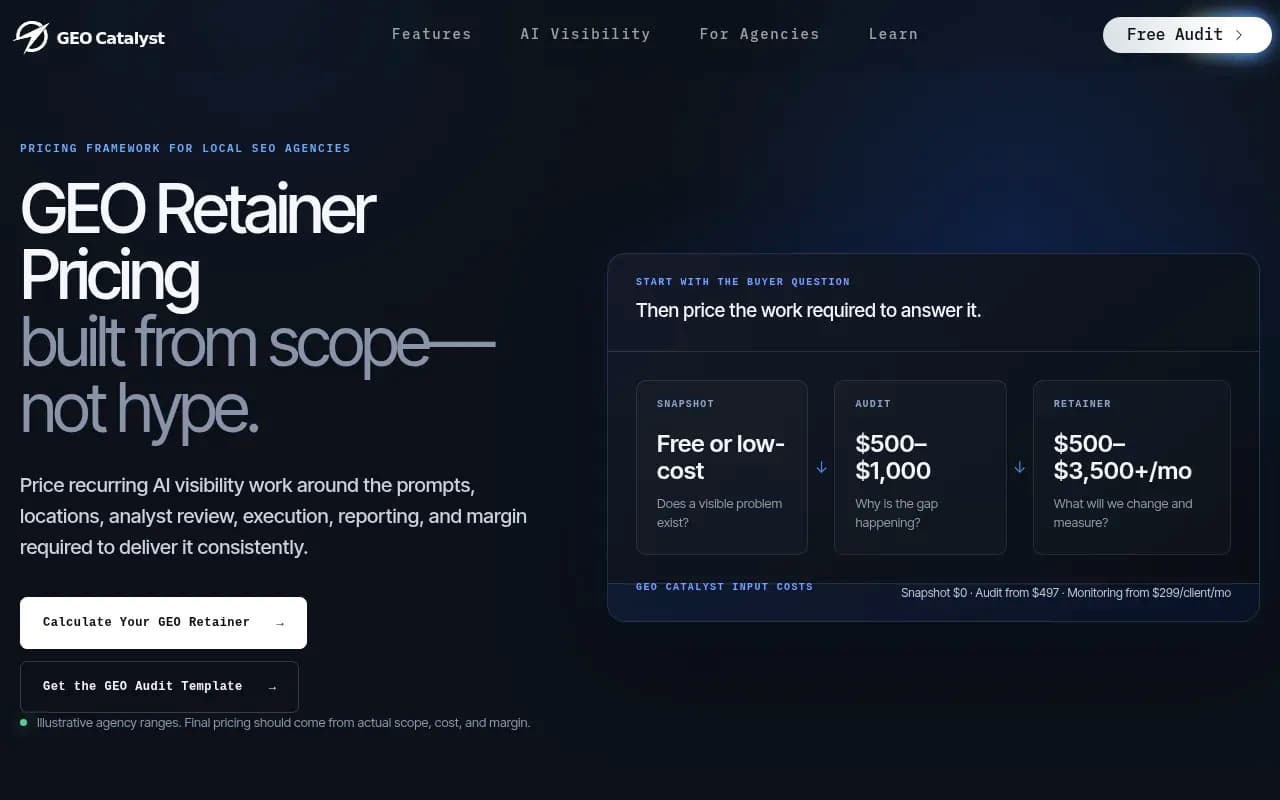
A one-time diagnostic, priced $1,500-$5,000, that shows a prospect exactly where they're invisible in AI answers. Tool cost here is minimal because you're running a single snapshot, not ongoing monitoring, so margins of 60-75% are realistic. This is also the best sales tool in the category. GEO Catalyst's framework calls this the "Snapshot" stage: free or low-cost, meant to prove a visible problem exists before you ask for real money.
Monthly retainer
The core recurring model, typically $3,000-$10,000+/month depending on scope. This is where tool cost as a percentage of revenue matters most. If your tool stack runs $600/month per client and you're charging $3,000, that's 20% of revenue before labor. Demand Local's target is to keep total tooling under 15% of GEO revenue and labor under 55%, which only works at retainer levels above roughly $4,000/month for a $600/month tool stack.
Hybrid SEO+GEO add-on
Instead of a standalone GEO retainer, you fold AI visibility work into an existing SEO contract as a 20-30% uplift. This spreads the tool cost across a retainer that already has healthy margin from traditional SEO work, which is often the most painless way to introduce GEO without scaring off a client with a brand-new line item.
White-label reseller
You pay a managed-service partner a wholesale rate (commonly around $2,000/month for a mid-tier engagement) and mark it up 40-60% to the client. Margins here are thinner, 35-50%, because someone else is taking the tool cost and labor cost off your plate, but it lets you launch a GEO offer with zero hiring and no tool contract of your own.
Building the actual math: a worked example
Take a mid-market client you're charging $5,000/month for a full GEO program.
Tool cost: say you're running a stack that covers monitoring across five engines, crawler logs, and monthly content generation. If you're using separate point solutions, that's realistically $600-$800/month once you add a monitoring tool at $245-$495 plus a content tool at $200-$300. If you're using a consolidated platform like Promptwatch's Professional tier at $245/month, which includes crawler logs and automated content generation in one price, you cut that stack cost by roughly 40-60%.
Labor: a contract GEO specialist runs $65-$75/hour per Hirelanz's benchmarks; budget 8-10 hours/month for a mid-tier client doing analysis, content review, and reporting. That's $520-$750 in labor.
Overhead and account management: GEO Catalyst's framework flags that interpretation, fulfillment, QA, revisions, and client reporting all sit on top of raw software cost, and this is routinely underestimated. Budget another $400-$600/month for account management time on a $5,000 retainer.
Add it up with the consolidated tool stack: $245 (tool) + $650 (labor) + $500 (overhead) = $1,395 in direct delivery cost against $5,000 revenue, a 72% gross margin. Swap in the fragmented three-tool stack at $700 instead of $245, and margin drops to 64%, still healthy but noticeably thinner for identical client output.
That gap, roughly eight points of margin, is the entire argument for consolidating onto fewer platforms rather than stacking point solutions. SEOforGPT's own calculator example shows a similar dynamic: an $8,000/month retainer nets a 79% margin once platform cost is kept to a single line item around $249/month rather than several.
Where agencies get the pricing wrong
The most common mistake is pricing the retainer off a competitor's rate card instead of your own delivery cost. GEO Catalyst's framework is blunt about this: platform cost is not the client fee. Interpretation, fulfillment, account management, QA, revisions, and overhead all sit on top of whatever you pay a vendor, and skipping that math is how agencies end up with $2,000/month retainers that lose money the moment a client asks for a second round of revisions.
The second mistake is bundling setup work into the monthly fee. SEOforGPT's calculator recommends charging a separate setup fee for prompt configuration, technical fixes, and analytics setup, and reserving the monthly fee for ongoing tracking, content, and reporting. Clients who see one flat number every month have no visibility into why their bill doesn't change even as scope creeps.
The third, and the one most relevant to the tool-cost problem specifically, is picking a monitoring platform before scoping the client. If you sign a client needing daily tracking across five engines and sixty prompts, then discover your tool's plan only covers twenty-five prompts on three engines, you either eat the upgrade cost silently or go back to the client mid-contract. Scope the prompt volume and engine coverage first, then match it to a tool tier, not the other way around.
A quick framework for picking your tool stack
For smaller clients (sub-$2,000/month retainers), a single lightweight tool like Otterly.AI or Peec AI's entry tier is usually enough; don't over-tool a client who isn't paying for daily multi-engine tracking.
For mid-market clients ($3,000-$8,000/month), a consolidated platform that bundles monitoring, crawler logs, and content generation keeps per-client tool cost in the $95-$245/month range rather than stacking multiple vendors into the $600-$800 zone.
For enterprise or agency-wide deployments, per-workspace models like Profound can still make sense if the client's budget supports the linear scaling, particularly if their SOC 2 and SSO requirements matter more than cost efficiency.
If you're running an agency book of business and want to browse the full category rather than default to the first tool you heard of, the GEO software directory at bestgeosoftware.com lists the current field with current pricing, which is worth a scan before you lock in a vendor contract for the year.
The bottom line for your 2026 retainers
The $400-800/client tool cost figure isn't a vendor pricing problem you can shop your way out of, it's a reflection of what it actually costs to track a brand's presence across five or more AI engines with enough frequency to catch real changes. The agencies making healthy margins on GEO in 2026 aren't the ones who found the cheapest tool. They're the ones who separated audit fees from retainer fees, priced retainers off their actual delivery cost rather than a competitor's rate card, and consolidated onto platforms that don't multiply cost by every client they sign.
Getting that math right is also, frankly, just good SEO agency practice applied to a newer channel. If your agency wants help building the content and technical work that actually earns AI citations, rather than just tracking whether you're getting them, that's a separate conversation from tooling, and it's one 1001 SEO Media has with agency partners regularly.