Key takeaways
- Product cards, carousels, and shopping panels look similar across ChatGPT, Google AI Mode, and Perplexity, but each pulls product data from a different pipeline, so optimizing for one doesn't automatically help you in another.
- ChatGPT's shopping results lean heavily on merchant feeds through the Agentic Commerce Protocol, Shopify Catalog data, and its own fallback search index; Google AI Mode runs on the Shopping Graph, a database of more than 50 billion listings refreshed in near real time.
- "GPT tags" like budget, premium, or streetwear are machine-assigned labels that correlate strongly with top-ranked product cards, 2.39% of rank-1 cards carry one versus 0.98% of lower-ranked cards, according to Profound's analysis.
- Ads inside ChatGPT's shopping and search responses went from zero to roughly 20-32% of citation-enabled responses between May and August 2026, per Promptwatch's ad-tracking data, so "organic" placement is getting crowded fast.
- Checkout mechanics differ by platform: ChatGPT is shifting toward merchant-controlled checkout, Google AI Mode uses Google Pay for its "buy for me" flow, and Perplexity leans on a PayPal-powered Instant Buy feature.
AI shopping has its own vocabulary now, and most of it didn't exist 18 months ago. If you work in ecommerce marketing, or you're just trying to figure out why your product shows up in one AI tool and not another, you need a shared language for this stuff. This glossary walks through the terms that actually matter in 2026, grouped by what they describe: the visual elements users see, the data infrastructure behind them, and the commerce mechanics that turn a chat into a sale.
The building blocks: what users actually see
Product card
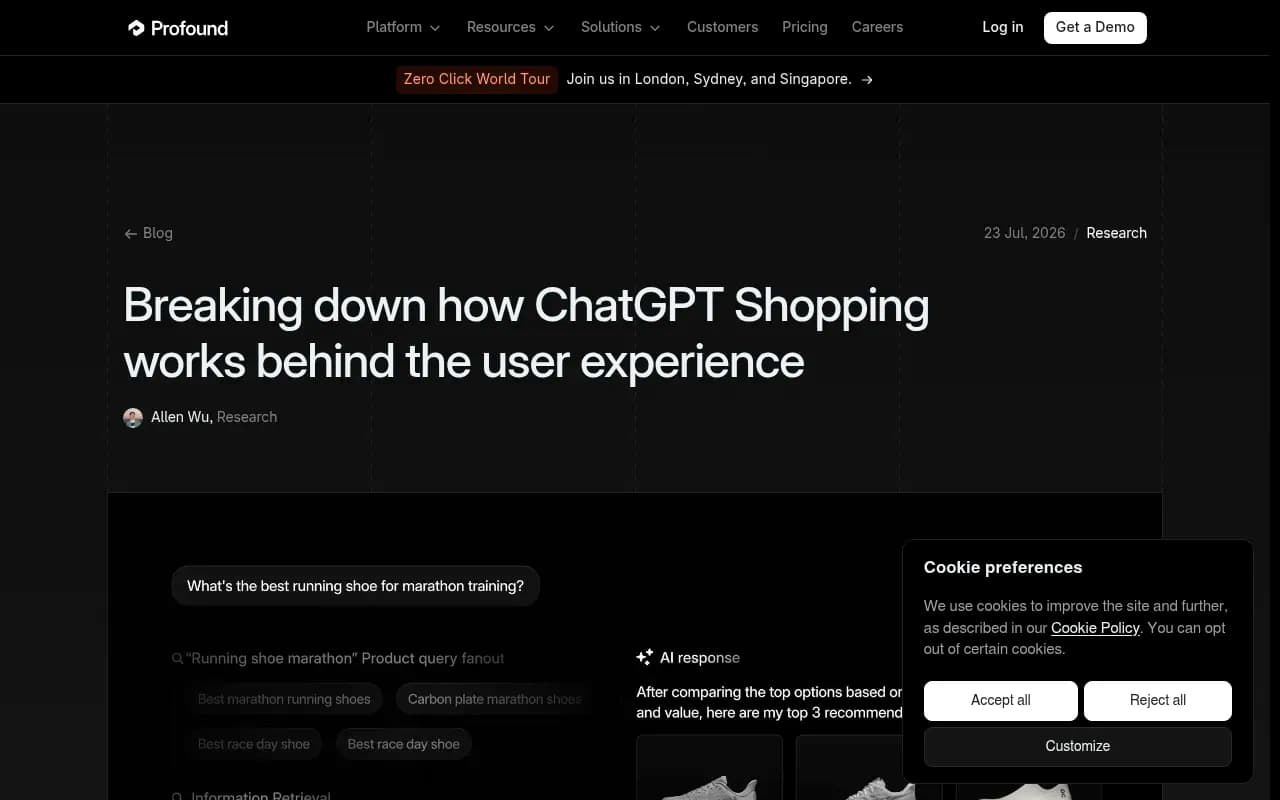
A product card is the individual unit of a shopping recommendation, typically showing a product name, price, merchant, star rating, and review count. In ChatGPT, each card can also carry a short line of reasoning explaining why that item was picked for you. Under the hood, a ChatGPT product card is a structured object with fields like title, position, price, merchants, rating, num_reviews, and a list of offers, each offer carrying its own merchant name, stock status, and whether it's checkoutable.
Carousel
When multiple product cards appear side by side, horizontally scrollable, that's a carousel. Both ChatGPT and Google's traditional search results use this pattern, though Google AI Mode swaps it for an updating side panel rather than a strict scroll. The distinction matters because carousel position and panel position aren't governed by the same ranking logic, a strong spot in Google's classic "Popular products" carousel doesn't guarantee the same visibility inside AI Mode's panel, which draws from the same Shopping Graph but applies its own filtering.
Shopping panel
Google AI Mode's term for the right-hand (or below-answer, on mobile) module where product results live. Unlike a static carousel, the panel updates dynamically as a shopper refines their question within the same conversation, Google's own example involves narrowing "a cute travel bag" down to one suited for a rainy-season trip to Portland, with the panel re-populating based on the added constraints.
GPT tag
A machine-assigned descriptive label ChatGPT attaches to a product, things like "budget," "premium," "streetwear," or "best overall." These aren't merchant-submitted, they're generated by the model itself based on how it interprets the product. The correlation with ranking is real: Profound's research found GPT tags appear on 2.39% of rank-1 product cards versus just 0.98% of cards ranked fourth or lower, a 144% relative lift. The most common tag categories by volume are value (10.6% of all tags), premium (6.5%), and style (4.5%).
Shopping research
OpenAI's term for a deeper, Deep Research-style shopping mode launched in late 2025. Instead of a quick card list, it asks clarifying questions, reads across many sources, and compiles a personalized buyer's guide, useful for categories with real tradeoffs like electronics or home appliances. One limitation worth flagging to clients: according to Modern Retail, shopping research doesn't currently cover Amazon products.
The infrastructure: where the product data actually comes from
Shopping Graph
Google's product database, and it's enormous: more than 50 billion listings pulled from everything from global retailers to local shops, with upwards of 2 billion listings refreshed every hour. Both Google's standard shopping carousel and AI Mode's panel draw from this same graph, but AI Mode applies an additional reasoning layer (Gemini) on top and tends to surface far fewer products per query than the classic carousel does.
Agentic Commerce Protocol (ACP)
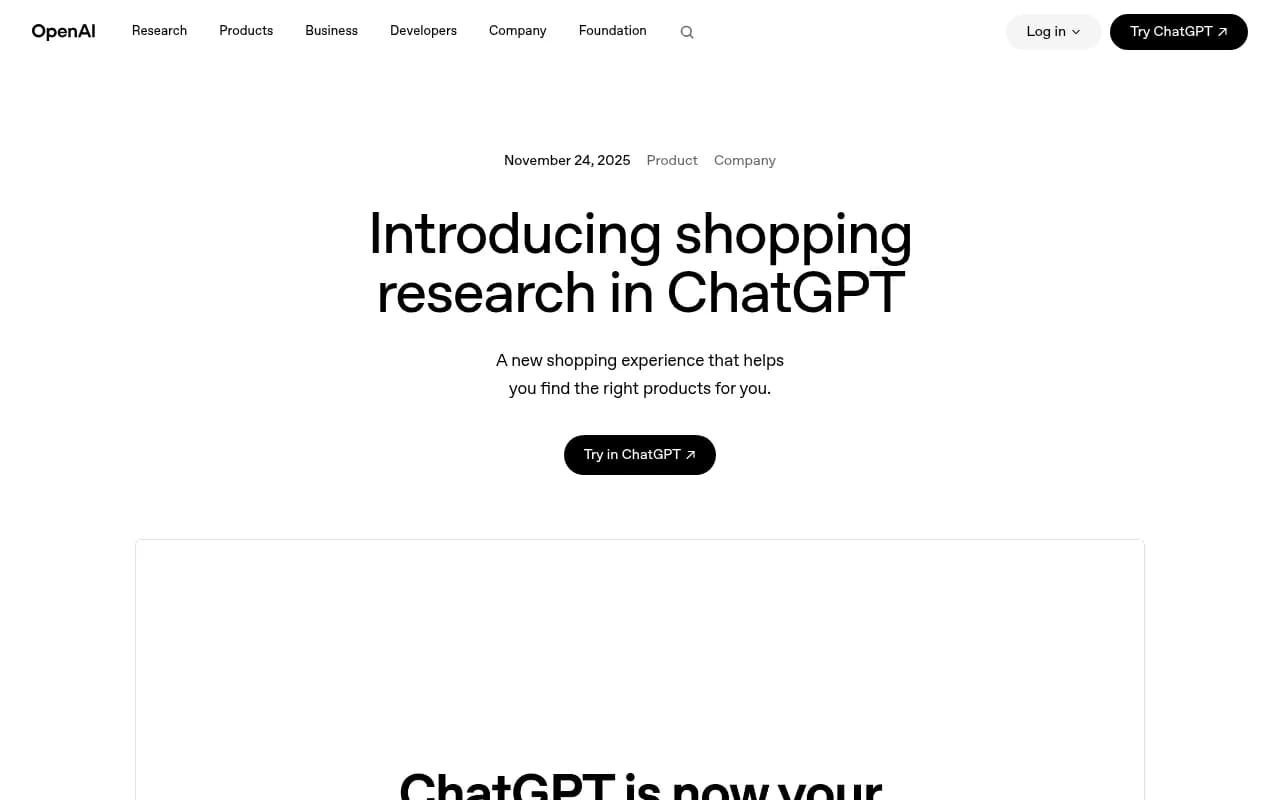
An open standard OpenAI co-developed with Stripe, launched September 2025, that lets merchants plug their product catalogs and checkout flows directly into ChatGPT. It's the rail that Instant Checkout and later product-discovery features run on. Merchants apply through chatgpt.com/merchants, and the protocol is documented publicly at agenticcommerce.dev. Google has its own answer brewing here too, the Universal Commerce Protocol (UCP), approaching the same problem from a different angle.
Merchant feed
The structured data file (think Google Merchant Center feed, or a Shopify Catalog export) a retailer submits so an AI platform knows what it sells, at what price, in what sizes, with what stock status. If you already maintain a solid Google Merchant Center feed, you're most of the way toward ChatGPT shopping eligibility too, since OpenAI's product discovery features were built to plug into the same kind of structured data.
Fallback search / fallback product search
When ChatGPT can't retrieve a clean offer for a product through its primary feed sources, it falls back to its own search index to fill in commercial details. Profound's research found this fallback path, combined with Google index signals and direct merchant sources, make up the three main ways ChatGPT sources product information. One surprising finding from that same research: Reddit accounts for roughly a third of all indexed shopping citations in ChatGPT, far more than any single ecommerce or review domain.
Query fan-out (shopping context)
Fan-out is what happens when an AI system expands a single user prompt into multiple background searches to gather enough information to answer well. Google's own documentation describes a user asking for a travel bag, then narrowing to a rainy May trip, triggering the system to "fan out" and run several parallel searches on weatherproofing and trip-length durability before surfacing matching products. The scale varies a lot by platform, Ahrefs found AI Mode typically runs 5 to 11 searches per shopping query, while ChatGPT's Deep Research mode ran 420 searches and cited 30 sources for a single "buy red phone case" example. For a deeper look at how this plays out specifically on ChatGPT, Promptwatch's research on how ChatGPT uses query fan-outs and its March 2026 update tracking are worth a look, and the broader fan-out volume trend is in Promptwatch's query fan-out dataset.
The commerce mechanics: how a browse turns into a sale
Instant Checkout
OpenAI's original in-chat purchase flow, launched September 2025 with Etsy and a roster of Shopify merchants (Glossier, SKIMS, Spanx, Vuori among the names announced). The idea was simple: confirm an order without ever leaving the chat window. It started with single-item purchases only.
Merchant-controlled checkout
By April 2026, OpenAI had already started moving away from pure in-chat checkout toward two newer models, as reported by Checkout.com: a redirect model, where the shopper gets routed to the merchant's own site to finish the purchase, and an app model, where merchants build a dedicated in-chat experience using OpenAI's SDK but keep their own checkout infrastructure. The stated principle behind the shift: "the merchant owns the checkout, not the AI platform."
Agentic checkout (Google)
Google's parallel mechanic inside AI Mode. A shopper can tap "track price," set a target size, color, or price threshold, get notified on a drop, then tap "buy for me" to let Google complete the purchase on the merchant's site using Google Pay.
Buy with Pro / Instant Buy (Perplexity)
Perplexity's checkout options. "Buy with Pro" lets Perplexity Pro subscribers in the US save payment and shipping details once and check out directly inside Perplexity for eligible products. "Instant Buy," launched with PayPal ahead of Black Friday 2025, extended agentic checkout to all Perplexity users across more than 5,000 merchants, with the retailer still legally the merchant of record.
Shopping-feature trigger rate
Not every ChatGPT web-search response includes shopping cards, the feature only fires on a small single-digit percentage of all responses, but that rate concentrates heavily on commercial and transactional prompts and has been actively tuned by OpenAI, briefly doubling in late May 2026 before dropping back weeks later. See Promptwatch's ChatGPT Shopping feature usage data for the trend line.
Ads in shopping responses
ChatGPT served zero ads in web-search responses until May 27, 2026. Within a few months that number climbed into the 20-32% range of citation-enabled responses on a rolling basis, with organic (non-branded, non-competitor) prompts making up roughly 73% of ad-bearing responses. That's a meaningful shift for anyone assuming "organic" product placement stays free of competition indefinitely. Full daily figures are in Promptwatch's ChatGPT ads over time report.
How the three platforms actually compare
| Platform | Where product data comes from | How checkout works | Scale / cadence |
|---|---|---|---|
| ChatGPT | Merchant feeds via ACP, Shopify Catalog, direct feed integrations, fallback search index | Shifting from in-chat Instant Checkout to merchant-controlled (redirect or in-chat app model) | 1.2 billion weekly users as of October 2026; ads in ~20-32% of search responses |
| Google AI Mode | Shopping Graph (50B+ listings, 2B+ refreshed hourly) plus Gemini reasoning | Agentic "buy for me" via Google Pay | Fan-out runs 5-11 searches per shopping query |
| Perplexity | Perplexity Merchant Program feeds | Buy with Pro (Pro users) and PayPal Instant Buy (all users) | 5,000+ merchants on Instant Buy at launch |
A useful thing to notice here: a product page optimized for Google's Shopping Graph doesn't automatically travel well into ChatGPT, and vice versa. Different feeds, different ranking signals, different fallback logic when data is missing.
What content actually gets cited around these product cards
It's worth separating "what shows up in the product card" from "what text ChatGPT cites alongside it." Promptwatch's content-type breakdown of ChatGPT citations shows product pages are the single most-cited content type overall (22.4% of all classified citations in a late-September 2026 window), with landing pages close behind at 16.8%. For commercial, comparison-shopping-style prompts specifically, product pages, landing pages, listicles, and comparison pages together make up roughly 70% of citations, according to Promptwatch's citation share by content type data. If you're building out product or category pages with AI shopping in mind, that's the content mix to prioritize, not generic blog posts.
Tools for tracking where your products actually show up
Because none of this is static, OpenAI alone has shipped three or four shopping-related changes in 2026, you generally want something monitoring this continuously rather than checking manually. Promptwatch tracks ChatGPT Shopping feature usage, ad presence, and citation patterns across ChatGPT, Google AI Mode and AI Overviews, Perplexity, and other AI platforms, and includes a dedicated ChatGPT Shopping and Ads Radar module for watching which competitors are showing up (and paying to show up) against your product prompts.

For catalog-specific visibility rather than general brand tracking, a few tools focus more narrowly on ecommerce. Alhena AI and Yotpo Discover both build AI visibility tracking around product catalogs specifically, while Ranketta focuses on product-level tracking for ecommerce brands, and Azoma positions itself around agentic-commerce GEO, optimizing for the AI shopping agents rather than general search visibility.
Yotpo Discover
If you want a broader view of GEO and AI visibility platforms beyond shopping specifically, the directory at bestgeosoftware.com is a reasonable place to browse what's out there.
A quick glossary cheat sheet
| Term | What it means in one line |
|---|---|
| Product card | A single structured product recommendation with name, price, rating, and reasoning |
| Carousel | Multiple product cards shown side by side, horizontally scrollable |
| Shopping panel | Google AI Mode's dynamically updating product module |
| GPT tag | Machine-assigned descriptive label (budget, premium, streetwear) correlated with higher-ranked cards |
| Shopping Graph | Google's 50B+ listing product database, refreshed continuously |
| Agentic Commerce Protocol (ACP) | OpenAI/Stripe's open standard for merchant feeds and checkout inside ChatGPT |
| Query fan-out | Running multiple background searches to answer one shopping prompt more thoroughly |
| Instant Checkout | ChatGPT's original in-chat, single-item purchase flow |
| Merchant-controlled checkout | Newer ChatGPT model where the merchant's own system handles payment, via redirect or in-chat app |
| Agentic checkout (Google) | Google Pay-powered "buy for me" flow inside AI Mode |
| Buy with Pro / Instant Buy | Perplexity's checkout features, for Pro users and all users respectively |
Why this vocabulary matters beyond trivia
I'll be honest, a lot of this terminology still feels half-settled. OpenAI has already rebranded and restructured its checkout approach once in under a year, and Google's "agentic checkout" rollout has been described as gradual since mid-2025 without a hard completion date. That instability is actually the point: if you're building a GEO or AEO strategy around shopping, you can't treat these mechanics as fixed. A feed that gets your product into ChatGPT's carousel today might need a different structure in six months if OpenAI shifts more weight toward merchant-controlled checkout and away from in-chat purchases.
The practical takeaway is to treat your merchant feed, your product page content, and your AI visibility monitoring as three things that need to stay in sync, not three separate projects. Good feed data gets you considered. Strong, specific product page content with reviews and comparison context gets you cited. Ongoing monitoring tells you when the rules changed again, because they will.