Key takeaways
- All three tools claim to connect AI visibility to revenue, but they do it differently: Trakkr traces visitors to revenue, Passionfruit leans on GA4 reporting, and Promptwatch ties crawler logs, citations and visitor analytics to content actions.
- Passionfruit Labs is the cheapest way in ($19/mo), but engine access is gated by plan. Content creation and AI Overviews are Enterprise only.
- Trakkr sits in the middle at $100/mo for 50 prompts per brand and 8 models. Promptwatch starts at $95/mo with 6,000 responses and 11 platforms.
- No tool can fully measure zero-click influence. Click-through attribution is the solid part; the rest is estimation, so pair any tool with a "how did you hear about us" field.
- If you want a tool that also fixes the gaps it finds, Promptwatch is the one of the three built around that loop.
Why revenue is the question now
Counting mentions was fine in 2024. In 2026 nobody in finance cares that your brand showed up in 31% of prompts. They want to know what it did to pipeline.
The pressure is real because the channel is moving. Adobe reports that generative AI referral traffic to US retail sites grew more than 1,200% year over year (Adobe Digital Insights), and the visitors that arrive tend to be high intent. Crisp, a Promptwatch customer, saw its AI traffic convert at 2x the rate of its other channels. That is a vendor case study, so treat it as one data point, not a law.
This guide compares three tools that all put revenue front and center: Trakkr, Passionfruit and Promptwatch. I will be upfront that this site is published by 1001 SEO Media, which uses Promptwatch as its own AI visibility platform. I have tried to stay honest about where each tool is stronger.
What "tying visibility to revenue" actually requires
Before comparing, it helps to split the problem into three pieces. Most tool pages blur them together.
- Visibility proof: are you named and cited for the prompts buyers use?
- Traffic proof: did an AI engine send a real visitor, and to which page?
- Revenue proof: did that visitor convert, and what was it worth?
Trakkr's own attribution guide makes a similar cut. It separates visibility proof from revenue proof and rates confidence by source: high for ChatGPT referrals, medium for AI Mode and AI Overviews via Search Console, and only directional for no-click answers. That is a sensible framing, and I would apply it to every tool here.
Rankscale's attribution notes give the practical formula: total AI-influenced revenue equals click-through revenue plus estimated zero-click revenue. The first half is easy. You segment referrers like chatgpt.com, perplexity.ai, claude.ai, gemini.google.com and copilot.microsoft.com in analytics. The second half needs proxies, and the cleanest one is a self-reported source question at signup or purchase. Coverage is low. The signal is clear.
A fourth piece matters too, and it is the one most comparisons skip: once you know where revenue is leaking, can the tool help you fix it?
Trakkr
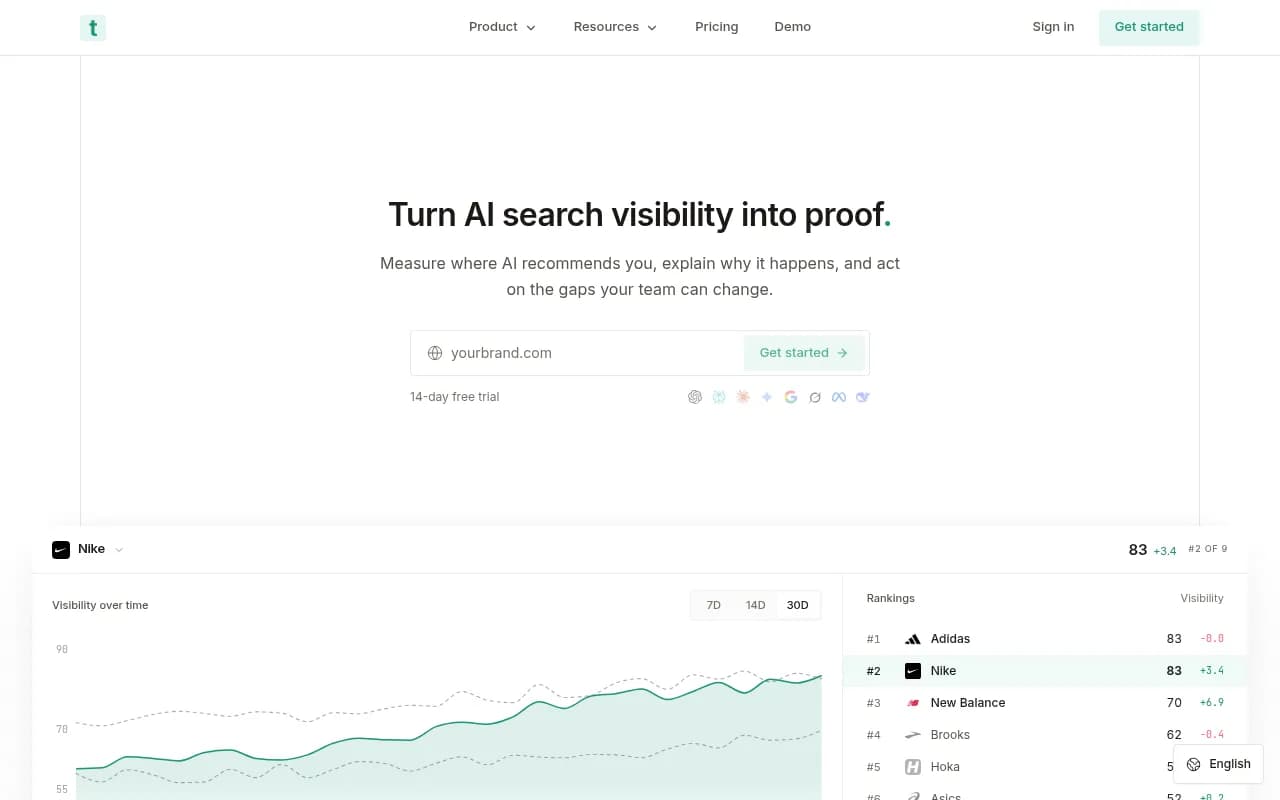
Trakkr's homepage tagline is "Trace every AI visitor to revenue," and the product is built around that idea. The demo dashboard shows revenue by source across ChatGPT, Perplexity, Claude and Gemini. Those numbers are illustrative, not real customer data, so judge the product by what it connects to, not by the demo.
Pricing and coverage
- Growth: $100/mo, 50 prompts per brand, 3 seats, 2,500 AI Pages requests and 25 article credits per month.
- Scale: $500/mo, 50 prompts per brand, unlimited seats, 10,000 AI Pages requests and 100 article credits. Aimed at teams running 10+ brands.
- Enterprise: from $1,000/mo.
- 14-day free trial, and a Shopping add-on at $49 per brand per month.
- 8 AI models on every paid plan, tracked daily.
The pricing page formatting was garbled when we checked, so confirm Scale and Enterprise terms on trakkr.ai before buying.
Where it is strong
The revenue framing runs through the whole product: AI crawler logs, live conversations citing your domain, and an Actions list ranked by ROI. The honesty of its attribution guide is a point in its favor. Few vendors will tell you that no-click answers are only directional.
Where to be careful
The 50-prompt cap per brand is tight if you sell into several segments. The Capital One Shopping statistic on its homepage (72% start with AI before buying) is unverified, so do not repeat it in your own reporting.
Passionfruit
Passionfruit is two things, which confuses people. getpassionfruit.com presents it mostly as a managed SEO and GEO agency with custom pricing. The self-serve software is Passionfruit Labs at getpassionfruit.ai, and that is what we compare here.

Pricing and coverage
| Plan | Price | Prompts | Engines |
|---|---|---|---|
| Lite | $19/mo | 20 daily | ChatGPT only |
| Starter | $49/mo | 70 | Adds Gemini and Perplexity |
| Pro | $99/mo | 150 | Adds Claude |
| Enterprise / Agency | Custom | Custom | Adds AI Overviews, Grok, Meta AI, Copilot, DeepSeek; content creation |
There is a 7-day free trial. A blog on Passionfruit's own site lists $199 to $999/mo, which looks like agency or older pricing, so do not mix the two up.
Where it is strong
The revenue feature is the draw. GA4-based analytics (sessions, key events and revenue per AI engine) is on every plan, even the $19 one. Unlimited competitors, page-level citation tracking, share of voice and sentiment are all included. Setup is simple: add your brand and competitors, connect GA4, pick prompts.
For a small team that already lives in GA4 and wants a cheap first read on AI revenue, that is a good deal.
Where to be careful
Engine gating is the catch. Most teams will need Starter or Pro to cover the engines their buyers use, and Google AI Overviews only arrive on Enterprise. ContentMonk scored it 6/10 on visibility largely for that reason. The "11x traffic increase" case study for Visily is vendor-reported. GA4 attribution also inherits all of GA4's blind spots on referrers.
Promptwatch
Promptwatch takes a wider view. Instead of stopping at "here is your revenue per engine," it tries to cover the full chain: why you are or are not cited, where AI finds your content, what traffic it drives, and what to do next.

Pricing and coverage
- Explore: free (1 project, 10 prompts, ChatGPT only).
- Essential: $95/mo, 50 prompts, 6,000 responses, all AI models, site audit, visitor events and content gap analysis. 7-day free trial.
- Professional: $245/mo, 150 prompts, 18,000 responses, 25M crawler logs, 5 articles.
- Business: $579/mo, 350 prompts, 42,000 responses, the automated Content Agent, state and city tracking, Shopping Insights and Ads Radar.
It tracks 11 AI platforms from their real interfaces, including coding agents like Claude Code and OpenCode. Confirm current numbers at promptwatch.com/pricing.
How the revenue link works
There are four layers, and they stack:
- IP-verified crawler logs show which AI bots (GPTBot, ChatGPT-User, ClaudeBot, PerplexityBot and others) read which pages, and whether they hit errors.
- Citation analytics show which of your pages get cited and where they sit in the source list.
- Visitor analytics track real traffic and conversions from AI platforms to your site.
- The Action Board and Content Agent turn gaps into prioritized tasks and drafts, with publishing to WordPress, Webflow or Framer.
That crawl-to-citation-to-click path is the part Passionfruit's GA4 view cannot show you. If GPTBot hits your pricing page hundreds of times a week and the page never gets cited, GA4 tells you nothing. Crawler logs do.
TreeHouse, the company behind Pararius, grew AI search to roughly 25% of organic conversions by fixing crawler access and publishing proprietary rental data. Again, a customer story, but it shows the shape of the work: the revenue came from fixes, not from dashboards.
Where to be careful
Promptwatch is the broadest of the three, which means more to learn. Crawler logs need a CDN or plugin integration (Cloudflare, Vercel, WordPress and so on), so expect some setup time. And its entry price is not the cheapest. If all you want is a GA4 revenue split, Passionfruit Lite costs a fraction.
Side-by-side comparison
| Trakkr | Passionfruit Labs | Promptwatch | |
|---|---|---|---|
| Entry paid price | $100/mo | $19/mo | $95/mo |
| Free option | 14-day trial | 7-day trial | Free Explore plan, 7-day trial on paid |
| Prompts at entry | 50 per brand | 20 (Lite), 70 (Starter) | 50 |
| Engines | 8 on all paid plans | 1 to 4 by plan, more on Enterprise | 11, all models from Essential |
| Revenue approach | Visitor to revenue tracing | GA4 revenue per engine | Visitor analytics plus crawler and citation data |
| AI crawler logs | Yes | Not confirmed | Yes, IP-verified |
| Content creation | Article credits | Enterprise only | Content Agent, CMS publishing |
| Shopping and ads | Shopping add-on, $49/brand | Not confirmed | Shopping Insights and Ads Radar (Business) |
| Best for | Multi-brand teams wanting a revenue-first dashboard | Small teams on GA4 with tight budgets | Teams that want to find and fix gaps |
What the citation data says about where revenue comes from
If you are going to tie visibility to revenue, it helps to know which pages AI actually quotes. Promptwatch Data's ChatGPT citation share by content type report (Sep 28 to Oct 4, 2026) found product pages are the most cited type at 22.4% of classified citations, with landing pages next at 16.8%. Together, 39% of citations go to pages describing what a company sells.
For commercial prompts the skew is stronger: product pages (26.0%), landing pages (20.6%), listicles (15.0%) and comparisons (7.9%) make up almost 70% of citations. Practically, that means your pricing and positioning copy is being quoted directly. If it is vague or out of date, AI will repeat the vague version to buyers.
There is also a freshness angle. Promptwatch Data's content half-life report tracked pages ChatGPT cited on July 6, 2026 for 90 days. Landing pages and docs stayed cited longest, while news lost half its pages within 36 days. Revenue-bearing pages are the durable ones. Invest there first.
And for software companies, the software-prompt citation report shows documentation and help centers lead, which is easy to overlook if you only track your marketing site.
Ads are now part of the picture
Revenue leakage can also come from competitors paying for your prompts. Per Promptwatch Data's ChatGPT ads report (May 20 to Aug 17, 2026), ads appeared in an average of 20.1% of ChatGPT responses that ran a web search. The past 7 days averaged 32.4%, and 73.3% of ad-bearing responses were organic prompts. If you care about commercial prompts, that is a lot of exposure. Of the three tools, only Promptwatch lists Ads Radar as a feature, on Business and agency plans.
How to set up revenue attribution, whichever tool you pick
Tools help, but the plumbing is mostly yours. A workable setup looks like this:
- Segment AI referrers in analytics. Create a channel group for chatgpt.com, perplexity.ai, claude.ai, gemini.google.com and copilot.microsoft.com.
- Define the conversion events that matter: demo requests, signups, purchases. Revenue per engine is only as good as these.
- Add a self-reported source field to your forms with an option like "ChatGPT or another AI assistant." It is the cheapest way to catch zero-click influence.
- Report AI Overviews and AI Mode as search exposure from Search Console, not as chatbot referral traffic. Trakkr's guide is right about that.
- Review weekly for the first month. Referrer data is noisy and some AI clicks arrive without a referrer at all.
- Tie fixes back to pages. When a page gets cited and its traffic grows, note it. That is your proof.
Expect gaps. No independent head-to-head data exists on attribution accuracy across these three tools, and I would be suspicious of anyone claiming otherwise.
Which one should you pick
Choose Passionfruit Labs if
You are a small team, already on GA4, and want the cheapest possible look at AI revenue. Plan on Starter or Pro, not Lite, so your engines are covered.
Choose Trakkr if
You manage several brands or clients, want a revenue-first interface, and are comfortable with 50 prompts per brand. The Scale plan makes more sense than stacking Growth accounts.
Choose Promptwatch if
You want to know why you are not being cited and have the tool help fix it. Crawler logs, citation analytics, visitor analytics and the Content Agent in one place mean the report turns into a to-do list, and published pages get tracked afterward. It also covers the most platforms and the shopping and ads angles.
If you want to look beyond these three, the GEO software directory and AI rank tracking directory list dozens more.
Questions to ask in any trial
- Which engines are included in the plan I will actually buy, not the top tier?
- Does revenue come from referrers, GA4, or a CRM integration? What happens to direct and no-referrer visits?
- Can I see crawler activity, or only responses?
- What happens when a prompt allowance runs out mid-month?
- Can I export data, and are there API or MCP options for my reporting stack?
Bottom line
All three tools can show you a number labeled "AI revenue." The difference is what sits behind it. Passionfruit is the budget GA4 view. Trakkr is a tidy revenue-first tracker for multi-brand teams. Promptwatch is the one that connects the dots from crawl to citation to click to action. Run the free trials side by side on your own top ten commercial prompts, and keep whichever one tells you something you can act on by Friday.
If you are weighing whether to build this capability in-house or hire help, that is a separate question, and 1001 SEO Media works with teams on exactly that kind of AI search measurement.