Heeb.ai Review 2026
Provides an API delivering structured SEO intelligence, sentiment detection, citation insights, and visibility scoring for LLM mentions.
Key takeaways
- Heeb.ai is a developer-first, pay-as-you-go API for checking brand mentions, sentiment, citations, and visibility across ChatGPT, Claude, Perplexity, Grok, and Google AI Mode — no dashboard, no subscriptions, just credits that never expire.
- Pricing starts at $10 for 400 credits (plus 20 free credits on signup), with per-model costs ranging from 1 credit (Perplexity Sonar, Grok 4.3) to 5 credits (GPT-5.5, Claude Opus 5).
- It's a monitoring-only tool. Compared with Promptwatch, it lacks AI crawler logs, content gap analysis, content generation and CMS publishing, visitor analytics, Reddit/YouTube citation tracking, and prompt volume data — you get raw mention data, and fixing what it reveals is entirely on you.
- Best fit: developers and SEO tool builders who want to embed AI visibility data into their own apps, n8n workflows, or client dashboards. Wrong fit: marketers who want a ready-made reporting interface.
- The product launched around late 2025 and has essentially no independent review track record yet — one 5.0 rating on TheresAnAIForThat is the entirety of its public feedback.
What Heeb.ai actually is
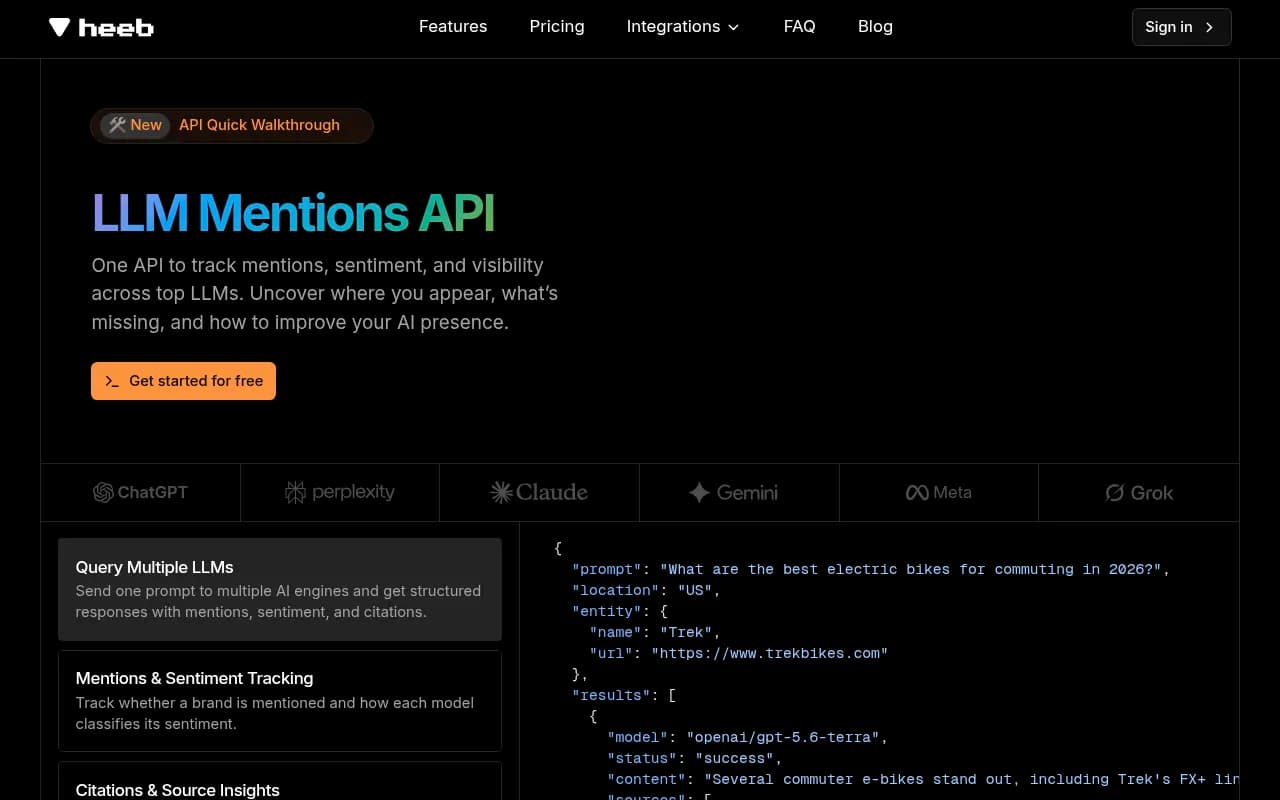
Most AI visibility tools are SaaS platforms: you log in, add prompts, and watch a dashboard. Heeb.ai skips all of that. It's a raw API, full stop. You POST a query with a prompt, an entity (your brand name and URL), an optional ISO country code, and a list of models. You get back a job ID, poll for the result, and receive structured JSON telling you whether each model mentioned you, how positively, what sources and citations backed the answer, and where in the response you appeared.
The response schema is genuinely well designed. Each model result includes a mentioned boolean, a sentiment classification (positive/neutral/negative), a mentions array with entity, product, and position, and separate sources versus citations objects — a distinction most tools don't bother making, separating the material a model drew on from references it explicitly cited. Aggregate scores roll up into a 0-100 visibility score and a -1 to 1 sentiment score. If you've ever tried to parse raw LLM output yourself to figure out whether your brand got named, this schema saves you hours of brittle regex work.
The async flow is straightforward: submit, wait 30 seconds to 2 minutes, retrieve. Authentication is a simple x-api-key header. It's the kind of API you can wire into a working prototype in an afternoon.
Pricing: cheap to start, hard to budget
Heeb.ai is pay-as-you-go only. $10 buys 400 credits, credits never expire, and you get 20 free credits just for signing up — enough to run a handful of test queries across a few models before paying anything. Packages scale up to 5,000 credits, and enterprise pricing is available by contacting [email protected].
Per-model costs vary meaningfully: Google AI Mode runs 2 credits, Perplexity Sonar 1, Sonar Pro 2, GPT-5.6-Luna 1, GPT-5.6-Terra 2, Claude Haiku 4.5 1, Claude Sonnet 5 3, and the heavyweight models (GPT-5.5, Claude Opus 5) 5 credits each. A single multi-model query across five engines might cost 8-15 credits depending on your model mix, so $10 covers roughly 30-50 full sweeps. For a developer testing the waters, that's excellent. For an agency tracking 100 prompts weekly across six models, the math gets murkier fast, and there's no flat-fee subscription to cap spend — subscriptions exist only "upon request" per the terms of service.
Two policy details worth knowing before you commit: refunds apply only to unused credits from your first purchase (within 30 days), and liability is capped at 12 months of fees or $100, whichever is greater. Neither is unusual for a small API business, but enterprise buyers should read the ToS before wiring this into client deliverables.
Where it fits: the n8n angle
Heeb.ai's most interesting recent move is its n8n community node, @heebai/n8n-nodes-heeb (MIT licensed, published September 2026). It ships with two operations — Submit Query and Get Result — plus typed error handling and a downloadable example workflow that pings Slack when your visibility score drops. For a small team that wants "tell me when ChatGPT stops mentioning us" without building a full app, this is the fastest path from zero to working alert. The catch: community nodes only work on self-hosted n8n, not n8n Cloud. There's also an MCP Client Tool route as a workaround if you need OAuth2 or multi-header auth.
Beyond n8n, integrations are DIY. The blog suggests pairing the API with Zapier, Slack, Looker, Grafana, or Google Data Studio, but those are suggestions, not built-in connectors. There's no official GitHub org, no SDK ecosystem, and no public changelog beyond the blog.
What it's missing versus full AI visibility platforms
This is where the honest assessment matters, because Heeb.ai sits in a category with far more complete tools. It measures; it does not help you improve.
- No AI crawler logs. You can't see whether ChatGPTBot or ClaudeBot actually visited your site, what they read, or whether they hit errors — data that explains why you're visible or invisible.
- No content gap analysis or content generation. If the API tells you Perplexity never mentions you for "best CRM for startups," the next step is yours to figure out.
- No traffic attribution. You see mentions, not clicks or conversions from AI platforms.
- No Reddit or YouTube citation tracking, no ChatGPT Shopping insights, no prompt volume or difficulty data, no query fan-outs.
- No dashboard. Everything is build-your-own reporting.
Promptwatch, by contrast, covers the full loop: crawler logs explain why you're invisible, citation analytics show where AI found your content, visitor analytics measure actual traffic, and Content Agents plus Unified Actions close the gap by planning and publishing fixes. If you want a managed platform rather than raw data, that's the difference — Heeb.ai gives you the measurement layer and trusts you to build the rest.

Who should use it
Developers building SEO/AEO tools. If you're building an AI visibility feature into your own SaaS product or client portal, Heeb.ai's clean JSON output is exactly what you want. This is the product's real audience, and for them, the pay-as-you-go model and simple schema are genuine strengths.
Technical SEO freelancers running light checks. A $10 credit pack plus the n8n Slack workflow is a legitimate budget setup for monitoring a handful of brands on prompt sets you control.
Market research tinkerers. Multi-model queries with location targeting (ISO country codes, US default) make it easy to compare how different engines discuss a category across regions.
Who should look elsewhere: marketing teams that want scheduled reports, competitor benchmarking, share-of-voice charts, or anyone who needs to answer "what do we do about this?" — the API's "actionable recommendations" feature is mentioned on the homepage but is thin compared to a platform that generates prioritized task lists and publishes content for you.
Limitations and caveats
The model catalog changes over time — the company's own docs warn that model IDs in your workflows can go stale, so hard-coded model lists will need maintenance. Meta appears on the homepage as a queryable engine but has no model IDs in the current pricing table, which suggests that support is upcoming or limited. And the inherent noisiness of LLM tracking applies here as it does everywhere: the same query to the same engine can return different sources on the same day, so single data points shouldn't drive decisions.
There's also a trust-formation problem. Heeb.ai is built by xLab, a company in Muscat, Oman, launched around December 2025. It has no G2 or Capterra presence, no Reddit discussions, no public GitHub activity beyond the n8n node, and one rating on TheresAnAIForThat. None of that means the product is bad — the API design suggests competent builders — but you're an early adopter, with everything that implies about longevity and support.
Bottom line
Heeb.ai is a solid, fairly priced measurement API for developers who want AI visibility data inside their own tooling, and the n8n node makes it accessible even to low-code teams. It does one thing — structured mention, sentiment, and citation data across major LLMs — and mostly does it cleanly. But it's a data feed, not a strategy. If you want to understand why you're invisible and have help fixing it — crawler logs, gap analysis, content generation, traffic attribution — Promptwatch is the stronger choice. If you're a developer who just needs the raw JSON and already has a plan for what to do with it, Heeb.ai is worth the $10 experiment.
Tags:
Frequently asked questions
What is Heeb.ai?
How much does Heeb.ai cost?
Which AI models does Heeb.ai support?
Does Heeb.ai have a dashboard or reporting interface?
How does Heeb.ai compare to Promptwatch?
Is Heeb.ai a good fit for agencies?
How long do Heeb.ai queries take?
Can I target specific countries with Heeb.ai?
Similar and alternative tools to Heeb.ai